
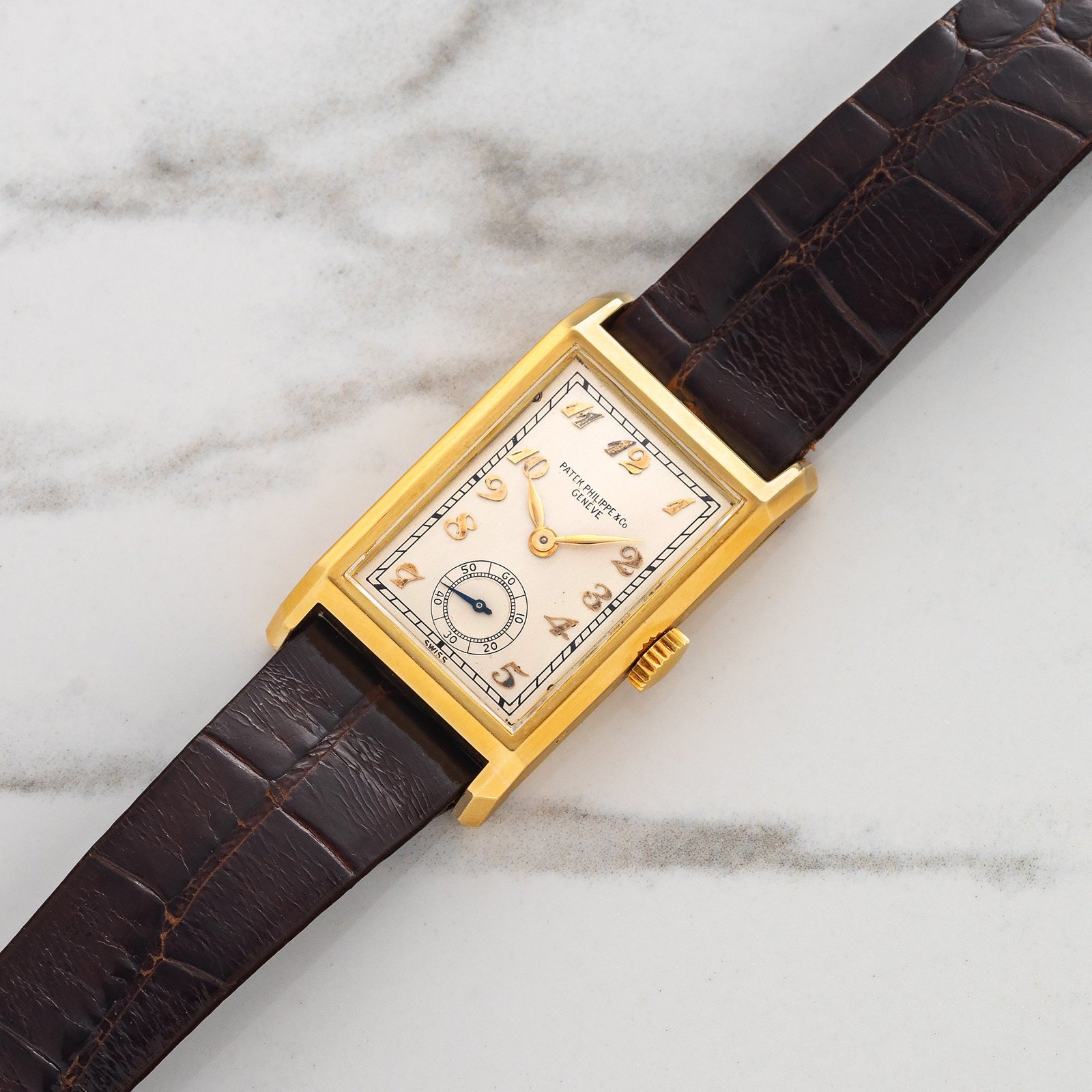
Wristwatches · Wristwatch
Patek Philippe "Tank", Breguet Numerals
- Maker / attribution
- Patek Philippe (maker)
- Date
- c. 1930s
- Historical period
- Golden Age of Mechanical Watchmaking (1900 – 1945)
- Country of origin
- Switzerland
- Object type
- Wristwatch
- Stock no.
- Product 10014155047188
- Credit line
- Dealer listing, Collectors Corner NY (product 10014155047188)
- Catalogue title (original)
- Patek Philippe "Tank" - Breguet Numerals (1930s) - Very Rare/*Unpolished* (English)
View the source record (dealer listing) ↗ (opens another website in a new tab)Suggest a correction
Record summary
Catalogued by Collectors Corner NY (dealer), New York (stock number Product 10014155047188), this is a wristwatch by Patek Philippe, made in Switzerland, dated c. 1930s. The Atlas places it in the Golden Age of Mechanical Watchmaking period (1900 – 1945) of its Wristwatches collection. The record is illustrated with 6 photographs.
Assembled from the source record's structured fields. Dates and attributions are given as the source states them; where a field is missing the Atlas leaves it blank rather than estimating.
Catalogue description
Dealer description — Collectors Corner NY
Patek Philippe's story is one of unyielding pursuit of perfection. Since its founding in 1839, the Swiss watchmaker has stood at the summit of horology, crafting timepieces that blend art and engineering in equal measure. Unlike many brands defined by a single model, Patek Philippe's identity rests on its legacy of uncompromising quality and craftsmanship. While icons like the Nautilus, Calatrava, and their perpetual calendars command the most attention today, the brand's catalog also hides a trove of lesser-known Patek Philippe watches waiting to be rediscovered. One such remarkable find is this rectangular "tank" style dress watch, circa 1930s. It is likely what helped inspire the later "Gondolo" model line and embodies horology of the Art Deco period. This piece was sourced through a friend of CCNY who purchased it directly from the original family who had it since new. The caseback shows two generations of the "Quarrier" name engraved in both '39 and '72. Mr. Quarrier served as a lieutenant in the U.S. Army in Korea for two years and worked in Detroit in sales and advertising at General Motors. Notably, it features a stunning Breguet numeral dial. Any "true vintage" Patek will have a special aura to it that can't be replicated in later iterations and the addition of these numerals takes it to another level of beauty and rarity. This example has a very nicely preserved dial with minimal distracting wear. It has been lightly cleaned in the past but PP dials were designed to be and such is the case for the vast majority of pieces in this period. The case is remarkably sharp and appears unpolished with a crisp hallmark and finishing still present. For any collector who appreciates a timepiece with a story, this piece is a great opportunity for your collection. An archive extract is included. It confirms the Breguet dial and a production date of 1937.
Historical context
Golden Age of Mechanical Watchmaking (1900 – 1945)
The wristwatch displaces the pocket watch; waterproof cases, self-winding and grand complications.
The wristwatch overtook the pocket watch. Military use in the First World War, aviation, water-resistant cases (1926), automatic winding (1923–31), rectangular Art Deco designs and early chronographs and calendars defined the period.
Read the period in the timelineMore wristwatches from this periodEarlier: Industrial Revolution
Atlas type guide
Wristwatches
Bracelet watches were worn by women from the early nineteenth century — Breguet made one for Caroline Murat, Queen of Naples, in 1810–12 — but the wristwatch only became a man's instrument with military use and aviation in the early twentieth century. Between the World Wars it overtook the pocket watch; the 1920s and 1930s brought rectangular Art Deco cases, water-resistant cases and the first automatic winding systems.
After 1945 the wristwatch became a carrier of identity — dress watches, sports and dive watches, chronographs, calendars — produced by Swiss, American, Japanese, German, Soviet and Chinese industries. The quartz revolution after 1969 and the mechanical renaissance since the 1990s, including the rise of independent watchmakers, complete the story.
What to look for
- The reference number (between the lugs or inside the case back) and serial number, the starting point for dating.
- The calibre: its maker and number are often stamped under the dial or on the bridge.
- Originality of dial, hands and crown — refinished ('redial') dials are common.
- Case material marks: 18K/750, 14K/585, stainless steel, gold-filled, plated.
Dating clues
- Wire-lug cases: before c. 1925.
- Water-resistant screw-down cases: from 1926.
- Quartz movements: from 1969; sapphire crystals widespread after c. 1980.
General guidance written by the Atlas editors about this kind of object. It is not a statement about this particular piece; for that, rely on the source record above and on physical examination.
Related records
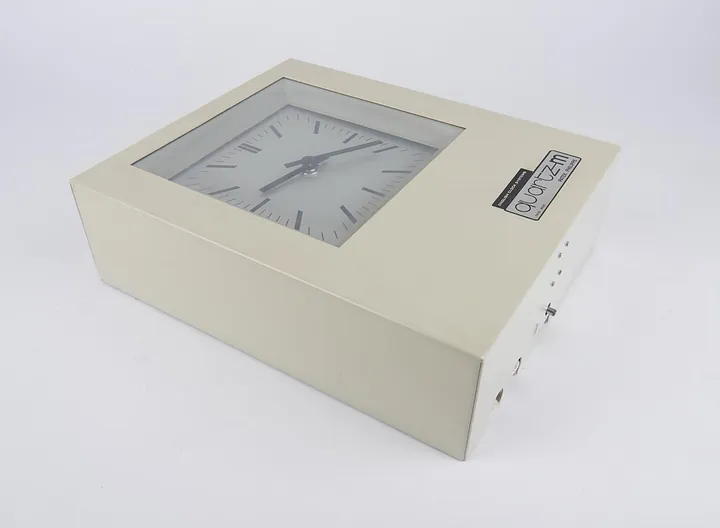
Clocks · 1965–1975
Quartz master clock QM 1, with movement by Patek Phillippe, Switzerland, 1965–1975. Supplied by English Clock Systems.
Science Museum Group, London
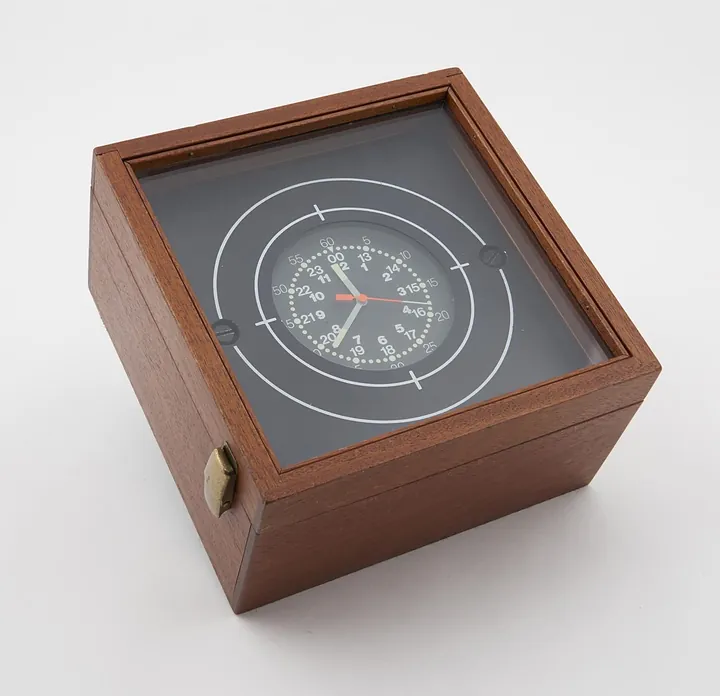
Instruments · 1965–1984
Chronometer by Patek Philippe and Kelvin Hughes, England, 1965–1984
Science Museum Group, London
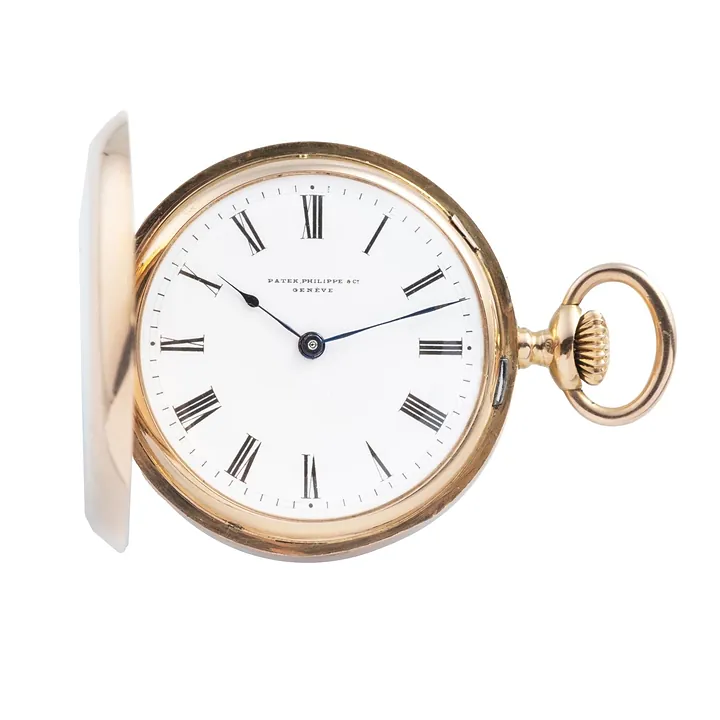
Pocket Watches · c. 1895
Patek Philippe pocket watch, c. 1895
Antiquorum auction archive, Geneva

Pocket Watches · c. 1900
Patek Philippe Chronometro Gondolo, c. 1900
Antiquorum auction archive, Geneva

Wristwatches · 1931
Rolex 'Oyster Perpetual' rotor self-winding wrist-watch, lever escapement, in steel case with glass in back, Montres Rolex SA, Geneva, Switzerland, 1931
Science Museum Group, London

Wristwatches · 1900–1999
Wristwatch by Certina, Switzerland, 1900–1999
Nordic Museum Foundation

Wristwatches · 1900–1999
Wristwatch by Omega, Västerås, 1900–1999
Nordic Museum Foundation

Wristwatches · 1900–1999
Wristwatch by Universal, Switzerland, 1900–1999
Nordic Museum Foundation