
Wristwatches · Regulator annual calendar wristwatch
Patek Philippe Ref. 5235G-001 Annual Calendar Regulator
- Maker / attribution
- Patek Philippe (source attribution)
- Date
- 2019
- Historical period
- Contemporary Horology (2010 – Present)
- Country of origin
- Switzerland
- Object type
- Regulator annual calendar wristwatch
- Materials / technique
- 18K White Gold
- Holding institution
- Phillips
- Accession / object no.
- patek-philippe-ref-5235g-001-annual-calendar-regulator-27c37e9571
- Credit line
- Phillips
- Catalogue title (original)
- Patek Philippe, Ref. 5235G Annual Calendar \"Regulator\" (English)
View the source record ↗ (opens another website in a new tab)Suggest a correction
Record summary
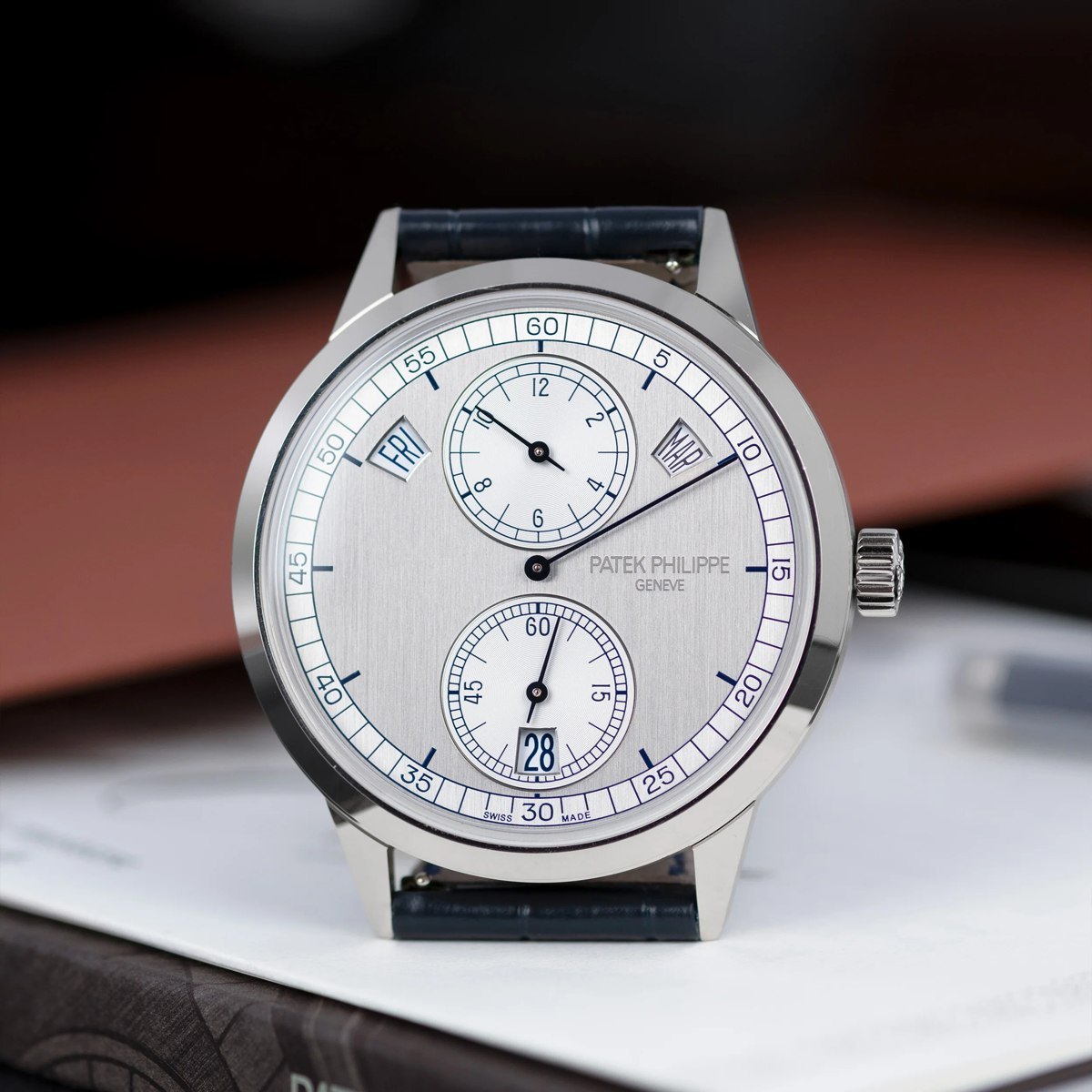
Held and catalogued by Phillips (object number patek-philippe-ref-5235g-001-annual-calendar-regulator-27c37e9571), this is a regulator annual calendar wristwatch attributed to Patek Philippe, made in Switzerland, dated 2019. The Atlas places it in the Contemporary Horology period (2010 – Present) of its Wristwatches collection. Materials and techniques recorded by the source: 18K White Gold. The record is illustrated with 1 photograph.
Assembled from the source record's structured fields. Dates and attributions are given as the source states them; where a field is missing the Atlas leaves it blank rather than estimating.
Catalogue description
Original object description
Encased in 40.5 mm of 18-karat white gold, the Patek Philippe reference 5235G-001 combines an annual calendar complication with a regulator dial arrangement powered by the automatic caliber 31-260. A dominant central hand records the minutes, while subsidiary dials at 12 and 6 o'clock present the hours and constant seconds, and calendar indications are shown through framed apertures for the day, date, and month. Stated as produced in 2019, the watch is equipped with an 18-karat white gold pin buckle and retains its original box, documentation, and accessories.
Original object description
The regulator dial is described in primary documentation with a vertically brushed silvered finish, using a central blued-steel hand for minutes, dedicated subsidiary dials for hours at 12 o'clock and continuous seconds at 6 o'clock, a date aperture inside the 6 o'clock register, beveled windows for the day at 10 and month at 2, and the inscription 'PATEK PHILIPPE GENEVE' at 3 o'clock. Discrepant vendor cataloguing alternatively lists the dial as brushed anthracite featuring rose gold chapter rings on the subsidiary registers.
Original object description
The mirror-polished 18K white gold case measures 40.5 mm across and exhibits coin-edge crown detailing alongside angular, pronounced lugs and bezel architecture recalling reference 3448. It is worn on a strap fitted with an 18K white gold 'Art Deco' style pin buckle. The seller notes the case as unpolished, an assertion that cannot be verified solely from the provided face-on imagery.
Original object description
Mechanical energy is provided by the automatic Calibre 31-260, documented as the initial serial-production movement from Patek Philippe to incorporate both Spiromax and Pulsomax components together. Neither the movement nor the sapphire display back is visible in the provided photo. Documented to 2019, the package includes inner and outer boxes, operating manuals, an instruction portfolio, a setting tool, a polishing cloth, and the certificate of guarantee, while individual serial numbers for the case and movement are not stated.
Historical context
Contemporary Horology (2010 – Present)
Silicon components, connected watches, optical-lattice research clocks and a thriving independent scene.
Smartwatches became the world's best-selling watches, while mechanical watchmaking focuses on craft, innovation (silicon components, new escapements) and independent makers.
Read the period in the timelineMore wristwatches from this periodEarlier: Mechanical Renaissance
Atlas type guide
Calendar, moon-phase and perpetual calendar watches
Calendar complications range from a simple date to the perpetual calendar, which automatically allows for months of different lengths and leap years until 2100. Pocket watches with perpetual calendars were made in the eighteenth and nineteenth centuries; Patek Philippe made the first perpetual calendar wristwatch in 1925, and series production followed in 1941. The annual calendar (Patek Philippe, 1996) needs correction only once a year.
Moon-phase displays use a disc with two moons and 59 teeth advanced daily, approximating the 29.5-day lunation; more precise trains reduce the error to one day in over a century.
What to look for
- Apertures or subsidiary dials for day, date, month and leap year.
- Moon disc under a 'bosom' shaped aperture.
- Recessed correctors on the case band for setting the calendar.
Dating clues
- Triple-date wristwatches: popular c. 1940–1955.
- Perpetual calendar wristwatches: from 1925 (unique) and 1941 (series).
General guidance written by the Atlas editors about this kind of object. It is not a statement about this particular piece; for that, rely on the source record above and on physical examination.
Related records

Clocks · 1965–1975
Quartz master clock QM 1, with movement by Patek Phillippe, Switzerland, 1965–1975. Supplied by English Clock Systems.
Science Museum Group, London

Instruments · 1965–1984
Chronometer by Patek Philippe and Kelvin Hughes, England, 1965–1984
Science Museum Group, London

Pocket Watches · c. 1895
Patek Philippe pocket watch, c. 1895
Antiquorum auction archive, Geneva

Pocket Watches · c. 1900
Patek Philippe Chronometro Gondolo, c. 1900
Antiquorum auction archive, Geneva

Wristwatches · c. 2010s
Breguet Type XXI, ref. 3810, c. 2010s (Antiquorum Lot 381-24)
Antiquorum auction archive, Geneva

Wristwatches · c. 2010s
Breguet Type XXI, ref. 3810, c. 2010s (Antiquorum Lot 386-229)
Antiquorum auction archive, Geneva

Wristwatches · Sold in September 2010
Breitling Cosmonaute, ref. A 22322, Sold in September 2010
Antiquorum auction archive, Geneva

Wristwatches · c. 2010
Corum Bubble Chrono, ref. 396.150.20, c. 2010
Antiquorum auction archive, Geneva