
Wristwatches · Wristwatch
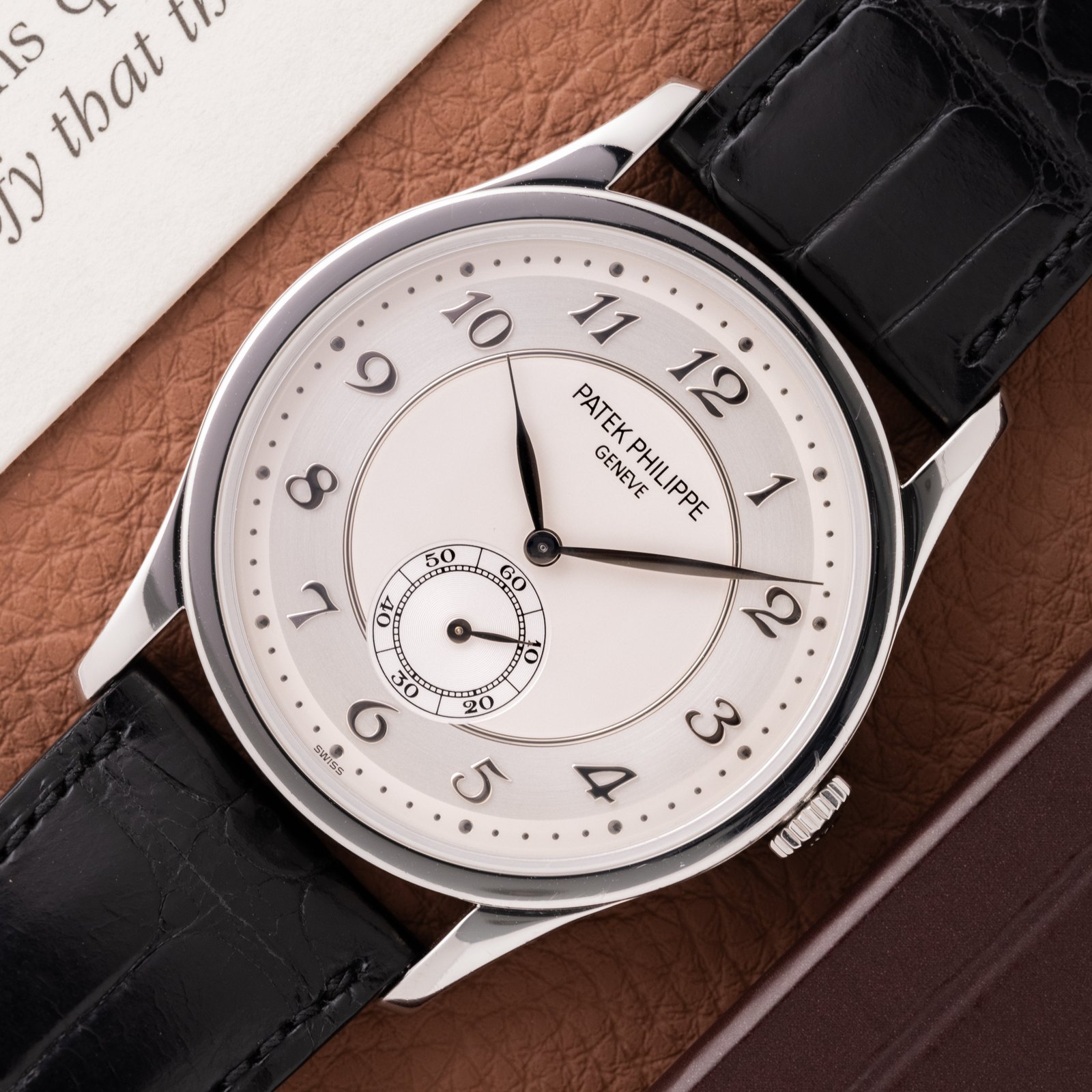
Patek Philippe Platinum Breguet Calatrava (Ref. 5196P), 2009
- Maker / attribution
- Patek Philippe (maker)
- Date
- 2009
- Historical period
- Mechanical Renaissance (1990 – 2010)
- Country of origin
- Switzerland
- Object type
- Wristwatch
- Materials / technique
- platinum
- Dimensions
- Case 31 mm
- Stock no.
- Product 8834767978679
- Credit line
- Dealer listing, Huntington Company (product 8834767978679)
- Catalogue title (original)
- 2009 Patek Philippe Platinum Breguet Calatrava - Papers (Ref. 5196P) (English)
View the source record (dealer listing) ↗ (opens another website in a new tab)Suggest a correction
Record summary
Catalogued by Huntington Company (dealer) (stock number Product 8834767978679), this is a wristwatch by Patek Philippe, made in Switzerland, dated 2009. The Atlas places it in the Mechanical Renaissance period (1990 – 2010) of its Wristwatches collection. Materials and techniques recorded by the source: platinum. Recorded dimensions: Case 31 mm. The record is illustrated with 6 photographs.
Assembled from the source record's structured fields. Dates and attributions are given as the source states them; where a field is missing the Atlas leaves it blank rather than estimating.
Catalogue description
Dealer description — Huntington Company
History and Significance Few watches have played a more important role in defining the identity of Patek Philippe than the Calatrava. Introduced in 1932 with the legendary reference 96, the collection established a design philosophy centered around simplicity, proportion, and exceptional craftsmanship. At a time when wristwatch design was still evolving, the Calatrava introduced a distinctly modern approach to traditional dress watchmaking, drawing inspiration from the clean lines and functional principles associated with the Bauhaus movement. Its influence would extend across generations of Patek Philippe watches, establishing a recognizable aesthetic that remains remarkably relevant nearly a century later. The reference 5196 belongs to this distinguished lineage, offering a contemporary interpretation of one of the most important designs in the manufacturer's history. Introduced in 2004, the reference 5196 represented a return to the classical proportions and styling of the original Calatrava. While the reference 96 measured approximately 31mm, the reference 5196 adopted a more contemporary 37mm case while preserving the fundamental design principles that made its predecessor so successful. The collection was produced in several precious metal configurations, each offering a slightly different interpretation of the traditional Calatrava aesthetic. The platinum reference 5196P is particularly interesting because it differs considerably from its yellow, rose, and white gold counterparts. Rather than simply changing the case material, Patek Philippe introduced an entirely different dial design that gave the platinum execution a distinct personality within the collection. One of the most recognizable characteristics of the reference 5196P is its beautiful arrangement of applied Breguet numerals. These distinctive numerals have a long history in traditional watchmaking, originating with Abraham-Louis Breguet and becoming closely associated with some of the finest examples of classical horology. Their elegant curves and decorative forms introduce a level of character that differs considerably from the simpler baton markers found on the gold versions of the reference 5196. The silver dial provides a particularly attractive foundation for the numerals, allowing their shape and craftsmanship to become the focal point of the design. It is a thoughtful departure from the more minimalist styling traditionally associated with the Calatrava. The platinum construction is another important part of what distinguishes the reference 5196P. Platinum has long occupied a special position within Patek Philippe's catalog, often associated with some of the manufacturer's most prestigious and understated creations. Unlike yellow or rose gold, platinum offers a cooler, more discreet appearance while possessing a noticeably greater density. Patek Philippe has frequently used the material for distinctive executions of established references, sometimes incorporating unique dial designs that separate them from the rest of the collection. The reference 5196P follows this tradition, combining the familiar Calatrava silhouette with a dial configuration that is exclusive to the platinum model. Beneath the dial is Patek Philippe's manually wound caliber 215 PS, a movement closely associated with the manufacturer's traditional dress watches. Introduced decades before the reference 5196, the caliber 215 became an important part of Patek Philippe's mechanical movement catalog, valued for its slim construction and refined execution. The movement incorporates a subsidiary seconds display and reflects the manufacturer's longstanding appreciation for traditional hand-wound watchmaking. Its use in the reference 5196 reinforces the connection between the modern Calatrava and the manually wound dress watches that established Patek Philippe's reputation during the twentieth century. The result is a watch that combines contemporary proportions with a distinctly classical mechanical foundation. Writer’s Thoughts Among the different executions of the reference 5196, the platinum version is arguably the most interesting. The yellow, rose, and white gold models follow a familiar Calatrava formula, but the reference 5196P takes a noticeably different approach with its applied Breguet numerals. That single design decision changes the entire personality of the watch, introducing a level of historical character that makes it feel closer to some of Patek Philippe's most beautiful vintage dress watches. The numerals are expressive without becoming excessive, giving the dial a richness that is difficult to achieve with conventional markers. It is a particularly successful example of Patek Philippe making an established design feel entirely different through a relatively subtle change. Our Promise Every watch is thoroughly vetted, carefully described with complete transparency, and guaranteed authentic. Each piece is offered in honest condition, ensuring collectors receive a timepiece that reflects both originality and integrity. Specifications Brand: Patek Philippe Model: Calatrava Reference: 5196P Year: 2009 Case Material: Platinum Case Size: 37mm Dial: Silver Dial with Applied Breguet Numerals Movement: Patek Philippe Caliber 215 PS, Manual Wind Strap/Buckle: Original Patek Philippe Leather Strap Buckle/Clasp: Original Patek Philippe Platinum Buckle Contents: Watch, Original Papers, and Booklets Condition Case: Platinum case retains its elegant Calatrava proportions and distinctive stepped bezel design. Dial: Silver dial features beautifully executed applied Breguet numerals and a traditional subsidiary seconds register, all in mint condition. Hands: Original hands are sharp and clean. Crystal: Crystal remains perfect. Strap/Buckle: Original Patek Philippe leather strap remains in great condition. Buckle/Clasp: Original Patek Philippe platinum buckle remains sharp and clean.
Historical context
Mechanical Renaissance (1990 – 2010)
Mechanical watches return as cultural objects; independent watchmaking flourishes.
Mechanical watches returned as cultural and luxury objects. Complications, tourbillons and new materials proliferated; independent watchmakers such as George Daniels, F.P. Journe and Philippe Dufour revived artisanal watchmaking; collecting vintage watches became a major field.
Read the period in the timelineMore wristwatches from this periodEarlier: Quartz Revolution
Atlas type guide
Wristwatches
Bracelet watches were worn by women from the early nineteenth century — Breguet made one for Caroline Murat, Queen of Naples, in 1810–12 — but the wristwatch only became a man's instrument with military use and aviation in the early twentieth century. Between the World Wars it overtook the pocket watch; the 1920s and 1930s brought rectangular Art Deco cases, water-resistant cases and the first automatic winding systems.
After 1945 the wristwatch became a carrier of identity — dress watches, sports and dive watches, chronographs, calendars — produced by Swiss, American, Japanese, German, Soviet and Chinese industries. The quartz revolution after 1969 and the mechanical renaissance since the 1990s, including the rise of independent watchmakers, complete the story.
What to look for
- The reference number (between the lugs or inside the case back) and serial number, the starting point for dating.
- The calibre: its maker and number are often stamped under the dial or on the bridge.
- Originality of dial, hands and crown — refinished ('redial') dials are common.
- Case material marks: 18K/750, 14K/585, stainless steel, gold-filled, plated.
Dating clues
- Wire-lug cases: before c. 1925.
- Water-resistant screw-down cases: from 1926.
- Quartz movements: from 1969; sapphire crystals widespread after c. 1980.
General guidance written by the Atlas editors about this kind of object. It is not a statement about this particular piece; for that, rely on the source record above and on physical examination.
Related records

Clocks · 1965–1975
Quartz master clock QM 1, with movement by Patek Phillippe, Switzerland, 1965–1975. Supplied by English Clock Systems.
Science Museum Group, London

Instruments · 1965–1984
Chronometer by Patek Philippe and Kelvin Hughes, England, 1965–1984
Science Museum Group, London

Pocket Watches · c. 1895
Patek Philippe pocket watch, c. 1895
Antiquorum auction archive, Geneva

Pocket Watches · c. 1900
Patek Philippe Chronometro Gondolo, c. 1900
Antiquorum auction archive, Geneva

Wristwatches · 2008
Wristwatch by Breitling?, 2008
Museum Rotterdam

Wristwatches · c. 1990s
Audemars Piguet Bamboo, c. 1990s
Antiquorum auction archive, Geneva

Wristwatches · c. 1990
Audemars Piguet Huitieme Perpetual Calendar, ref. 25696PT, c. 1990
Antiquorum auction archive, Geneva

Wristwatches · c. 1990
Breitling Chronomat, ref. b13050.1, c. 1990
Antiquorum auction archive, Geneva