
Wristwatches · Wristwatch
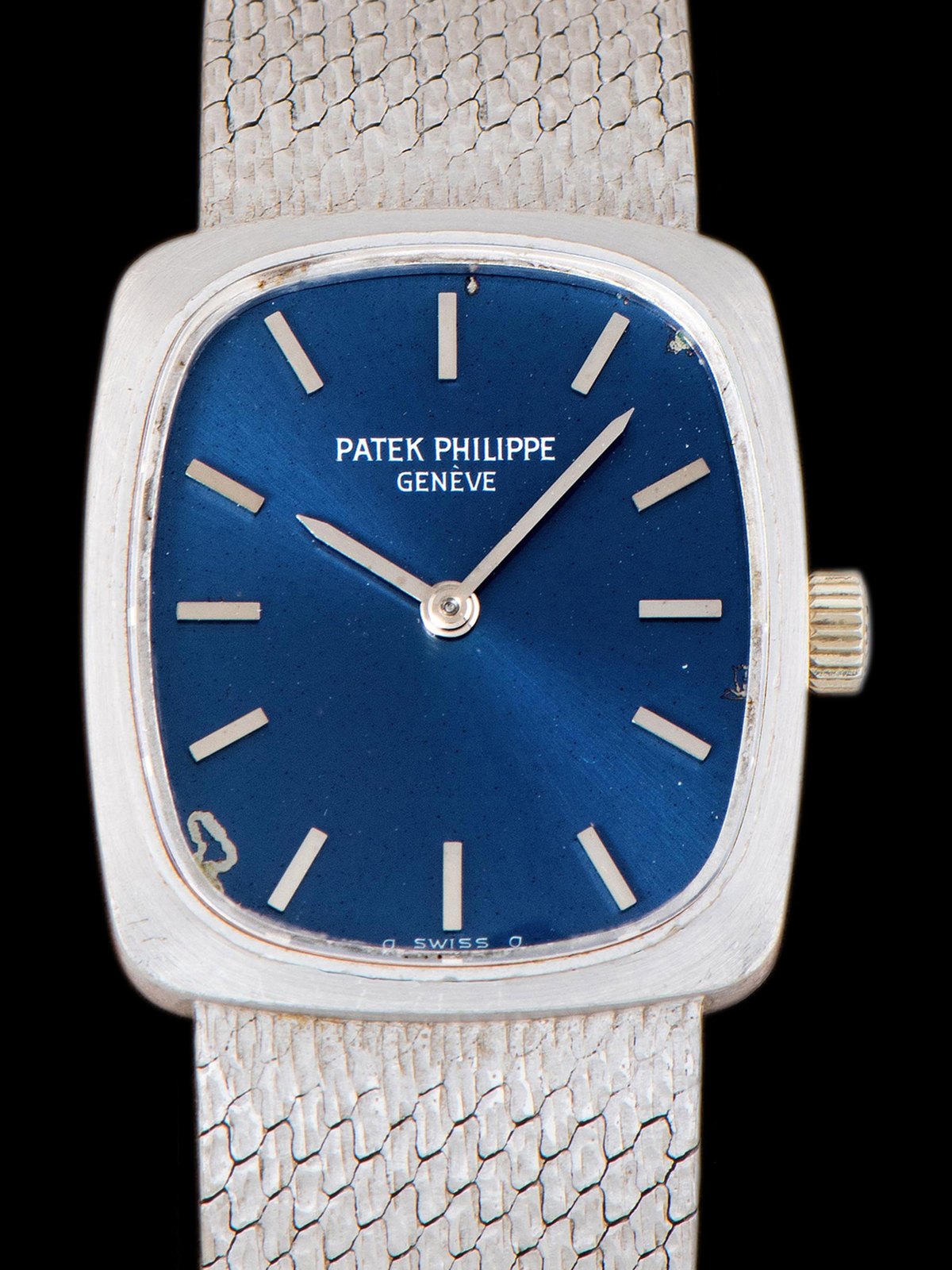
Patek Philippe Ladies Ellipse 18K WG (Ref. 4217/1) Blue "Sigma" Dial, 1970s
- Maker / attribution
- Patek Philippe (maker)
- Date
- 1970s
- Historical period
- Quartz Revolution (1969 – 1990)
- Country of origin
- Switzerland
- Object type
- Wristwatch
- Stock no.
- PP42171
- Credit line
- Dealer listing, Craft & Tailored (PP42171)
- Catalogue title (original)
- 1970s Patek Philippe Ladies Ellipse 18K WG (Ref. 4217/1) Blue "Sigma" Dial (English)
View the source record (dealer listing) ↗ (opens another website in a new tab)Suggest a correction
Record summary
Catalogued by Craft & Tailored (dealer), Los Angeles (stock number PP42171), this is a wristwatch by Patek Philippe, made in Switzerland, dated 1970s. The Atlas places it in the Quartz Revolution period (1969 – 1990) of its Wristwatches collection. The record is illustrated with 6 photographs.
Assembled from the source record's structured fields. Dates and attributions are given as the source states them; where a field is missing the Atlas leaves it blank rather than estimating.
Catalogue description
Dealer description — Craft & Tailored
'You never actually own a Patek Philippe. You merely look after it for the next generation.’ — Patek Philippe started this now ubiquitous marketing campaign in 1966 and never looked back, though they already had an outstanding legacy since the watchmaker was founded in the year 1839. Patek built its reputation on several foundational pillars: tradition, innovation, and excellence, all of which are paramount in every timepiece they make, both old and new. The recent uptick in interest in 1970s avant-garde wristwatch designs has been more than welcome, as these once-underappreciated, yet extremely fun timepieces have long deserved a moment in the spotlight. Much like this geometric Ellipse ladies' timepiece ref. 4217/1 from Patek Phillipe, cast in 18K white gold with an artisanally crafted integrated bracelet and blue dial. While the precise execution of this watch feels very Patek Philippe, the general styling reminds us of similar designs that would have come from Piaget in this era. Namely, the models that used precious materials along with unusual case shapes from the traditional round wristwatch designs, to sensational effect. SPECS Stock # PP42171 Brand Patek Philippe Style Ellipse Model 4217/1 Serial 27XXXXX / 12XXXXX Size Women's Material 18K White Gold Dial Blue Millimeters 21 X 23.5 Bracelet Integrated 18K WG Mesh Bracelet W/ Adjustable Clasp CASE & BRACELET The attractive, geometric 18K white gold case is exceptionally well-preserved, exhibiting honest signs of use with no notable evidence of prior polishing present. The integrated 18k white gold bracelet is a work of art and features a gorgeous hammered texture finish. The bracelet exhibits no stretch and will fit between a 6.25-inch and 6.5-inch wrist. DIAL & HANDS The original blue sunburst "Sigma" dial is simply beautiful, and exhibits some expected age that is common on metallic colored dial from this era, though no external damage is present. The original solid white gold hands are also flawless. ACCESSORIES
Historical context
Quartz Revolution (1969 – 1990)
Seiko's Astron begins mass quartz timekeeping; traditional industries contract sharply.
Quartz and digital watches transformed the market after 1969. Swiss employment collapsed, Japanese and Hong Kong production soared, and the Swatch (1983) helped the Swiss industry recover; mechanical watches survived as luxury goods.
Read the period in the timelineMore wristwatches from this periodEarlier: Modern Mechanical Horology
Atlas type guide
Wristwatches
Bracelet watches were worn by women from the early nineteenth century — Breguet made one for Caroline Murat, Queen of Naples, in 1810–12 — but the wristwatch only became a man's instrument with military use and aviation in the early twentieth century. Between the World Wars it overtook the pocket watch; the 1920s and 1930s brought rectangular Art Deco cases, water-resistant cases and the first automatic winding systems.
After 1945 the wristwatch became a carrier of identity — dress watches, sports and dive watches, chronographs, calendars — produced by Swiss, American, Japanese, German, Soviet and Chinese industries. The quartz revolution after 1969 and the mechanical renaissance since the 1990s, including the rise of independent watchmakers, complete the story.
What to look for
- The reference number (between the lugs or inside the case back) and serial number, the starting point for dating.
- The calibre: its maker and number are often stamped under the dial or on the bridge.
- Originality of dial, hands and crown — refinished ('redial') dials are common.
- Case material marks: 18K/750, 14K/585, stainless steel, gold-filled, plated.
Dating clues
- Wire-lug cases: before c. 1925.
- Water-resistant screw-down cases: from 1926.
- Quartz movements: from 1969; sapphire crystals widespread after c. 1980.
General guidance written by the Atlas editors about this kind of object. It is not a statement about this particular piece; for that, rely on the source record above and on physical examination.
Related records

Clocks · 1965–1975
Quartz master clock QM 1, with movement by Patek Phillippe, Switzerland, 1965–1975. Supplied by English Clock Systems.
Science Museum Group, London

Instruments · 1965–1984
Chronometer by Patek Philippe and Kelvin Hughes, England, 1965–1984
Science Museum Group, London

Pocket Watches · c. 1895
Patek Philippe pocket watch, c. 1895
Antiquorum auction archive, Geneva

Pocket Watches · c. 1900
Patek Philippe Chronometro Gondolo, c. 1900
Antiquorum auction archive, Geneva

Wristwatches · 1970
Wristwatch by Heno, Switzerland, 1970
Museum Rotterdam

Wristwatches · 1960–1986
'Tri-Compax' calendar chronograph wristwatch in gold case, by Universal, Geneva, Switzerland, 1960–1986.
Science Museum Group, London

Wristwatches · 1969–1970
Beta 21 Quartz wristwatch movement, made in Switzerland, 1970.
Science Museum Group, London

Wristwatches · c. 1969
Omega Speedmaster Moonwatch, ref. 145022-69st, c. 1969
Antiquorum auction archive, Geneva