
Wristwatches · Wristwatch
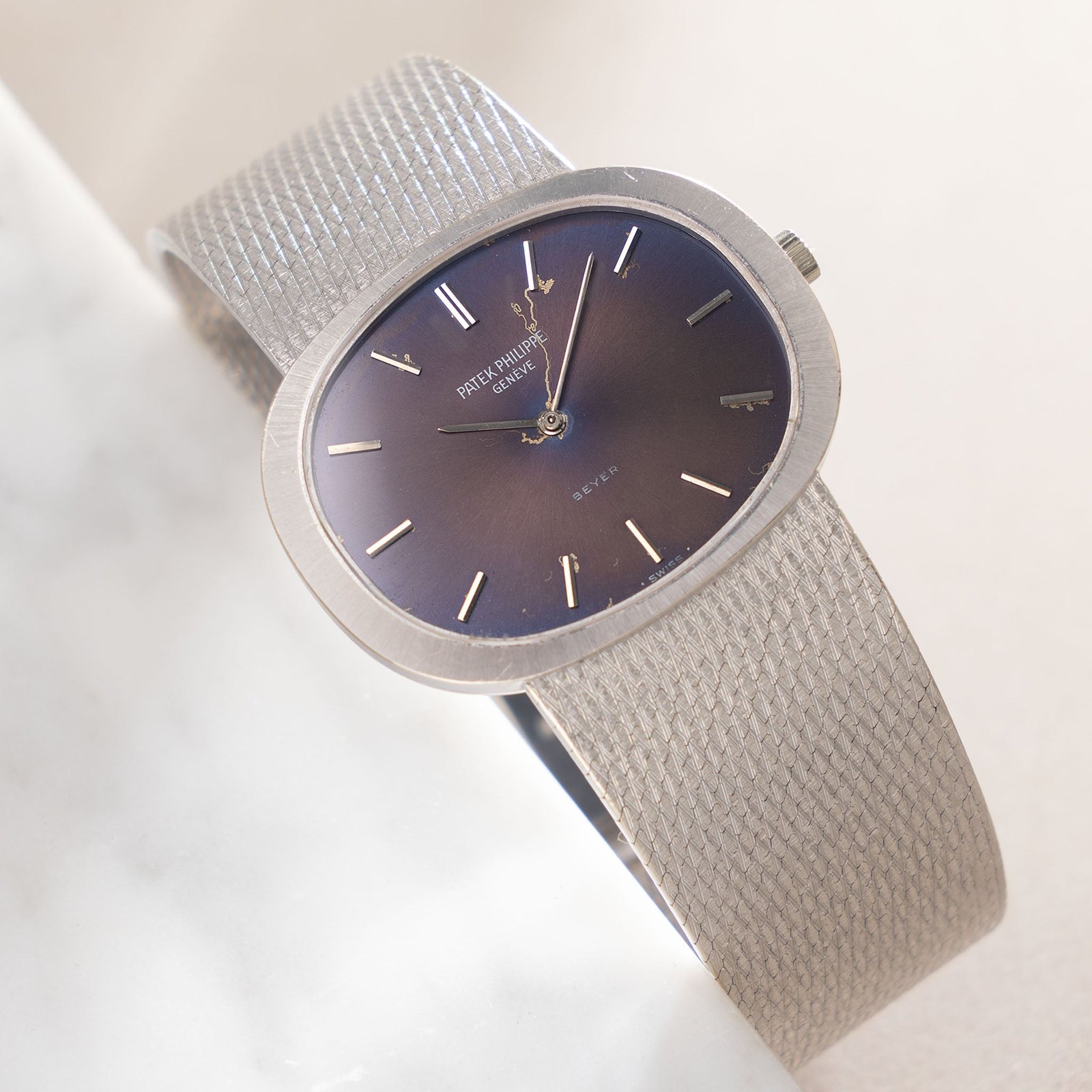
Patek Philippe Golden Ellipse in 18k White Gold ref 3545 Double Signed Beyer Colour Changed Dial “Lightning Bolt “, mid 1970s
- Maker / attribution
- Patek Philippe (maker)
- Date
- mid 1970s
- Historical period
- Quartz Revolution (1969 – 1990)
- Country of origin
- Switzerland
- Object type
- Wristwatch
- Materials / technique
- 18k white gold
- Dimensions
- Case 34 mm
- Stock no.
- W-3498
- Credit line
- Dealer listing, Bulang & Sons (W-3498)
- Catalogue title (original)
- Patek Philippe Golden Ellipse in 18k White Gold ref 3545 Double Signed Beyer Colour Changed Dial “Lightning Bolt “ (English)
View the source record (dealer listing) ↗ (opens another website in a new tab)Suggest a correction
Record summary
Catalogued by Bulang & Sons (dealer), Copenhagen (stock number W-3498), this is a wristwatch by Patek Philippe, made in Switzerland, dated mid 1970s. The Atlas places it in the Quartz Revolution period (1969 – 1990) of its Wristwatches collection. Materials and techniques recorded by the source: 18k white gold. Recorded dimensions: Case 34 mm. The record is illustrated with 6 photographs.
Assembled from the source record's structured fields. Dates and attributions are given as the source states them; where a field is missing the Atlas leaves it blank rather than estimating.
Catalogue description
Dealer description — Bulang & Sons
More than two millennia ago, the Greek mathematician Euclid defined a principle of perfect proportion that would come to be known as the Golden Ratio — a balance so naturally pleasing that Renaissance scholar Luca Pacioli later called it De Divina Proportione , the “Divine Proportion.” Expressed as the ratio 1:1.618, it represents the ideal point where symmetry meets beauty. Drawing on this timeless concept, Patek Philippe introduced the Golden Ellipse over fifty years ago — a watch that translates mathematical harmony into pure visual elegance. Distinctive within the brand’s collection, it remains one of Patek Philippe’s most enduring and refined designs. This horizontal “Ellipse,” measuring 26 x 34 mm, has several rare features. First, it is crafted in white gold and fitted with a dial that was originally blue but has aged over time into a stunning purple hue. The sunburst lacquer dials produced during that era were known to develop a unique patina, as the lacquer layer would partially fade due to oxidation. On this particular example, the blue finish has evolved into a lightning bolt–like streak extending from the hand axle toward the one o’clock marker — a natural effect that gives this “Golden Ratio” watch a distinctly cool edge. Furthermore, this piece is double-signed “Beyer.” Beyer Watches & Jewellery in Zurich is the oldest watch retailer in the world, founded in 1760 and continuously operated by the Beyer family for eight generations. The fine, thin, integrated white gold bracelet fits wrists up to 17.5 cm and remains in excellent condition. Powering the watch is the hand-wound caliber 23-300, which has been fully checked and regulated by our watchmaker. Once blue, now kissed by time into shades of royal violet — its dial bears a gentle lightning bolt, a mark of its journey. Double-signed by Beyer,come on guys , what is not to love here ?! Specifications: Patek Philippe Golden Ellipse reference 3545 26 x 34mm 18 k white gold case Case number , dating to the mid-1970s Colour changed blue dial to purple dial with stick markers , Beyer double signed and no lumed stick hands Caliber 23-300 hand-wound movement 18k white gold integrated bracelet Fully serviced by our watchmaker
Historical context
Quartz Revolution (1969 – 1990)
Seiko's Astron begins mass quartz timekeeping; traditional industries contract sharply.
Quartz and digital watches transformed the market after 1969. Swiss employment collapsed, Japanese and Hong Kong production soared, and the Swatch (1983) helped the Swiss industry recover; mechanical watches survived as luxury goods.
Read the period in the timelineMore wristwatches from this periodEarlier: Modern Mechanical Horology
Atlas type guide
Wristwatches
Bracelet watches were worn by women from the early nineteenth century — Breguet made one for Caroline Murat, Queen of Naples, in 1810–12 — but the wristwatch only became a man's instrument with military use and aviation in the early twentieth century. Between the World Wars it overtook the pocket watch; the 1920s and 1930s brought rectangular Art Deco cases, water-resistant cases and the first automatic winding systems.
After 1945 the wristwatch became a carrier of identity — dress watches, sports and dive watches, chronographs, calendars — produced by Swiss, American, Japanese, German, Soviet and Chinese industries. The quartz revolution after 1969 and the mechanical renaissance since the 1990s, including the rise of independent watchmakers, complete the story.
What to look for
- The reference number (between the lugs or inside the case back) and serial number, the starting point for dating.
- The calibre: its maker and number are often stamped under the dial or on the bridge.
- Originality of dial, hands and crown — refinished ('redial') dials are common.
- Case material marks: 18K/750, 14K/585, stainless steel, gold-filled, plated.
Dating clues
- Wire-lug cases: before c. 1925.
- Water-resistant screw-down cases: from 1926.
- Quartz movements: from 1969; sapphire crystals widespread after c. 1980.
General guidance written by the Atlas editors about this kind of object. It is not a statement about this particular piece; for that, rely on the source record above and on physical examination.
Related records

Clocks · 1965–1975
Quartz master clock QM 1, with movement by Patek Phillippe, Switzerland, 1965–1975. Supplied by English Clock Systems.
Science Museum Group, London

Instruments · 1965–1984
Chronometer by Patek Philippe and Kelvin Hughes, England, 1965–1984
Science Museum Group, London

Pocket Watches · c. 1895
Patek Philippe pocket watch, c. 1895
Antiquorum auction archive, Geneva

Pocket Watches · c. 1900
Patek Philippe Chronometro Gondolo, c. 1900
Antiquorum auction archive, Geneva

Wristwatches · 1970
Wristwatch by Heno, Switzerland, 1970
Museum Rotterdam

Wristwatches · 1960–1986
'Tri-Compax' calendar chronograph wristwatch in gold case, by Universal, Geneva, Switzerland, 1960–1986.
Science Museum Group, London

Wristwatches · 1969–1970
Beta 21 Quartz wristwatch movement, made in Switzerland, 1970.
Science Museum Group, London

Wristwatches · c. 1969
Omega Speedmaster Moonwatch, ref. 145022-69st, c. 1969
Antiquorum auction archive, Geneva