
Wristwatches · Wristwatch
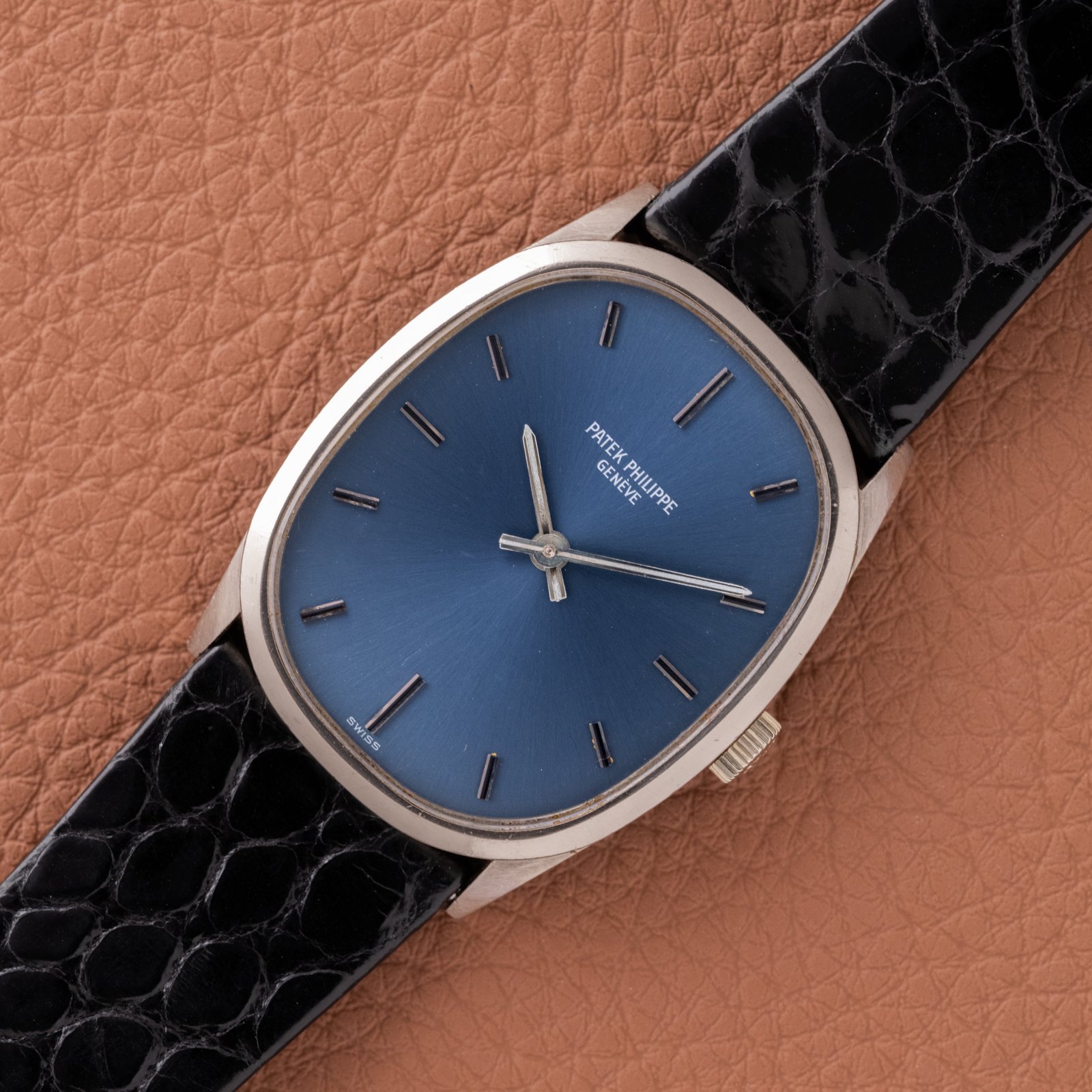
Patek Philippe Golden Ellipse Blue Dial in White Gold (Ref. 3546), 1970s
- Maker / attribution
- Patek Philippe (maker)
- Date
- 1970s
- Historical period
- Quartz Revolution (1969 – 1990)
- Country of origin
- Switzerland
- Object type
- Wristwatch
- Materials / technique
- white gold
- Dimensions
- Case 27 mm
- Stock no.
- Product 15932552118455
- Credit line
- Dealer listing, Huntington Company (product 15932552118455)
- Catalogue title (original)
- 1970s Patek Philippe Golden Ellipse Blue Dial in White Gold (Ref. 3546) (English)
View the source record (dealer listing) ↗ (opens another website in a new tab)Suggest a correction
Record summary
Catalogued by Huntington Company (dealer) (stock number Product 15932552118455), this is a wristwatch by Patek Philippe, made in Switzerland, dated 1970s. The Atlas places it in the Quartz Revolution period (1969 – 1990) of its Wristwatches collection. Materials and techniques recorded by the source: white gold. Recorded dimensions: Case 27 mm. The record is illustrated with 6 photographs.
Assembled from the source record's structured fields. Dates and attributions are given as the source states them; where a field is missing the Atlas leaves it blank rather than estimating.
Catalogue description
Dealer description — Huntington Company
History and Significance When Patek Philippe introduced the Golden Ellipse in 1968, the collection represented a dramatic departure from the traditional round and rectangular dress watches that had defined much of the manufacturer's history. Its unusual case shape was inspired by the golden ratio, a mathematical relationship that has influenced art, architecture, and design for centuries. Rather than following conventional proportions, the Ellipse combined the softness of an oval with the structure of a rectangle, creating a silhouette that was immediately recognizable. The design was particularly appropriate for the late 1960s, when Swiss manufacturers were increasingly exploring unconventional case shapes and new approaches to luxury watchmaking. More than half a century later, the Golden Ellipse remains one of Patek Philippe's most distinctive creations. The reference 3546 belongs to the early decades of the collection, a period when the Golden Ellipse was offered in a fascinating variety of sizes, metals, and dial configurations. While yellow gold examples became closely associated with the model, white gold executions introduced a considerably different personality. The cool tone of the metal allowed the unusual case architecture to take on a more restrained appearance, placing greater emphasis on the dial and the proportions of the watch. At 27mm, the reference 3546 retains the elegant dimensions associated with the earliest Ellipse models, relying on its broad case and distinctive shape rather than conventional size to establish its presence. Blue dials occupy a particularly important place in the history of the Golden Ellipse. The color became one of the collection's defining characteristics, creating a striking contrast against the precious metal cases and minimal applied hour markers. Early examples frequently incorporated rich blue finishes that could develop remarkable variations in tone over time. On this reference 3546, the dial has faded into a particularly attractive shade of blue, with a softer, almost atmospheric appearance that differs considerably from the deeper finishes typically associated with the collection. The original black hands have also aged to a pale ghost-white tone, introducing an unusual contrast that gives the watch an entirely individual character. Writer’s Thoughts The reference 3546 is particularly appealing because the aging has given the watch a personality that would be difficult to find in a more conventional example. The blue dial has developed a beautiful faded appearance, moving away from the rich, saturated color usually associated with the Golden Ellipse. The original black hands have aged evenly to a ghost-white tone, creating a striking contrast against the softened blue background. These are the kinds of changes that make vintage watches interesting as individual objects rather than simply examples of a particular reference. Our Promise Every watch is thoroughly vetted, carefully described with complete transparency, and guaranteed authentic. Each piece is offered in honest condition, ensuring collectors receive a timepiece that reflects both originality and integrity. Specifications Model: Golden Ellipse Reference: 3546 Year: 1970s Case Material: 18k White Gold Case Size: 27mm Dial: Blue Dial with Attractive Fading and Applied Hour Markers Movement: Manual-Winding Mechanical Movement Strap/Buckle: Original Patek Philippe Leather Strap Buckle/Clasp: Original Patek Philippe Ellipse Buckle Contents: Watch only Condition Case: White gold case remains in excellent vintage condition with light surface wear consistent with age and use. The case appears unpolished and retains attractive original definition. Dial: Blue dial has developed a beautiful, even faded appearance with soft variations in color. The applied hour markers and printing remain well preserved. Hands: Original black hands have aged evenly to an attractive ghost-white tone, complementing the faded blue dial. Crystal: Crystal remains in good condition with light surface wear consistent with age and use. Strap/Buckle: Original Patek Philippe leather strap remains in good vintage condition with signs of wear consistent with age. Buckle/Clasp: Original Patek Philippe Ellipse buckle remains in good condition with light surface wear.
Historical context
Quartz Revolution (1969 – 1990)
Seiko's Astron begins mass quartz timekeeping; traditional industries contract sharply.
Quartz and digital watches transformed the market after 1969. Swiss employment collapsed, Japanese and Hong Kong production soared, and the Swatch (1983) helped the Swiss industry recover; mechanical watches survived as luxury goods.
Read the period in the timelineMore wristwatches from this periodEarlier: Modern Mechanical Horology
Atlas type guide
Wristwatches
Bracelet watches were worn by women from the early nineteenth century — Breguet made one for Caroline Murat, Queen of Naples, in 1810–12 — but the wristwatch only became a man's instrument with military use and aviation in the early twentieth century. Between the World Wars it overtook the pocket watch; the 1920s and 1930s brought rectangular Art Deco cases, water-resistant cases and the first automatic winding systems.
After 1945 the wristwatch became a carrier of identity — dress watches, sports and dive watches, chronographs, calendars — produced by Swiss, American, Japanese, German, Soviet and Chinese industries. The quartz revolution after 1969 and the mechanical renaissance since the 1990s, including the rise of independent watchmakers, complete the story.
What to look for
- The reference number (between the lugs or inside the case back) and serial number, the starting point for dating.
- The calibre: its maker and number are often stamped under the dial or on the bridge.
- Originality of dial, hands and crown — refinished ('redial') dials are common.
- Case material marks: 18K/750, 14K/585, stainless steel, gold-filled, plated.
Dating clues
- Wire-lug cases: before c. 1925.
- Water-resistant screw-down cases: from 1926.
- Quartz movements: from 1969; sapphire crystals widespread after c. 1980.
General guidance written by the Atlas editors about this kind of object. It is not a statement about this particular piece; for that, rely on the source record above and on physical examination.
Related records
Clocks · 1965–1975
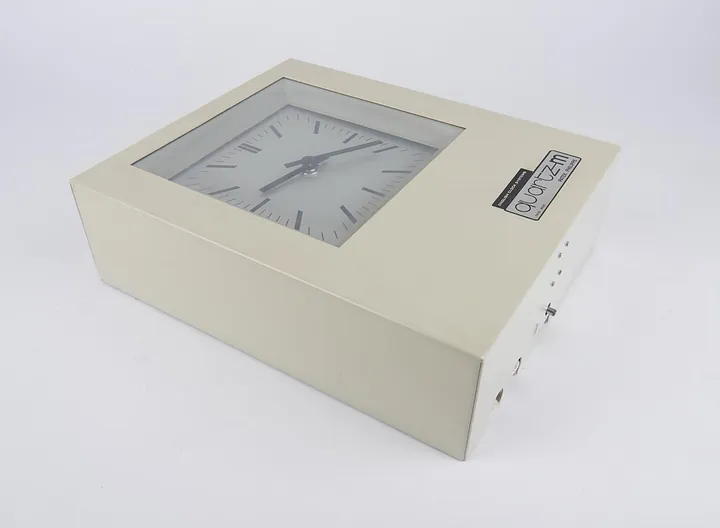
Quartz master clock QM 1, with movement by Patek Phillippe, Switzerland, 1965–1975. Supplied by English Clock Systems.
Science Museum Group, London
Instruments · 1965–1984
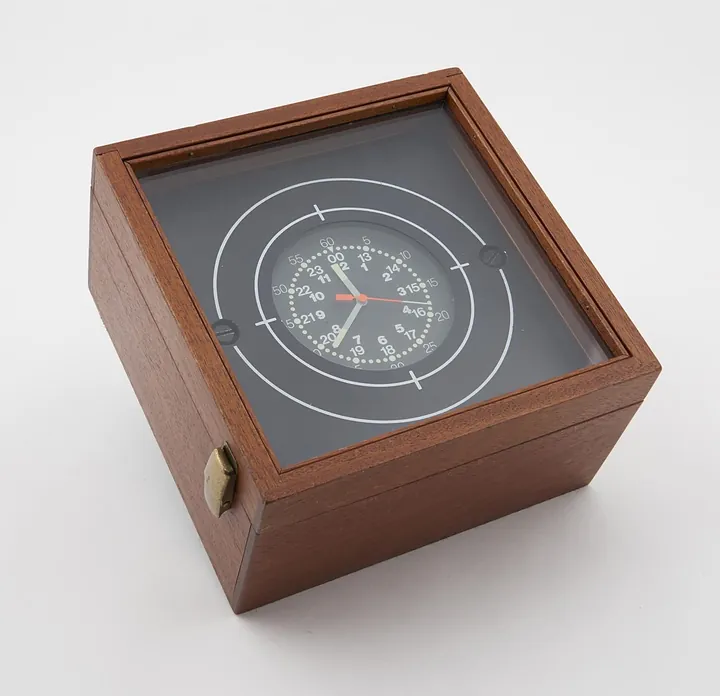
Chronometer by Patek Philippe and Kelvin Hughes, England, 1965–1984
Science Museum Group, London
Pocket Watches · c. 1895
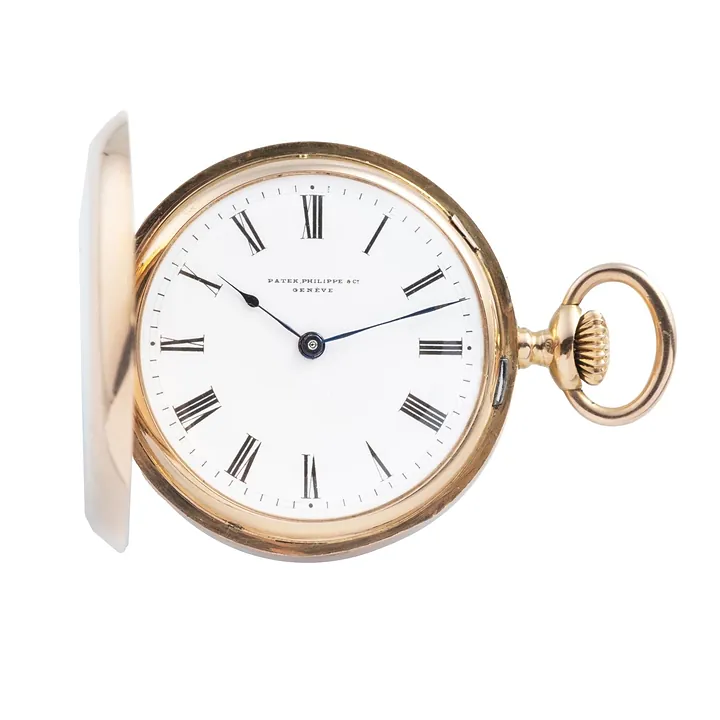
Patek Philippe pocket watch, c. 1895
Antiquorum auction archive, Geneva

Pocket Watches · c. 1900
Patek Philippe Chronometro Gondolo, c. 1900
Antiquorum auction archive, Geneva

Wristwatches · 1970
Wristwatch by Heno, Switzerland, 1970
Museum Rotterdam

Wristwatches · 1960–1986
'Tri-Compax' calendar chronograph wristwatch in gold case, by Universal, Geneva, Switzerland, 1960–1986.
Science Museum Group, London

Wristwatches · 1969–1970
Beta 21 Quartz wristwatch movement, made in Switzerland, 1970.
Science Museum Group, London

Wristwatches · c. 1969
Omega Speedmaster Moonwatch, ref. 145022-69st, c. 1969
Antiquorum auction archive, Geneva