
Wristwatches · Wristwatch
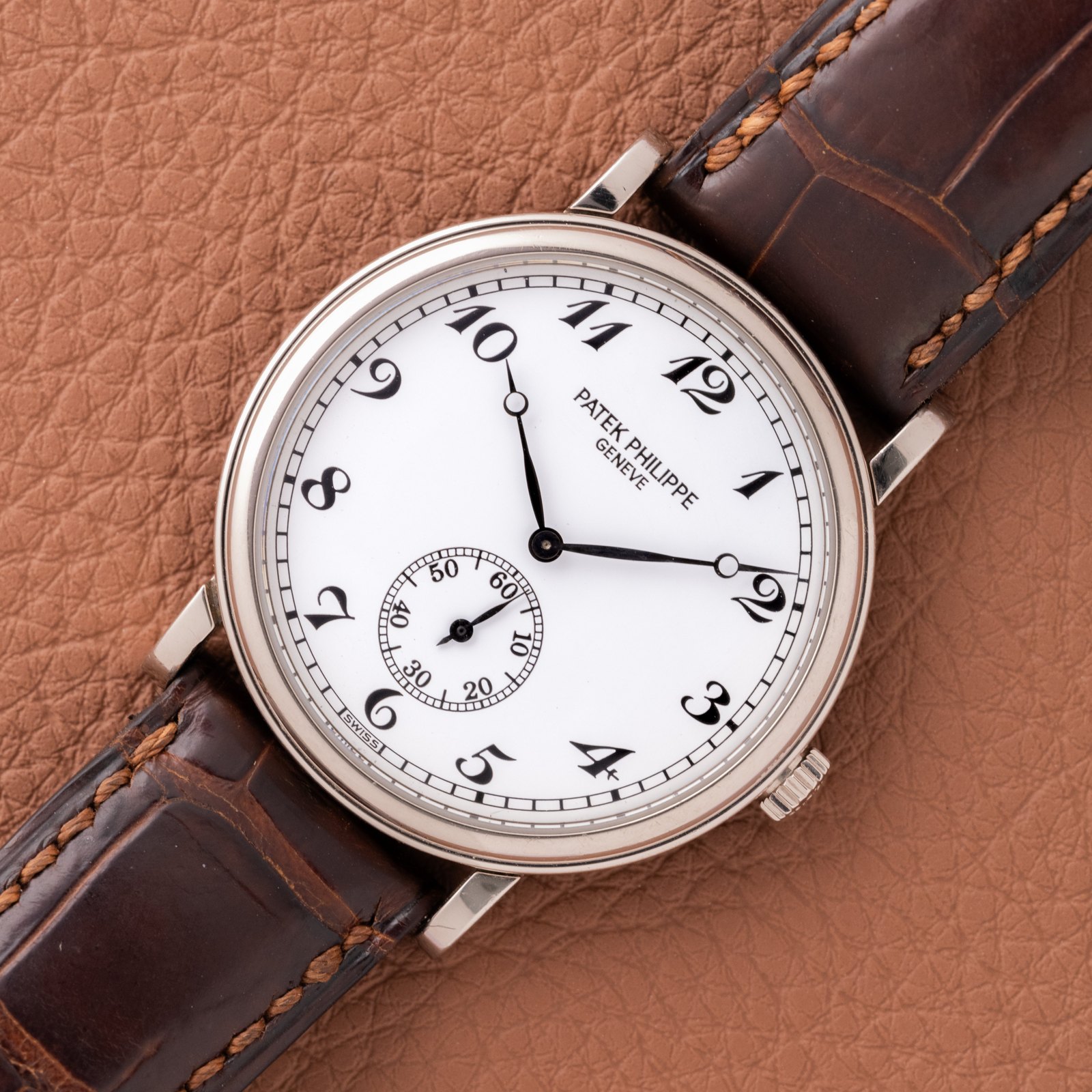
Patek Philippe Calatrava White Gold Breguet Porcelain Dial (Ref. 5022G), 1990s
- Maker / attribution
- Patek Philippe (maker)
- Date
- 1990s
- Historical period
- Mechanical Renaissance (1990 – 2010)
- Country of origin
- Switzerland
- Object type
- Wristwatch
- Materials / technique
- white gold
- Dimensions
- Case 33 mm
- Stock no.
- Product 8834714304695
- Credit line
- Dealer listing, Huntington Company (product 8834714304695)
- Catalogue title (original)
- 1990s Patek Philippe Calatrava White Gold Breguet Porcelain Dial (Ref. 5022G) (English)
View the source record (dealer listing) ↗ (opens another website in a new tab)Suggest a correction
Record summary
Catalogued by Huntington Company (dealer) (stock number Product 8834714304695), this is a wristwatch by Patek Philippe, made in Switzerland, dated 1990s. The Atlas places it in the Mechanical Renaissance period (1990 – 2010) of its Wristwatches collection. Materials and techniques recorded by the source: white gold. Recorded dimensions: Case 33 mm. The record is illustrated with 6 photographs.
Assembled from the source record's structured fields. Dates and attributions are given as the source states them; where a field is missing the Atlas leaves it blank rather than estimating.
Catalogue description
Dealer description — Huntington Company
History and Significance Patek Philippe has spent generations perfecting the art of the understated dress watch, and the Calatrava remains one of the finest expressions of that philosophy. Introduced in 1932, the Calatrava established a design language centered on proportion, restraint, and timeless elegance. Throughout the decades, Patek Philippe has explored that philosophy through countless interpretations, from minimalist designs to more traditional, decorative executions. The reference 5022G belongs firmly to the latter category, drawing inspiration from the elegance of early twentieth-century watchmaking. One of the defining characteristics of the reference 5022G is its beautiful use of Breguet numerals. Named after the legendary watchmaker Abraham-Louis Breguet, this distinctive style of numeral has become closely associated with traditional haute horlogerie. The sweeping curves and delicate flourishes bring a wonderful sense of personality to an otherwise restrained design. Few dial configurations capture the romance of classical watchmaking quite as effectively. The reference 5022G also demonstrates Patek Philippe's ability to borrow from pocket-watch design without creating something that feels dated. The railway-style minute track, subsidiary seconds display, and elegant hands recall an era when precision and legibility were expressed through carefully considered details. These elements work together to give the watch an almost architectural sense of balance. Rather than relying on elaborate complications, the design celebrates the beauty of traditional timekeeping. Another important aspect of the reference 5022G is its place within Patek Philippe's broader Calatrava collection. While certain Calatrava references have become famous for their minimalist Bauhaus-inspired aesthetics, others embrace a more expressive and historically rooted approach. The reference 5022G represents that wonderful alternative, offering the refinement expected from Patek Philippe with a considerably more distinctive personality. It is a reminder that classical watchmaking can be both conservative and full of character. Writer’s Thoughts The Patek Philippe Calatrava reference 5022G is an especially charming example of how much personality can exist within a traditional dress watch. The combination of black Breguet numerals, beautiful typography, and the subsidiary seconds display gives the entire design an almost romantic quality. There is something particularly appealing about a watch that feels connected to the earliest traditions of fine Swiss watchmaking without appearing overly formal. Among the many interpretations of the Calatrava, the reference 5022G stands out for its balance of elegance and character. The appeal of the reference 5022G extends well beyond the Patek Philippe name. The design feels complete, with every element contributing something meaningful to the overall appearance. The dial has enough visual interest to reward close attention, yet remains wonderfully clean and balanced at a glance. For collectors drawn to the more traditional side of Patek Philippe, the reference 5022G represents an especially compelling expression of the Calatrava. Our Promise Every watch is thoroughly vetted, carefully described with complete transparency, and guaranteed authentic. Each piece is offered in honest condition, ensuring collectors receive a timepiece that reflects both originality and integrity. Specifications Brand: Patek Philippe Model: Calatrava Reference: 5022G Year: 1990s Case Material: 18K White Gold Case Size: 33mm Dial: White Porcelain Dial with Black Painted Breguet Numerals and Subsidiary Seconds Movement: Manual Wind S trap/Buckle: Original Patek Philippe Brown Alligator Strap Buckle/Clasp: Original Patek Philippe 18K White Gold Buckle Contents: Watch only Condition Case: Excellent overall condition with light surface wear. Dial: Beautifully preserved porcelain dial with clean numerals and printing. Hands: Excellent condition. Crystal: Clean with no significant visible scratches. Strap/Buckle: Original strap showing visible wear and creasing. B uckle/Clasp: Original white gold buckle with light surface wear.
Historical context
Mechanical Renaissance (1990 – 2010)
Mechanical watches return as cultural objects; independent watchmaking flourishes.
Mechanical watches returned as cultural and luxury objects. Complications, tourbillons and new materials proliferated; independent watchmakers such as George Daniels, F.P. Journe and Philippe Dufour revived artisanal watchmaking; collecting vintage watches became a major field.
Read the period in the timelineMore wristwatches from this periodEarlier: Quartz Revolution
Atlas type guide
Wristwatches
Bracelet watches were worn by women from the early nineteenth century — Breguet made one for Caroline Murat, Queen of Naples, in 1810–12 — but the wristwatch only became a man's instrument with military use and aviation in the early twentieth century. Between the World Wars it overtook the pocket watch; the 1920s and 1930s brought rectangular Art Deco cases, water-resistant cases and the first automatic winding systems.
After 1945 the wristwatch became a carrier of identity — dress watches, sports and dive watches, chronographs, calendars — produced by Swiss, American, Japanese, German, Soviet and Chinese industries. The quartz revolution after 1969 and the mechanical renaissance since the 1990s, including the rise of independent watchmakers, complete the story.
What to look for
- The reference number (between the lugs or inside the case back) and serial number, the starting point for dating.
- The calibre: its maker and number are often stamped under the dial or on the bridge.
- Originality of dial, hands and crown — refinished ('redial') dials are common.
- Case material marks: 18K/750, 14K/585, stainless steel, gold-filled, plated.
Dating clues
- Wire-lug cases: before c. 1925.
- Water-resistant screw-down cases: from 1926.
- Quartz movements: from 1969; sapphire crystals widespread after c. 1980.
General guidance written by the Atlas editors about this kind of object. It is not a statement about this particular piece; for that, rely on the source record above and on physical examination.
Related records

Clocks · 1965–1975
Quartz master clock QM 1, with movement by Patek Phillippe, Switzerland, 1965–1975. Supplied by English Clock Systems.
Science Museum Group, London

Instruments · 1965–1984
Chronometer by Patek Philippe and Kelvin Hughes, England, 1965–1984
Science Museum Group, London

Pocket Watches · c. 1895
Patek Philippe pocket watch, c. 1895
Antiquorum auction archive, Geneva

Pocket Watches · c. 1900
Patek Philippe Chronometro Gondolo, c. 1900
Antiquorum auction archive, Geneva

Wristwatches · 2008
Wristwatch by Breitling?, 2008
Museum Rotterdam

Wristwatches · c. 1990s
Audemars Piguet Bamboo, c. 1990s
Antiquorum auction archive, Geneva

Wristwatches · c. 1990
Audemars Piguet Huitieme Perpetual Calendar, ref. 25696PT, c. 1990
Antiquorum auction archive, Geneva

Wristwatches · c. 1990
Breitling Chronomat, ref. b13050.1, c. 1990
Antiquorum auction archive, Geneva