
Wristwatches · Wristwatch
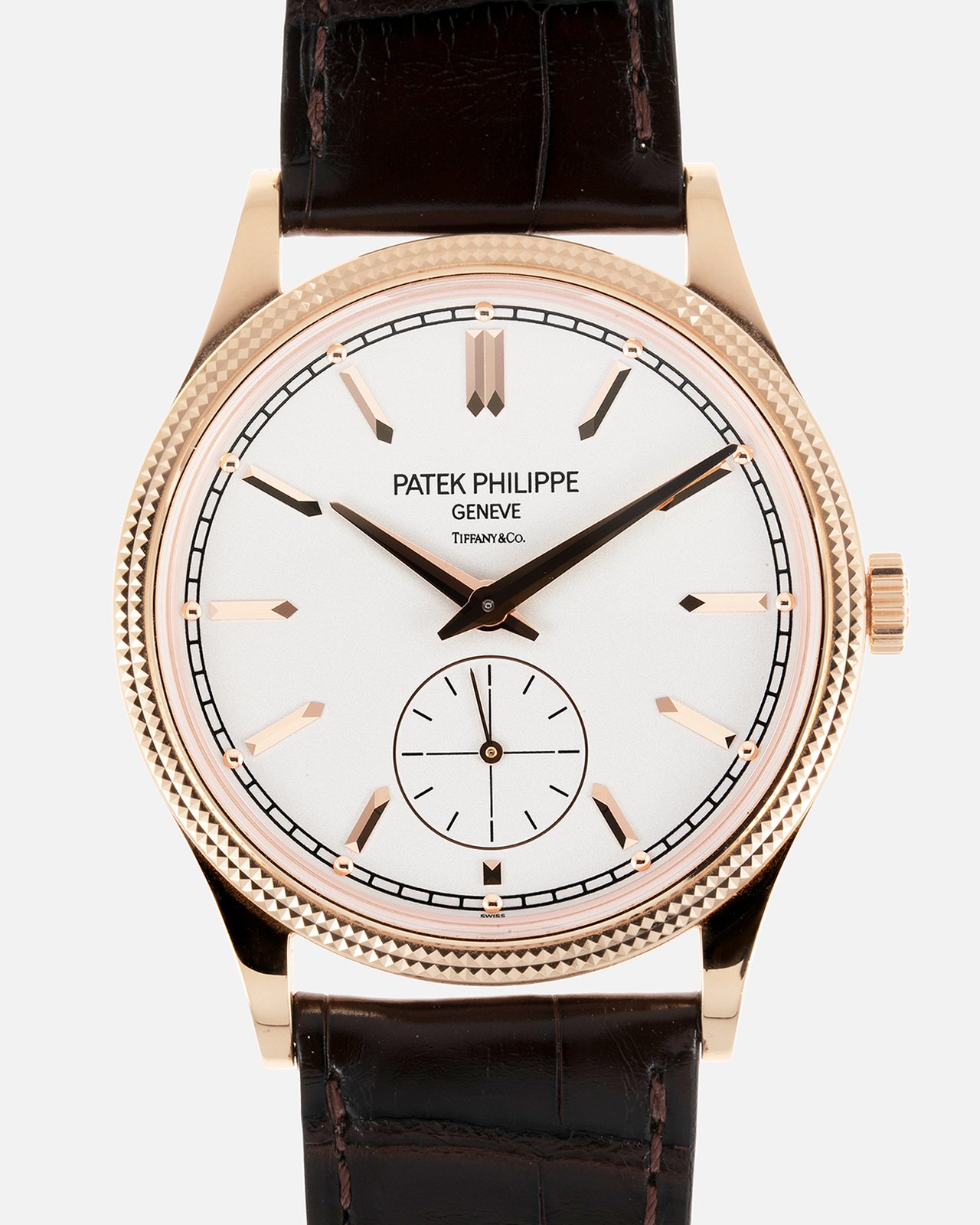
Patek Philippe Calatrava 6119R Tiffany & Co, 2021
- Maker / attribution
- Patek Philippe (maker)
- Date
- 2021
- Historical period
- Contemporary Horology (2010 – Present)
- Country of origin
- Switzerland
- Object type
- Wristwatch
- Dimensions
- Case 39 mm
- Stock no.
- Product 6843694153815
- Credit line
- Dealer listing, S.Song Watches (product 6843694153815)
- Catalogue title (original)
- Patek Philippe Calatrava 6119R Tiffany & Co (English)
View the source record (dealer listing) ↗ (opens another website in a new tab)Suggest a correction
Record summary
Catalogued by S.Song Watches (dealer), Seattle (stock number Product 6843694153815), this is a wristwatch by Patek Philippe, made in Switzerland, dated 2021. The Atlas places it in the Contemporary Horology period (2010 – Present) of its Wristwatches collection. Recorded dimensions: Case 39 mm. The record is illustrated with 6 photographs.
Assembled from the source record's structured fields. Dates and attributions are given as the source states them; where a field is missing the Atlas leaves it blank rather than estimating.
Catalogue description
Dealer description — S.Song Watches
Perhaps the most iconic dress watch collection ever, the Patek Philippe Calatrava embodies the very essence of what a classically styled timepiece should look like. Defining the entire market niche in 1932 when it was first released, the Calatrava has become a mainstay within Patek Philippe's offerings even to this very day. It is widely recognized by collectors and connoisseurs all around the world to be the quintessential dress watch, which sets the bar for many brands that came after it, and one that Patek Philippe continues to build on its rich tradition to this day. The very first Calatrava Ref. 96 was introduced in 1932, which was a time when pocket watches were gradually getting phased out as the general public began to lean towards wristwatches. Since then, there have been numerous iterations of the classic Calatrava, from varying case sizes to dial styles. But this particular example being offered here is a special one and is easily one of my favorite modern Calatravas today – the Ref. 6119R-001 with an elusive Tiffany & Co. stamped dial. For those who do not know, Tiffany & Co. was actually Patek Philippe’s very first official retailer in the United States and has been selling Patek Philippe timepieces since 1851. Since then, this distribution partnership eventually evolved into an ongoing collaboration of producing timepieces that are double stamped, which is why we see examples like this right here bearing both Patek Philippe and Tiffany & Co. logos. While Patek Philippe in the past has had double-stamped dials by other distributors around the world, the only one remaining that is allowed this privilege today is Tiffany and Co in New York. Now, the reason why I love this particular example is not entirely because of that Tiffany & Co. stamp on the dial but due to the fact that Patek has managed to update and improve a design that is already deemed legendary in its own right, and so here we are. One of the things I think Patek did really well with this reference is the way they incorporated modern elements into a fundamentally vintage design canvas, which allow the Ref. 6119R-001 to transcend modern watchmaking trends quite effortlessly. It takes inspiration from several references from its decorated catalog dating back to as far as 1932 and its very first Calatrava Ref. 96. It also serves as a tribute to the well-known and historic Calatrava Ref. 3919 and its successor, the Ref. 5119. The Ref. 6119R-001 blends several signature design elements into one in the form of a larger case to create a more contemporary guise in keeping with modern collectors' preferences residing with larger watches. Sized at 39mm x 8.08mm, the Ref. 6119R-001 features a refined aesthetic with its studded guilloched “Clous de Paris” hobnail patterned bezel (as seen on the Ref. 3520) layered upon an otherwise understated circular case design with sharp lugs. The case is constructed from 18-carat rose gold with a subtle, grained silvery dial featuring faceted applied rose gold hour markers, a set of dauphine style hour and minute hands, a sub-seconds at 6 o ‘clock, and the ever so elusive Tiffany & Co. stamp right beneath the Patek Philippe branding text at 12 o ‘clock. Powering this beauty of a timepiece from within is Patek’s new manual-wound, 27-jeweled, in-house Cal. 30-255 PS. Fun fact: Patek’s naming convention of the movement is basically Cal. (Diameter) – (Thickness), which means this caliber is 30.4mm wide, and 2.55mm thick. It is also worth mentioning that the Ref. 6119R-001 comes equipped with a display case back to prominently show off the beautifully decorated movement. I find this a real visual treat because the standard practice for hand-wound Calatravas has always been to hide the movement behind a closed case back. Further, the Cal. 30-255 PS also boasts an excellent 65-hour power reserve due to its twin-barrel construction. The Calatrava has always been the quiet yet unwavering pillar model of Patek's extensive catalog range. The fact that Patek went the extra mile to retain the original Calatrava's timeless charisma while ensuring the range possesses the necessary technical footing to remain competitive within the Maison’s ever-evolving lineup further reinforces the importance of the Calatrava lineage. In my opinion, I feel that this iteration of the Calatrava is Patek’s way of pushing the boundaries of what a Calatrava with a contemporary spirit would look like today, whilst maintaining and acknowledging its momentous past. Overall, this is another fantastic update to one of Patek Philippe’s most important and iconic lines and is exactly the update that will continue to maintain the legacy of the Calatrava. Combined with the Tiffany and Co. New York provenance, this makes this particular 6119 the most desirable, rare, and special example in the world.
Historical context
Contemporary Horology (2010 – Present)
Silicon components, connected watches, optical-lattice research clocks and a thriving independent scene.
Smartwatches became the world's best-selling watches, while mechanical watchmaking focuses on craft, innovation (silicon components, new escapements) and independent makers.
Read the period in the timelineMore wristwatches from this periodEarlier: Mechanical Renaissance
Atlas type guide
Wristwatches
Bracelet watches were worn by women from the early nineteenth century — Breguet made one for Caroline Murat, Queen of Naples, in 1810–12 — but the wristwatch only became a man's instrument with military use and aviation in the early twentieth century. Between the World Wars it overtook the pocket watch; the 1920s and 1930s brought rectangular Art Deco cases, water-resistant cases and the first automatic winding systems.
After 1945 the wristwatch became a carrier of identity — dress watches, sports and dive watches, chronographs, calendars — produced by Swiss, American, Japanese, German, Soviet and Chinese industries. The quartz revolution after 1969 and the mechanical renaissance since the 1990s, including the rise of independent watchmakers, complete the story.
What to look for
- The reference number (between the lugs or inside the case back) and serial number, the starting point for dating.
- The calibre: its maker and number are often stamped under the dial or on the bridge.
- Originality of dial, hands and crown — refinished ('redial') dials are common.
- Case material marks: 18K/750, 14K/585, stainless steel, gold-filled, plated.
Dating clues
- Wire-lug cases: before c. 1925.
- Water-resistant screw-down cases: from 1926.
- Quartz movements: from 1969; sapphire crystals widespread after c. 1980.
General guidance written by the Atlas editors about this kind of object. It is not a statement about this particular piece; for that, rely on the source record above and on physical examination.
Related records
Clocks · 1965–1975
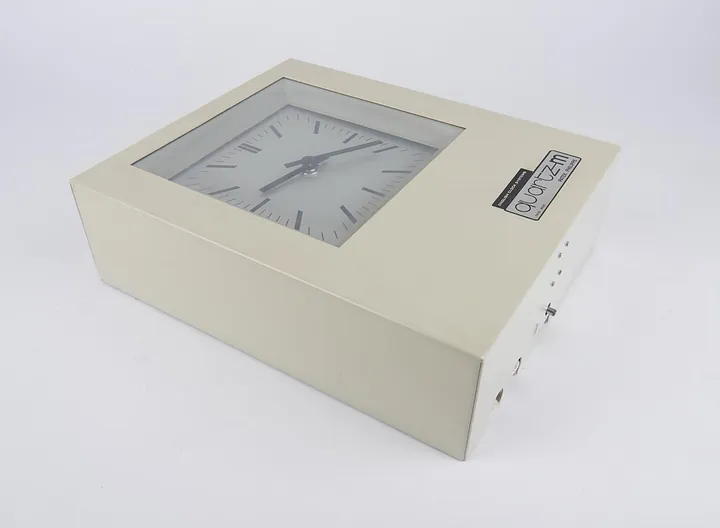
Quartz master clock QM 1, with movement by Patek Phillippe, Switzerland, 1965–1975. Supplied by English Clock Systems.
Science Museum Group, London
Instruments · 1965–1984
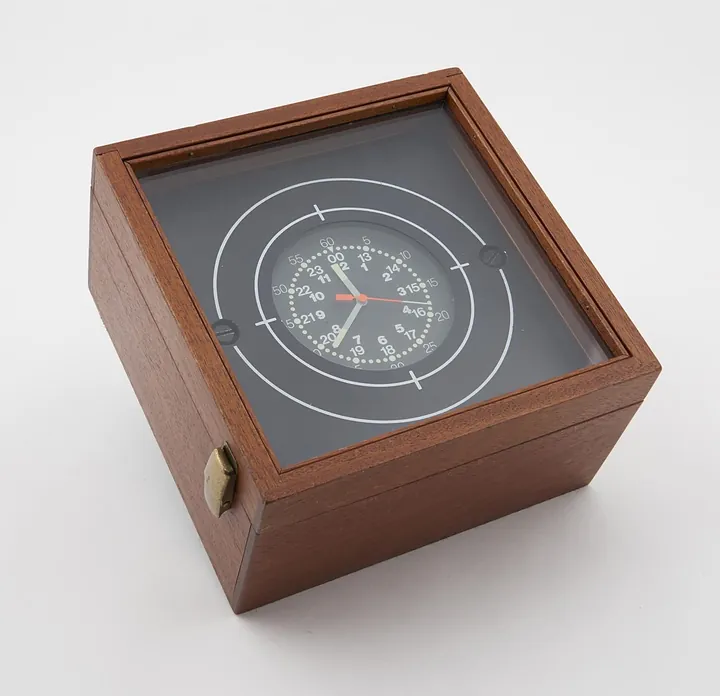
Chronometer by Patek Philippe and Kelvin Hughes, England, 1965–1984
Science Museum Group, London
Pocket Watches · c. 1895
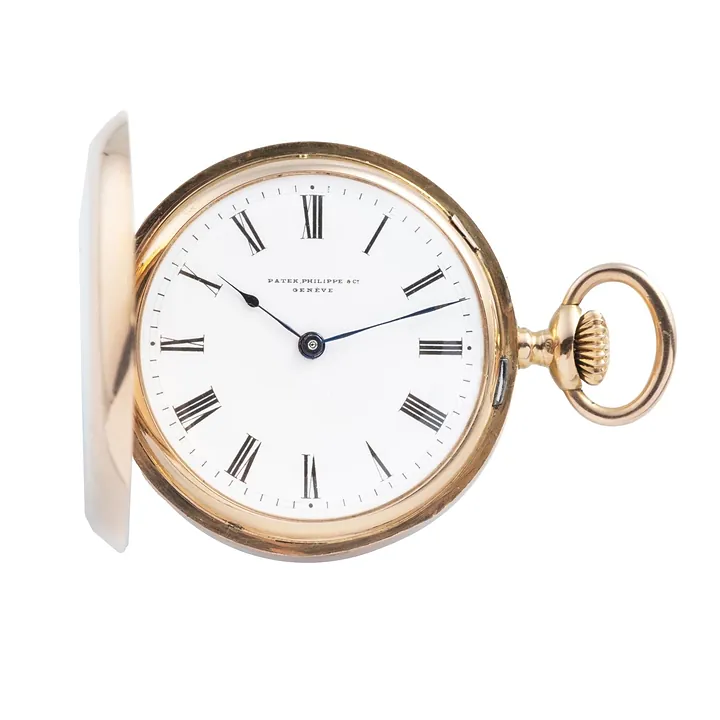
Patek Philippe pocket watch, c. 1895
Antiquorum auction archive, Geneva

Pocket Watches · c. 1900
Patek Philippe Chronometro Gondolo, c. 1900
Antiquorum auction archive, Geneva

Wristwatches · c. 2010s
Breguet Type XXI, ref. 3810, c. 2010s (Antiquorum Lot 381-24)
Antiquorum auction archive, Geneva

Wristwatches · c. 2010s
Breguet Type XXI, ref. 3810, c. 2010s (Antiquorum Lot 386-229)
Antiquorum auction archive, Geneva

Wristwatches · Sold in September 2010
Breitling Cosmonaute, ref. A 22322, Sold in September 2010
Antiquorum auction archive, Geneva

Wristwatches · c. 2010
Corum Bubble Chrono, ref. 396.150.20, c. 2010
Antiquorum auction archive, Geneva