
Wristwatches · Wristwatch
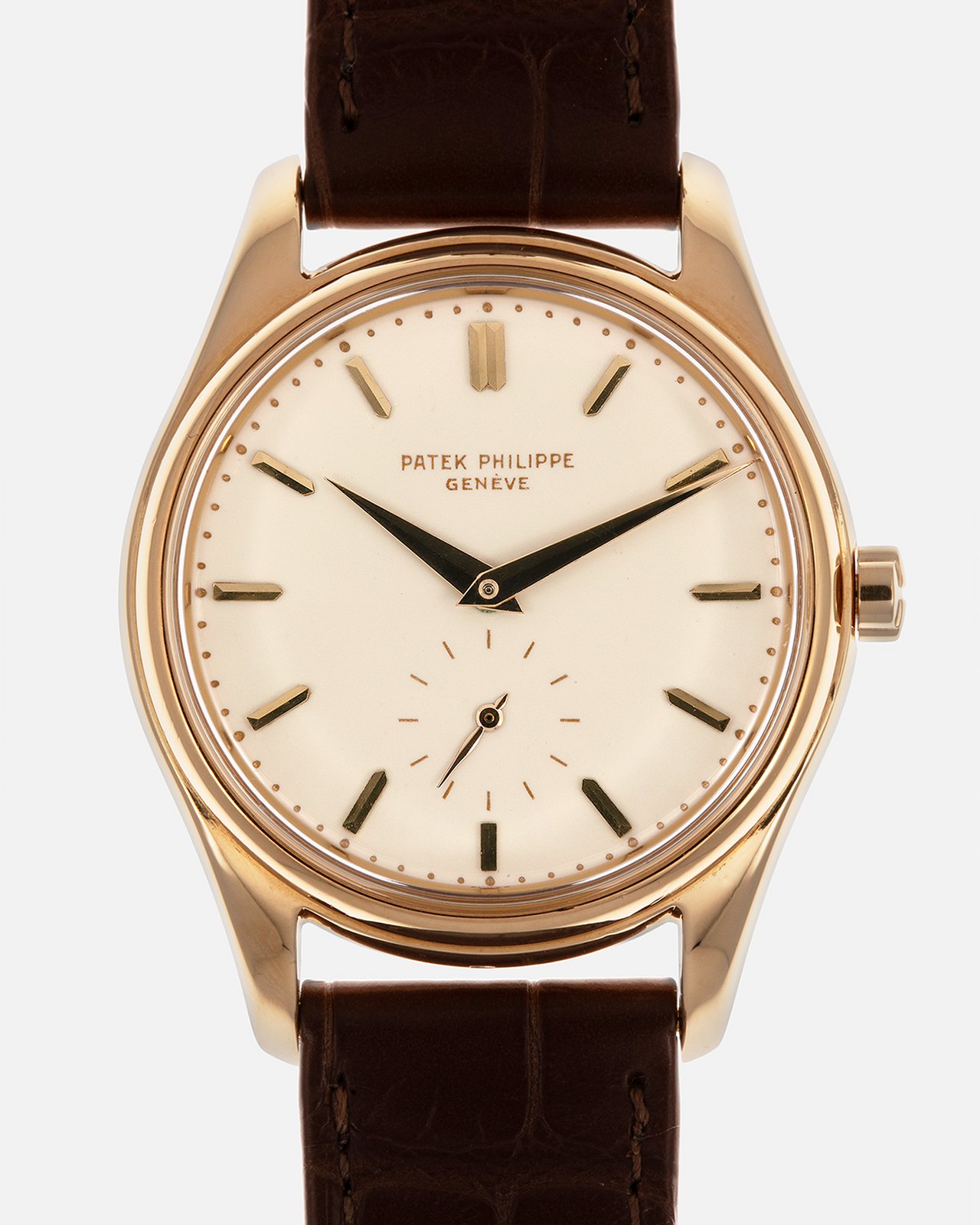
Patek Philippe Calatrava 2526 Enamel Yellow Gold, 1957
- Maker / attribution
- Patek Philippe (maker)
- Date
- 1957
- Historical period
- Modern Mechanical Horology (1945 – 1969)
- Country of origin
- Switzerland
- Object type
- Wristwatch
- Materials / technique
- yellow gold
- Stock no.
- Product 7653846515799
- Credit line
- Dealer listing, S.Song Watches (product 7653846515799)
- Catalogue title (original)
- Patek Philippe Calatrava 2526 Enamel Yellow Gold (English)
View the source record (dealer listing) ↗ (opens another website in a new tab)Suggest a correction
Record summary
Catalogued by S.Song Watches (dealer), Seattle (stock number Product 7653846515799), this is a wristwatch by Patek Philippe, made in Switzerland, dated 1957. The Atlas places it in the Modern Mechanical Horology period (1945 – 1969) of its Wristwatches collection. Materials and techniques recorded by the source: yellow gold. The record is illustrated with 6 photographs.
Assembled from the source record's structured fields. Dates and attributions are given as the source states them; where a field is missing the Atlas leaves it blank rather than estimating.
Catalogue description
Dealer description — S.Song Watches
Few references embody mid-century Patek Philippe quite like the 2526. Introduced in the early 1950s, the 2526 was not merely another Calatrava, but the manufacture’s first self-winding wristwatch, created to showcase Patek Philippe’s vision of the modern luxury timepiece. Widely regarded today as one of the finest time-only watches ever produced by the manufacture, the 2526 remains deeply revered amongst seasoned collectors and enthusiasts, admired not simply for its design, but for the level of thought, engineering, and craftsmanship beneath its understated exterior. To understand the significance of the 2526, one must first go back to its inception. First unveiled at the 1953 Basel Fair during a period of rapid evolution within the watch industry, the 2526 arrived at a time when watch brands increasingly turned their attention towards automatic movements. Scholarship suggests that approximately 3,000 examples were ultimately produced across yellow, rose, and white gold, as well as platinum. While that figure already makes the 2526 relatively scarce, its importance extends far beyond rarity. In many ways, the 2526 represented the convergence of horological artistry, technical innovation, and modern watchmaking at Patek Philippe. Having previously handled and offered a beautiful first-series variant, distinguished by its “dimpled” index appearance, the present example hails from the later third-series configuration of the 2526, generally associated with production during the latter half of the 1950s. Based on its production year, matching case and movement numbers, which fall within the known third series range, this watch represents the later evolution of the reference, distinguished by its elongated applied baton markers, flatter caseback, and shortened baton hour marker at 6:00. The dial nevertheless remains the defining feature of the 2526. Unlike conventional lacquered dials of the era, Patek Philippe utilised a true enamel dial construction, giving the surface an unmistakable porcelain-like depth under changing light. At a time when most brands had already transitioned towards more economical lacquered dials, Patek Philippe’s decision to utilise fired enamel reflected the ambitious philosophy behind the reference. A significant distinction between the first series and later executions lies in the way the indices were mounted. While early first-series dials utilised pin-set indices that left subtle “dimples” visible beneath the enamel surface, later series examples such as this adopted indices mounted directly onto the dial itself, resulting in a cleaner and more restrained appearance. On third-series examples, the baton marker layout, faceted indices, dauphine-style handset, and elegant typography further emphasise the purity of the enamel surface while remaining unmistakably Calatrava in character. Cased in yellow gold, the 2526 possesses a physical presence uncommon amongst dress watches of the period, with a notably substantial case architecture defined by its broad bezel, sculpted lugs, and three-part screw-down construction. Together with its charming oversized “PP” signed crown, the watch carries a distinct sense of gravitas on the wrist. Beyond aesthetics, the oversized crown also reflected the unusually robust construction of the 2526, conceived with water resistance standards far ahead of most contemporary dress watches. Beneath its elegant exterior sits the groundbreaking Cal. 12-600 AT, widely regarded as one of the finest automatic calibres ever produced. Introduced as Patek’s first self-winding calibre, it represented a major technical milestone for the manufacture and reflected the brand’s commitment to developing a fully in-house automatic movement at a time when many relied on external suppliers. Featuring a beautifully decorated 18-carat gold rotor, Gyromax balance, and impeccably finished components engineered to an uncompromising standard, the movement showcased both technical prowess and exceptional finishing. Particularly impressive is the level of care devoted to its execution despite the absence of exhibition casebacks during the era, with wide Côtes de Genève (Geneva stripes), sharp bevels, and meticulous finishing carried out to the same standard expected of Patek Philippe’s most important references. Even decades later, the Cal. 12-600 AT remains highly regarded amongst watchmakers for both its durability and sophisticated construction. Though subtler than its earlier counterparts, the later series 2526 has become deeply appreciated amongst seasoned collectors precisely because of this maturity. Less overtly decorative, it is a watch entirely confident in its proportions, execution, and historical importance. More than seventy years after its introduction, the 2526 remains one of the clearest expressions of Patek Philippe’s golden era philosophy, where technical innovation, craftsmanship, and elegance were delivered with discretion. Perhaps that is ultimately what makes the 2526 such an enduring timepiece. Its legacy lies not in bold complications or excessive decoration, but in the clarity of its design and the seriousness of its execution. Beneath its understated exterior lies an extraordinary level of thought, craftsmanship, and refinement that only becomes more apparent the longer one spends with the watch. The over-engineered Cal. 12-600 AT, rich enamel dial, and balanced case design together represent the qualities that continue to make mid-century Patek Philippe so deeply respected amongst collectors today.
Historical context
Modern Mechanical Horology (1945 – 1969)
Tool watches for divers, pilots and astronauts; electric watches anticipate the electronic age.
The classic era of the mechanical wristwatch: dive watches, chronographs for motor racing and space flight, GMT watches for jet travel, slim dress watches, automatic calendars, and the rise of Japanese manufacturers alongside Swiss, American, German and Soviet industries.
Read the period in the timelineMore wristwatches from this periodEarlier: Golden Age of Mechanical Watchmaking
Atlas type guide
Wristwatches
Bracelet watches were worn by women from the early nineteenth century — Breguet made one for Caroline Murat, Queen of Naples, in 1810–12 — but the wristwatch only became a man's instrument with military use and aviation in the early twentieth century. Between the World Wars it overtook the pocket watch; the 1920s and 1930s brought rectangular Art Deco cases, water-resistant cases and the first automatic winding systems.
After 1945 the wristwatch became a carrier of identity — dress watches, sports and dive watches, chronographs, calendars — produced by Swiss, American, Japanese, German, Soviet and Chinese industries. The quartz revolution after 1969 and the mechanical renaissance since the 1990s, including the rise of independent watchmakers, complete the story.
What to look for
- The reference number (between the lugs or inside the case back) and serial number, the starting point for dating.
- The calibre: its maker and number are often stamped under the dial or on the bridge.
- Originality of dial, hands and crown — refinished ('redial') dials are common.
- Case material marks: 18K/750, 14K/585, stainless steel, gold-filled, plated.
Dating clues
- Wire-lug cases: before c. 1925.
- Water-resistant screw-down cases: from 1926.
- Quartz movements: from 1969; sapphire crystals widespread after c. 1980.
General guidance written by the Atlas editors about this kind of object. It is not a statement about this particular piece; for that, rely on the source record above and on physical examination.
Related records

Clocks · 1965–1975
Quartz master clock QM 1, with movement by Patek Phillippe, Switzerland, 1965–1975. Supplied by English Clock Systems.
Science Museum Group, London

Instruments · 1965–1984
Chronometer by Patek Philippe and Kelvin Hughes, England, 1965–1984
Science Museum Group, London

Pocket Watches · c. 1895
Patek Philippe pocket watch, c. 1895
Antiquorum auction archive, Geneva

Pocket Watches · c. 1900
Patek Philippe Chronometro Gondolo, c. 1900
Antiquorum auction archive, Geneva

Wristwatches · 1945
Wristwatch by Eterna, 1945
Museum Rotterdam

Wristwatches · c. 1945
Breitling Premier, ref. 790, c. 1945
Antiquorum auction archive, Geneva

Wristwatches · c. 1945
Universal Genève Uni-Compax, ref. 22492, c. 1945
Antiquorum auction archive, Geneva

Wristwatches · c. 1950s
Baume & Mercier wristwatch, c. 1950s
Antiquorum auction archive, Geneva