
Wristwatches · Wristwatch
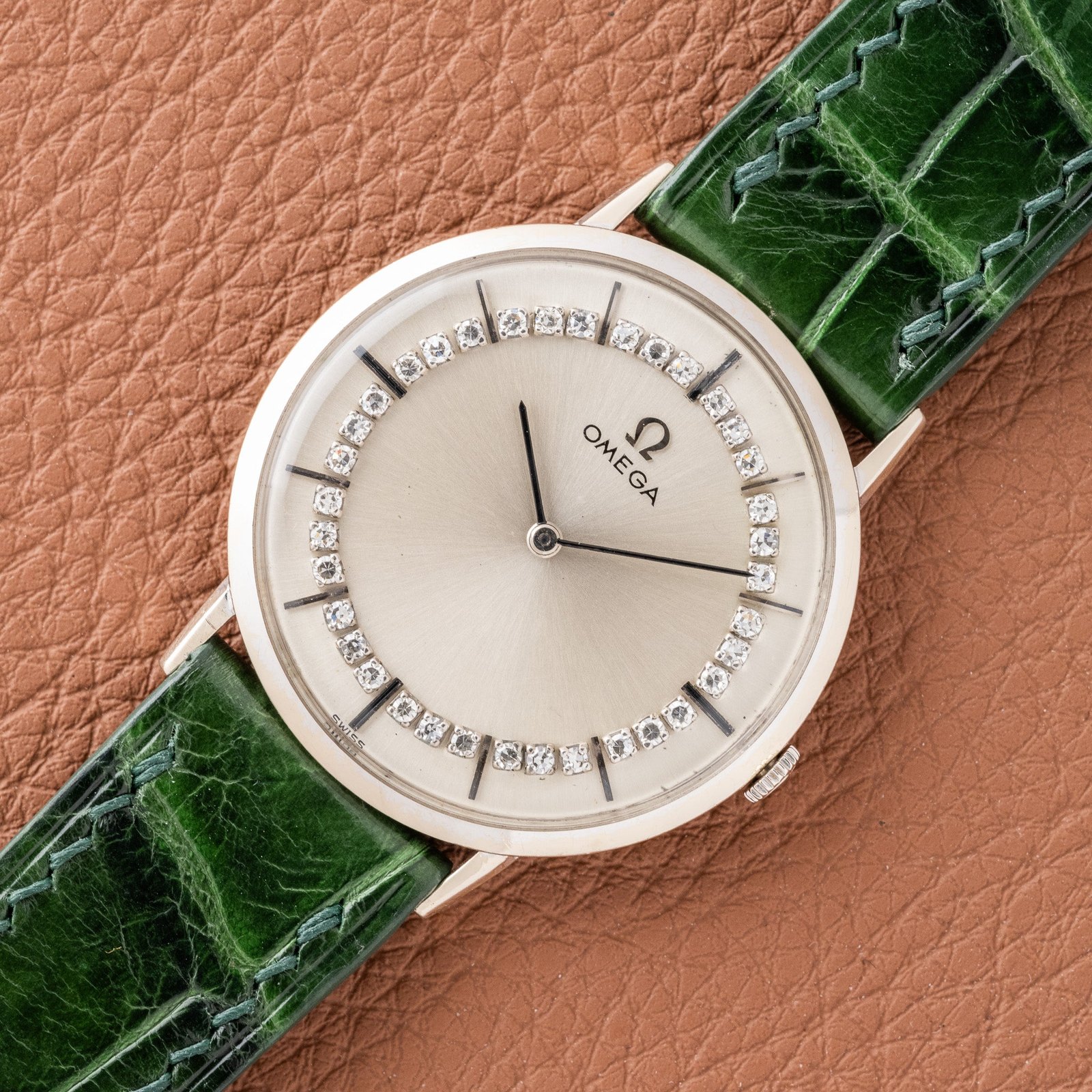
Omega Ultra Slim Dress Watch - Factory Diamond Dial (Ref. D6672), 1963
- Maker / attribution
- Omega (maker)
- Date
- 1963
- Historical period
- Modern Mechanical Horology (1945 – 1969)
- Country of origin
- Switzerland
- Object type
- Wristwatch
- Dimensions
- Case 33 mm
- Stock no.
- Product 8355973300407
- Credit line
- Dealer listing, Huntington Company (product 8355973300407)
- Catalogue title (original)
- 1963 Omega Ultra Slim Dress Watch - Factory Diamond Dial (Ref. D6672) (English)
View the source record (dealer listing) ↗ (opens another website in a new tab)Suggest a correction
Record summary
Catalogued by Huntington Company (dealer) (stock number Product 8355973300407), this is a wristwatch by Omega, made in Switzerland, dated 1963. The Atlas places it in the Modern Mechanical Horology period (1945 – 1969) of its Wristwatches collection. Recorded dimensions: Case 33 mm. The record is illustrated with 6 photographs.
Assembled from the source record's structured fields. Dates and attributions are given as the source states them; where a field is missing the Atlas leaves it blank rather than estimating.
Catalogue description
Dealer description — Huntington Company
History and Significance Start your vintage journey with confidence. History & Significance Founded in 1848, Omega has long been at the forefront of watchmaking innovation. From the creation of the first in-house Omega Calibre in 1894 to its role as Official Olympic Timekeeper since 1932, Omega consistently set standards in accuracy and reliability. The Speedmaster’s role in NASA’s space program—most famously the Apollo 11 moon landing—cemented its reputation as one of the most important watchmakers of the 20th century. By the early 1970s, Omega’s catalog spanned from sports chronographs to elegant dress watches like this D6672. Gold dress watches of this era reflected a shift toward slim, refined timepieces with clean dials and versatile proportions. Pieces like this represent Omega’s ability to deliver timeless sophistication at an attainable level, making them enduring favorites for both new and seasoned collectors. Writer's Thoughts What stands out most about this Omega Ref. D6672 is its balance of refinement and simplicity. The champagne dial, featuring Roman numerals, feels classic, while the slim 6.5mm case makes it extremely wearable. It’s the kind of watch that can be worn daily or saved for special occasions, offering a quiet elegance that has aged beautifully over the last 50 years. Our Promise Every watch is fully vetted, carefully described with complete transparency, and guaranteed authentic. This Omega Ref. D6672 is presented in original condition, offering a trustworthy example of Swiss vintage watchmaking. Specifications Brand: Omega Model: Ref. D6672 Year: 1963 Case Material: 14k Gold Case Size: 33mm, 17mm lug width, 6.5mm thick Bezel: Smooth gold bezel Dial: Silver sunburst dial with diamonds Crystal: Acrylic Movement: Manual wind Strap: New strap Buckle: Generic buckle Contents: Watch only Condition Case: Unpolished with sharp lugs; surfaces remain crisp and even with natural patina on the yellow gold. Bezel: Smooth bezel, sharp and unpolished. Crystal: Acrylic crystal in excellent shape with light wear. Dial: Original dial, clean and well preserved. Minimal signs of age. Hands: Original and in near-perfect condition. Strap: New strap in like-new condition. Buckle: Generic buckle in like-new condition.
Historical context
Modern Mechanical Horology (1945 – 1969)
Tool watches for divers, pilots and astronauts; electric watches anticipate the electronic age.
The classic era of the mechanical wristwatch: dive watches, chronographs for motor racing and space flight, GMT watches for jet travel, slim dress watches, automatic calendars, and the rise of Japanese manufacturers alongside Swiss, American, German and Soviet industries.
Read the period in the timelineMore wristwatches from this periodEarlier: Golden Age of Mechanical Watchmaking
Atlas type guide
Wristwatches
Bracelet watches were worn by women from the early nineteenth century — Breguet made one for Caroline Murat, Queen of Naples, in 1810–12 — but the wristwatch only became a man's instrument with military use and aviation in the early twentieth century. Between the World Wars it overtook the pocket watch; the 1920s and 1930s brought rectangular Art Deco cases, water-resistant cases and the first automatic winding systems.
After 1945 the wristwatch became a carrier of identity — dress watches, sports and dive watches, chronographs, calendars — produced by Swiss, American, Japanese, German, Soviet and Chinese industries. The quartz revolution after 1969 and the mechanical renaissance since the 1990s, including the rise of independent watchmakers, complete the story.
What to look for
- The reference number (between the lugs or inside the case back) and serial number, the starting point for dating.
- The calibre: its maker and number are often stamped under the dial or on the bridge.
- Originality of dial, hands and crown — refinished ('redial') dials are common.
- Case material marks: 18K/750, 14K/585, stainless steel, gold-filled, plated.
Dating clues
- Wire-lug cases: before c. 1925.
- Water-resistant screw-down cases: from 1926.
- Quartz movements: from 1969; sapphire crystals widespread after c. 1980.
General guidance written by the Atlas editors about this kind of object. It is not a statement about this particular piece; for that, rely on the source record above and on physical examination.
Related records

Instruments · 1950–1976
Omega Megaquartz 2400 marine chronometer, 1950–1976
Science Museum Group, London

Instruments · 1960–1979
Stopwatch / timer by Omega, 1960–1979
Science Museum Group, London

Instruments · 1960–1979
Stopwatch / timer by Omega, Switzerland, 1960–1979
Science Museum Group, London

Instruments · 1960–1979
Stopwatch by Omega, Swiss made, single-button type reading 0 - 60 seconds in fifths and 0 - 5 minutes in minutes on subsidiary dial, 1960-79.
Science Museum Group, London

Wristwatches · 1945
Wristwatch by Eterna, 1945
Museum Rotterdam

Wristwatches · c. 1945
Breitling Premier, ref. 790, c. 1945
Antiquorum auction archive, Geneva

Wristwatches · c. 1945
Universal Genève Uni-Compax, ref. 22492, c. 1945
Antiquorum auction archive, Geneva

Wristwatches · c. 1950s
Baume & Mercier wristwatch, c. 1950s
Antiquorum auction archive, Geneva