
Wristwatches · Wristwatch
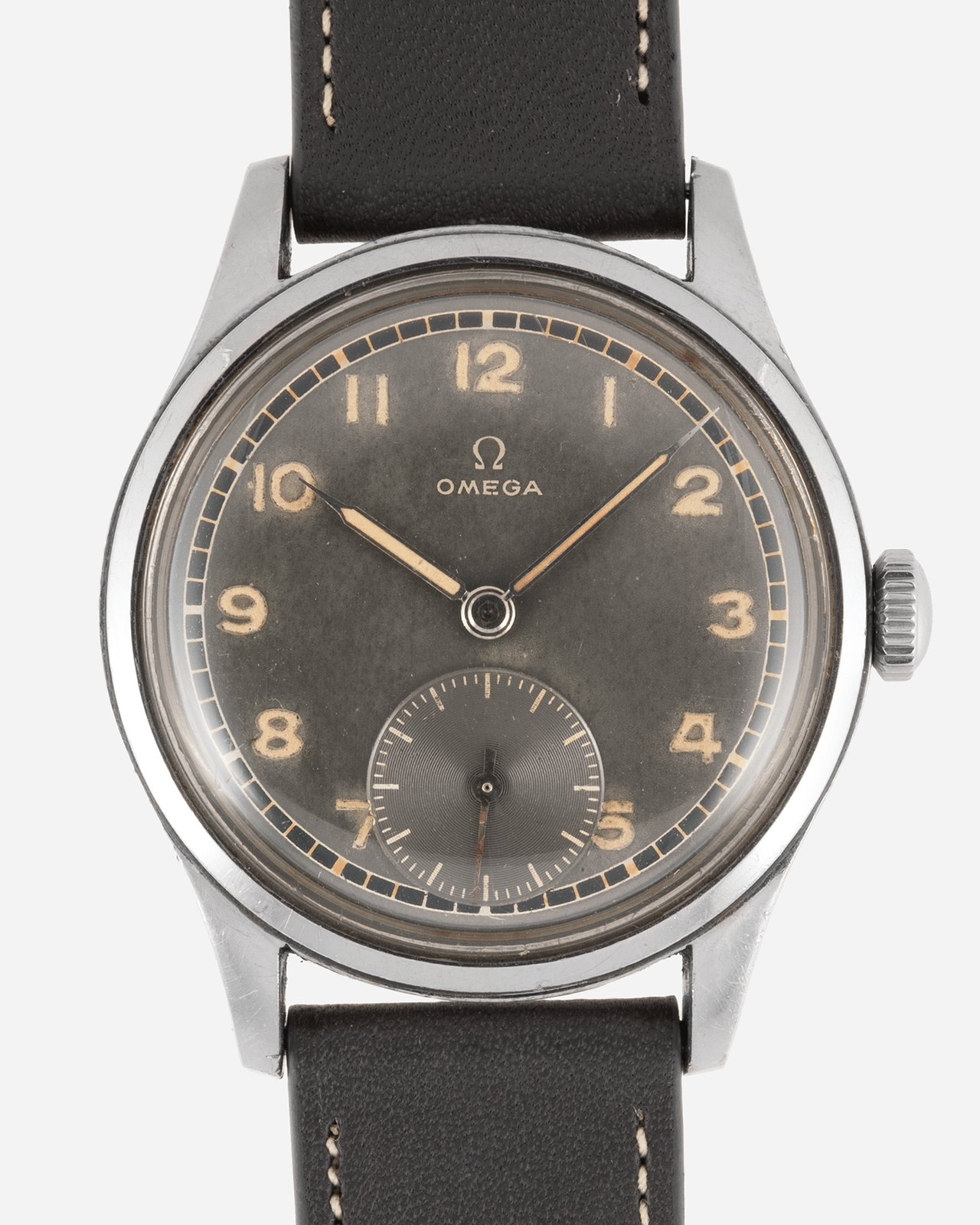
Omega Suveran 2400-4 Grey, 1944
- Maker / attribution
- Omega (maker)
- Date
- 1944
- Historical period
- Golden Age of Mechanical Watchmaking (1900 – 1945)
- Country of origin
- Switzerland
- Object type
- Wristwatch
- Stock no.
- Product 4659335200855
- Credit line
- Dealer listing, S.Song Watches (product 4659335200855)
- Catalogue title (original)
- Omega Suveran 2400-4 Grey (English)
View the source record (dealer listing) ↗ (opens another website in a new tab)Suggest a correction
Record summary
Catalogued by S.Song Watches (dealer), Seattle (stock number Product 4659335200855), this is a wristwatch by Omega, made in Switzerland, dated 1944. The Atlas places it in the Golden Age of Mechanical Watchmaking period (1900 – 1945) of its Wristwatches collection. The record is illustrated with 6 photographs.
Assembled from the source record's structured fields. Dates and attributions are given as the source states them; where a field is missing the Atlas leaves it blank rather than estimating.
Catalogue description
Dealer description — S.Song Watches
Known mostly for their Speedmaster, Seamaster, Railmaster, and Constellation collections, Omega is a brand that seems to base most of their offerings within this small selection of collections. While these collections are certainly all iconic in their own right, they fail to depict the legendary watchmaker's history completely. To understand Omega's impact on the world of horology, we will need to examine their other collections, such as the Omega Suveran. Manufactured during the 1940s, the Omega Suveran, "Sovereign" in English, had one purpose to serve, to make money. While this might seem glaringly obvious given that is the objective for every watch, the Omega Suveran's purpose was to make money for the Swedish Government. With money tight during WWII, the Swedish government sought a way to break free from their dependency on Nazi Germany. While issuing government bonds was one way to raise money, the Swedes decided to sell watches to the public to achieve this too. After approaching Omega to sell them watches, the Swedish government would retail these watches to their citizens and thus secure a rather unorthodox source of income. This income, just like that produced from the bonds they issued, aided in bridging the gap in Sweden's WWII budget deficit, an action the government officials called a "defense loan”. Thanks to its exclusive sale through the Swedish government in the '40s, and their rather limited sales channels, the Omega Suveran is a collectible piece of both, horological history, and WWII history. Powered by the 30T2 movement, a legendary manual-wind military movement, and featuring a grey dial with a gorgeous patina, the example I have on offer is truly a spectacular piece of history that would fit well in any collection.
Historical context
Golden Age of Mechanical Watchmaking (1900 – 1945)
The wristwatch displaces the pocket watch; waterproof cases, self-winding and grand complications.
The wristwatch overtook the pocket watch. Military use in the First World War, aviation, water-resistant cases (1926), automatic winding (1923–31), rectangular Art Deco designs and early chronographs and calendars defined the period.
Read the period in the timelineMore wristwatches from this periodEarlier: Industrial Revolution
Atlas type guide
Wristwatches
Bracelet watches were worn by women from the early nineteenth century — Breguet made one for Caroline Murat, Queen of Naples, in 1810–12 — but the wristwatch only became a man's instrument with military use and aviation in the early twentieth century. Between the World Wars it overtook the pocket watch; the 1920s and 1930s brought rectangular Art Deco cases, water-resistant cases and the first automatic winding systems.
After 1945 the wristwatch became a carrier of identity — dress watches, sports and dive watches, chronographs, calendars — produced by Swiss, American, Japanese, German, Soviet and Chinese industries. The quartz revolution after 1969 and the mechanical renaissance since the 1990s, including the rise of independent watchmakers, complete the story.
What to look for
- The reference number (between the lugs or inside the case back) and serial number, the starting point for dating.
- The calibre: its maker and number are often stamped under the dial or on the bridge.
- Originality of dial, hands and crown — refinished ('redial') dials are common.
- Case material marks: 18K/750, 14K/585, stainless steel, gold-filled, plated.
Dating clues
- Wire-lug cases: before c. 1925.
- Water-resistant screw-down cases: from 1926.
- Quartz movements: from 1969; sapphire crystals widespread after c. 1980.
General guidance written by the Atlas editors about this kind of object. It is not a statement about this particular piece; for that, rely on the source record above and on physical examination.
Related records

Instruments · 1950–1976
Omega Megaquartz 2400 marine chronometer, 1950–1976
Science Museum Group, London

Instruments · 1960–1979
Stopwatch / timer by Omega, 1960–1979
Science Museum Group, London

Instruments · 1960–1979
Stopwatch / timer by Omega, Switzerland, 1960–1979
Science Museum Group, London

Instruments · 1960–1979
Stopwatch by Omega, Swiss made, single-button type reading 0 - 60 seconds in fifths and 0 - 5 minutes in minutes on subsidiary dial, 1960-79.
Science Museum Group, London

Wristwatches · 1931
Rolex 'Oyster Perpetual' rotor self-winding wrist-watch, lever escapement, in steel case with glass in back, Montres Rolex SA, Geneva, Switzerland, 1931
Science Museum Group, London

Wristwatches · 1900–1999
Wristwatch by Certina, Switzerland, 1900–1999
Nordic Museum Foundation

Wristwatches · 1900–1999
Wristwatch by Omega, Västerås, 1900–1999
Nordic Museum Foundation

Wristwatches · 1900–1999
Wristwatch by Universal, Switzerland, 1900–1999
Nordic Museum Foundation