
Wristwatches · Wristwatch
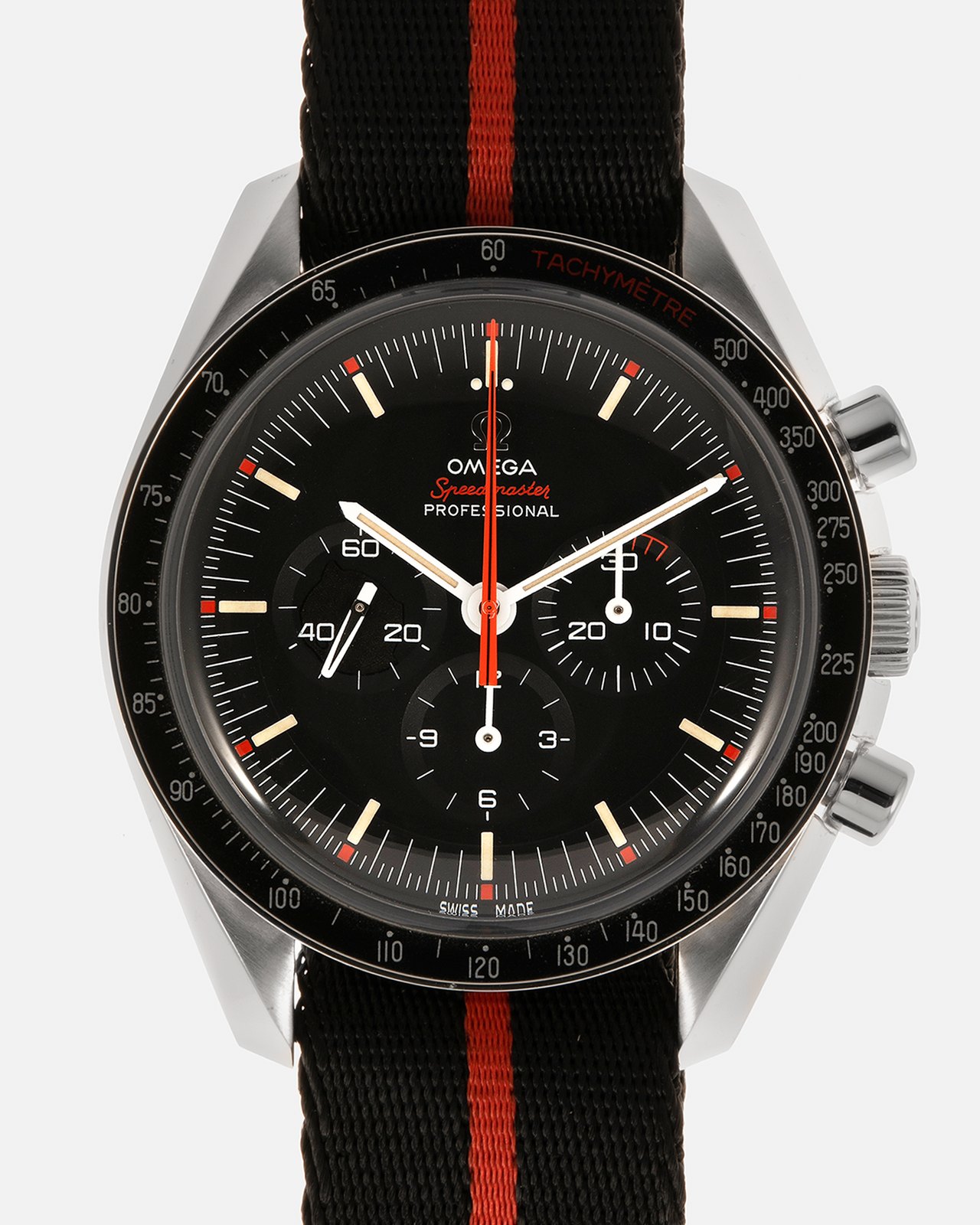
Omega Speedmaster Speedy Tuesday Ultraman, 2018
- Maker / attribution
- Omega (maker)
- Date
- 2018
- Historical period
- Contemporary Horology (2010 – Present)
- Country of origin
- Switzerland
- Object type
- Wristwatch
- Dimensions
- Case 42 mm
- Stock no.
- Product 7346476220503
- Credit line
- Dealer listing, S.Song Watches (product 7346476220503)
- Catalogue title (original)
- Omega Speedmaster Speedy Tuesday Ultraman (English)
View the source record (dealer listing) ↗ (opens another website in a new tab)Suggest a correction
Record summary
Catalogued by S.Song Watches (dealer), Seattle (stock number Product 7346476220503), this is a wristwatch by Omega, made in Switzerland, dated 2018. The Atlas places it in the Contemporary Horology period (2010 – Present) of its Wristwatches collection. Recorded dimensions: Case 42 mm. The record is illustrated with 6 photographs.
Assembled from the source record's structured fields. Dates and attributions are given as the source states them; where a field is missing the Atlas leaves it blank rather than estimating.
Catalogue description
Dealer description — S.Song Watches
While the Omega Speedmaster was originally designed as a racing watch, with its chronograph function and tachymeter scale, this aspect has largely been forgotten over time. Today, the Speedmaster is far more famous for its space exploration ties. Known as the ‘Moonwatch’, the Omega Speedmaster Professional made history by being the first watch flight-qualified by NASA for all manned space missions, and it became the first watch worn on the moon during the Apollo 11 mission in 1969. As a result, the Speedmaster has become a cult icon in the watch collecting world, and it's hard not to see why, as collectors can now buy into such a great story and with a generation that grew up idolising space travel and astronauts, this watch would certainly have to be one of the most important chronographs ever made. Interestingly, the Speedmaster has not only become an icon in real-life space travel but has also permeated into science fiction, with the ‘Ultraman’ Speedmaster being one of the most iconic examples. In the early ’70s, a particular variant of the Speedmaster appeared in the Japanese TV show Return of Ultraman , and collectors quickly took notice. The Speedmasters used in the show were a 1967 transitional model with a bright orange chronograph seconds hand, and as a result, the orange-hand Speedmasters from that era became known as the ‘Ultraman.’ Due to their rarity and transitional nature, these models fetch a significant premium on the market. The Ultraman connection is especially fitting, as science fiction and space travel have always been closely intertwined, and it seems almost destined that the Speedmaster would become associated with space in every possible way. Fast forward to today, one of the most popular hashtags on Instagram for watches is undoubtedly #SpeedyTuesday. Created by the influential watch blog Fratello Watches in 2012, it began as a series of articles, where they featured different variants of the Speedmaster each week. Over the years, the hashtag gained traction on Instagram, and now, every Tuesday, Speedmaster collectors would post their #SpeedyTuesday shots. In fact, the phenomenon became so popular that it caught the attention of Omega, leading to the creation of this: a 2,012-piece limited edition Speedmaster 'Ultraman’, which also marked the second collaboration between Omega and Fratello Watches. The connection here between the two is that, for the second series, the design team drew inspiration from the Ultraman TV series and reimagined it with a modern touch. As expected, the result was another resounding success with the watches selling out quickly upon its release. The watch has a vintage-inspired design, featuring an old-style applied Omega logo on the dial and crown, as well as a ‘dot over 90’ bezel. This detail references pre-1970s Speedmasters, where the dot on the tachymeter scale at 90 was placed above the numerals (vintage collectors, of course, can be very particular about these details). In the show, dedicated Ultraman fans know that due to the lack of sufficient sunlight and the filtering effect of Earth's atmosphere, an ‘Ultra’ can only remain on Earth for about three minutes, a detail marked by the ‘colour timer’ (or ‘warning light’) on their chests. As a nod to this little detail, Omega has highlighted the first three minutes of the minute counter at 3:00 in orange. Additionally, as a tribute to Ultraman, a silhouette of his head is subtly placed in the running seconds sub-dial at 9:00. This silhouette becomes visible only when exposed to UV light, for which Omega conveniently includes a torch as part of the package. Just like all iconic designs, not much has changed with the Speedmaster for over 50 years. While the early Speedmasters had a different case, ever since Omega transitioned into their Speedmaster Professional line, it has consistently sported a black dial with rectangular luminous indexes, stick hour and minute hands with an arrow chronograph seconds hand and a 42mm asymmetrical stainless steel case with a black aluminium tachymeter bezel. Even with this limited edition featuring deep and vibrant orange accents, it is still instantly recognizable. Furthermore, this Speedy Tuesday Ultraman is powered by the venerable Cal. 1861, Omega’s in-house, manual-winding chronograph movement that is the descendant of the legendary 861 movements used in Speedmasters since 1969.
Historical context
Contemporary Horology (2010 – Present)
Silicon components, connected watches, optical-lattice research clocks and a thriving independent scene.
Smartwatches became the world's best-selling watches, while mechanical watchmaking focuses on craft, innovation (silicon components, new escapements) and independent makers.
Read the period in the timelineMore wristwatches from this periodEarlier: Mechanical Renaissance
Atlas type guide
Wristwatches
Bracelet watches were worn by women from the early nineteenth century — Breguet made one for Caroline Murat, Queen of Naples, in 1810–12 — but the wristwatch only became a man's instrument with military use and aviation in the early twentieth century. Between the World Wars it overtook the pocket watch; the 1920s and 1930s brought rectangular Art Deco cases, water-resistant cases and the first automatic winding systems.
After 1945 the wristwatch became a carrier of identity — dress watches, sports and dive watches, chronographs, calendars — produced by Swiss, American, Japanese, German, Soviet and Chinese industries. The quartz revolution after 1969 and the mechanical renaissance since the 1990s, including the rise of independent watchmakers, complete the story.
What to look for
- The reference number (between the lugs or inside the case back) and serial number, the starting point for dating.
- The calibre: its maker and number are often stamped under the dial or on the bridge.
- Originality of dial, hands and crown — refinished ('redial') dials are common.
- Case material marks: 18K/750, 14K/585, stainless steel, gold-filled, plated.
Dating clues
- Wire-lug cases: before c. 1925.
- Water-resistant screw-down cases: from 1926.
- Quartz movements: from 1969; sapphire crystals widespread after c. 1980.
General guidance written by the Atlas editors about this kind of object. It is not a statement about this particular piece; for that, rely on the source record above and on physical examination.
Related records

Instruments · 1950–1976
Omega Megaquartz 2400 marine chronometer, 1950–1976
Science Museum Group, London

Instruments · 1960–1979
Stopwatch / timer by Omega, 1960–1979
Science Museum Group, London

Instruments · 1960–1979
Stopwatch / timer by Omega, Switzerland, 1960–1979
Science Museum Group, London

Instruments · 1960–1979
Stopwatch by Omega, Swiss made, single-button type reading 0 - 60 seconds in fifths and 0 - 5 minutes in minutes on subsidiary dial, 1960-79.
Science Museum Group, London

Wristwatches · c. 2010s
Breguet Type XXI, ref. 3810, c. 2010s (Antiquorum Lot 381-24)
Antiquorum auction archive, Geneva

Wristwatches · c. 2010s
Breguet Type XXI, ref. 3810, c. 2010s (Antiquorum Lot 386-229)
Antiquorum auction archive, Geneva

Wristwatches · Sold in September 2010
Breitling Cosmonaute, ref. A 22322, Sold in September 2010
Antiquorum auction archive, Geneva

Wristwatches · c. 2010
Corum Bubble Chrono, ref. 396.150.20, c. 2010
Antiquorum auction archive, Geneva