
Wristwatches · Wristwatch
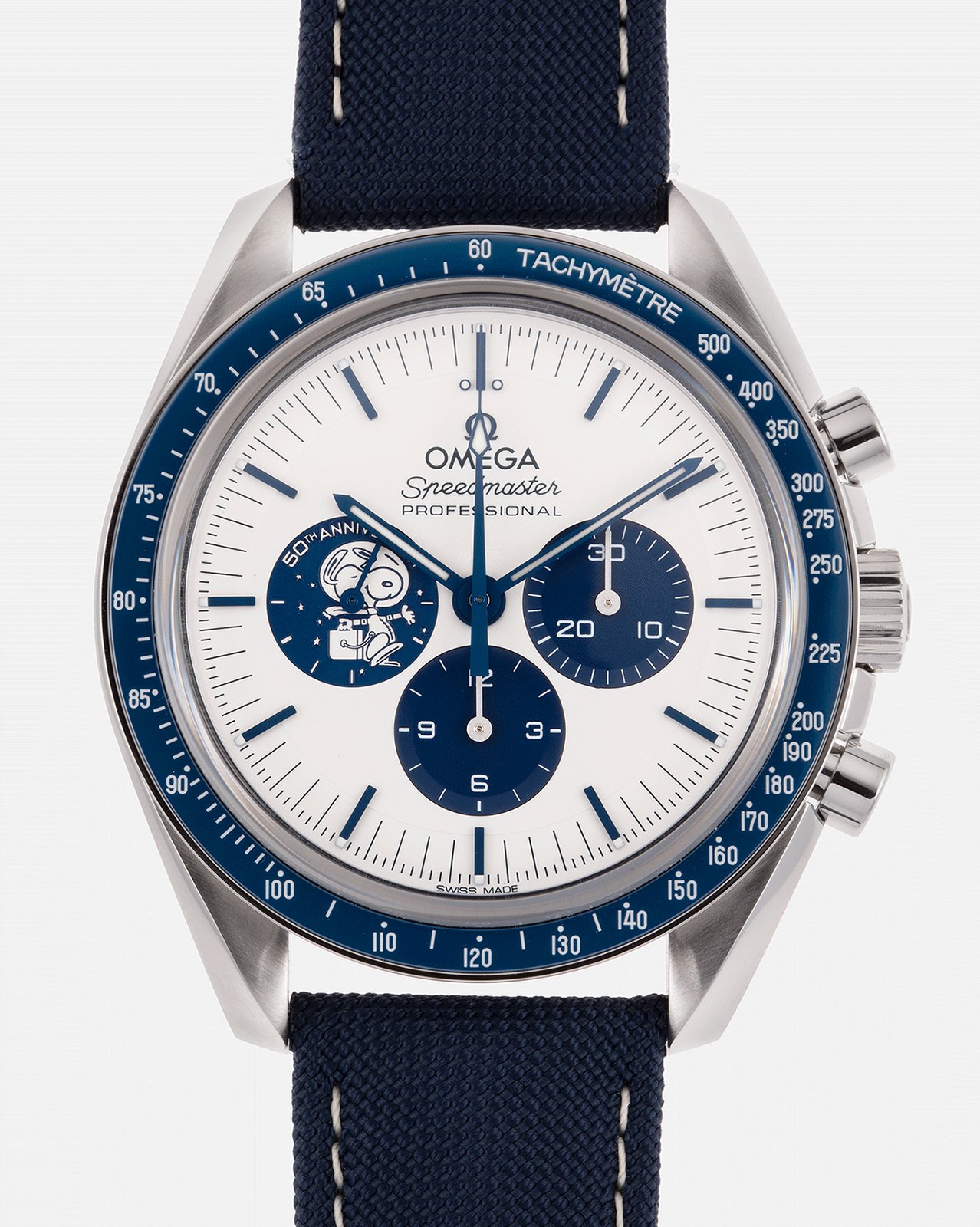
Omega Speedmaster Silver Snoopy Award 50th Anniversary, 2021
- Maker / attribution
- Omega (maker)
- Date
- 2021
- Historical period
- Contemporary Horology (2010 – Present)
- Country of origin
- Switzerland
- Object type
- Wristwatch
- Materials / technique
- silver
- Stock no.
- Product 6562118795351
- Credit line
- Dealer listing, S.Song Watches (product 6562118795351)
- Catalogue title (original)
- Omega Speedmaster Silver Snoopy Award 50th Anniversary (English)
View the source record (dealer listing) ↗ (opens another website in a new tab)Suggest a correction
Record summary
Catalogued by S.Song Watches (dealer), Seattle (stock number Product 6562118795351), this is a wristwatch by Omega, made in Switzerland, dated 2021. The Atlas places it in the Contemporary Horology period (2010 – Present) of its Wristwatches collection. Materials and techniques recorded by the source: silver. The record is illustrated with 6 photographs.
Assembled from the source record's structured fields. Dates and attributions are given as the source states them; where a field is missing the Atlas leaves it blank rather than estimating.
Catalogue description
Dealer description — S.Song Watches
Initially released in 1957 as a race timing tool watch, the Omega Speedmaster is one of the most iconic modern chronograph timepieces ever made- not thanks to what it was made for but instead because of its historically important use in space and on the moon. Three years before the Speedmaster's eventual qualification for spaceflight, numerous brands submitted their best watches to NASA in 1962, including the eventual contract winners - Omega. Following a long list of gruelling tests, the Speedmaster was selected in 1965 to be NASA's standard-issue space-faring timepiece and the rest, as they say, is history. Omega has always had a relationship with space and also with the Snoopy character. While these Snoopy pieces have always been popular, with two iterations before the current example you see, not many know the historical context that underpins these iconic watches. Just two days into the flight of the Apollo 13 mission in 1970, one of the onboard oxygen tanks exploded, forcing the entire crew into the lunar module. Following the explosion, the ship was thrown off course, and the mission was to be abandoned. This meant that a perfectly timed 14-second long engine burn was required to put the ship back into Earth's orbit. Without their digital clocks, the crew relied on Jack Swigert's Omega Speedmaster to time the burn, ultimately proving successful and resulting in Omega being awarded the Silver Snoopy Award for ensuring the mission was saved. With Snoopy being a longtime mascot for NASA, the Silver Snoopy Award is a special honour given to individuals in and associated with NASA for outstanding achievements in space flight. Paying homage to the illustrious award with Snoopy in its 9 o'clock subdial, the 50th Anniversary Snoopy Speedmaster is perhaps the most distinctive of the three-anniversary models. With a dial made of silver, in reference to the Snoopy award, the hands and indices create a stark contrast to the dial thanks to their intense blue PVD coating. Continuing with this blue and silver theme, the subdials, bezel and nylon fabric are also the same blue colour as the hands and indices. While the watch looks stunning from the front, the real surprise comes when you flip the watch over. It features a depiction of the Moon, Earth, and a white Command and Service Module (CSM) with Snoopy riding along inside. With Snoopy's CSM moving across the case back when the chronograph is engaged, Omega's innovative attention to detail is refreshing. Travelling around the far side of the Moon, Omega makes a direct reference to the trip the Apollo 13 astronauts were forced to take all those years ago. In addition to this, the Earth itself spins once per minute as it is connected to the seconds hand subdial, providing a nice subtle visual touch. Powered by the modern moon watch movement, the manual-wind cal. 3861, this timepiece comes housed in an incredible Apollo 13 presentation box. A slimmed-down version of the large Moonwatch box, it features a Snoopy patch on top and an image of Snoopy on his dog house within. Supplied with a loupe, a pouch, and a soft cloth, this is as full a set as a timepiece can be. Today, while the Silver Snoopy Award 50th Anniversary Speedmaster is not a limited edition, it is produced in extremely low numbers that rival the Rolex Daytona and is perhaps the most in-demand piece from Omega today. Only existing clients with a sizeable previous purchase are entitled to be allocated a piece.
Historical context
Contemporary Horology (2010 – Present)
Silicon components, connected watches, optical-lattice research clocks and a thriving independent scene.
Smartwatches became the world's best-selling watches, while mechanical watchmaking focuses on craft, innovation (silicon components, new escapements) and independent makers.
Read the period in the timelineMore wristwatches from this periodEarlier: Mechanical Renaissance
Atlas type guide
Wristwatches
Bracelet watches were worn by women from the early nineteenth century — Breguet made one for Caroline Murat, Queen of Naples, in 1810–12 — but the wristwatch only became a man's instrument with military use and aviation in the early twentieth century. Between the World Wars it overtook the pocket watch; the 1920s and 1930s brought rectangular Art Deco cases, water-resistant cases and the first automatic winding systems.
After 1945 the wristwatch became a carrier of identity — dress watches, sports and dive watches, chronographs, calendars — produced by Swiss, American, Japanese, German, Soviet and Chinese industries. The quartz revolution after 1969 and the mechanical renaissance since the 1990s, including the rise of independent watchmakers, complete the story.
What to look for
- The reference number (between the lugs or inside the case back) and serial number, the starting point for dating.
- The calibre: its maker and number are often stamped under the dial or on the bridge.
- Originality of dial, hands and crown — refinished ('redial') dials are common.
- Case material marks: 18K/750, 14K/585, stainless steel, gold-filled, plated.
Dating clues
- Wire-lug cases: before c. 1925.
- Water-resistant screw-down cases: from 1926.
- Quartz movements: from 1969; sapphire crystals widespread after c. 1980.
General guidance written by the Atlas editors about this kind of object. It is not a statement about this particular piece; for that, rely on the source record above and on physical examination.
Related records

Instruments · 1950–1976
Omega Megaquartz 2400 marine chronometer, 1950–1976
Science Museum Group, London

Instruments · 1960–1979
Stopwatch / timer by Omega, 1960–1979
Science Museum Group, London

Instruments · 1960–1979
Stopwatch / timer by Omega, Switzerland, 1960–1979
Science Museum Group, London

Instruments · 1960–1979
Stopwatch by Omega, Swiss made, single-button type reading 0 - 60 seconds in fifths and 0 - 5 minutes in minutes on subsidiary dial, 1960-79.
Science Museum Group, London

Wristwatches · c. 2010s
Breguet Type XXI, ref. 3810, c. 2010s (Antiquorum Lot 381-24)
Antiquorum auction archive, Geneva

Wristwatches · c. 2010s
Breguet Type XXI, ref. 3810, c. 2010s (Antiquorum Lot 386-229)
Antiquorum auction archive, Geneva

Wristwatches · Sold in September 2010
Breitling Cosmonaute, ref. A 22322, Sold in September 2010
Antiquorum auction archive, Geneva

Wristwatches · c. 2010
Corum Bubble Chrono, ref. 396.150.20, c. 2010
Antiquorum auction archive, Geneva