
Wristwatches · Wristwatch
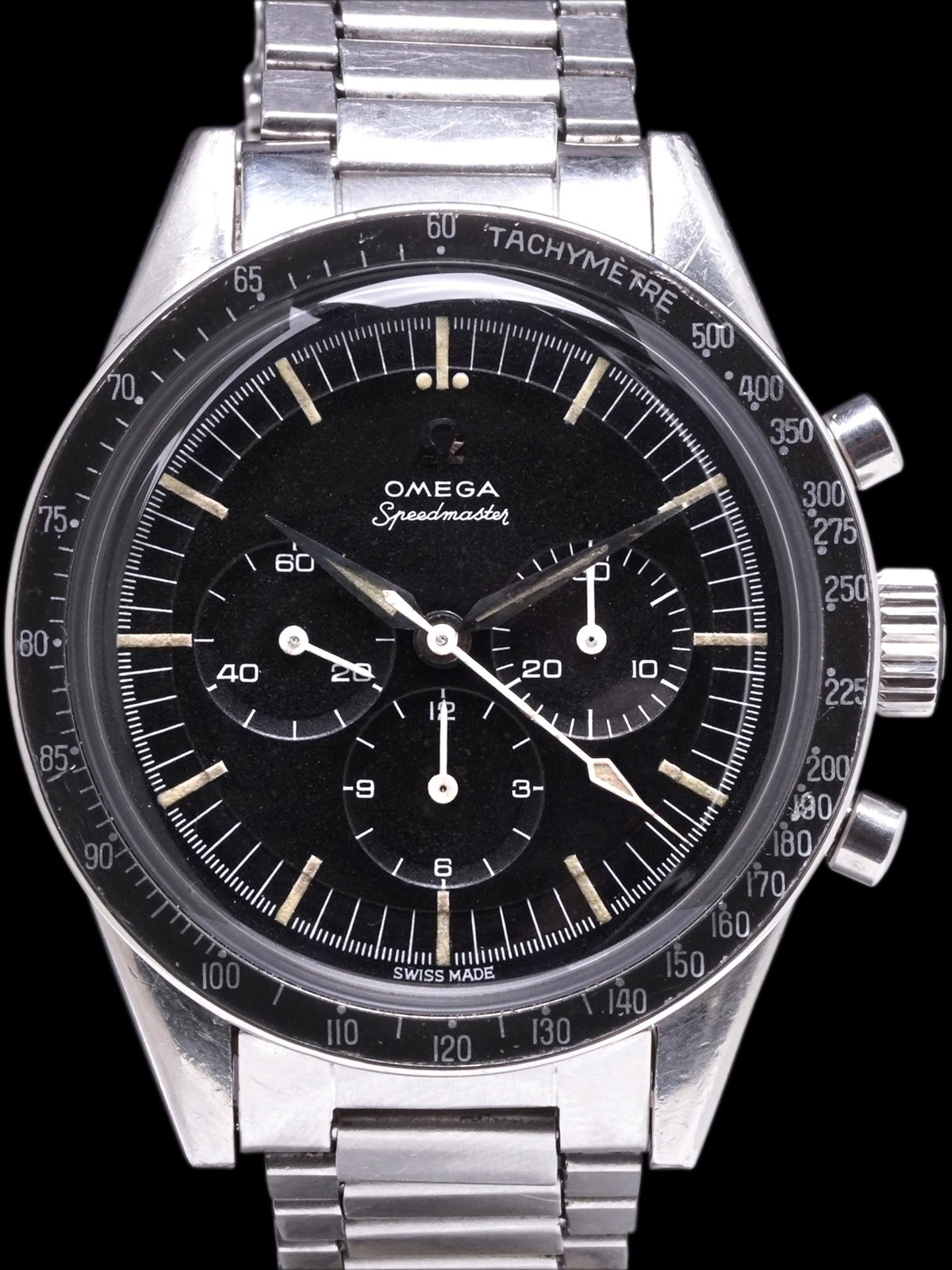
Omega Speedmaster (Ref. CK2998-61) Cal. 321 W/ Military Provenance & Letter From The Original Owner, 1962
- Maker / attribution
- Omega (maker)
- Date
- 1962
- Historical period
- Modern Mechanical Horology (1945 – 1969)
- Country of origin
- Switzerland
- Object type
- Wristwatch
- Stock no.
- OMSPMCK299861
- Credit line
- Dealer listing, Craft & Tailored (OMSPMCK299861)
- Catalogue title (original)
- 1962 OMEGA Speedmaster (Ref. CK2998-61) Cal. 321 W/ Military Provenance & Letter From The Original Owner (English)
View the source record (dealer listing) ↗ (opens another website in a new tab)Suggest a correction
Record summary
Catalogued by Craft & Tailored (dealer), Los Angeles (stock number OMSPMCK299861), this is a wristwatch by Omega, made in Switzerland, dated 1962. The Atlas places it in the Modern Mechanical Horology period (1945 – 1969) of its Wristwatches collection. The record is illustrated with 6 photographs.
Assembled from the source record's structured fields. Dates and attributions are given as the source states them; where a field is missing the Atlas leaves it blank rather than estimating.
Catalogue description
Dealer description — Craft & Tailored
The Speedmaster is, and always will be, an icon. Not only within the world of watches, but in culture as well. Before the famous Speedmaster Professional ref. 145.022 made it onto the Moon via the Apollo 11 missions, several other Speemasters saw their own notoriety whether it was on the arm of another astronaut, a formula 1 driver, or on the wrist of a Naval flight navigator Lieutenant. The watch presented here is the latter. This Speedmaster ref. CK2998-61 is an impressive watch in its own right, being the last of the alluring CK series of the Speedmasters, and retains all of its original and charming components. Aside from being a very original watch, this Speedmaster accompanied Lt. Ralph O. Snyder of the U.S. Navy, during the Vietnam War. Impressively Lt. Snyder was a Naval Flight Navigator operating within the Heavy Photo-Reconnaissance Squadron 61, or VAP-61 based out of the Naval Air Station in Agana, Guam. This Omega Speedmaster ref. CK2998-61 was truly used as a military instrument. Being that GPS did not exist yet, Naval navigators utilized celestial navigation to maintain and track their intended course, and of course, an accurate timekeeping tool was absolutely necessary, and this specific Speedmaster was Lt. Snyder’s timekeeping tool of choice. And according to Lt. Snyder, this Omega served him very well during many long day and night flights over the Pacific Ocean and Vietnam. SPECS Stock # OMSPMCK299861 Brand Omega Style Speedmaster Model CK2998-61 Serial 189XXXXX Size Men's Material SS Dial Matte Black "Pie-Pan" Applied Logo Millimeters 38.5 Bracelet Original Omega 7915 Flat-Link Stretch Bracelet W/ 6 End Pieces CASE & BRACELET The straight lug case has been lightly polished in the past and shows honest signs of use, the lug chamfers retain a soft presence, though this is very common for this case design and the lugs remain very full and symmetrical. The original "dot over 90" bezel has achieved a beautiful grey coloration and displays very subtle signs of use. The case retains its original "flat-foot" Omega crown and original pump pushers. The case back retains its original factory engraving of the hippocampus and "Speedmaster" text in very crisp and visible condition. The original Omega 7915 flat-link stretch bracelet with 6 end pieces is in excellent condition for its age and retains 24 links. DIAL & HANDS The original matte black "Swiss Made" step dial with an applied Omega logo is exceptionally well preserved, showing almost no signs of aging and absolutely no blemishes. The early tritium lume plots have age to a handsome golden patina and exhibit no degradation when inspected under U.V. light. The original alpha hour and minute hands, and center chronograph hand have aged a few shades darker than the hands and exhibit no degradation under U.V. light inspection. The sub-dial hands remain original as well. ACCESSORIES
Historical context
Modern Mechanical Horology (1945 – 1969)
Tool watches for divers, pilots and astronauts; electric watches anticipate the electronic age.
The classic era of the mechanical wristwatch: dive watches, chronographs for motor racing and space flight, GMT watches for jet travel, slim dress watches, automatic calendars, and the rise of Japanese manufacturers alongside Swiss, American, German and Soviet industries.
Read the period in the timelineMore wristwatches from this periodEarlier: Golden Age of Mechanical Watchmaking
Atlas type guide
Military, pilot and travel watches
The wristwatch owes much of its adoption by men to warfare and aviation. Wristlets — small pocket watches soldered with lugs and worn on a strap — were used in colonial campaigns and became standard equipment in the First World War, with protective grilles over the crystal ('shrapnel guards'). Louis Cartier's Santos (1904), designed for the aviator Alberto Santos-Dumont, is often cited as an early purpose-made pilot's watch.
In the Second World War governments specified watches in detail: the German B-Uhr observation watches, the American A-11, and the British 'W.W.W.' (the 'Dirty Dozen' set of 1945). After the war, jet travel brought GMT and world-time watches, which show two or more time zones at once — Louis Cottier's world-time mechanism and the Rolex GMT-Master (1955) are examples.
What to look for
- Military markings on the case back: broad arrow, issue numbers, 'W.W.W.', 'A.T.P.'
- High-legibility black dials with luminous Arabic numerals; oversized crowns for gloved hands.
- 24-hour hands and rotating 24-hour bezels or city rings on GMT/world-time watches.
- Wire lugs on early wristlets converted from pocket watches.
Dating clues
- Wire-lug wristlets: c. 1900–1925.
- Military specifications of the Second World War: 1939–1945.
- GMT and world-time wristwatches: mainly after 1950.
General guidance written by the Atlas editors about this kind of object. It is not a statement about this particular piece; for that, rely on the source record above and on physical examination.
Related records

Instruments · 1950–1976
Omega Megaquartz 2400 marine chronometer, 1950–1976
Science Museum Group, London

Instruments · 1960–1979
Stopwatch / timer by Omega, 1960–1979
Science Museum Group, London

Instruments · 1960–1979
Stopwatch / timer by Omega, Switzerland, 1960–1979
Science Museum Group, London

Instruments · 1960–1979
Stopwatch by Omega, Swiss made, single-button type reading 0 - 60 seconds in fifths and 0 - 5 minutes in minutes on subsidiary dial, 1960-79.
Science Museum Group, London

Wristwatches · 1945
Wristwatch by Eterna, 1945
Museum Rotterdam

Wristwatches · c. 1945
Breitling Premier, ref. 790, c. 1945
Antiquorum auction archive, Geneva

Wristwatches · c. 1945
Universal Genève Uni-Compax, ref. 22492, c. 1945
Antiquorum auction archive, Geneva

Wristwatches · c. 1950s
Baume & Mercier wristwatch, c. 1950s
Antiquorum auction archive, Geneva