
Wristwatches · Wristwatch
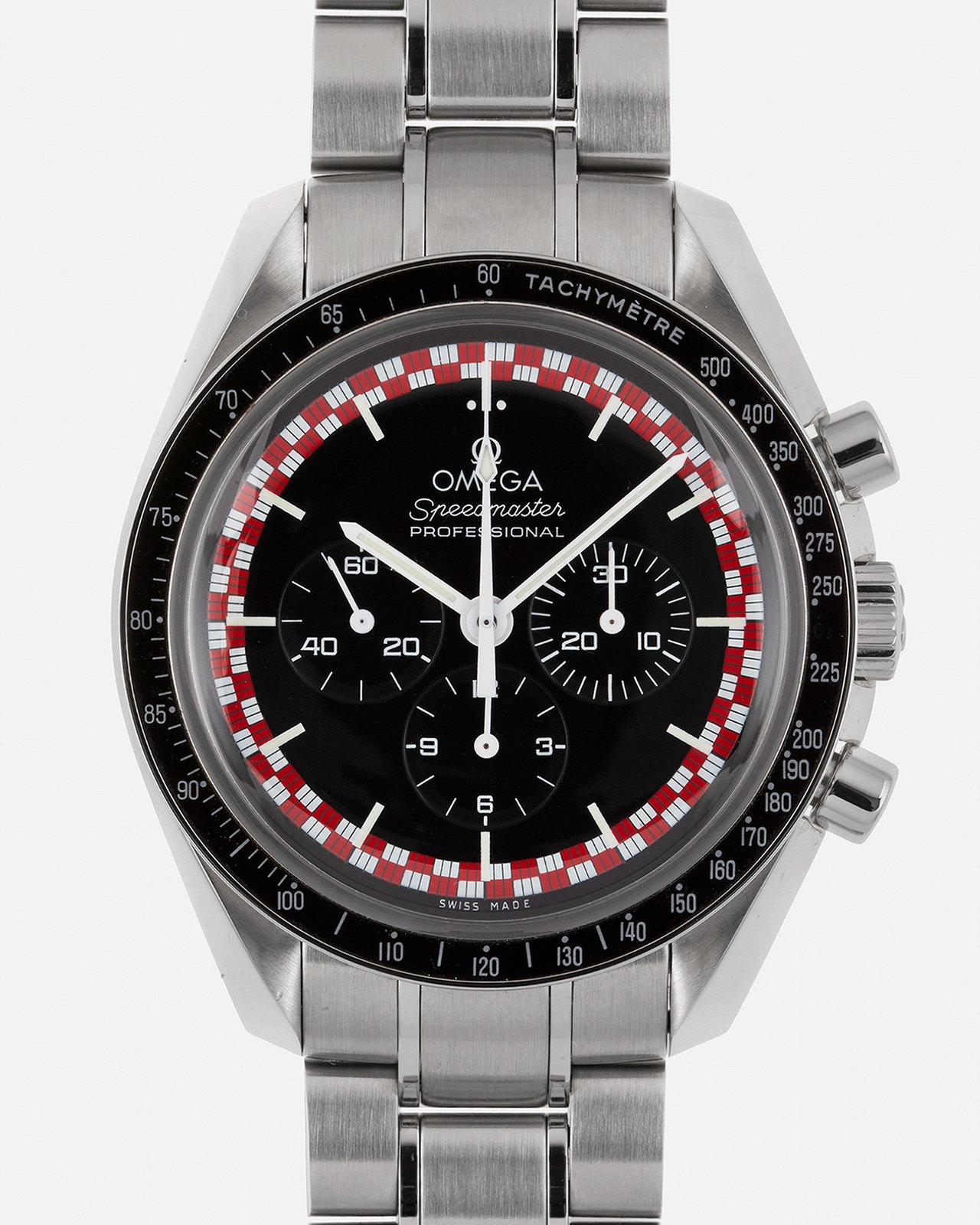
Omega Speedmaster Racing 'Tin Tin', 2017
- Maker / attribution
- Omega (maker)
- Date
- 2017
- Historical period
- Contemporary Horology (2010 – Present)
- Country of origin
- Switzerland
- Object type
- Wristwatch
- Stock no.
- Product 6554988118103
- Credit line
- Dealer listing, S.Song Watches (product 6554988118103)
- Catalogue title (original)
- Omega Speedmaster Racing 'Tin Tin' (English)
View the source record (dealer listing) ↗ (opens another website in a new tab)Suggest a correction
Record summary
Catalogued by S.Song Watches (dealer), Seattle (stock number Product 6554988118103), this is a wristwatch by Omega, made in Switzerland, dated 2017. The Atlas places it in the Contemporary Horology period (2010 – Present) of its Wristwatches collection. The record is illustrated with 6 photographs.
Assembled from the source record's structured fields. Dates and attributions are given as the source states them; where a field is missing the Atlas leaves it blank rather than estimating.
Catalogue description
Dealer description — S.Song Watches
While the Omega Speedmaster was created as a racing watch, with its chronograph function and tachymeter scale, today this has long been forgotten and instead has become more famous for its exploits in space. Known as the ‘Moonwatch’, the Omega Speedmaster Professional made history by being flight-qualified by NASA for all manned space flights and becoming the first watch worn on the moon when it was on the wrists of astronauts during the Apollo 11 mission in 1969. As a result, the Speedmaster has become a cult icon, and its hard not to see why. Collectors can buy into such a great story and with a generation that grew up idolising space travel and astronauts, this watch would certainly have to be one of the most important wristwatches ever made. Many will know that Omega has released a lot of limited Speedmasters over the years, but of all, the most unusual would have to be the Speedmaster Racing Ref. 311.30.42.30.01.004, or as it is more commonly known, the ‘Tin Tin’. First released in 2013, this watch created confusion and was largely panned as Omega ‘losing’ its way, with many accusing the brand of milking the Speedmaster name with yet another variation. As it was never officially marketed as a commemoration of ‘Tin Tin’, the general public just saw it as a red and white Speedmaster dial, with nothing else changed. What they didn't know, was that there was a very interesting story that makes this watch so particular and in my opinon, collectible. The story was uncovered by the good guys at Fratello Watches, where they figured out that this Omega ‘Racing’ Speedmaster was actually supposed to be an official collaboration with Hergé the owners of Tin Tin. The red and white colours you see on the dial are representative of the similarly coloured rocket ship that Tin Tin used in the comic strips to land on the moon. Working together, Omega actually created this dial with a rocket ship on the subdial and a special caseback but towards the tail end, Hergé decided to pull out, leaving Omega with all of these dials. While this may sound far fetched, Robert-Jan Broer, who is the founder of Fratello Watches and an authority of Speedmaster, has actually seen the prototype watch at Omega in Biel, but due to legal reasons, it is not allowed to be shown to the public (for now, I think). Now with Omega left with all of these dials, they nevertheless proceeded to make a red and white Speedmaster, omitting the ‘Tin Tin’ name. The story really tallies up as when this was introduced, there was no publicity to it and it was quietly pulled a year or so lately without anyone really noticing. While this wasn’t strictly a limited edition, it is estimated that 1000-2000 pieces were produced, making it in line with what an Omega limited would be. Aesthetically, it is a beautiful watch. The red and white checks are actually painted on and you can see a very nice depth and texture from this. Stories like this can only happen out of mistakes and this aberration in Omega’s production makes the Omega Speedmaster Tin Tin a highly collectible piece and a great investment.
Historical context
Contemporary Horology (2010 – Present)
Silicon components, connected watches, optical-lattice research clocks and a thriving independent scene.
Smartwatches became the world's best-selling watches, while mechanical watchmaking focuses on craft, innovation (silicon components, new escapements) and independent makers.
Read the period in the timelineMore wristwatches from this periodEarlier: Mechanical Renaissance
Atlas type guide
Wristwatches
Bracelet watches were worn by women from the early nineteenth century — Breguet made one for Caroline Murat, Queen of Naples, in 1810–12 — but the wristwatch only became a man's instrument with military use and aviation in the early twentieth century. Between the World Wars it overtook the pocket watch; the 1920s and 1930s brought rectangular Art Deco cases, water-resistant cases and the first automatic winding systems.
After 1945 the wristwatch became a carrier of identity — dress watches, sports and dive watches, chronographs, calendars — produced by Swiss, American, Japanese, German, Soviet and Chinese industries. The quartz revolution after 1969 and the mechanical renaissance since the 1990s, including the rise of independent watchmakers, complete the story.
What to look for
- The reference number (between the lugs or inside the case back) and serial number, the starting point for dating.
- The calibre: its maker and number are often stamped under the dial or on the bridge.
- Originality of dial, hands and crown — refinished ('redial') dials are common.
- Case material marks: 18K/750, 14K/585, stainless steel, gold-filled, plated.
Dating clues
- Wire-lug cases: before c. 1925.
- Water-resistant screw-down cases: from 1926.
- Quartz movements: from 1969; sapphire crystals widespread after c. 1980.
General guidance written by the Atlas editors about this kind of object. It is not a statement about this particular piece; for that, rely on the source record above and on physical examination.
Related records

Instruments · 1950–1976
Omega Megaquartz 2400 marine chronometer, 1950–1976
Science Museum Group, London

Instruments · 1960–1979
Stopwatch / timer by Omega, 1960–1979
Science Museum Group, London

Instruments · 1960–1979
Stopwatch / timer by Omega, Switzerland, 1960–1979
Science Museum Group, London

Instruments · 1960–1979
Stopwatch by Omega, Swiss made, single-button type reading 0 - 60 seconds in fifths and 0 - 5 minutes in minutes on subsidiary dial, 1960-79.
Science Museum Group, London

Wristwatches · c. 2010s
Breguet Type XXI, ref. 3810, c. 2010s (Antiquorum Lot 381-24)
Antiquorum auction archive, Geneva

Wristwatches · c. 2010s
Breguet Type XXI, ref. 3810, c. 2010s (Antiquorum Lot 386-229)
Antiquorum auction archive, Geneva

Wristwatches · Sold in September 2010
Breitling Cosmonaute, ref. A 22322, Sold in September 2010
Antiquorum auction archive, Geneva

Wristwatches · c. 2010
Corum Bubble Chrono, ref. 396.150.20, c. 2010
Antiquorum auction archive, Geneva