
Wristwatches · Wristwatch
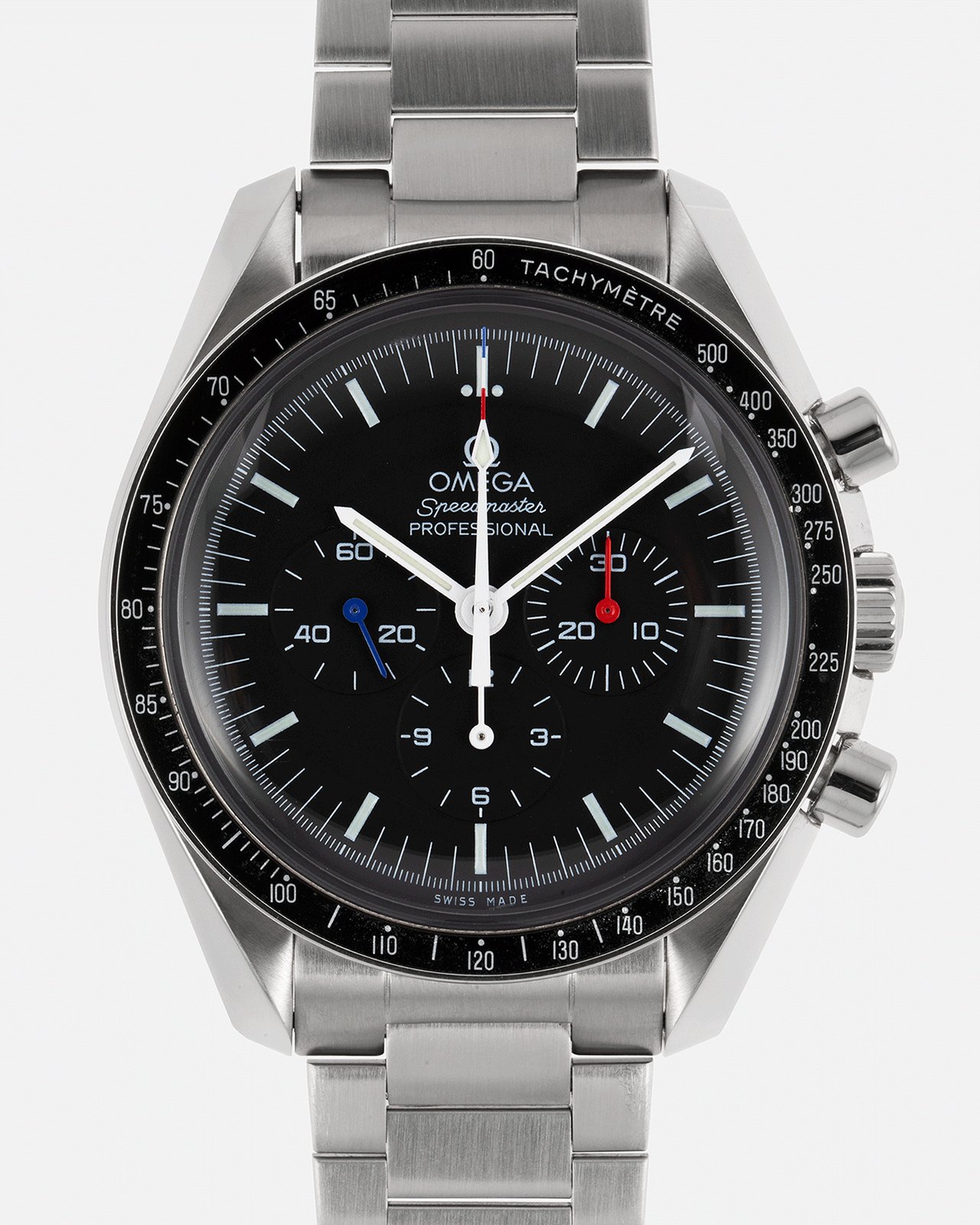
Omega Speedmaster Professional RAID, 2017
- Maker / attribution
- Omega (maker)
- Date
- 2017
- Historical period
- Contemporary Horology (2010 – Present)
- Country of origin
- Switzerland
- Object type
- Wristwatch
- Stock no.
- Product 6634598400087
- Credit line
- Dealer listing, S.Song Watches (product 6634598400087)
- Catalogue title (original)
- Omega Speedmaster Professional RAID (English)
View the source record (dealer listing) ↗ (opens another website in a new tab)Suggest a correction
Record summary
Catalogued by S.Song Watches (dealer), Seattle (stock number Product 6634598400087), this is a wristwatch by Omega, made in Switzerland, dated 2017. The Atlas places it in the Contemporary Horology period (2010 – Present) of its Wristwatches collection. The record is illustrated with 6 photographs.
Assembled from the source record's structured fields. Dates and attributions are given as the source states them; where a field is missing the Atlas leaves it blank rather than estimating.
Catalogue description
Dealer description — S.Song Watches
Best known for iconic tool watches like the Seamaster, Railmaster, and Speedmaster, Omega has earned their plaudits as a watchmaker focused on developing tough watches that can take a beating and operate in exceptional environments. Perhaps pushing that notion to the extreme, the Omega Speedmaster RAID is a privately-offered variant of the iconic Speedmaster designed for an elite tactical unit of the French police called the "Research, Assistance, Intervention, Deterrence," or "RAID" for short. Founded in 1985, the RAID unit is perhaps one of the most formidable tactical policing units in the world, with just 450 highly trained members. Beginning life as an idea thought up by famed French watch collector, dealer, and distributor Antoine de Macedo after he befriended members of RAID and was gifted one of the unit's medallions, Antoine then approached Omega to create a limited-edition timepiece that featured the RAID medallion as its caseback, and in 2017 the watch was born. With the inscription "SERVIR SANS FAILLIR" (to serve unfailingly) further linking the watch to the elite unit, each of the 250 pieces produced is numbered and uses the unit's emblem to denote its remarkable story. Never publicly offered, these 250 watches are exceptionally rare due to the fact they were offered to members of the RAID unit only. Designed with the intention of being an understated watch, much like how the unit themselves must operate on missions, the watch retains much of the Speedmaster's conventional external design, except for its subdial hands and chronograph hand. Coloured blue, white and red, as they appear on the dial, the subdial hands recall the French flag, as once again referenced by the timepiece's central chronograph hand, with a French flag blue white, and red tip. Featuring a unique RAID-customised box, the watch comes with the same RAID medallion that inspired its caseback and two NATO straps. One is a stealthy black, and the other follows the French flag convention that finds itself on the handset of the watch. Powered by the iconic cal. 1861, this manually wound timepiece retains its original design and aesthetic while celebrating the brave service people within RAID. A unique watch with an intriguing story as far as its origin is concerned, the Speedmaster RAID is a watch that deviates from Omega's usual formula for creating limited edition timepieces which is just another reason to love it for its unconventional history.
Historical context
Contemporary Horology (2010 – Present)
Silicon components, connected watches, optical-lattice research clocks and a thriving independent scene.
Smartwatches became the world's best-selling watches, while mechanical watchmaking focuses on craft, innovation (silicon components, new escapements) and independent makers.
Read the period in the timelineMore wristwatches from this periodEarlier: Mechanical Renaissance
Atlas type guide
Wristwatches
Bracelet watches were worn by women from the early nineteenth century — Breguet made one for Caroline Murat, Queen of Naples, in 1810–12 — but the wristwatch only became a man's instrument with military use and aviation in the early twentieth century. Between the World Wars it overtook the pocket watch; the 1920s and 1930s brought rectangular Art Deco cases, water-resistant cases and the first automatic winding systems.
After 1945 the wristwatch became a carrier of identity — dress watches, sports and dive watches, chronographs, calendars — produced by Swiss, American, Japanese, German, Soviet and Chinese industries. The quartz revolution after 1969 and the mechanical renaissance since the 1990s, including the rise of independent watchmakers, complete the story.
What to look for
- The reference number (between the lugs or inside the case back) and serial number, the starting point for dating.
- The calibre: its maker and number are often stamped under the dial or on the bridge.
- Originality of dial, hands and crown — refinished ('redial') dials are common.
- Case material marks: 18K/750, 14K/585, stainless steel, gold-filled, plated.
Dating clues
- Wire-lug cases: before c. 1925.
- Water-resistant screw-down cases: from 1926.
- Quartz movements: from 1969; sapphire crystals widespread after c. 1980.
General guidance written by the Atlas editors about this kind of object. It is not a statement about this particular piece; for that, rely on the source record above and on physical examination.
Related records

Instruments · 1950–1976
Omega Megaquartz 2400 marine chronometer, 1950–1976
Science Museum Group, London

Instruments · 1960–1979
Stopwatch / timer by Omega, 1960–1979
Science Museum Group, London

Instruments · 1960–1979
Stopwatch / timer by Omega, Switzerland, 1960–1979
Science Museum Group, London

Instruments · 1960–1979
Stopwatch by Omega, Swiss made, single-button type reading 0 - 60 seconds in fifths and 0 - 5 minutes in minutes on subsidiary dial, 1960-79.
Science Museum Group, London

Wristwatches · c. 2010s
Breguet Type XXI, ref. 3810, c. 2010s (Antiquorum Lot 381-24)
Antiquorum auction archive, Geneva

Wristwatches · c. 2010s
Breguet Type XXI, ref. 3810, c. 2010s (Antiquorum Lot 386-229)
Antiquorum auction archive, Geneva

Wristwatches · Sold in September 2010
Breitling Cosmonaute, ref. A 22322, Sold in September 2010
Antiquorum auction archive, Geneva

Wristwatches · c. 2010
Corum Bubble Chrono, ref. 396.150.20, c. 2010
Antiquorum auction archive, Geneva