
Wristwatches · Wristwatch
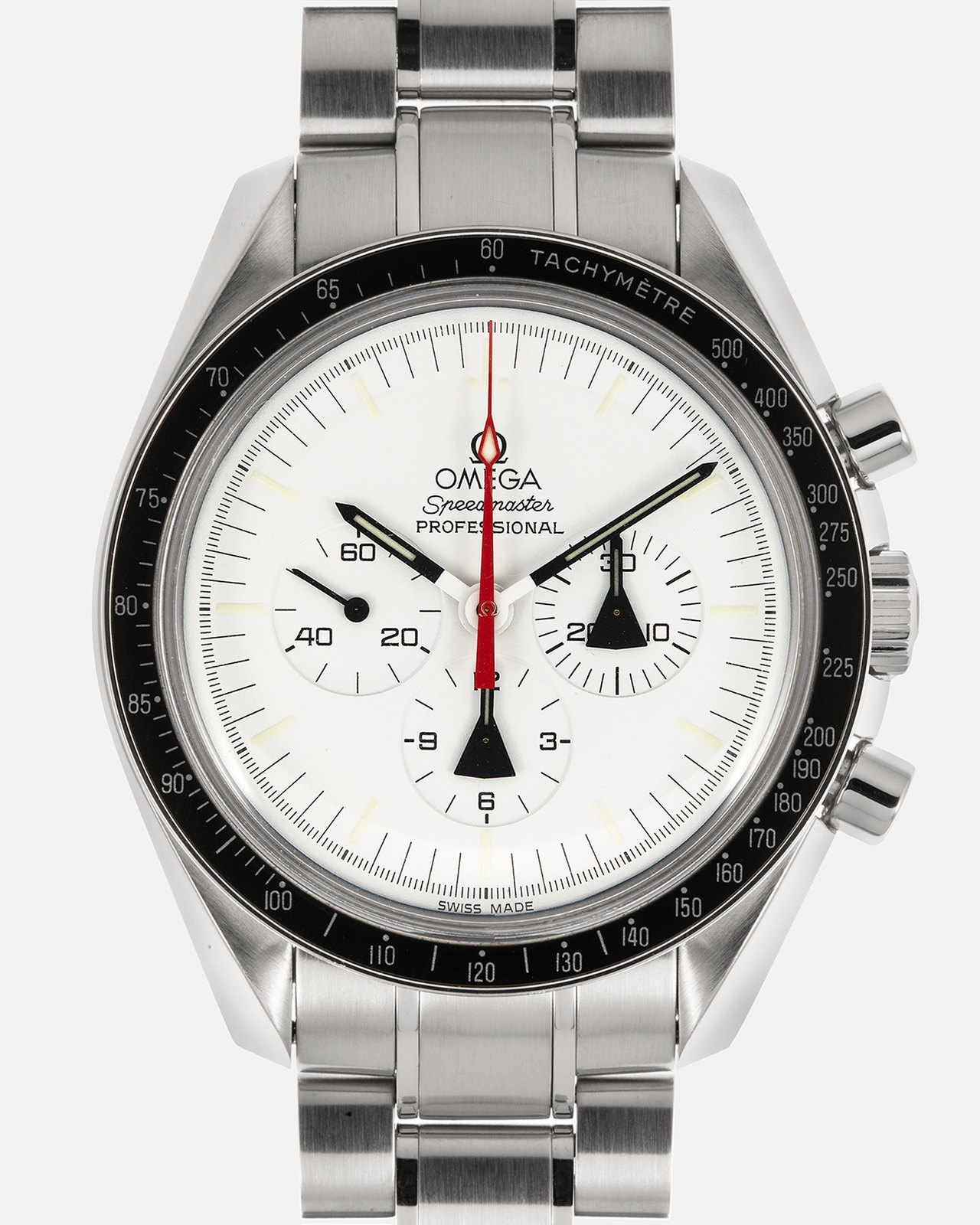
Omega Speedmaster Professional Alaska Project, 2017
- Maker / attribution
- Omega (maker)
- Date
- 2017
- Historical period
- Contemporary Horology (2010 – Present)
- Country of origin
- Switzerland
- Object type
- Wristwatch
- Dimensions
- Case 42 mm
- Stock no.
- Product 7508636270679
- Credit line
- Dealer listing, S.Song Watches (product 7508636270679)
- Catalogue title (original)
- Omega Speedmaster Professional Alaska Project (English)
View the source record (dealer listing) ↗ (opens another website in a new tab)Suggest a correction
Record summary
Catalogued by S.Song Watches (dealer), Seattle (stock number Product 7508636270679), this is a wristwatch by Omega, made in Switzerland, dated 2017. The Atlas places it in the Contemporary Horology period (2010 – Present) of its Wristwatches collection. Recorded dimensions: Case 42 mm. The record is illustrated with 6 photographs.
Assembled from the source record's structured fields. Dates and attributions are given as the source states them; where a field is missing the Atlas leaves it blank rather than estimating.
Catalogue description
Dealer description — S.Song Watches
Of all the watches ever made, few are as instantly recognizable or as thoroughly documented as the Omega Speedmaster. Celebrated for its storied past and its enduring influence on modern watchmaking, the Speedmaster is best known as the first watch worn on the Moon. Its legacy is inseparable from NASA and the history of space exploration; a partnership that led to one of the most fascinating chapters in Omega’s history: the Alaska Project. You see, at the time, although NASA had already chosen the Speedmaster as its official timepiece, Omega’s engineers were determined to take the concept a step further—to design a version built expressly to withstand the rigours of space travel. The original Speedmaster had already proven its mettle, even earning Omega the prestigious Snoopy Award. Yet the Alaska Project took that reliability to new extremes. Developed through intensive experimentation and several prototypes, Omega eventually paid tribute to the Alaska II design in 2008 with a limited-edition run of 1,970 pieces known as the Speedmaster Alaska Project. Visually, the Alaska Project is unmistakable. Its crisp white dial features baton hands for timekeeping and rocket-shaped hands within the recessed chronograph subdials, which is a subtle nod to its extraterrestrial purpose. The most distinctive element, however, is its bright red anodised aluminium “thermal shield,” a removable shroud-like outer case built to protect the watch from extreme temperature fluctuations in space. Beyond safeguarding the hesalite crystal, the thermal cover improves legibility with engraved chronograph markings and enables the watch to function in temperatures ranging from –148°C to 260°C—conditions few mechanical watches could survive. At its core beats Omega’s hand-wound Cal. 1861, the same movement that powers many of the brand’s most famous and beloved Speedmasters. Its 42mm stainless steel case remains faithful to the classic Moonwatch profile, ensuring it wears just as familiar. Ultimately, the Alaska Project captures the spirit and essence of exploration that defines the Speedmaster line: a daring experiment that honours the Moonwatch legacy while technically pushing it further than ever before. Today, it stands as one of the most distinctive and sought-after limited-edition Speedmasters ever produced.
Historical context
Contemporary Horology (2010 – Present)
Silicon components, connected watches, optical-lattice research clocks and a thriving independent scene.
Smartwatches became the world's best-selling watches, while mechanical watchmaking focuses on craft, innovation (silicon components, new escapements) and independent makers.
Read the period in the timelineMore wristwatches from this periodEarlier: Mechanical Renaissance
Atlas type guide
Wristwatches
Bracelet watches were worn by women from the early nineteenth century — Breguet made one for Caroline Murat, Queen of Naples, in 1810–12 — but the wristwatch only became a man's instrument with military use and aviation in the early twentieth century. Between the World Wars it overtook the pocket watch; the 1920s and 1930s brought rectangular Art Deco cases, water-resistant cases and the first automatic winding systems.
After 1945 the wristwatch became a carrier of identity — dress watches, sports and dive watches, chronographs, calendars — produced by Swiss, American, Japanese, German, Soviet and Chinese industries. The quartz revolution after 1969 and the mechanical renaissance since the 1990s, including the rise of independent watchmakers, complete the story.
What to look for
- The reference number (between the lugs or inside the case back) and serial number, the starting point for dating.
- The calibre: its maker and number are often stamped under the dial or on the bridge.
- Originality of dial, hands and crown — refinished ('redial') dials are common.
- Case material marks: 18K/750, 14K/585, stainless steel, gold-filled, plated.
Dating clues
- Wire-lug cases: before c. 1925.
- Water-resistant screw-down cases: from 1926.
- Quartz movements: from 1969; sapphire crystals widespread after c. 1980.
General guidance written by the Atlas editors about this kind of object. It is not a statement about this particular piece; for that, rely on the source record above and on physical examination.
Related records

Instruments · 1950–1976
Omega Megaquartz 2400 marine chronometer, 1950–1976
Science Museum Group, London

Instruments · 1960–1979
Stopwatch / timer by Omega, 1960–1979
Science Museum Group, London

Instruments · 1960–1979
Stopwatch / timer by Omega, Switzerland, 1960–1979
Science Museum Group, London

Instruments · 1960–1979
Stopwatch by Omega, Swiss made, single-button type reading 0 - 60 seconds in fifths and 0 - 5 minutes in minutes on subsidiary dial, 1960-79.
Science Museum Group, London

Wristwatches · c. 2010s
Breguet Type XXI, ref. 3810, c. 2010s (Antiquorum Lot 381-24)
Antiquorum auction archive, Geneva

Wristwatches · c. 2010s
Breguet Type XXI, ref. 3810, c. 2010s (Antiquorum Lot 386-229)
Antiquorum auction archive, Geneva

Wristwatches · Sold in September 2010
Breitling Cosmonaute, ref. A 22322, Sold in September 2010
Antiquorum auction archive, Geneva

Wristwatches · c. 2010
Corum Bubble Chrono, ref. 396.150.20, c. 2010
Antiquorum auction archive, Geneva