
Wristwatches · Wristwatch
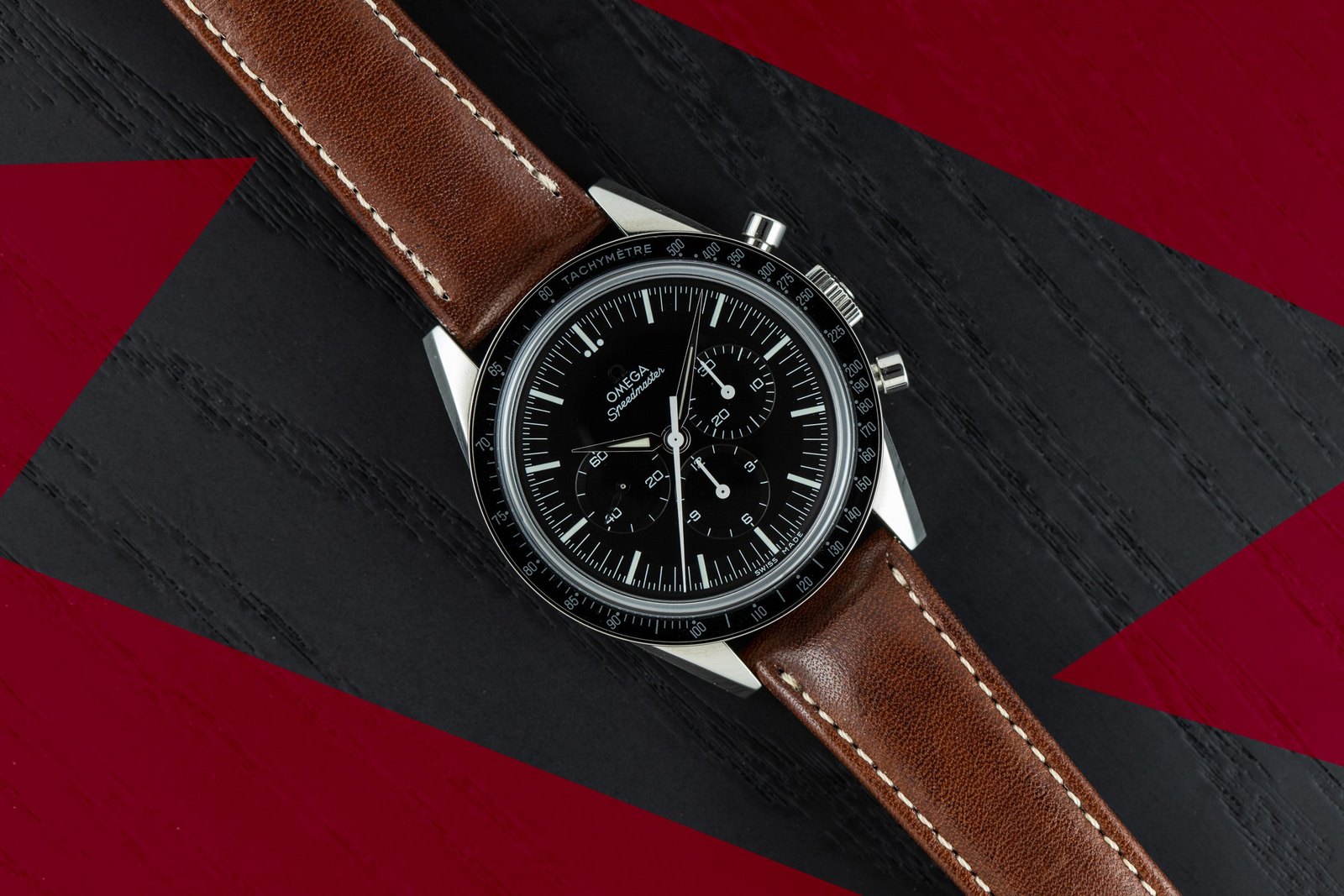
Omega Speedmaster First Omega In Space, 2013
- Maker / attribution
- Omega (maker)
- Date
- 2013
- Historical period
- Contemporary Horology (2010 – Present)
- Country of origin
- Switzerland
- Object type
- Wristwatch
- Dimensions
- Case 39.5 mm
- Stock no.
- 40960019
- Credit line
- Dealer listing, Analog/Shift (40960019)
- Catalogue title (original)
- Omega Speedmaster First Omega In Space (English)
View the source record (dealer listing) ↗ (opens another website in a new tab)Suggest a correction
Record summary
Catalogued by Analog/Shift (dealer), New York (stock number 40960019), this is a wristwatch by Omega, made in Switzerland, dated 2013. The Atlas places it in the Contemporary Horology period (2010 – Present) of its Wristwatches collection. Recorded dimensions: Case 39.5 mm. The record is illustrated with 6 photographs.
Assembled from the source record's structured fields. Dates and attributions are given as the source states them; where a field is missing the Atlas leaves it blank rather than estimating.
Catalogue description
Dealer description — Analog/Shift
Why We Love It On October 3, 1962, Walter M. Schirra orbited the Earth in a Mercury rocket with the call-sign Sigma 7. The mission that Schirra piloted, Mercury Atlas-8, was the fifth manned space mission in the Mercury program. Schirra orbited the Earth a record six times, making his the longest manned spaceflight ever achieved at that stage in the Space Race. This model captures the look and feel of the CK2998, with a 39.5mm straight lug case, reminiscent of its ancestors. Like the CK2998, the logo on the dial of the First Omega in Space is applied, and the hour and minute hands are the "alpha" style that were present in the Speedy until the Reference 105.003 debuted in 1964; likewise, the dial lacks the inscription "Professional," since the CK2998 predates the Speedy's flight qualification by NASA in 1965. The only departures from the original are the crystal, the case back, the bezel, and the movement. The crystal of the First Omega in Space is sapphire, and the case back is adorned by a medallion embossed with the hippocampus seen on Speedmasters until the post-Moon Reference 145.022 was released in 1971. While purists questioned the choice of the Calibre 1861 movement instead of the legendary Caliber .321 used in Schirra's actual Speedmaster, the Caliber 1861 was also flight-qualified by NASA, and is just as venerated in collectors' circles for that fact. The First Omega in Space is a worthy successor to its progenitor, and is a great addition to Omega's limited editions of Speedmaster. This example dates to 2013 and comes complete with its inner and outer boxes, books, and cards. As true to the original as can be without being an exact replica, the First Omega in Space deserves a place in the possession of even the most discerning vintage collectors. The Speedmaster Story "Contact Light." After touching the lander down on the lunar surface, Buzz Aldrin transmitted to Houston control these words, nary more than a whisper, the first communication between human beings not concurrently on the same planet. When Neil Armstrong set foot on the moon for the first time, his Omega Speedmaster was in the module serving as a backup for its electric timer that had malfunctioned. It was Aldrin who, following Armstrong to become the second human to walk on the moon, introduced the Speedmaster to the lunar surface. Today, Omega has become synonymous with the Apollo missions, the moon landing and space exploration in general. The provenance of the brand, driven by the incredible reliability and functionality of the watches that they produced throughout the space era is second to none. But at the heart of the moon missions, at the core of their objective, was the intrinsic human desire to explore, to crest the horizon and, undaunted, step forth into the unknown. NASA approved the Speedmaster for its space missions because it was the best, most accurate timepiece they could find, and testing revealed that it needed no modification in order to remain functional under the duress of space flight. NASA was concerned with accuracy, durability and usability; they didn't care about Omega's history, they needed a tool that could accompany humans on a mission to the moon and help them get back safely. They exposed the Speedmaster to high and low temperatures, blasted it with vibrations, challenged it with g-force extremes and submitted it to high and low pressure. Through it all, the Speedmaster ticked on, proving that it could go where no watch had ever gone before. Today the Omega Speedmaster is often regarded by collectors and enthusiasts to be the single most important wristwatch ever made, if for no other reason than that it accompanied us on mankind’s greatest feat – touching down on and exploring a heavenly body. While most of the Omega Speedmasters in circulation haven’t left Earth’s atmosphere, we can all take a certain amount of pride in knowing that they could – and would continue to perform just as they would down here on the ground. When you stop and think about all that entails, that’s really saying something.
Historical context
Contemporary Horology (2010 – Present)
Silicon components, connected watches, optical-lattice research clocks and a thriving independent scene.
Smartwatches became the world's best-selling watches, while mechanical watchmaking focuses on craft, innovation (silicon components, new escapements) and independent makers.
Read the period in the timelineMore wristwatches from this periodEarlier: Mechanical Renaissance
Atlas type guide
Wristwatches
Bracelet watches were worn by women from the early nineteenth century — Breguet made one for Caroline Murat, Queen of Naples, in 1810–12 — but the wristwatch only became a man's instrument with military use and aviation in the early twentieth century. Between the World Wars it overtook the pocket watch; the 1920s and 1930s brought rectangular Art Deco cases, water-resistant cases and the first automatic winding systems.
After 1945 the wristwatch became a carrier of identity — dress watches, sports and dive watches, chronographs, calendars — produced by Swiss, American, Japanese, German, Soviet and Chinese industries. The quartz revolution after 1969 and the mechanical renaissance since the 1990s, including the rise of independent watchmakers, complete the story.
What to look for
- The reference number (between the lugs or inside the case back) and serial number, the starting point for dating.
- The calibre: its maker and number are often stamped under the dial or on the bridge.
- Originality of dial, hands and crown — refinished ('redial') dials are common.
- Case material marks: 18K/750, 14K/585, stainless steel, gold-filled, plated.
Dating clues
- Wire-lug cases: before c. 1925.
- Water-resistant screw-down cases: from 1926.
- Quartz movements: from 1969; sapphire crystals widespread after c. 1980.
General guidance written by the Atlas editors about this kind of object. It is not a statement about this particular piece; for that, rely on the source record above and on physical examination.
Related records

Instruments · 1950–1976
Omega Megaquartz 2400 marine chronometer, 1950–1976
Science Museum Group, London

Instruments · 1960–1979
Stopwatch / timer by Omega, 1960–1979
Science Museum Group, London

Instruments · 1960–1979
Stopwatch / timer by Omega, Switzerland, 1960–1979
Science Museum Group, London

Instruments · 1960–1979
Stopwatch by Omega, Swiss made, single-button type reading 0 - 60 seconds in fifths and 0 - 5 minutes in minutes on subsidiary dial, 1960-79.
Science Museum Group, London

Wristwatches · c. 2010s
Breguet Type XXI, ref. 3810, c. 2010s (Antiquorum Lot 381-24)
Antiquorum auction archive, Geneva

Wristwatches · c. 2010s
Breguet Type XXI, ref. 3810, c. 2010s (Antiquorum Lot 386-229)
Antiquorum auction archive, Geneva

Wristwatches · Sold in September 2010
Breitling Cosmonaute, ref. A 22322, Sold in September 2010
Antiquorum auction archive, Geneva

Wristwatches · c. 2010
Corum Bubble Chrono, ref. 396.150.20, c. 2010
Antiquorum auction archive, Geneva