
Wristwatches · Wristwatch
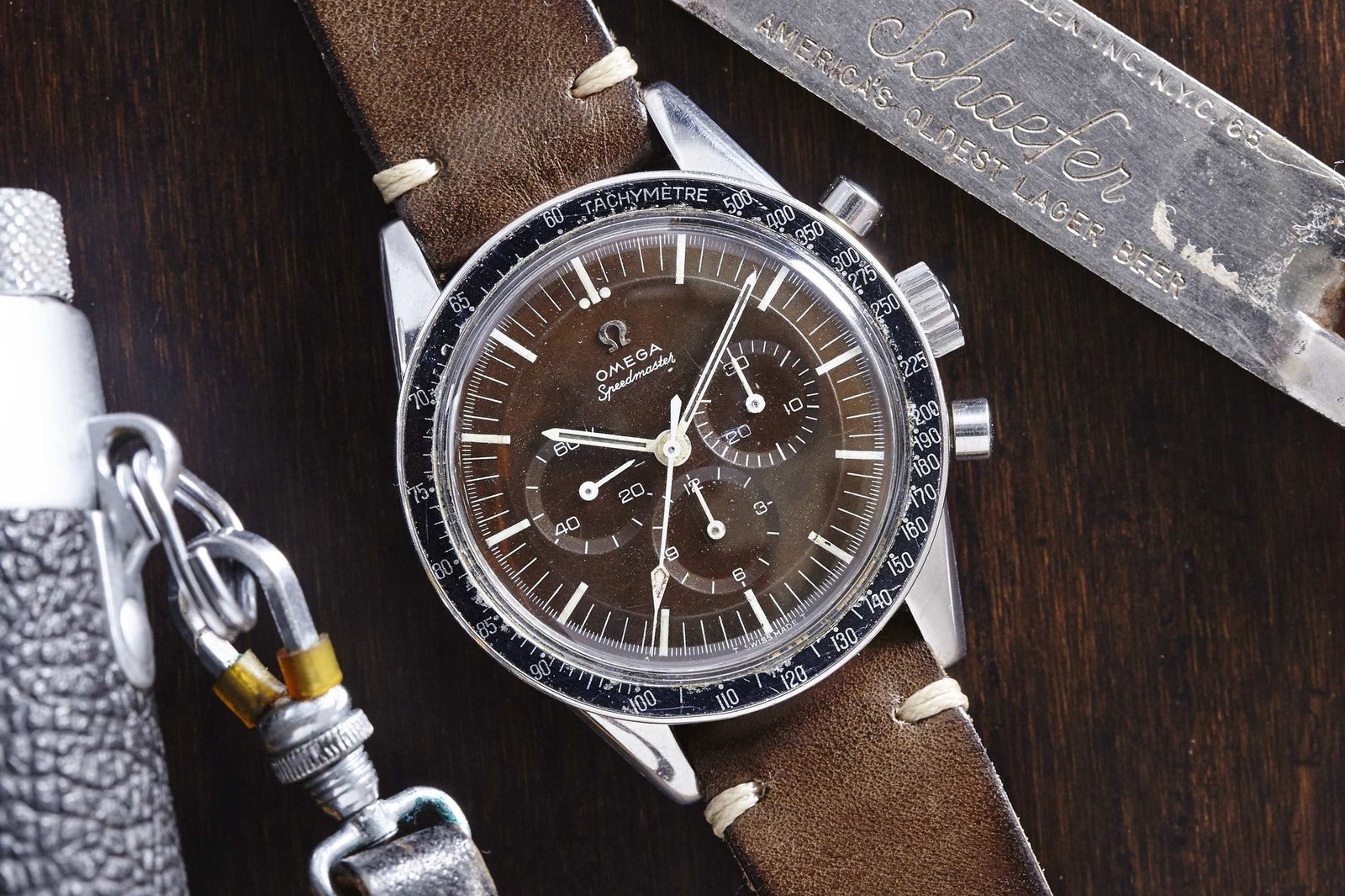
Omega Speedmaster Ed White, c. 1964
- Maker / attribution
- Omega (maker)
- Date
- c. 1964
- Historical period
- Modern Mechanical Horology (1945 – 1969)
- Country of origin
- Switzerland
- Object type
- Wristwatch
- Stock no.
- Product 1683132161
- Credit line
- Dealer listing, Analog/Shift (product 1683132161)
- Catalogue title (original)
- Omega Speedmaster Ed White (English)
View the source record (dealer listing) ↗ (opens another website in a new tab)Suggest a correction
Record summary
Catalogued by Analog/Shift (dealer), New York (stock number Product 1683132161), this is a wristwatch by Omega, made in Switzerland, dated c. 1964. The Atlas places it in the Modern Mechanical Horology period (1945 – 1969) of its Wristwatches collection. The record is illustrated with 6 photographs.
Assembled from the source record's structured fields. Dates and attributions are given as the source states them; where a field is missing the Atlas leaves it blank rather than estimating.
Catalogue description
Dealer description — Analog/Shift
There are Speedmasters, and then there are Speedmasters. This is one of the latter! If you're eyeballing this piece you probably already know that the Omega Speedmaster Professional chronograph is one of the finest and most important timepieces of all time. You already know that it was the first timepiece to be qualified for manned space flight missions by NASA. You already know that the Calibre .321 column wheel chronograph unit is one of the finest manual winding movements of all time. And you already know that it was the first watch worn on the moon - earning it qualification beyond reproach for every terrestrial use you could think of. And you know that since the Eagle landed the Speedmaster Professional has remained virtually unchanged in appearance to this day, making it a timekeeping icon in every sense of the word, and one of the most sought-after timepieces by collectors world wide. But what came before that Professional model? How did Omega cut its teeth and earn its stripes? Well, you're looking at it. Originally born in 1957, the Omega Speedmaster underwent a number of modifications and improvements in its first decade of production, eventually earning its place in the history books and hearts of passionate horologists. A variety of cases, dials, hands, and bezels graced these early limited production models, making them highly collectable artifacts for serious Speedmaster collectors today. One of the most desirable variants is the Reference 105.003 that you see here. Worn by Astronaut Ed White during the first American Space Walk, this early "Pre-Professional" Speedmaster is now referenced by his name amongst collectors. Featuring a straight-lug case with no crown guards, this model has a slimmer, more svelte profile than its progeny. With a pie-pan dial with applied Omega logo and "Speedmaster" only script, this beauty dates to approximately 1964, heralding the end of the "Pre-Pro" era and ushering in the age of a timepiece that would accompany astronauts to a new world. For vintage watch enthusiasts like us, this is the stuff dreams are made of. The importance of early Speedmasters on the collector market cannot be understated. Although models such as the 105.003 command significantly higher values than their 145.012/145.022 descendants, in our opinion they still remain a tremendous value. This watch will be 50 years old in the new year, and has been witness to an age most of us only dream about. This particular piece stands out from the crowd with its absolutely mouth-watering tropical dial - a sure sign of wear and use in the sun over many years! With a clean, honest case, original hands, and a nicely worn (but not beat up) "Dot Over 90" bezel, this Speedmaster definitely has "The Right Stuff" and we don't expect it to last long, so contact us quickly if you're interested! For more information on the Reference 105.003 Speedmaster, check out this great writeup by the Speedy experts over at Fratello, HERE .
Historical context
Modern Mechanical Horology (1945 – 1969)
Tool watches for divers, pilots and astronauts; electric watches anticipate the electronic age.
The classic era of the mechanical wristwatch: dive watches, chronographs for motor racing and space flight, GMT watches for jet travel, slim dress watches, automatic calendars, and the rise of Japanese manufacturers alongside Swiss, American, German and Soviet industries.
Read the period in the timelineMore wristwatches from this periodEarlier: Golden Age of Mechanical Watchmaking
Atlas type guide
Wristwatches
Bracelet watches were worn by women from the early nineteenth century — Breguet made one for Caroline Murat, Queen of Naples, in 1810–12 — but the wristwatch only became a man's instrument with military use and aviation in the early twentieth century. Between the World Wars it overtook the pocket watch; the 1920s and 1930s brought rectangular Art Deco cases, water-resistant cases and the first automatic winding systems.
After 1945 the wristwatch became a carrier of identity — dress watches, sports and dive watches, chronographs, calendars — produced by Swiss, American, Japanese, German, Soviet and Chinese industries. The quartz revolution after 1969 and the mechanical renaissance since the 1990s, including the rise of independent watchmakers, complete the story.
What to look for
- The reference number (between the lugs or inside the case back) and serial number, the starting point for dating.
- The calibre: its maker and number are often stamped under the dial or on the bridge.
- Originality of dial, hands and crown — refinished ('redial') dials are common.
- Case material marks: 18K/750, 14K/585, stainless steel, gold-filled, plated.
Dating clues
- Wire-lug cases: before c. 1925.
- Water-resistant screw-down cases: from 1926.
- Quartz movements: from 1969; sapphire crystals widespread after c. 1980.
General guidance written by the Atlas editors about this kind of object. It is not a statement about this particular piece; for that, rely on the source record above and on physical examination.
Related records

Instruments · 1950–1976
Omega Megaquartz 2400 marine chronometer, 1950–1976
Science Museum Group, London

Instruments · 1960–1979
Stopwatch / timer by Omega, 1960–1979
Science Museum Group, London

Instruments · 1960–1979
Stopwatch / timer by Omega, Switzerland, 1960–1979
Science Museum Group, London

Instruments · 1960–1979
Stopwatch by Omega, Swiss made, single-button type reading 0 - 60 seconds in fifths and 0 - 5 minutes in minutes on subsidiary dial, 1960-79.
Science Museum Group, London

Wristwatches · 1945
Wristwatch by Eterna, 1945
Museum Rotterdam

Wristwatches · c. 1945
Breitling Premier, ref. 790, c. 1945
Antiquorum auction archive, Geneva

Wristwatches · c. 1945
Universal Genève Uni-Compax, ref. 22492, c. 1945
Antiquorum auction archive, Geneva

Wristwatches · c. 1950s
Baume & Mercier wristwatch, c. 1950s
Antiquorum auction archive, Geneva