
Wristwatches · Wristwatch
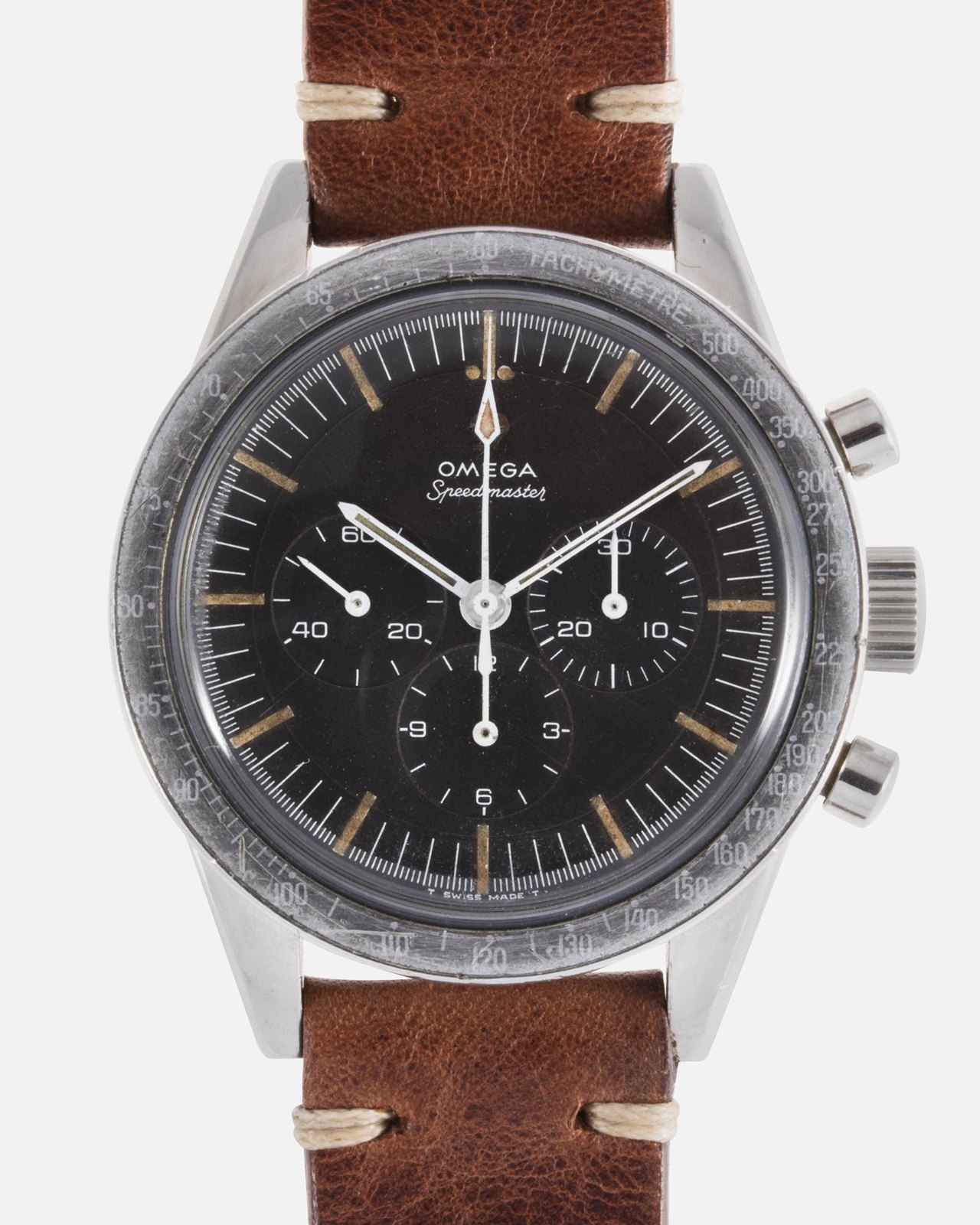
Omega Speedmaster 'Ed White' 105.003 Tropical, 1966
- Maker / attribution
- Omega (maker)
- Date
- 1966
- Historical period
- Modern Mechanical Horology (1945 – 1969)
- Country of origin
- Switzerland
- Object type
- Wristwatch
- Stock no.
- Product 3596328599639
- Credit line
- Dealer listing, S.Song Watches (product 3596328599639)
- Catalogue title (original)
- Omega Speedmaster 'Ed White' 105.003 Tropical (English)
View the source record (dealer listing) ↗ (opens another website in a new tab)Suggest a correction
Record summary
Catalogued by S.Song Watches (dealer), Seattle (stock number Product 3596328599639), this is a wristwatch by Omega, made in Switzerland, dated 1966. The Atlas places it in the Modern Mechanical Horology period (1945 – 1969) of its Wristwatches collection. The record is illustrated with 6 photographs.
Assembled from the source record's structured fields. Dates and attributions are given as the source states them; where a field is missing the Atlas leaves it blank rather than estimating.
Catalogue description
Dealer description — S.Song Watches
If I were to ask a group of watch collectors what just might be the most iconic watch of all time, I guarantee quite a few will say the Omega Speedmaster. While it was initially intended as a wristwatch for racing, the Speedmaster is most famously known as the moon watch. This is because it was selected by NASA as their official watch, worn during the first American spacewalk as part of the Gemini 4 mission and was the first watch worn on the moon during the Apollo 11 mission. The selection process NASA went through to select a suitable wristwatch was vigorous. Between Rolex, Omega and Longines-Wittnauer, each watch went through testing in extreme conditions and as we all now know, the Omega Speedmaster came out as the most reliable and durable. The Reference 105.003 is the last of the straight lugged cases before Omega transitioned into the more familiar lyre lug cases. The straight lugged cases are coveted because of its rarity and the 105.003 is one of the most popular. This watch is dubbed the ‘Ed White’ because it was the reference that White himself wore during his historic spacewalk and as he was the first American to do so, the nickname stuck. This particular example is beautiful for its well-preserved case and beautiful dial that has gone slightly tropical. The ghosted bezel adds a unique touch and overall is one of the nicer examples out there. Early Speedmasters are the most collectable for several reasons. Firstly because chronographs were not very popular during that period. They just didn’t produce many, making it much rarer than other models of the period. Another big reason lies inside the watch, specifically the famed Calibre 321. The column wheel 321 movement is legendary, developed by Lemania and used as ebauches for big brands like Patek Philippe, it is one of the most celebrated movements and only found on early Speedmasters before they changed to the more economical cam-activated 861 movement in 1969. It is no surprise that these Speedmaster are so in demand as it blends historical importance, insane quality, rarity and straight up good looks into one piece. What's not to love?
Historical context
Modern Mechanical Horology (1945 – 1969)
Tool watches for divers, pilots and astronauts; electric watches anticipate the electronic age.
The classic era of the mechanical wristwatch: dive watches, chronographs for motor racing and space flight, GMT watches for jet travel, slim dress watches, automatic calendars, and the rise of Japanese manufacturers alongside Swiss, American, German and Soviet industries.
Read the period in the timelineMore wristwatches from this periodEarlier: Golden Age of Mechanical Watchmaking
Atlas type guide
Wristwatches
Bracelet watches were worn by women from the early nineteenth century — Breguet made one for Caroline Murat, Queen of Naples, in 1810–12 — but the wristwatch only became a man's instrument with military use and aviation in the early twentieth century. Between the World Wars it overtook the pocket watch; the 1920s and 1930s brought rectangular Art Deco cases, water-resistant cases and the first automatic winding systems.
After 1945 the wristwatch became a carrier of identity — dress watches, sports and dive watches, chronographs, calendars — produced by Swiss, American, Japanese, German, Soviet and Chinese industries. The quartz revolution after 1969 and the mechanical renaissance since the 1990s, including the rise of independent watchmakers, complete the story.
What to look for
- The reference number (between the lugs or inside the case back) and serial number, the starting point for dating.
- The calibre: its maker and number are often stamped under the dial or on the bridge.
- Originality of dial, hands and crown — refinished ('redial') dials are common.
- Case material marks: 18K/750, 14K/585, stainless steel, gold-filled, plated.
Dating clues
- Wire-lug cases: before c. 1925.
- Water-resistant screw-down cases: from 1926.
- Quartz movements: from 1969; sapphire crystals widespread after c. 1980.
General guidance written by the Atlas editors about this kind of object. It is not a statement about this particular piece; for that, rely on the source record above and on physical examination.
Related records

Instruments · 1950–1976
Omega Megaquartz 2400 marine chronometer, 1950–1976
Science Museum Group, London

Instruments · 1960–1979
Stopwatch / timer by Omega, 1960–1979
Science Museum Group, London

Instruments · 1960–1979
Stopwatch / timer by Omega, Switzerland, 1960–1979
Science Museum Group, London

Instruments · 1960–1979
Stopwatch by Omega, Swiss made, single-button type reading 0 - 60 seconds in fifths and 0 - 5 minutes in minutes on subsidiary dial, 1960-79.
Science Museum Group, London

Wristwatches · 1945
Wristwatch by Eterna, 1945
Museum Rotterdam

Wristwatches · c. 1945
Breitling Premier, ref. 790, c. 1945
Antiquorum auction archive, Geneva

Wristwatches · c. 1945
Universal Genève Uni-Compax, ref. 22492, c. 1945
Antiquorum auction archive, Geneva

Wristwatches · c. 1950s
Baume & Mercier wristwatch, c. 1950s
Antiquorum auction archive, Geneva