
Wristwatches · Wristwatch
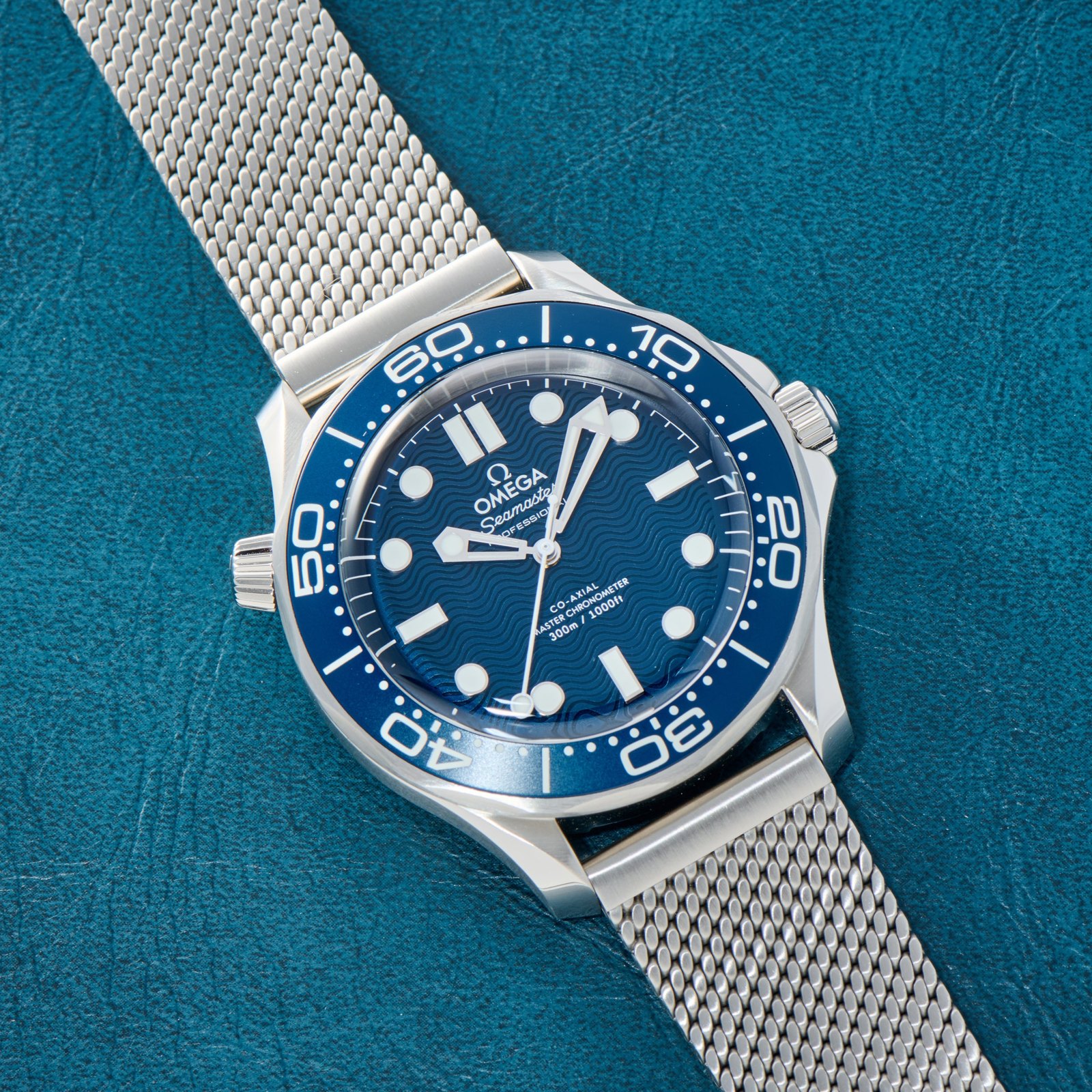
Omega Seamaster Professional 300 James Bond 60th Anniversary, c. 2025
- Maker / attribution
- Omega (maker)
- Date
- c. 2025
- Historical period
- Contemporary Horology (2010 – Present)
- Country of origin
- Switzerland
- Object type
- Wristwatch
- Dimensions
- Case 42 mm
- Stock no.
- 40960329
- Credit line
- Dealer listing, Analog/Shift (40960329)
- Catalogue title (original)
- Omega Seamaster Professional 300 James Bond 60th Anniversary (English)
View the source record (dealer listing) ↗ (opens another website in a new tab)Suggest a correction
Record summary
Catalogued by Analog/Shift (dealer), New York (stock number 40960329), this is a wristwatch by Omega, made in Switzerland, dated c. 2025. The Atlas places it in the Contemporary Horology period (2010 – Present) of its Wristwatches collection. Recorded dimensions: Case 42 mm. The record is illustrated with 6 photographs.
Assembled from the source record's structured fields. Dates and attributions are given as the source states them; where a field is missing the Atlas leaves it blank rather than estimating.
Catalogue description
Dealer description — Analog/Shift
The Seamaster 300 was Omega's response to the Rolex Submariner upon its introduction in 1957. Featuring a robust steel case with a 300-meter depth rating, a rotating bezel graduated with dive-timing scales, and a metal bracelet with diver's expansion links, the early Seamaster 300 was not only functional a diver that would go on to see use in Her Majesty's Navy, but is arguably one of the handsomest sports watch designs of the past century. As it evolved, the Omega Seamaster 300 went on to see numerous evolutionary changes, with nearly innumerable variants in a variety of materials and colorways produced in the past 60 years. This fact alone has made the Seamaster Professional line (as it came to be known) so desirable to a large portion of the collector community — simply because they don't all look exactly the same . Omega went on to create numerous limited-edition Seamaster 300s in celebration of its partnership with the James Bond 007 franchise. While some of these featured the now-famous “wave” dial motif popularized by the film Goldeneye , others featured gloss-black or other variants. This particular piece, a Reference 210.30.42.20.03.002 , dates to circa 2025 and was released to celebrate 60 years of James Bond. This edition features the iconic GoldenEye blue wave dial that made the Seamaster line iconic in the 1990s, and pairs this with an incredible exhibition caseback with the classic Bond crosshair motif from the beginning of every movie. In 42mm in stainless steel, this piece is paired with a stainless steel mesh bracelet and packs 300 meters of water resistance. For the lover of James Bond or just an admirer of the Seamaster, this piece is a must! Snag it now!
Historical context
Contemporary Horology (2010 – Present)
Silicon components, connected watches, optical-lattice research clocks and a thriving independent scene.
Smartwatches became the world's best-selling watches, while mechanical watchmaking focuses on craft, innovation (silicon components, new escapements) and independent makers.
Read the period in the timelineMore wristwatches from this periodEarlier: Mechanical Renaissance
Atlas type guide
Dive and water-resistant watches
Keeping water and dust out of a wristwatch was a long-standing challenge. Rolex's screw-down Oyster case (1926) and Omega's Marine (1932) were landmarks; in the early 1950s Blancpain's Fifty Fathoms and Rolex's Submariner defined the professional dive watch with rotating bezels for timing dives, luminous dials and high water resistance. The ISO 6425 standard (1982) later codified what a 'diver's watch' must do.
Dive watches became icons of post-war design and exploration, and their evolution — helium escape valves, ceramic bezels, saturation-diving depth ratings — records the history of underwater work.
What to look for
- Unidirectional or bidirectional rotating bezel with minute markings.
- Screw-down crown and case back; depth rating printed on the dial.
- Luminous hands and markers (radium before c. 1960, tritium c. 1960–1998, then Super-LumiNova).
- Reference numbers on the case between the lugs or inside the back.
Dating clues
- Screw-down Oyster cases: from 1926.
- Professional dive watches: from 1953.
- Tritium 'T' marks on dials: c. 1960–1998.
General guidance written by the Atlas editors about this kind of object. It is not a statement about this particular piece; for that, rely on the source record above and on physical examination.
Related records

Instruments · 1950–1976
Omega Megaquartz 2400 marine chronometer, 1950–1976
Science Museum Group, London

Instruments · 1960–1979
Stopwatch / timer by Omega, 1960–1979
Science Museum Group, London

Instruments · 1960–1979
Stopwatch / timer by Omega, Switzerland, 1960–1979
Science Museum Group, London

Instruments · 1960–1979
Stopwatch by Omega, Swiss made, single-button type reading 0 - 60 seconds in fifths and 0 - 5 minutes in minutes on subsidiary dial, 1960-79.
Science Museum Group, London

Wristwatches · c. 2010s
Breguet Type XXI, ref. 3810, c. 2010s (Antiquorum Lot 381-24)
Antiquorum auction archive, Geneva

Wristwatches · c. 2010s
Breguet Type XXI, ref. 3810, c. 2010s (Antiquorum Lot 386-229)
Antiquorum auction archive, Geneva

Wristwatches · Sold in September 2010
Breitling Cosmonaute, ref. A 22322, Sold in September 2010
Antiquorum auction archive, Geneva

Wristwatches · c. 2010
Corum Bubble Chrono, ref. 396.150.20, c. 2010
Antiquorum auction archive, Geneva