
Wristwatches · Wristwatch
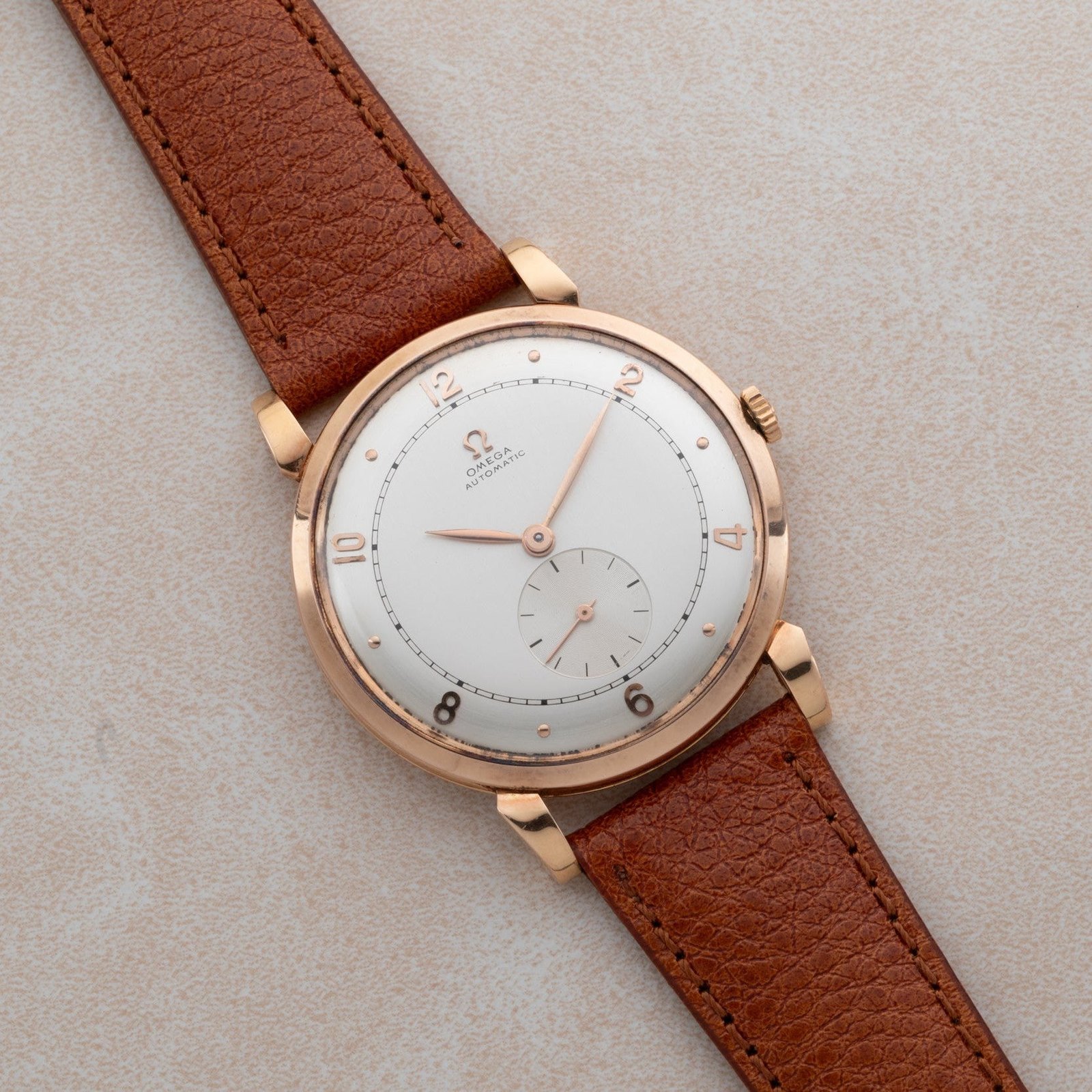
Omega Dress Watch, late 1940s
- Maker / attribution
- Omega (maker)
- Date
- late 1940s
- Historical period
- Golden Age of Mechanical Watchmaking (1900 – 1945)
- Country of origin
- Switzerland
- Object type
- Wristwatch
- Dimensions
- Case 37.5 mm
- Stock no.
- 40960236
- Credit line
- Dealer listing, Analog/Shift (40960236)
- Catalogue title (original)
- Omega Dress Watch (English)
View the source record (dealer listing) ↗ (opens another website in a new tab)Suggest a correction
Record summary
Catalogued by Analog/Shift (dealer), New York (stock number 40960236), this is a wristwatch by Omega, made in Switzerland, dated late 1940s. The Atlas places it in the Golden Age of Mechanical Watchmaking period (1900 – 1945) of its Wristwatches collection. Recorded dimensions: Case 37.5 mm. The record is illustrated with 6 photographs.
Assembled from the source record's structured fields. Dates and attributions are given as the source states them; where a field is missing the Atlas leaves it blank rather than estimating.
Catalogue description
Dealer description — Analog/Shift
When you think of Omega, you probably picture the Speedmaster, Seamaster, or if you’re a bit more adventurous, the Railmaster. While these pieces played significant roles in forming the watch industry of today, many of Omega’s older, classic offerings provide an exceptional look into their era, speaking to the stories and history from years past. Take this Reference 2482, for example. Dating to the late 1940s, early 1950s, this piece is preserved in exceptional condition, serving as almost a witness to a bygone era. Considered a large watch at the time, the 37.5mm case is perfect in a modern context. This piece is fashioned from yellow gold and features matching applied markers alternating between respective 'dot' indices, and Arabic numerals. The watch has beautiful angular lugs executed in a style characteristic of the era and is accompanied by a matching yellow gold feuille handset, a oversized constant seconds subsidiary dial, a black-accented 'railroad' minute track and an applied Omega logo at 12 o’clock. This is the type of watch that you cannot wear without smiling. Simply looking at a piece like this, which has aged so evenly while maintaining its original character and form, puts a picture in your mind of the world back when this watch first was released. Powered by Omega’s caliber 332 bumper-style movement, this piece offers an opportunity to step outside the world of iconic Omega and into the world of classic vintage styling and timeless dress watch heritage. Consider this beautifully-maintained in near time-capsule quality!
Historical context
Golden Age of Mechanical Watchmaking (1900 – 1945)
The wristwatch displaces the pocket watch; waterproof cases, self-winding and grand complications.
The wristwatch overtook the pocket watch. Military use in the First World War, aviation, water-resistant cases (1926), automatic winding (1923–31), rectangular Art Deco designs and early chronographs and calendars defined the period.
Read the period in the timelineMore wristwatches from this periodEarlier: Industrial Revolution
Atlas type guide
Wristwatches
Bracelet watches were worn by women from the early nineteenth century — Breguet made one for Caroline Murat, Queen of Naples, in 1810–12 — but the wristwatch only became a man's instrument with military use and aviation in the early twentieth century. Between the World Wars it overtook the pocket watch; the 1920s and 1930s brought rectangular Art Deco cases, water-resistant cases and the first automatic winding systems.
After 1945 the wristwatch became a carrier of identity — dress watches, sports and dive watches, chronographs, calendars — produced by Swiss, American, Japanese, German, Soviet and Chinese industries. The quartz revolution after 1969 and the mechanical renaissance since the 1990s, including the rise of independent watchmakers, complete the story.
What to look for
- The reference number (between the lugs or inside the case back) and serial number, the starting point for dating.
- The calibre: its maker and number are often stamped under the dial or on the bridge.
- Originality of dial, hands and crown — refinished ('redial') dials are common.
- Case material marks: 18K/750, 14K/585, stainless steel, gold-filled, plated.
Dating clues
- Wire-lug cases: before c. 1925.
- Water-resistant screw-down cases: from 1926.
- Quartz movements: from 1969; sapphire crystals widespread after c. 1980.
General guidance written by the Atlas editors about this kind of object. It is not a statement about this particular piece; for that, rely on the source record above and on physical examination.
Related records

Instruments · 1950–1976
Omega Megaquartz 2400 marine chronometer, 1950–1976
Science Museum Group, London

Instruments · 1960–1979
Stopwatch / timer by Omega, 1960–1979
Science Museum Group, London

Instruments · 1960–1979
Stopwatch / timer by Omega, Switzerland, 1960–1979
Science Museum Group, London

Instruments · 1960–1979
Stopwatch by Omega, Swiss made, single-button type reading 0 - 60 seconds in fifths and 0 - 5 minutes in minutes on subsidiary dial, 1960-79.
Science Museum Group, London

Wristwatches · 1931
Rolex 'Oyster Perpetual' rotor self-winding wrist-watch, lever escapement, in steel case with glass in back, Montres Rolex SA, Geneva, Switzerland, 1931
Science Museum Group, London

Wristwatches · 1900–1999
Wristwatch by Certina, Switzerland, 1900–1999
Nordic Museum Foundation

Wristwatches · 1900–1999
Wristwatch by Omega, Västerås, 1900–1999
Nordic Museum Foundation

Wristwatches · 1900–1999
Wristwatch by Universal, Switzerland, 1900–1999
Nordic Museum Foundation