
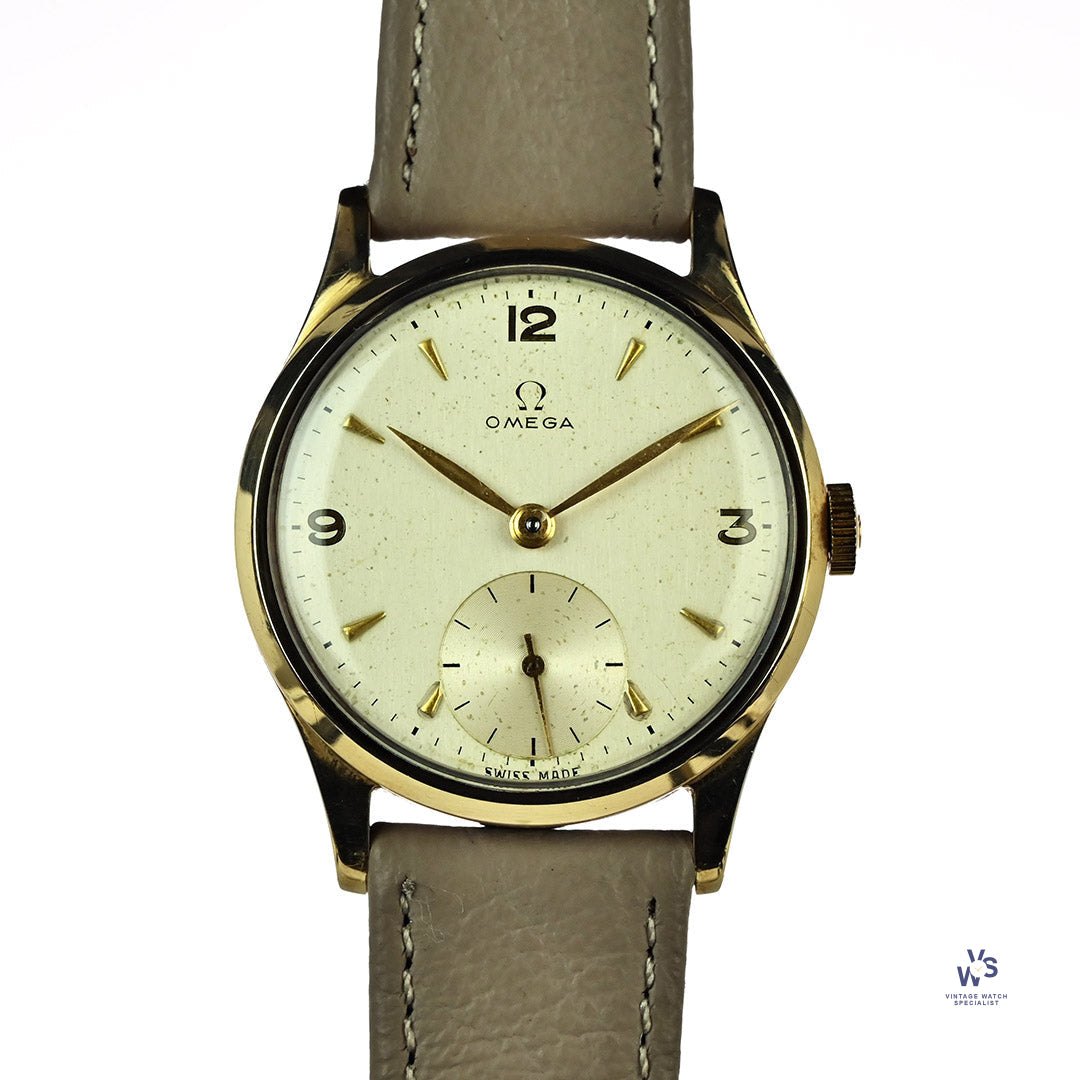
Wristwatches · Wristwatch
Omega, circa 1947
- Maker / attribution
- Omega (maker)
- Date
- c. 1947
- Historical period
- Modern Mechanical Horology (1945 – 1969)
- Country of origin
- Switzerland
- Object type
- Wristwatch
- Dimensions
- Case 33 mm
- Stock no.
- VWS3127cs
- Credit line
- Dealer listing, Vintage Watch Specialist (VWS3127cs)
- Catalogue title (original)
- Omega - Dennison Case 9ct Gold Dress Watch with Original Omega Box - c.1947 (English)
View the source record (dealer listing) ↗ (opens another website in a new tab)Suggest a correction
Record summary
Catalogued by Vintage Watch Specialist (dealer), United Kingdom (stock number VWS3127cs), this is a wristwatch by Omega, made in Switzerland, dated c. 1947. The Atlas places it in the Modern Mechanical Horology period (1945 – 1969) of its Wristwatches collection. Recorded dimensions: Case 33 mm. The record is illustrated with 6 photographs.
Assembled from the source record's structured fields. Dates and attributions are given as the source states them; where a field is missing the Atlas leaves it blank rather than estimating.
Catalogue description
Dealer description — Vintage Watch Specialist
A Beautiful Vintage Omega Dress watch in 9ct Gold Dennison Made Case with an Explorer Style Dial, Sold with Original Box, c.1947 Omega, a name synonymous with precision and innovation in the world of horology, embarked on its journey in 1848. Founded by Louis Brandt in La Chaux-de-Fonds, Switzerland, Omega initially focused on crafting key-wound precision pocket watches. By 1894, the company introduced the revolutionary 19-line calibre movement named "Omega", symbolizing ultimate achievement. This innovation not only led to the rebranding of the company as Omega but also set a new benchmark for accuracy and reliability in watchmaking. Omega's commitment to excellence propelled it to become the official timekeeper for the British Royal Flying Corps in 1917 and later for the American army during World War I. The brand achieved another milestone when it was chosen as the official timekeeper for the Olympic Games in 1932, a role it has proudly fulfilled more than any other watchmaker. The launch of the iconic Seamaster (1948), Speedmaster (1957), and Constellation (1952) collections solidified Omega's legacy. What's on Offer You cannot go wrong with a classic vintage Omega, which is a fantastic example. This 9ct gold watch is in superb vintage shape and looks beautiful on the wrist. At 33mm the proportions are fairly slight, however it does wear larger on the wrist which is due to its super slim gold bezel. The dial is charming, ivory coloured with an even spattering of patina which will pull the heartstrings of anybody who appreciates the natural ageing process of watches and how it manifests in unique ways on the dial - you'll never find another watch the same! The dial boasts an 'Explorer' style dial with Arabic numerals at quarters, applied arrowhead indexes, slim gold leaf hands and a recessed sub-dial at 6 o'clock. The dial is encapsulated underneath shatterproof Plexiglas and encased in a 9ct gold case produced by Dennison - Dennison designed and manufactured watch cases. for several brands including Omega, and were world-renowned for their craftsmanship. The watch is paired with a beautiful stone coloured leather strap with a contrast stitch and its original Omega box. A superb purchase and very good value for a gold watch from Omega.
Historical context
Modern Mechanical Horology (1945 – 1969)
Tool watches for divers, pilots and astronauts; electric watches anticipate the electronic age.
The classic era of the mechanical wristwatch: dive watches, chronographs for motor racing and space flight, GMT watches for jet travel, slim dress watches, automatic calendars, and the rise of Japanese manufacturers alongside Swiss, American, German and Soviet industries.
Read the period in the timelineMore wristwatches from this periodEarlier: Golden Age of Mechanical Watchmaking
Atlas type guide
Wristwatches
Bracelet watches were worn by women from the early nineteenth century — Breguet made one for Caroline Murat, Queen of Naples, in 1810–12 — but the wristwatch only became a man's instrument with military use and aviation in the early twentieth century. Between the World Wars it overtook the pocket watch; the 1920s and 1930s brought rectangular Art Deco cases, water-resistant cases and the first automatic winding systems.
After 1945 the wristwatch became a carrier of identity — dress watches, sports and dive watches, chronographs, calendars — produced by Swiss, American, Japanese, German, Soviet and Chinese industries. The quartz revolution after 1969 and the mechanical renaissance since the 1990s, including the rise of independent watchmakers, complete the story.
What to look for
- The reference number (between the lugs or inside the case back) and serial number, the starting point for dating.
- The calibre: its maker and number are often stamped under the dial or on the bridge.
- Originality of dial, hands and crown — refinished ('redial') dials are common.
- Case material marks: 18K/750, 14K/585, stainless steel, gold-filled, plated.
Dating clues
- Wire-lug cases: before c. 1925.
- Water-resistant screw-down cases: from 1926.
- Quartz movements: from 1969; sapphire crystals widespread after c. 1980.
General guidance written by the Atlas editors about this kind of object. It is not a statement about this particular piece; for that, rely on the source record above and on physical examination.
Related records

Instruments · 1950–1976
Omega Megaquartz 2400 marine chronometer, 1950–1976
Science Museum Group, London

Instruments · 1960–1979
Stopwatch / timer by Omega, 1960–1979
Science Museum Group, London

Instruments · 1960–1979
Stopwatch / timer by Omega, Switzerland, 1960–1979
Science Museum Group, London

Instruments · 1960–1979
Stopwatch by Omega, Swiss made, single-button type reading 0 - 60 seconds in fifths and 0 - 5 minutes in minutes on subsidiary dial, 1960-79.
Science Museum Group, London

Wristwatches · 1945
Wristwatch by Eterna, 1945
Museum Rotterdam

Wristwatches · c. 1945
Breitling Premier, ref. 790, c. 1945
Antiquorum auction archive, Geneva

Wristwatches · c. 1945
Universal Genève Uni-Compax, ref. 22492, c. 1945
Antiquorum auction archive, Geneva

Wristwatches · c. 1950s
Baume & Mercier wristwatch, c. 1950s
Antiquorum auction archive, Geneva