
Wristwatches · Wristwatch
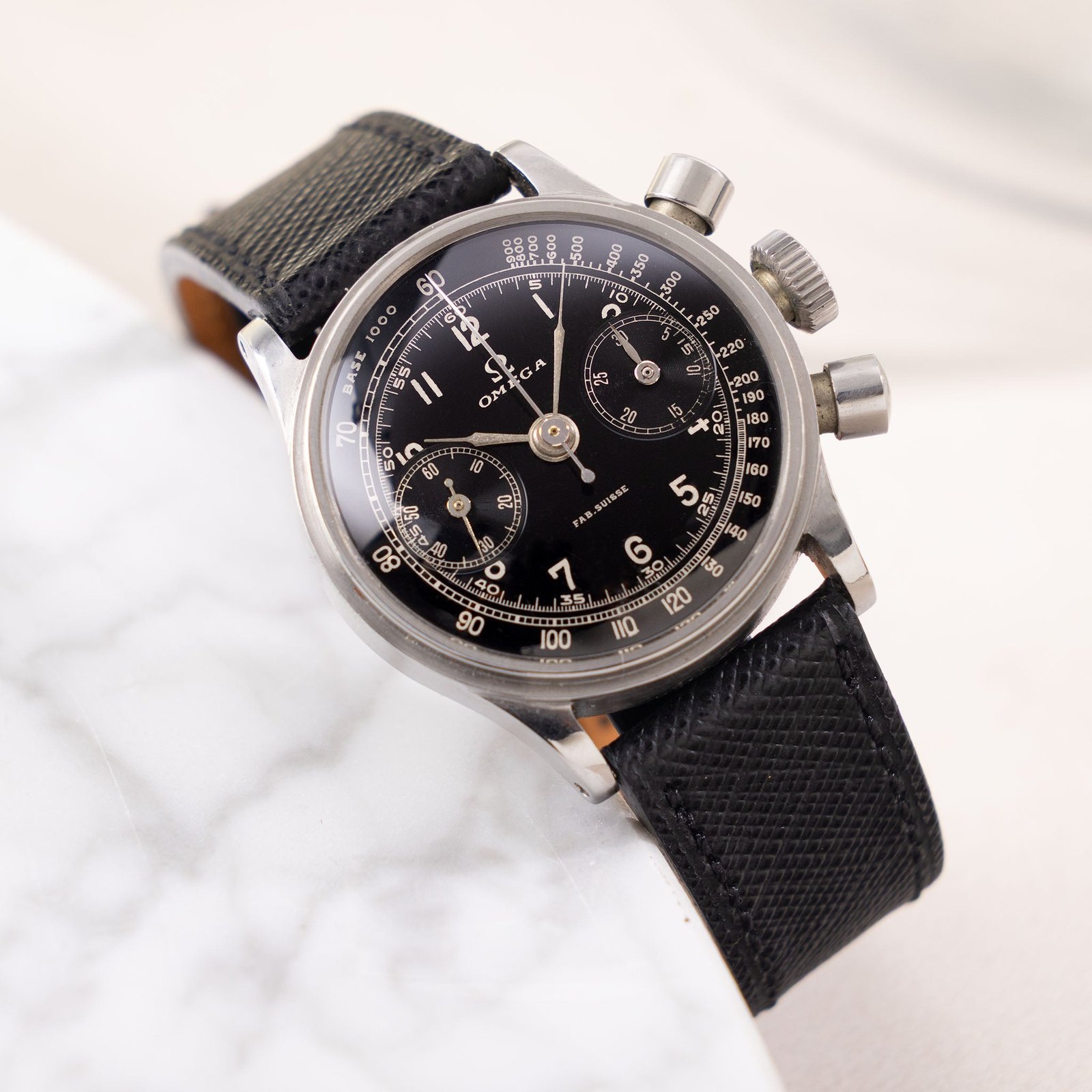
Omega Chronograph 28.9 Movement Screw-down Case Black Dial, early 1940
- Maker / attribution
- Omega (maker)
- Date
- early 1940
- Historical period
- Golden Age of Mechanical Watchmaking (1900 – 1945)
- Country of origin
- Switzerland
- Object type
- Wristwatch
- Dimensions
- Case 28.9 mm
- Stock no.
- W-3797
- Credit line
- Dealer listing, Bulang & Sons (W-3797)
- Catalogue title (original)
- Omega Chronograph 28.9 Movement Screw-down Case Black Dial (English)
View the source record (dealer listing) ↗ (opens another website in a new tab)Suggest a correction
Record summary
Catalogued by Bulang & Sons (dealer), Copenhagen (stock number W-3797), this is a wristwatch by Omega, made in Switzerland, dated early 1940. The Atlas places it in the Golden Age of Mechanical Watchmaking period (1900 – 1945) of its Wristwatches collection. Recorded dimensions: Case 28.9 mm. The record is illustrated with 6 photographs.
Assembled from the source record's structured fields. Dates and attributions are given as the source states them; where a field is missing the Atlas leaves it blank rather than estimating.
Catalogue description
Dealer description — Bulang & Sons
The history of Omega SA began in 1848, when 23-year-old watchmaker Louis Brandt established a small workshop in La Chaux-de-Fonds, Switzerland. Over the following 175 years, Omega evolved from a modest atelier into one of the world’s most celebrated watch manufacturers, renowned for its achievements in precision timekeeping, space exploration, professional diving watches, and mechanical innovation. Among the brand’s most important early developments was the Omega Calibre 28.9 CHRO — Omega’s first compact wrist chronograph movement, produced in very limited numbers between 1932 and approximately 1943. Developed in collaboration with Lemania, where it was known as the Lemania 13CH, this groundbreaking 28.9 mm movement laid the foundation for Omega’s future sports and military chronographs, eventually evolving into the legendary Calibre 321 used in the first NASA-approved Speedmaster. Closely related to the better-known Calibre 33.3, the 28.9 is considerably rarer, especially in a screw-back waterproof case configuration such as the present example. This particular watch is housed in a steel case with a screw-down case back and oversized pump pushers, giving it a strong and purposeful appearance. The glossy black dial is especially attractive, featuring two recessed sub-dials for the chronograph functions, a base-1000 scale, and a finely printed minute track. The clean, no-lume hands complete the design beautifully and give the watch an exceptionally elegant and balanced appearance. This historically important chronograph is fitted with a beautiful Bulang and Sons strap and has been fully serviced by our watchmaker. Together, these two watches represent an extraordinary opportunity for the serious collector: historically important Omega chronographs with rare movements, waterproof screw-back cases, outstanding overall condition, and an almost impossible-to-find consecutive serial relationship.. An increasingly rare calibre housed in a beautifully balanced and highly wearable case. Specifications: Omega Chronograph 35mm steel case with screw-down case back Rare black dial, base 1000 scale pump pushers no lume leaf style hands Cal. 28.9 hand wound movement Movement Serial 938xxxx dating to the early 1940’s Bulang and sons leather strap Fully serviced by our watchmaker
Historical context
Golden Age of Mechanical Watchmaking (1900 – 1945)
The wristwatch displaces the pocket watch; waterproof cases, self-winding and grand complications.
The wristwatch overtook the pocket watch. Military use in the First World War, aviation, water-resistant cases (1926), automatic winding (1923–31), rectangular Art Deco designs and early chronographs and calendars defined the period.
Read the period in the timelineMore wristwatches from this periodEarlier: Industrial Revolution
Atlas type guide
Chronographs and split-seconds watches
A chronograph is a watch with an additional seconds hand that can be started, stopped and returned to zero independently of the timekeeping. Louis Moinet built an early example in 1816 and Nicolas Rieussec a recording 'chronographe' in 1821; Adolphe Nicole's heart-shaped reset cam (patented 1862) made the modern return-to-zero possible. Split-seconds (rattrapante) chronographs add a second hand that can be stopped for intermediate times; flyback chronographs restart instantly.
Chronographs were essential tools for doctors (pulsometer scales), artillery (telemeter), engineers and sport. In wristwatches, Valjoux, Venus, Lemania and later the automatic chronographs of 1969 (Zenith El Primero, the Chronomatic Calibre 11 group and Seiko 6139) are milestones.
What to look for
- Push-pieces on the case band or a single button in the crown (monopusher).
- Subsidiary registers for minutes and hours; tachymeter, telemeter or pulsometer scales.
- Column wheel versus cam control visible in the movement.
- Calibre markings of specialist makers (Valjoux, Lemania, Venus, Landeron).
Dating clues
- Pocket chronographs with heart cam reset: after 1862.
- Wrist chronographs: from c. 1910; two-button designs from the 1930s.
- Automatic chronographs: from 1969.
General guidance written by the Atlas editors about this kind of object. It is not a statement about this particular piece; for that, rely on the source record above and on physical examination.
Read next:Flyback chronographChronograph
Related records

Instruments · 1950–1976
Omega Megaquartz 2400 marine chronometer, 1950–1976
Science Museum Group, London

Instruments · 1960–1979
Stopwatch / timer by Omega, 1960–1979
Science Museum Group, London

Instruments · 1960–1979
Stopwatch / timer by Omega, Switzerland, 1960–1979
Science Museum Group, London

Instruments · 1960–1979
Stopwatch by Omega, Swiss made, single-button type reading 0 - 60 seconds in fifths and 0 - 5 minutes in minutes on subsidiary dial, 1960-79.
Science Museum Group, London

Wristwatches · 1931
Rolex 'Oyster Perpetual' rotor self-winding wrist-watch, lever escapement, in steel case with glass in back, Montres Rolex SA, Geneva, Switzerland, 1931
Science Museum Group, London

Wristwatches · 1900–1999
Wristwatch by Certina, Switzerland, 1900–1999
Nordic Museum Foundation
Wristwatches · 1900–1999
Wristwatch by Omega, Västerås, 1900–1999
Nordic Museum Foundation
Wristwatches · 1900–1999
Wristwatch by Universal, Switzerland, 1900–1999
Nordic Museum Foundation