
Wristwatches · Wristwatch
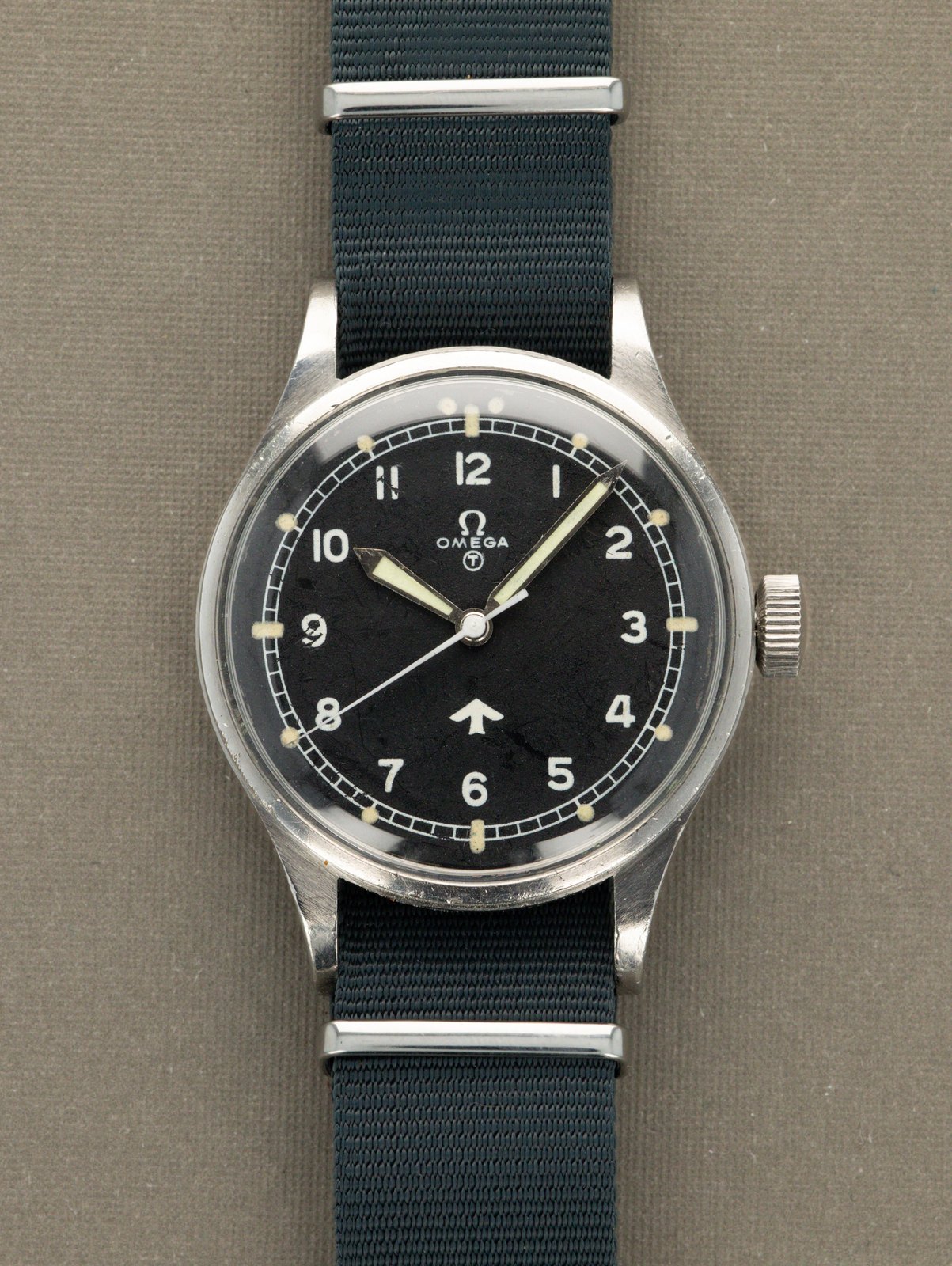
Omega 6B/542 ref. 2777-1, Matte Black 'Fat Arrow' Dial RAF-Issued
- Maker / attribution
- Omega (maker)
- Date
- c. 1953
- Historical period
- Modern Mechanical Horology (1945 – 1969)
- Country of origin
- Switzerland
- Object type
- Wristwatch
- Dimensions
- Case 36 mm
- Stock no.
- OC3263
- Credit line
- Dealer listing, Oliver & Clarke (OC3263)
- Catalogue title (original)
- Omega 6B/542 Ref. 2777-1 - Matte Black 'Fat Arrow' Dial RAF-Issued Unpolished (English)
View the source record (dealer listing) ↗ (opens another website in a new tab)Suggest a correction
Record summary
Catalogued by Oliver & Clarke (dealer), United Kingdom (stock number OC3263), this is a wristwatch by Omega, made in Switzerland, dated c. 1953. The Atlas places it in the Modern Mechanical Horology period (1945 – 1969) of its Wristwatches collection. Recorded dimensions: Case 36 mm. The record is illustrated with 6 photographs.
Assembled from the source record's structured fields. Dates and attributions are given as the source states them; where a field is missing the Atlas leaves it blank rather than estimating.
Catalogue description
Dealer description — Oliver & Clarke
Omega is undeniably one of the most historically important timepiece manufactures of all time. In fact, the Speedmaster is probably the most important wrist watch of all time. As a result, the Speedmaster casts a massive shadow over all of its siblings.... even over firmly planted models like the Seamaster and Constellation ranges. The resulting effect is double sided: many vintage Omegas, we feel are incredibly undervalued in the market as it exists today, with the other side of that being that hidden gems are shocking attainable. The piece that we have here is special for a multitude of reasons. Not dissimilar to the 'Dirty Dozen' watches of WWII, this piece was commissioned by the British Ministry Of Defence to produce a watch that met a series of standards. Omega, along with a handful of other prominent watch manufacturers would rise to the challenge to produce a timepiece that had a certain level of resistance to shock, magnetism, dust, and of course, excellent timekeeping. Dating to circa 1953, this example is offered in fantastic overall condition. The 36mm case remains unpolished and shows normal wear with no notable damage or indication this ever really saw the action that it was intended... It features 'fixed' lug bars and a screw-down caseback with all of the correct engravings. No doubt the most intriguing element of the condition on this piece, is the dial. As a general rule with military watches, hands and dials were replaces under contract service, and as a result is accepted in the collector community. The result is that many military-issued piece prior to the 1960s no longer have their original dials with Radium paint, rather later dials with Tritium (this is where the 'Circle T' comes from). With the 6B/542, however, rather than a 'circle T' the MOD choose to denote the presence of Tritium on the new dials with a thicker 'fat' Broad Arrow. The dial itself presents nicely, showing light wear throughout with clear printing and evenly patinated Tritium elements and a correct Tritium 'sword' handset. This piece comes fitted to a very appropriate Admiralty Grey NATO strap from Phoenix and is powered by Omegas Cal. 283 manual-winding movement. Rumored to have only been produced for a year or two, there's no saying how many examples survive today, let alone in condition as well-rounded as this. To many collectors of vintage, regardless of whether the focus is of military watches or not, this piece has everything going for it. Military issued, properly vintage, and its from one of the most storied brands in the history of watchmaking. This is a real piece of history — a phrase often repeated in the world of watches, though rarely as deservedly as in this case.
Historical context
Modern Mechanical Horology (1945 – 1969)
Tool watches for divers, pilots and astronauts; electric watches anticipate the electronic age.
The classic era of the mechanical wristwatch: dive watches, chronographs for motor racing and space flight, GMT watches for jet travel, slim dress watches, automatic calendars, and the rise of Japanese manufacturers alongside Swiss, American, German and Soviet industries.
Read the period in the timelineMore wristwatches from this periodEarlier: Golden Age of Mechanical Watchmaking
Atlas type guide
Military, pilot and travel watches
The wristwatch owes much of its adoption by men to warfare and aviation. Wristlets — small pocket watches soldered with lugs and worn on a strap — were used in colonial campaigns and became standard equipment in the First World War, with protective grilles over the crystal ('shrapnel guards'). Louis Cartier's Santos (1904), designed for the aviator Alberto Santos-Dumont, is often cited as an early purpose-made pilot's watch.
In the Second World War governments specified watches in detail: the German B-Uhr observation watches, the American A-11, and the British 'W.W.W.' (the 'Dirty Dozen' set of 1945). After the war, jet travel brought GMT and world-time watches, which show two or more time zones at once — Louis Cottier's world-time mechanism and the Rolex GMT-Master (1955) are examples.
What to look for
- Military markings on the case back: broad arrow, issue numbers, 'W.W.W.', 'A.T.P.'
- High-legibility black dials with luminous Arabic numerals; oversized crowns for gloved hands.
- 24-hour hands and rotating 24-hour bezels or city rings on GMT/world-time watches.
- Wire lugs on early wristlets converted from pocket watches.
Dating clues
- Wire-lug wristlets: c. 1900–1925.
- Military specifications of the Second World War: 1939–1945.
- GMT and world-time wristwatches: mainly after 1950.
General guidance written by the Atlas editors about this kind of object. It is not a statement about this particular piece; for that, rely on the source record above and on physical examination.
Related records

Instruments · 1950–1976
Omega Megaquartz 2400 marine chronometer, 1950–1976
Science Museum Group, London

Instruments · 1960–1979
Stopwatch / timer by Omega, 1960–1979
Science Museum Group, London

Instruments · 1960–1979
Stopwatch / timer by Omega, Switzerland, 1960–1979
Science Museum Group, London

Instruments · 1960–1979
Stopwatch by Omega, Swiss made, single-button type reading 0 - 60 seconds in fifths and 0 - 5 minutes in minutes on subsidiary dial, 1960-79.
Science Museum Group, London

Wristwatches · 1945
Wristwatch by Eterna, 1945
Museum Rotterdam

Wristwatches · c. 1945
Breitling Premier, ref. 790, c. 1945
Antiquorum auction archive, Geneva

Wristwatches · c. 1945
Universal Genève Uni-Compax, ref. 22492, c. 1945
Antiquorum auction archive, Geneva

Wristwatches · c. 1950s
Baume & Mercier wristwatch, c. 1950s
Antiquorum auction archive, Geneva