
Wristwatches · Wristwatch
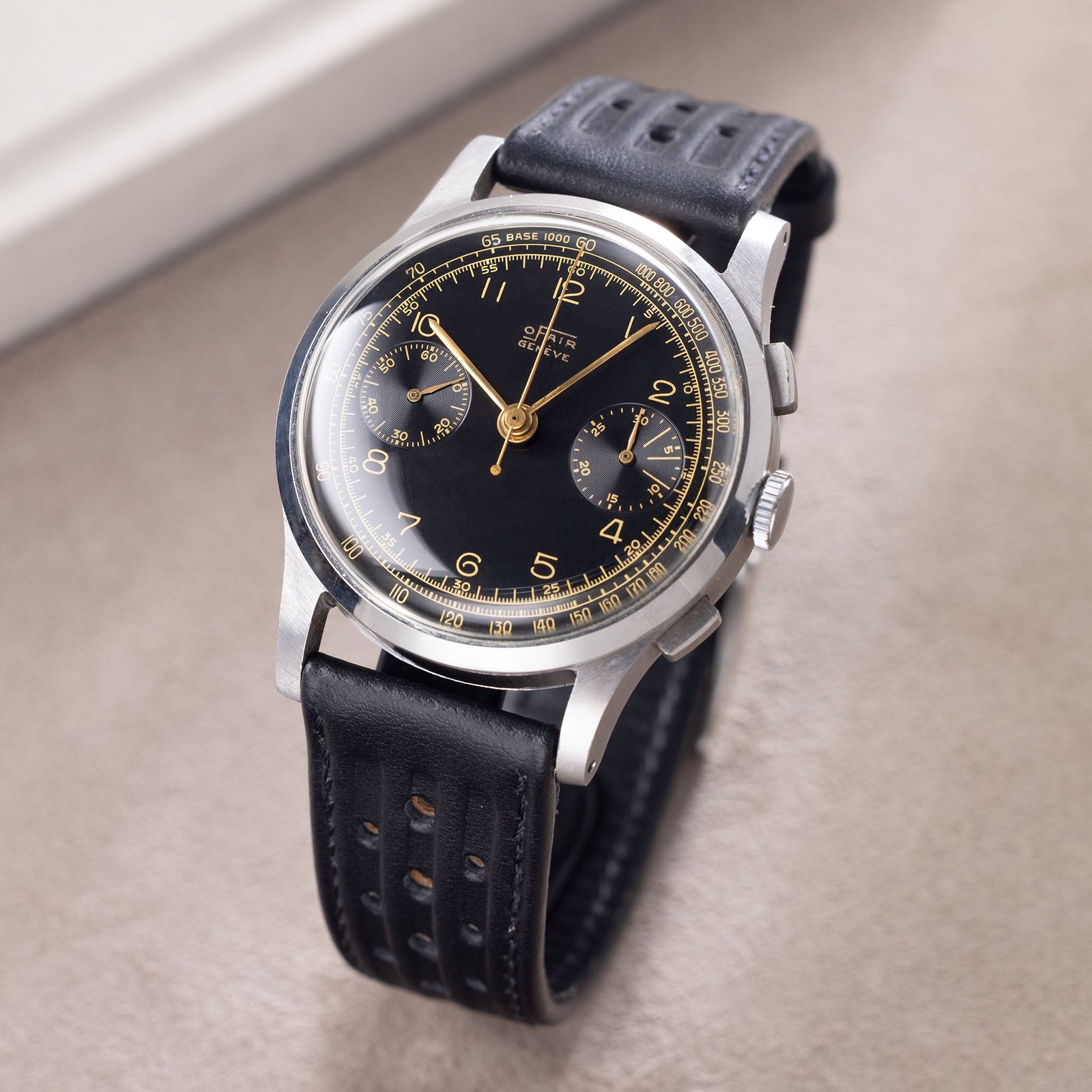
Ofair Cal.22 1940's Oversized Chronograph Black dial Motor sport Championship Geneva
- Maker / attribution
- Ofair (maker)
- Date
- 1940
- Historical period
- Golden Age of Mechanical Watchmaking (1900 – 1945)
- Country of origin
- Switzerland
- Object type
- Wristwatch
- Dimensions
- Case 37 mm
- Stock no.
- W-3893
- Credit line
- Dealer listing, Bulang & Sons (W-3893)
- Catalogue title (original)
- Ofair Cal.22 1940's Oversized Chronograph Black dial Motor sport Championship Geneva (English)
View the source record (dealer listing) ↗ (opens another website in a new tab)Suggest a correction
Record summary
Catalogued by Bulang & Sons (dealer), Copenhagen (stock number W-3893), this is a wristwatch by Ofair, made in Switzerland, dated 1940. The Atlas places it in the Golden Age of Mechanical Watchmaking period (1900 – 1945) of its Wristwatches collection. Recorded dimensions: Case 37 mm. The record is illustrated with 6 photographs.
Assembled from the source record's structured fields. Dates and attributions are given as the source states them; where a field is missing the Atlas leaves it blank rather than estimating.
Catalogue description
Dealer description — Bulang & Sons
The Ofair Watch Company, often branded as Ofair Genève, was a Swiss watch brand active primarily during the 1950s and 1960s. The company specialised in elegant complications, producing high-quality chronographs, triple-calendar watches and moonphase models that reflected the classical style of the era. Presented here is a beautifully preserved, oversized chronograph measuring an impressive 37 mm. The stainless steel case features the characteristic square chronograph pushers of the period and a snap-on case back. The beautifully preserved dial features a classic bi-compax layout with two subsidiary registers, an outer Base 1000 scale, rich gilt printing and applied Arabic numerals. It is exactly the kind of elegant mid-century chronograph that continues to captivate collectors today. The most intriguing feature, however, is found on the case back. It bears the following presentation engraving: “Offert par l'État et la Ville de Genève, Finale Championnat Suisse aux Engins 1946.” Translated, this reads: “Presented by the State and the City of Geneva, Final of the 1946 Swiss Apparatus Gymnastics Championship.” Presentation watches are among the most charming pieces to discover. Unlike standard production watches, they tell the story of a particular moment in time and of the person who originally received them. While the identity of the original recipient has unfortunately been lost to history, this remarkable engraving transforms an already attractive chronograph into a fascinating historical object with a story all its own. Powering the watch is the robust, hand-wound Valjoux 22 chronograph movement, one of the great workhorse calibres of its era. It has been fully serviced by our watchmaker and is ready to be enjoyed for many years to come. Some vintage watches are collected for their movements, others for their design. This Ofair offers something even rarer — a tangible connection to a moment in history, preserved in steel for eight decades. Specifications: Ofair Genève Chronograph 37 mm steel case with snap back case back Rare black dial with base 1000 scale Square pushers Case back engraving for the Swiss final of the 1946 Swiss Gymnastics Championships No lume stick style hands Valjoux.22 hand wound movement Serial serial 54xxx dating to the 1940’s Bulang and sons leather strap Fully serviced by our watchmaker
Historical context
Golden Age of Mechanical Watchmaking (1900 – 1945)
The wristwatch displaces the pocket watch; waterproof cases, self-winding and grand complications.
The wristwatch overtook the pocket watch. Military use in the First World War, aviation, water-resistant cases (1926), automatic winding (1923–31), rectangular Art Deco designs and early chronographs and calendars defined the period.
Read the period in the timelineMore wristwatches from this periodEarlier: Industrial Revolution
Atlas type guide
Chronographs and split-seconds watches
A chronograph is a watch with an additional seconds hand that can be started, stopped and returned to zero independently of the timekeeping. Louis Moinet built an early example in 1816 and Nicolas Rieussec a recording 'chronographe' in 1821; Adolphe Nicole's heart-shaped reset cam (patented 1862) made the modern return-to-zero possible. Split-seconds (rattrapante) chronographs add a second hand that can be stopped for intermediate times; flyback chronographs restart instantly.
Chronographs were essential tools for doctors (pulsometer scales), artillery (telemeter), engineers and sport. In wristwatches, Valjoux, Venus, Lemania and later the automatic chronographs of 1969 (Zenith El Primero, the Chronomatic Calibre 11 group and Seiko 6139) are milestones.
What to look for
- Push-pieces on the case band or a single button in the crown (monopusher).
- Subsidiary registers for minutes and hours; tachymeter, telemeter or pulsometer scales.
- Column wheel versus cam control visible in the movement.
- Calibre markings of specialist makers (Valjoux, Lemania, Venus, Landeron).
Dating clues
- Pocket chronographs with heart cam reset: after 1862.
- Wrist chronographs: from c. 1910; two-button designs from the 1930s.
- Automatic chronographs: from 1969.
General guidance written by the Atlas editors about this kind of object. It is not a statement about this particular piece; for that, rely on the source record above and on physical examination.
Read next:Flyback chronographChronograph
Related records

Wristwatches · 1931
Rolex 'Oyster Perpetual' rotor self-winding wrist-watch, lever escapement, in steel case with glass in back, Montres Rolex SA, Geneva, Switzerland, 1931
Science Museum Group, London

Wristwatches · 1900–1999
Wristwatch by Certina, Switzerland, 1900–1999
Nordic Museum Foundation
Wristwatches · 1900–1999
Wristwatch by Omega, Västerås, 1900–1999
Nordic Museum Foundation
Wristwatches · 1900–1999
Wristwatch by Universal, Switzerland, 1900–1999
Nordic Museum Foundation
Wristwatches · c. 1900
Wristwatch, probably Switzerland, c. 1900 (no. 57124)
German Clock Museum
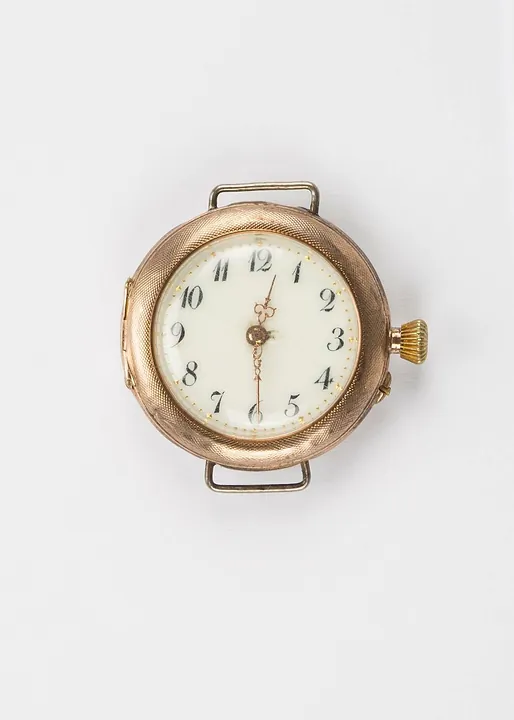
Wristwatches · c. 1900
Wristwatch, probably Switzerland, c. 1900 (no. 57216)
German Clock Museum
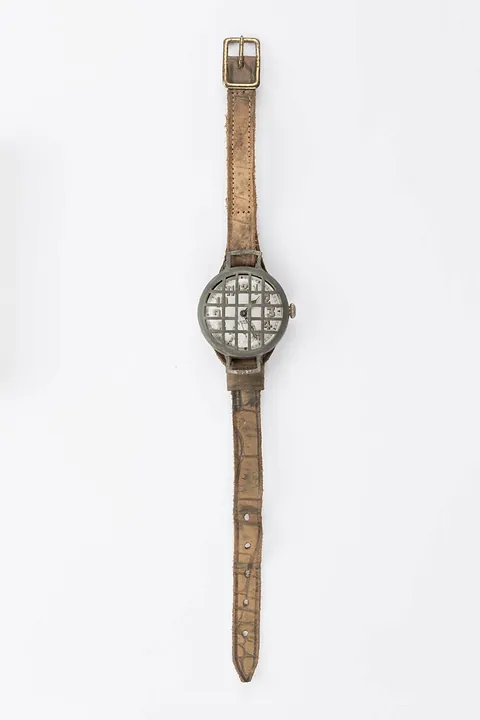
Wristwatches · c. 1915
Wristwatch by S.S.und Co., Stauffer, Son und Co., Switzerland, c. 1915
German Clock Museum
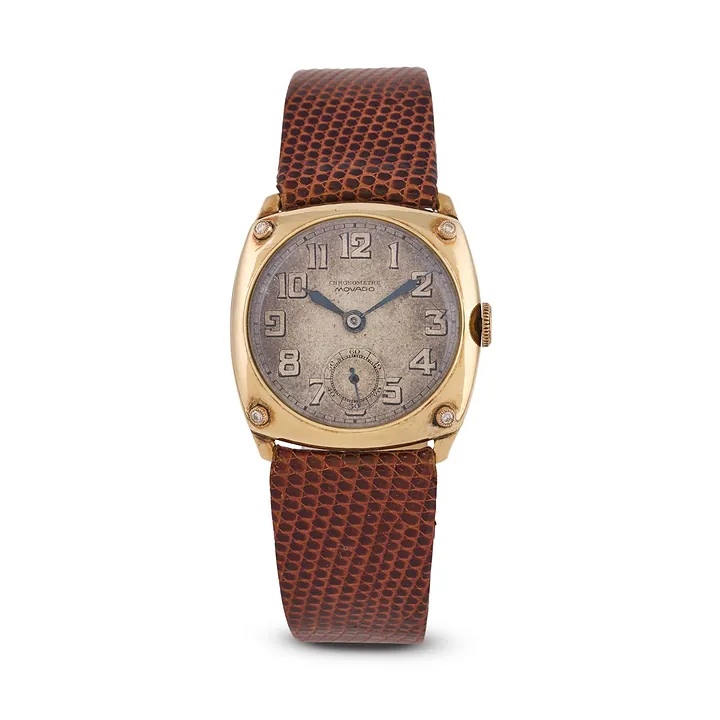
Wristwatches · c. 1920s
Movado Chronometre, ref. 41536, c. 1920s
Antiquorum auction archive, Geneva