Clocks · Clock
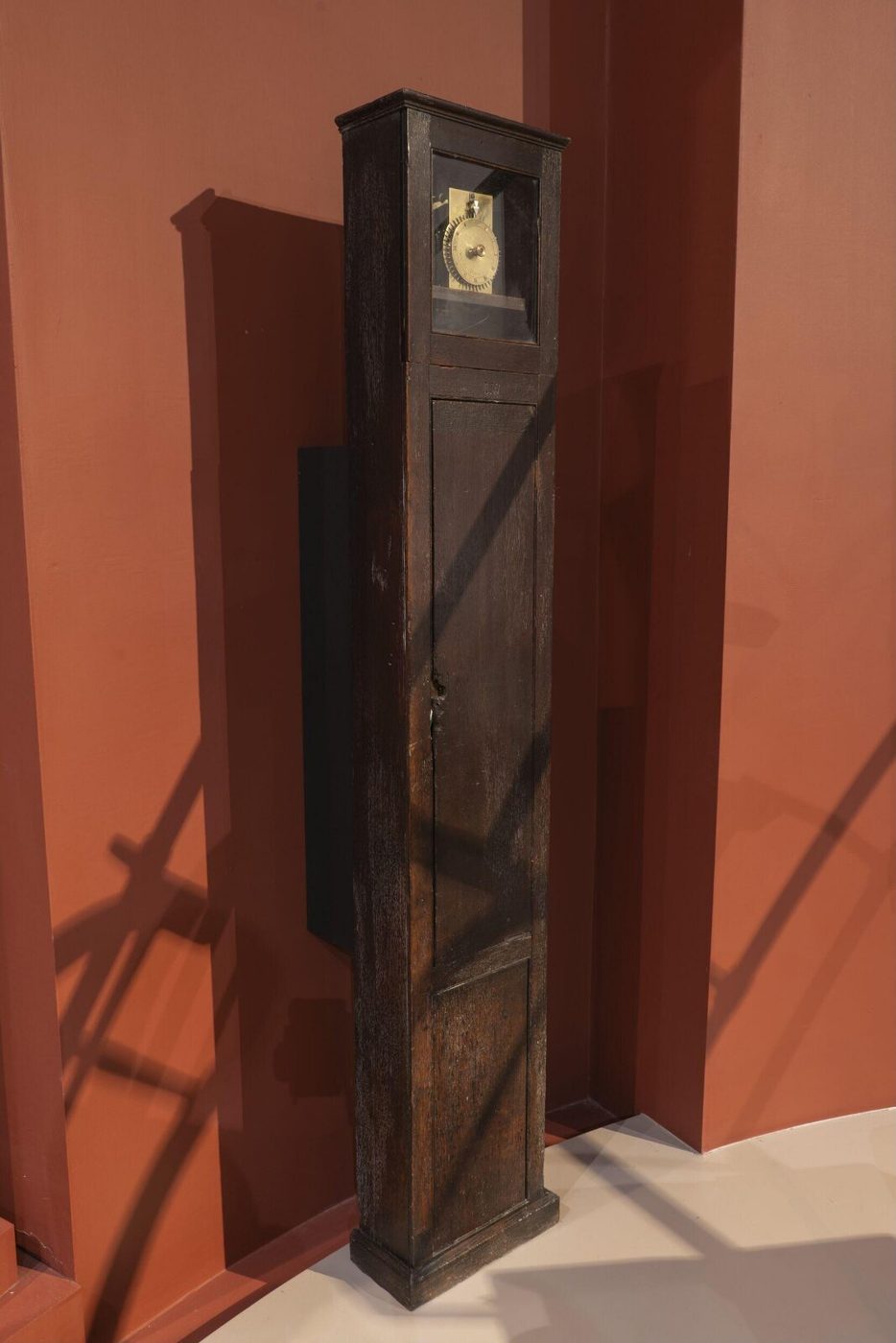
Night Watchman's Clock or Noctuary, John Whitehurst of Derby, 1806; Engraved wood with clock mechancism and a brass dial.
- Maker / attribution
- Unrecorded in source
- Date
- 1806
- Historical period
- Precision & Scientific Horology (1750 – 1850)
- Country of origin
- Unrecorded in source
- Object type
- Clock
- Materials / technique
- wood, brass, engraved
- Dimensions
- Height: 1940 mm; Width: 330 mm
- Holding institution
- Victoria and Albert Museum, London
- Accession / object no.
- WE.7566-2014
- Credit line
- V&A Wedgwood Collection. Presented by Art Fund with major support from the National Lottery Heritage Fund, private donations and a public appeal.
Record summary
Held and catalogued by Victoria and Albert Museum, London (object number WE.7566-2014), this is a clock, dated 1806. The Atlas places it in the Precision & Scientific Horology period (1750 – 1850) of its Clocks collection. Materials and techniques recorded by the source: wood, brass, engraved. Recorded dimensions: Height: 1940 mm; Width: 330 mm. The record is illustrated with 3 photographs.
Assembled from the source record's structured fields. Dates and attributions are given as the source states them; where a field is missing the Atlas leaves it blank rather than estimating.
Catalogue description
V&A — Summary
The need for a clock to regulate the movements of Watchmen in factories (and indeed country homes), was very much the product of the new orders of the Industrial Revolution. The clock has a revolving brass 12 hour dial, each is sub-divided into quarters, at each of which the rim was drilled to take pins which protrude about 5/8 ths of an inch. The Watchmen on reading the clock would depress a lever in the case which would operate a small hammer which in turn would depress a pin. The clock case would be locked and the foreman was able to check on the progress of his watchmen by which pins had been depressed. The actual time could be read against the brass pointer against the dial. After 12 hours the pins were automatically re-set by passing over a ramp.
V&A gallery label
With industrialisation came new ways to regulate workers. This clock was used at Etruria to keep a record of the night watchman's movements during a shift. The clock has a revolving 12-hour dial, with markers at 15-minute intervals. The watchman would clock in by pressing a lever on the case, which operated a small hammer, moving a pin on the dial. After 12 hours the pins were automatically reset for the next shift.
Historical context
Precision & Scientific Horology (1750 – 1850)
Harrison solves longitude; Mudge invents the lever; Breguet's Paris workshop defines the modern watch.
The age of the deadbeat escapement, compensated pendulums and observatory regulators. Domestic clocks spread through the middle classes: English longcase and bracket clocks, French gilt-bronze mantel clocks, Viennese Biedermeier wall clocks, Black Forest painted-shield clocks, and the first American shelf clocks.
Read the period in the timelineMore clocks from this periodEarlier: Early Modern Horology
Atlas type guide
Timers, stopwatches, chronoscopes and time recorders
Instruments for measuring short intervals or recording when something happened form a large and practical branch of horology. Sports stopwatches and split-seconds timers, laboratory chronoscopes (such as Hipp's, which measured thousandths of a second for psychology and ballistics experiments), metronomes for music, watchmen's clocks that recorded patrol rounds, and the time recorders that clocked factory workers in and out all derive from clock and watch technology.
These objects matter historically because they show timekeeping leaving the observatory and the drawing room and entering industry, science and sport. Many were mass-produced, and their dials, scales and patents chart the rise of electrification and industrial management.
What to look for
- Scales graduated in fifths, tenths or hundredths of a second, or decimal minutes for industrial use.
- Start, stop and reset push-pieces; a second hand that can be stopped independently (split seconds).
- Recording devices: paper discs or tapes, printing mechanisms, keys or punches.
- Patent numbers and dates on the dial or case, which give a terminus post quem.
Dating clues
- Hipp chronoscopes were made from the 1840s into the twentieth century.
- Employee time recorders spread from the 1890s (Bundy, IBM, International Time Recording Co.).
- Quartz and electronic timers replaced mechanical stopwatches in sport from the 1970s.
General guidance written by the Atlas editors about this kind of object. It is not a statement about this particular piece; for that, rely on the source record above and on physical examination.
Read next:ChronographFlyback chronograph
Related records
Clocks · 1701-1799
Alarm clock, Austria, 1701-1799
Science Museum Group, London
Clocks · 1711–1827
Longcase clock by David Roentgen ( - ), England, 1711–1827
Badisches Landesmuseum Karlsruhe
Clocks · 1723–1811
Table clock by Louis Montjoye, France, 1723–1811
Badisches Landesmuseum Karlsruhe
Clocks · 1738–1814
Table clock by Jean Simon Bourdier, France, 1738–1814
Badisches Landesmuseum Karlsruhe
Clocks · 1740-1760
Longcase clock, English, 1740-1760, japanned wood, John Ellicott
Victoria and Albert Museum, London
Clocks · 1740–60
Tall clock by Samuel Bagnall, United States, 1740–60
The Metropolitan Museum of Art, New York
Clocks · 1750-1800
Bracket clock in metal case with scroll handles and flamed-shaped top signed by Pierre Seignoret, Clockmaket to the the Comte d'Artois
Victoria and Albert Museum, London
Clocks · 1750
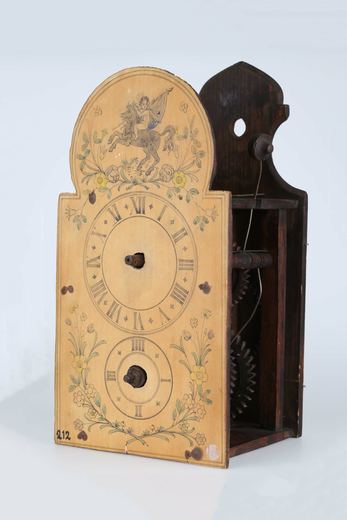
Clock by Georg Gfell, Germany, 1750
German Clock Museum