
Wristwatches · Wristwatch
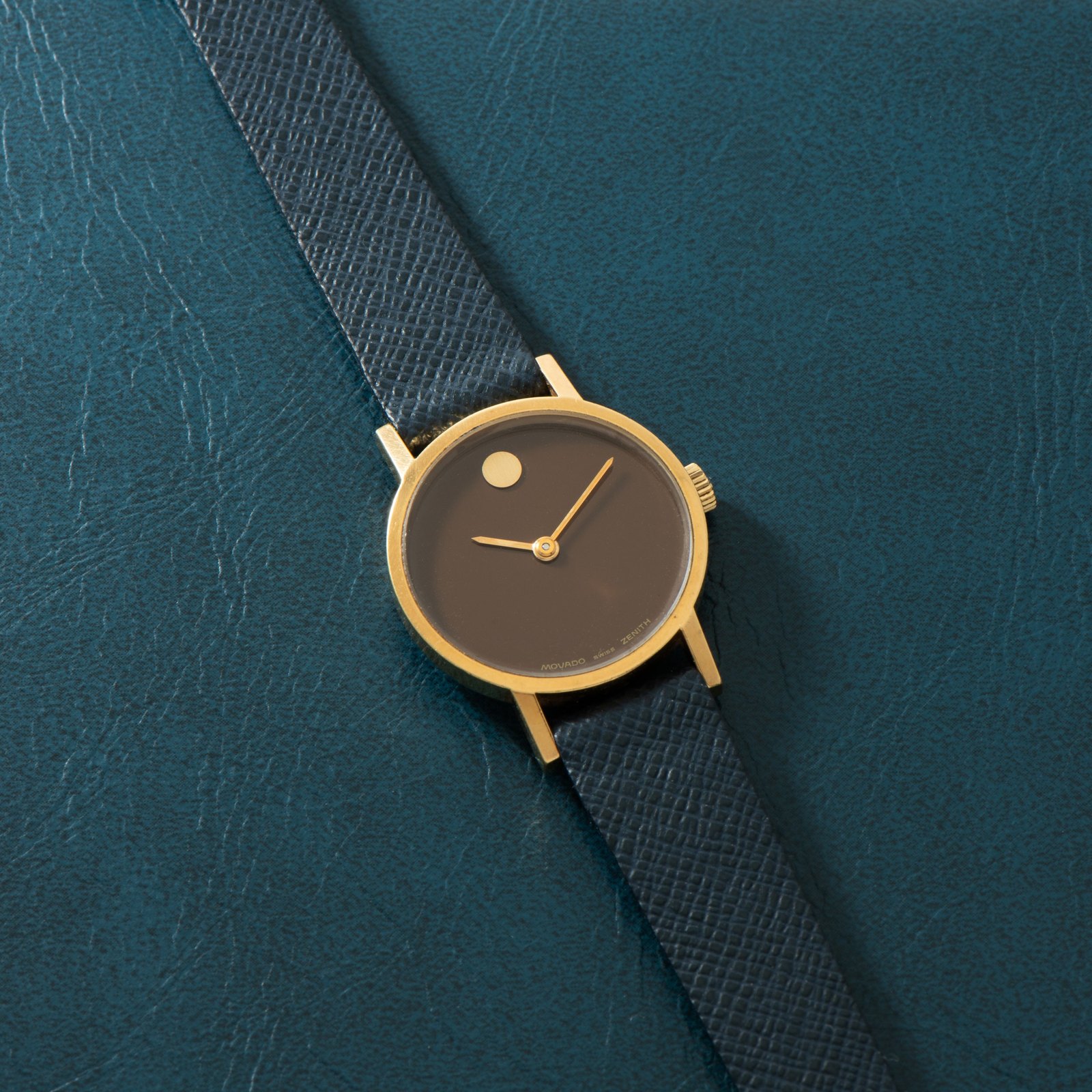
Movado 'Zenith' Museum Watch, 1970s
- Maker / attribution
- Movado (maker)
- Date
- 1970s
- Historical period
- Quartz Revolution (1969 – 1990)
- Country of origin
- Switzerland
- Object type
- Wristwatch
- Dimensions
- Case 25 mm
- Stock no.
- 40993433
- Credit line
- Dealer listing, Analog/Shift (40993433)
- Catalogue title (original)
- Movado 'Zenith' Museum Watch (English)
View the source record (dealer listing) ↗ (opens another website in a new tab)Suggest a correction
Record summary
Catalogued by Analog/Shift (dealer), New York (stock number 40993433), this is a wristwatch by Movado, made in Switzerland, dated 1970s. The Atlas places it in the Quartz Revolution period (1969 – 1990) of its Wristwatches collection. Recorded dimensions: Case 25 mm. The record is illustrated with 6 photographs.
Assembled from the source record's structured fields. Dates and attributions are given as the source states them; where a field is missing the Atlas leaves it blank rather than estimating.
Catalogue description
Dealer description — Analog/Shift
Few watch dials have achieved the status of true industrial design icons. Introduced by American designer Nathan George Horwitt in 1947, the Museum Dial distilled the concept of timekeeping into its purest form: a single gold dot at 12 o'clock representing the sun at high noon, with the hands orbiting below. Initially rejected by the watch industry for being too radical, Horwitt's design was later adopted by Movado in the 1960s and ultimately earned a place in the permanent collection of New York's Museum of Modern Art—giving rise to the now-famous "Museum Watch." This elegant example dates to the 1970s, a fascinating period when Movado and Zenith operated under the same corporate ownership as the MZM Group. Reflecting that partnership, the rich chocolate brown dial is signed "MOVADO SWISS ZENITH," a detail unique to watches produced during this era. Its minimalist composition remains as striking today as it was nearly fifty years ago, with slender gold hands sweeping across the uninterrupted dial toward the signature gold sun at noon. The watch is housed in a refined 25mm gold-filled case with a stainless steel caseback, proportions that perfectly suit the understated elegance of Horwitt's design. Inside beats a Swiss manual-winding mechanical movement, offering the tactile ritual of daily winding that complements the watch's thoughtful simplicity. Accompanying the watch are its original box and papers, an increasingly uncommon addition that enhances both its collectibility and its appeal to enthusiasts seeking a complete vintage package. Minimalist before minimalism became fashionable, the Museum Watch remains one of the most influential wristwatch designs ever created. Its enduring appeal lies not in complexity, but in restraint—a reminder that sometimes the boldest statement is made by leaving almost everything out.
Historical context
Quartz Revolution (1969 – 1990)
Seiko's Astron begins mass quartz timekeeping; traditional industries contract sharply.
Quartz and digital watches transformed the market after 1969. Swiss employment collapsed, Japanese and Hong Kong production soared, and the Swatch (1983) helped the Swiss industry recover; mechanical watches survived as luxury goods.
Read the period in the timelineMore wristwatches from this periodEarlier: Modern Mechanical Horology
Atlas type guide
Wristwatches
Bracelet watches were worn by women from the early nineteenth century — Breguet made one for Caroline Murat, Queen of Naples, in 1810–12 — but the wristwatch only became a man's instrument with military use and aviation in the early twentieth century. Between the World Wars it overtook the pocket watch; the 1920s and 1930s brought rectangular Art Deco cases, water-resistant cases and the first automatic winding systems.
After 1945 the wristwatch became a carrier of identity — dress watches, sports and dive watches, chronographs, calendars — produced by Swiss, American, Japanese, German, Soviet and Chinese industries. The quartz revolution after 1969 and the mechanical renaissance since the 1990s, including the rise of independent watchmakers, complete the story.
What to look for
- The reference number (between the lugs or inside the case back) and serial number, the starting point for dating.
- The calibre: its maker and number are often stamped under the dial or on the bridge.
- Originality of dial, hands and crown — refinished ('redial') dials are common.
- Case material marks: 18K/750, 14K/585, stainless steel, gold-filled, plated.
Dating clues
- Wire-lug cases: before c. 1925.
- Water-resistant screw-down cases: from 1926.
- Quartz movements: from 1969; sapphire crystals widespread after c. 1980.
General guidance written by the Atlas editors about this kind of object. It is not a statement about this particular piece; for that, rely on the source record above and on physical examination.
Related records
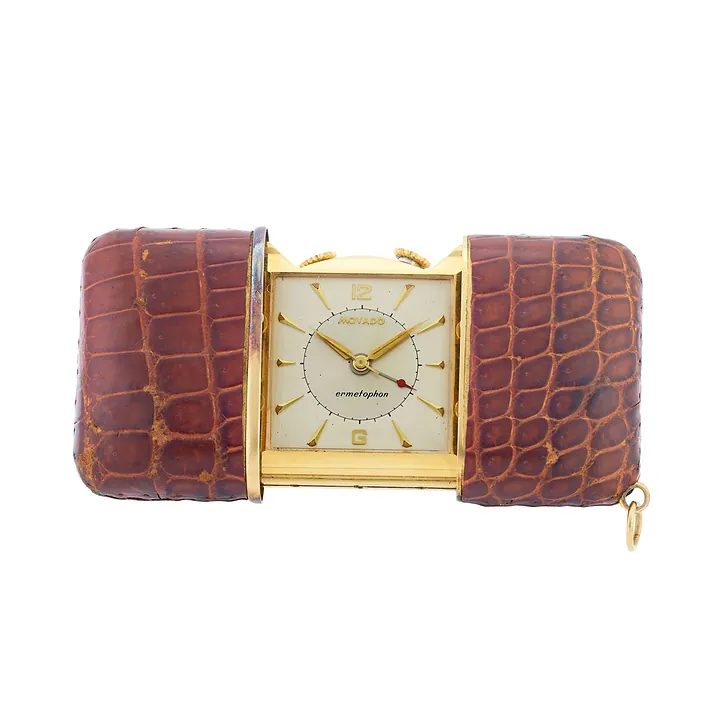
Pocket Watches · c. 1960s
Movado Ermetophone, c. 1960s
Antiquorum auction archive, Geneva
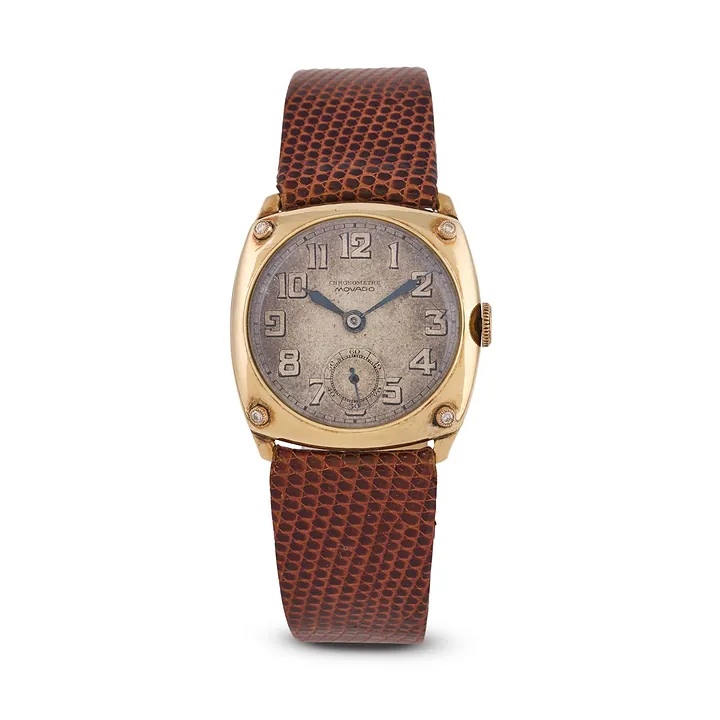
Wristwatches · c. 1920s
Movado Chronometre, ref. 41536, c. 1920s
Antiquorum auction archive, Geneva
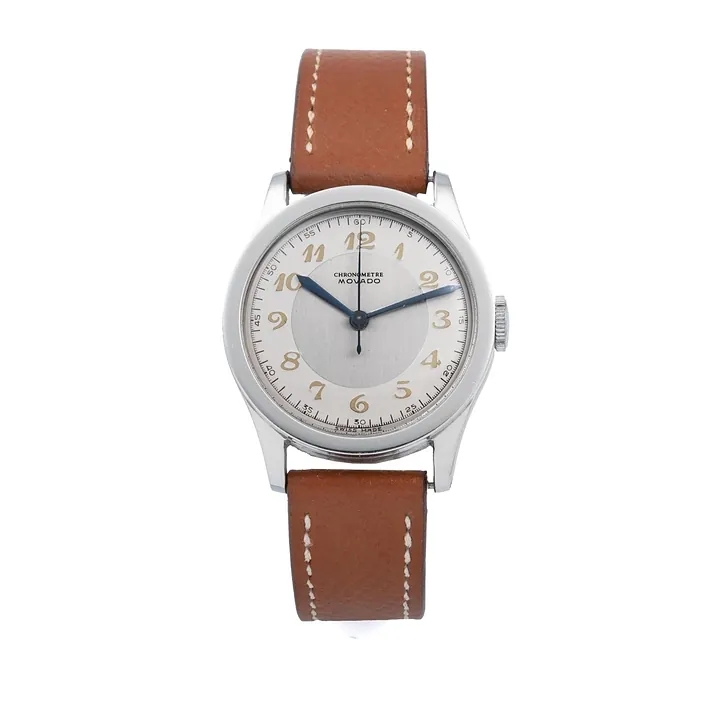
Wristwatches · c. 1930s
Movado "calatrava", ref. 17726, c. 1930s
Antiquorum auction archive, Geneva
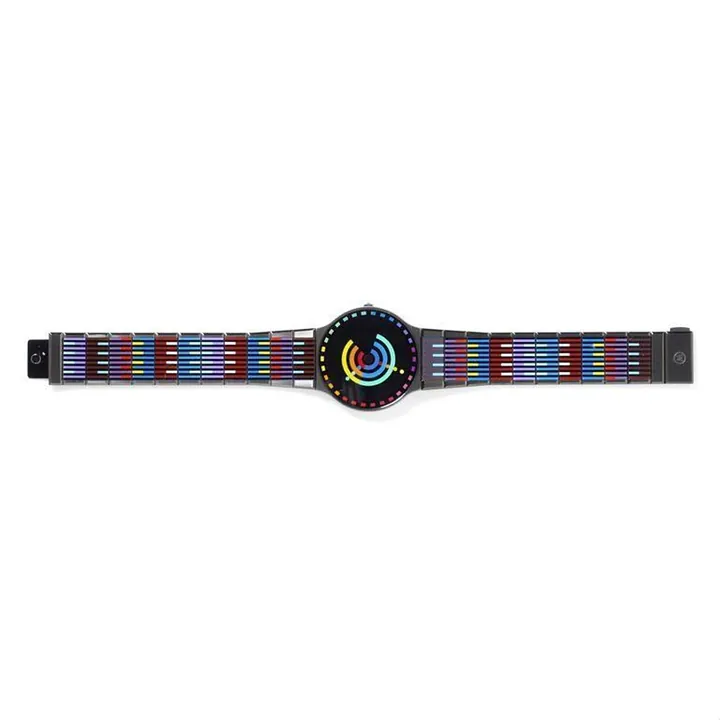
Wristwatches · c.1989
Steel, France and Switzerland, 1989; designed by Yaacov Agam (born 1928) for a limited edition by Movado
Victoria and Albert Museum, London

Wristwatches · 1970
Wristwatch by Heno, Switzerland, 1970
Museum Rotterdam

Wristwatches · 1960–1986
'Tri-Compax' calendar chronograph wristwatch in gold case, by Universal, Geneva, Switzerland, 1960–1986.
Science Museum Group, London

Wristwatches · 1969–1970
Beta 21 Quartz wristwatch movement, made in Switzerland, 1970.
Science Museum Group, London

Wristwatches · c. 1969
Omega Speedmaster Moonwatch, ref. 145022-69st, c. 1969
Antiquorum auction archive, Geneva