
Wristwatches · Wristwatch
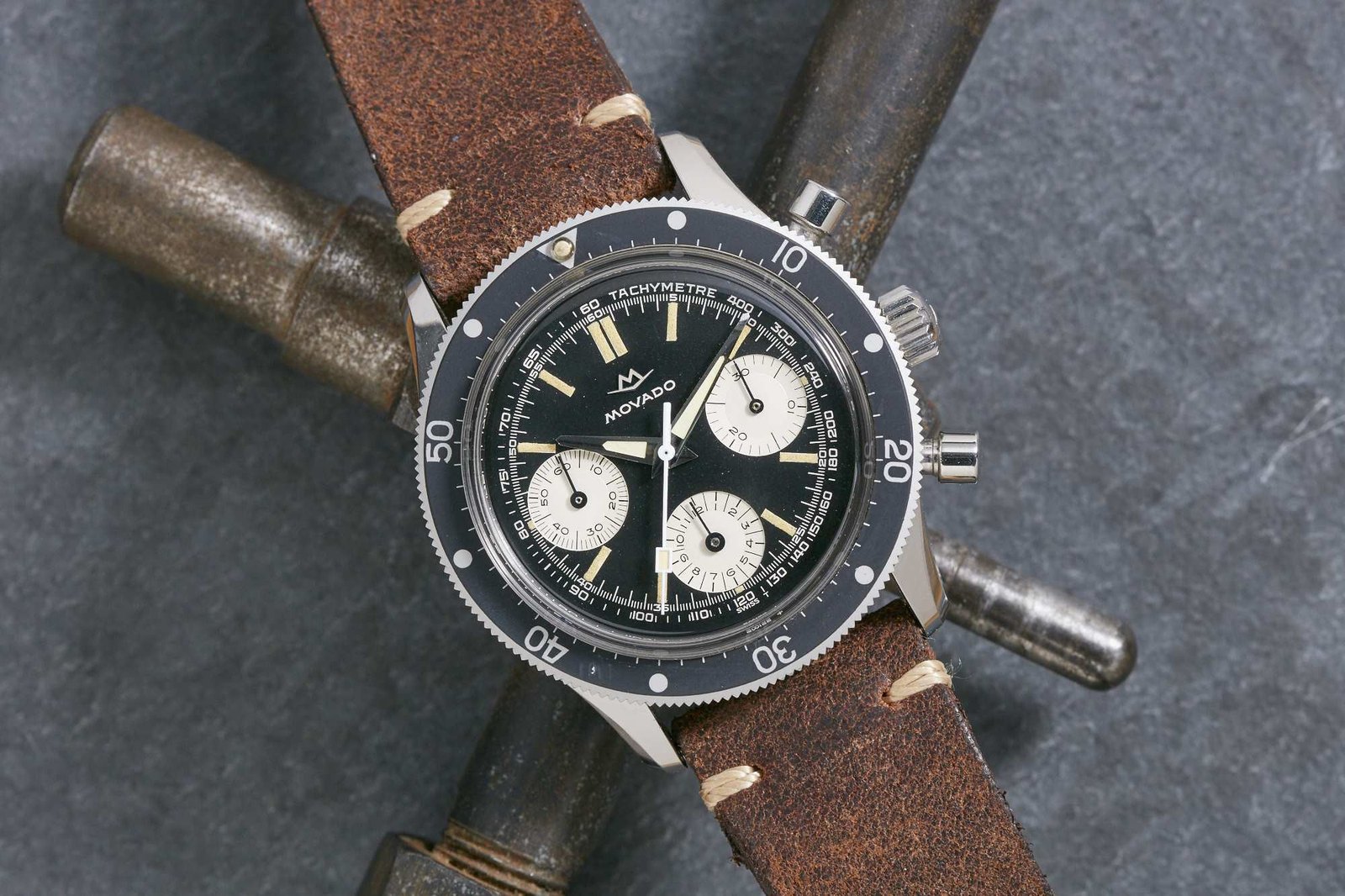
Movado Super Sub Sea Chronograph, early 1960s
- Maker / attribution
- Movado (maker)
- Date
- early 1960s
- Historical period
- Modern Mechanical Horology (1945 – 1969)
- Country of origin
- Switzerland
- Object type
- Wristwatch
- Dimensions
- Case 41 mm
- Stock no.
- Product 6469156673
- Credit line
- Dealer listing, Analog/Shift (product 6469156673)
- Catalogue title (original)
- Movado Super Sub Sea Chronograph (English)
View the source record (dealer listing) ↗ (opens another website in a new tab)Suggest a correction
Record summary
Catalogued by Analog/Shift (dealer), New York (stock number Product 6469156673), this is a wristwatch by Movado, made in Switzerland, dated early 1960s. The Atlas places it in the Modern Mechanical Horology period (1945 – 1969) of its Wristwatches collection. Recorded dimensions: Case 41 mm. The record is illustrated with 6 photographs.
Assembled from the source record's structured fields. Dates and attributions are given as the source states them; where a field is missing the Atlas leaves it blank rather than estimating.
Catalogue description
Dealer description — Analog/Shift
Movado started in 1881, when watchmaker Achilles Ditesheim opened a workshop for the production of pocket watches in La Chaux-de-Fonds. His brothers Léopold and Isidore joined him in 1886. By 1900, the brothers were producing wristwatches. In 1905, the brothers moved production to a new facility and christened their brand Movado, which means "always in motion" in Esperanto. Even in the early days, watches produced by the brothers garnered many awards, surpassing watches of their rivals at competitions. Movado produced incredible mechanical timepieces through the 20th century, gaining notoriety for their Museum Watch, a Bauhaus-inspired design from 1947 characterized by its singular hour marker at 12 o'clock, reminiscent of the sun at noon. Dating from the early 1960s, the Super Sub Sea Chronograph is a relative rare version of that elusive hybrid, the chronodiver. Earlier versions of this chronograph bore the M95 movement, first developed by Piguet in 1938, which has the distinction of being the first modular chronograph movement. These Super Sub Sea chronographs can be distinguished from later versions by the position of the chronograph registers, being closer together than in later versions. The look of the Super Sub Sea chronodiver changed after Movado and Zenith were united in 1969 under their parent holding company, Mondia-Zenith-Movado. This of course was a banner year for horology, being the debut of the Zenith El Primero movement and the Caliber 11 developed by Breitling, Heuer, and Buren. Due to a change in movement, the registers of these later Super Sub Sea chronodivers are farther apart now, and they lack the distinctive squiggly sub-dial hands that set the earlier chronodivers apart. At first glance, this later-model Super Sub Sea chronodiver takes designs cues from the Zenith A277, with its reverse-panda dial, rotating bezel, and prominent pushers. Indeed, these watches share movements: the Caliber 285. Zenith and Universal Gèneve worked together on a collaborative basis starting in the 1960s, with Zenith often adapting designs of Universal Gèneve ébauches to suit their own purposes. The Caliber 285 is a beautiful movement, with a column wheel and a Breguet hairspring. The Super Sub Sea is certainly a stunner, with a large, strong 41mm case. The case is sharp, robust, the kind of watch you won't definitely forget you're wearing when it's strapped to your wrist. For a watch that's as rare as it is sharp, it will certainly catch eyes.
Historical context
Modern Mechanical Horology (1945 – 1969)
Tool watches for divers, pilots and astronauts; electric watches anticipate the electronic age.
The classic era of the mechanical wristwatch: dive watches, chronographs for motor racing and space flight, GMT watches for jet travel, slim dress watches, automatic calendars, and the rise of Japanese manufacturers alongside Swiss, American, German and Soviet industries.
Read the period in the timelineMore wristwatches from this periodEarlier: Golden Age of Mechanical Watchmaking
Atlas type guide
Chronographs and split-seconds watches
A chronograph is a watch with an additional seconds hand that can be started, stopped and returned to zero independently of the timekeeping. Louis Moinet built an early example in 1816 and Nicolas Rieussec a recording 'chronographe' in 1821; Adolphe Nicole's heart-shaped reset cam (patented 1862) made the modern return-to-zero possible. Split-seconds (rattrapante) chronographs add a second hand that can be stopped for intermediate times; flyback chronographs restart instantly.
Chronographs were essential tools for doctors (pulsometer scales), artillery (telemeter), engineers and sport. In wristwatches, Valjoux, Venus, Lemania and later the automatic chronographs of 1969 (Zenith El Primero, the Chronomatic Calibre 11 group and Seiko 6139) are milestones.
What to look for
- Push-pieces on the case band or a single button in the crown (monopusher).
- Subsidiary registers for minutes and hours; tachymeter, telemeter or pulsometer scales.
- Column wheel versus cam control visible in the movement.
- Calibre markings of specialist makers (Valjoux, Lemania, Venus, Landeron).
Dating clues
- Pocket chronographs with heart cam reset: after 1862.
- Wrist chronographs: from c. 1910; two-button designs from the 1930s.
- Automatic chronographs: from 1969.
General guidance written by the Atlas editors about this kind of object. It is not a statement about this particular piece; for that, rely on the source record above and on physical examination.
Read next:Flyback chronographChronograph
Related records
Pocket Watches · c. 1960s
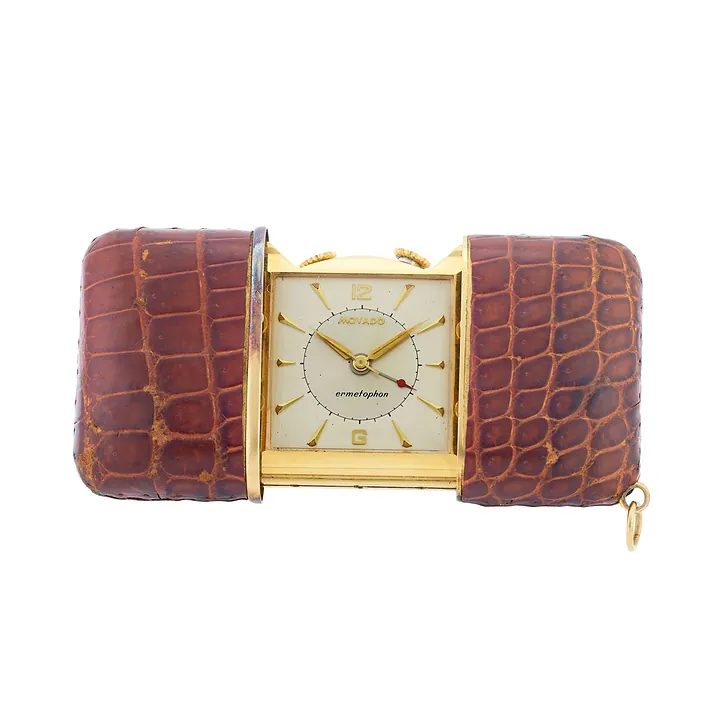
Movado Ermetophone, c. 1960s
Antiquorum auction archive, Geneva
Wristwatches · c. 1920s
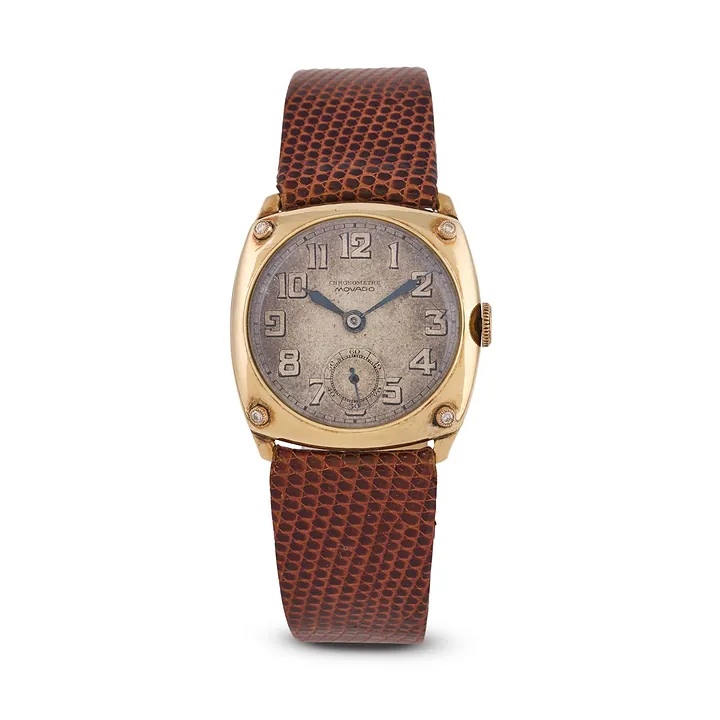
Movado Chronometre, ref. 41536, c. 1920s
Antiquorum auction archive, Geneva
Wristwatches · c. 1930s
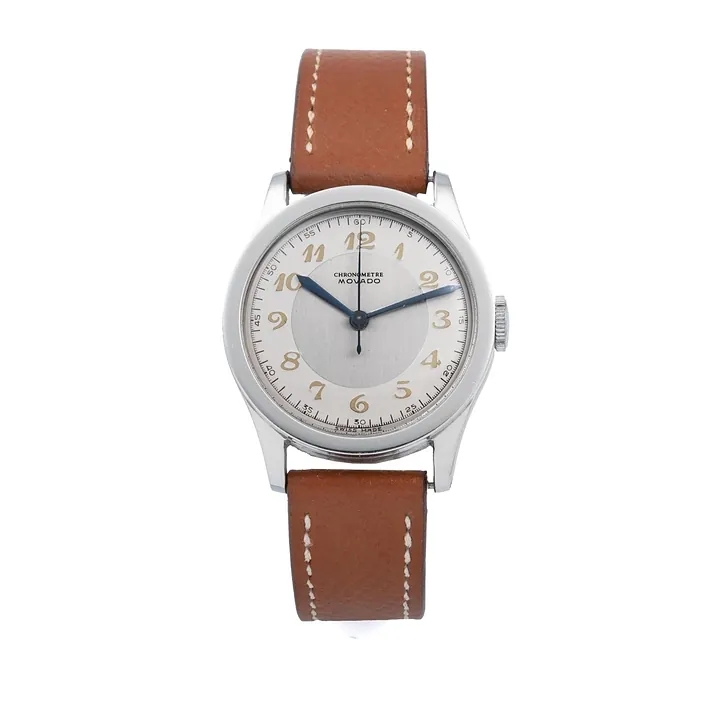
Movado "calatrava", ref. 17726, c. 1930s
Antiquorum auction archive, Geneva
Wristwatches · c.1989
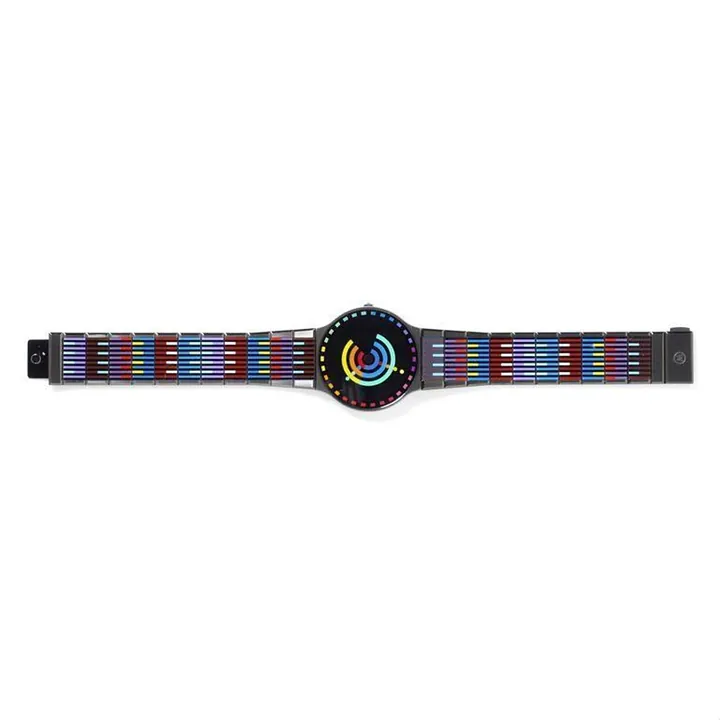
Steel, France and Switzerland, 1989; designed by Yaacov Agam (born 1928) for a limited edition by Movado
Victoria and Albert Museum, London

Wristwatches · 1945
Wristwatch by Eterna, 1945
Museum Rotterdam

Wristwatches · c. 1945
Breitling Premier, ref. 790, c. 1945
Antiquorum auction archive, Geneva

Wristwatches · c. 1945
Universal Genève Uni-Compax, ref. 22492, c. 1945
Antiquorum auction archive, Geneva

Wristwatches · c. 1950s
Baume & Mercier wristwatch, c. 1950s
Antiquorum auction archive, Geneva