
Wristwatches · Wristwatch
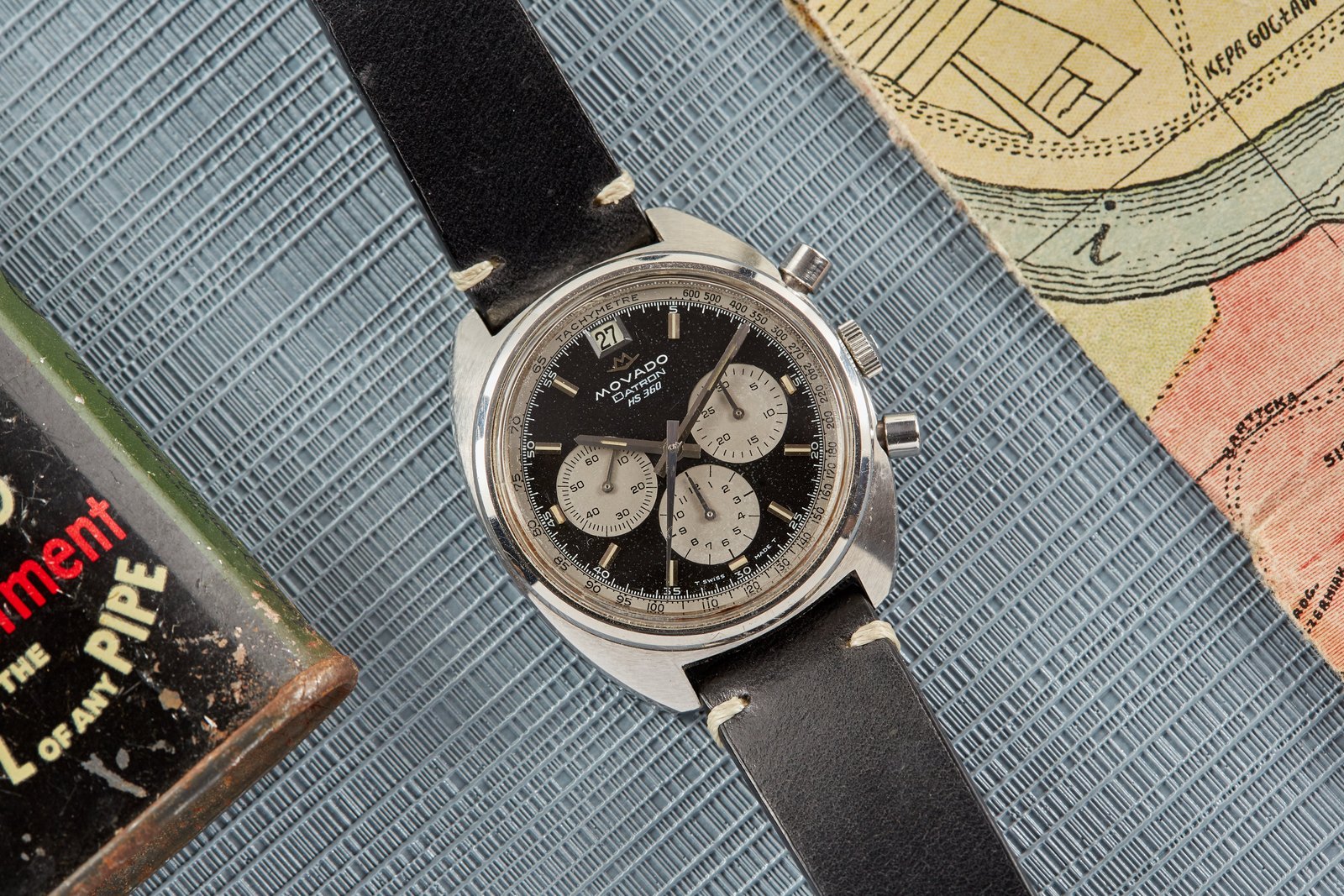
Movado Datron HS360 Chronograph, early 1970s
- Maker / attribution
- Movado (maker)
- Date
- early 1970s
- Historical period
- Quartz Revolution (1969 – 1990)
- Country of origin
- Switzerland
- Object type
- Wristwatch
- Dimensions
- Case 38 mm
- Stock no.
- Product 2020226760791
- Credit line
- Dealer listing, Analog/Shift (product 2020226760791)
- Catalogue title (original)
- Movado Datron HS360 Chronograph (English)
View the source record (dealer listing) ↗ (opens another website in a new tab)Suggest a correction
Record summary
Catalogued by Analog/Shift (dealer), New York (stock number Product 2020226760791), this is a wristwatch by Movado, made in Switzerland, dated early 1970s. The Atlas places it in the Quartz Revolution period (1969 – 1990) of its Wristwatches collection. Recorded dimensions: Case 38 mm. The record is illustrated with 6 photographs.
Assembled from the source record's structured fields. Dates and attributions are given as the source states them; where a field is missing the Atlas leaves it blank rather than estimating.
Catalogue description
Dealer description — Analog/Shift
Why We Love It Learning about - and then sharing knowledge about the lesser known horological gems is what makes the Analog/Shift team tick. While a cursory glance at this Movado Datron HS360 Chronograph may conjure thoughts of '70s cushion-case Heuers, further study of this unusual 38mm piece will leave no thought of envy for its contemporaries. Powered by the first hi-beat automatic chronograph movement ever made; the Calibre 3019 El Primero by Zenith, this Movado branded piece might just be the better (and far less expensive) option in the legendary movement's 50th Anniversary year. The design and ergonomic is very impressive on this timepiece. With refined touches ranging from subtly recessed subsidiary registers to its 12:00 quick-set date and signed crown, this is a high quality watch from a brand that no longer makes high quality mechanical watches (Movado - not Zenith!). Dating to the early 1970s, pieces such as this awesome HS360 have slipped under the radar of most collectors. Their loss! The Story While Movado is now best known as a producer of fashion watches like the Museum Watch, Movado's roots go much deeper than that. The company’s history reaches all the way back to 1881, when watchmaker Achilles Ditesheim opened a workshop in La Chaux-de-Fonds. His brothers Léopold and Isidore joined him in 1886. Production from that point on proved how true the name brand was—it means "always in motion" in Esperanto. Throughout the 20th century Movado produced incredible mechanical timepieces. They gained notoriety for the sophistication of the equipment and technology they employed, including electric tools. Unlike many of their counterparts, Movado's movements were designed and manufactured in-house. In the late 1960s, they were acquired by Zenith, and enjoyed perhaps their greatest period of success as the subsidiary of that brand. Their chronographs (which used the famous Zenith El Primero movement), particularly, were successful sellers.
Historical context
Quartz Revolution (1969 – 1990)
Seiko's Astron begins mass quartz timekeeping; traditional industries contract sharply.
Quartz and digital watches transformed the market after 1969. Swiss employment collapsed, Japanese and Hong Kong production soared, and the Swatch (1983) helped the Swiss industry recover; mechanical watches survived as luxury goods.
Read the period in the timelineMore wristwatches from this periodEarlier: Modern Mechanical Horology
Atlas type guide
Chronographs and split-seconds watches
A chronograph is a watch with an additional seconds hand that can be started, stopped and returned to zero independently of the timekeeping. Louis Moinet built an early example in 1816 and Nicolas Rieussec a recording 'chronographe' in 1821; Adolphe Nicole's heart-shaped reset cam (patented 1862) made the modern return-to-zero possible. Split-seconds (rattrapante) chronographs add a second hand that can be stopped for intermediate times; flyback chronographs restart instantly.
Chronographs were essential tools for doctors (pulsometer scales), artillery (telemeter), engineers and sport. In wristwatches, Valjoux, Venus, Lemania and later the automatic chronographs of 1969 (Zenith El Primero, the Chronomatic Calibre 11 group and Seiko 6139) are milestones.
What to look for
- Push-pieces on the case band or a single button in the crown (monopusher).
- Subsidiary registers for minutes and hours; tachymeter, telemeter or pulsometer scales.
- Column wheel versus cam control visible in the movement.
- Calibre markings of specialist makers (Valjoux, Lemania, Venus, Landeron).
Dating clues
- Pocket chronographs with heart cam reset: after 1862.
- Wrist chronographs: from c. 1910; two-button designs from the 1930s.
- Automatic chronographs: from 1969.
General guidance written by the Atlas editors about this kind of object. It is not a statement about this particular piece; for that, rely on the source record above and on physical examination.
Read next:Flyback chronographChronograph
Related records
Pocket Watches · c. 1960s
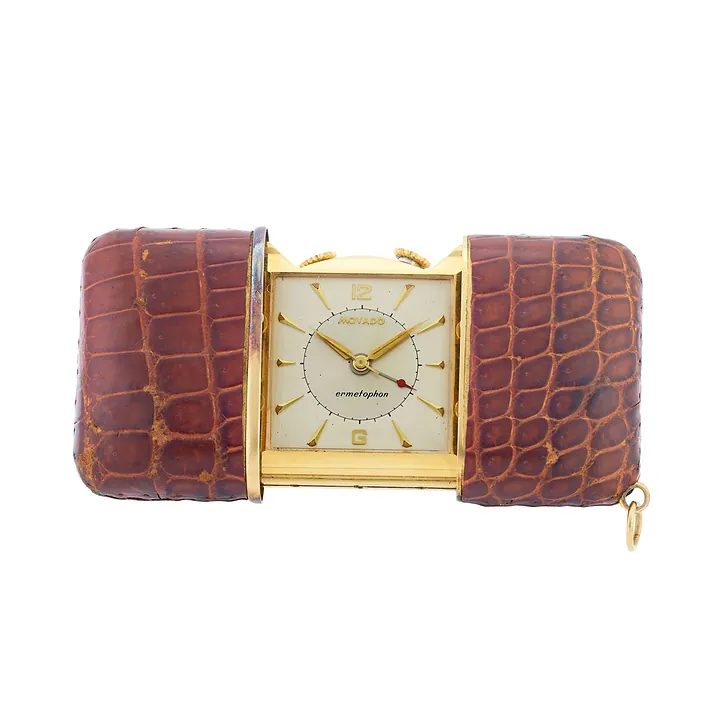
Movado Ermetophone, c. 1960s
Antiquorum auction archive, Geneva
Wristwatches · c. 1920s
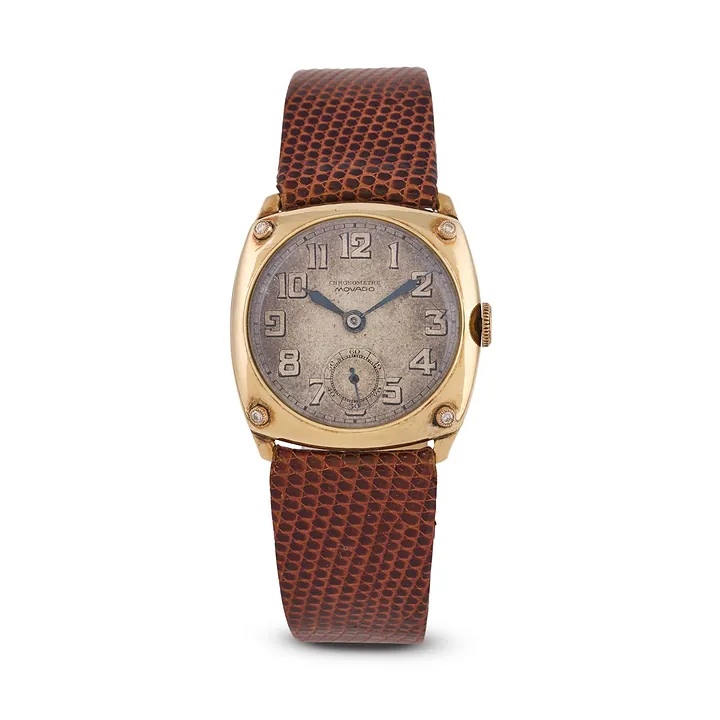
Movado Chronometre, ref. 41536, c. 1920s
Antiquorum auction archive, Geneva
Wristwatches · c. 1930s
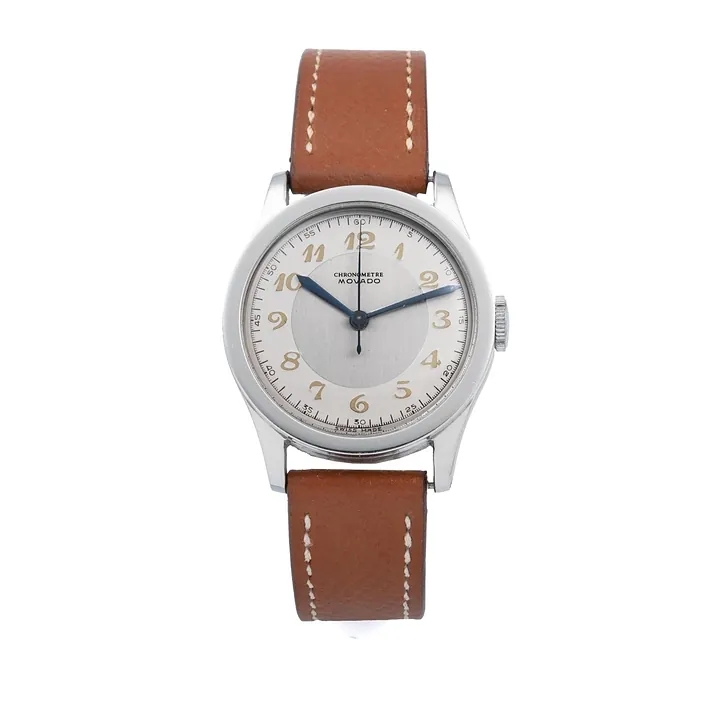
Movado "calatrava", ref. 17726, c. 1930s
Antiquorum auction archive, Geneva
Wristwatches · c.1989
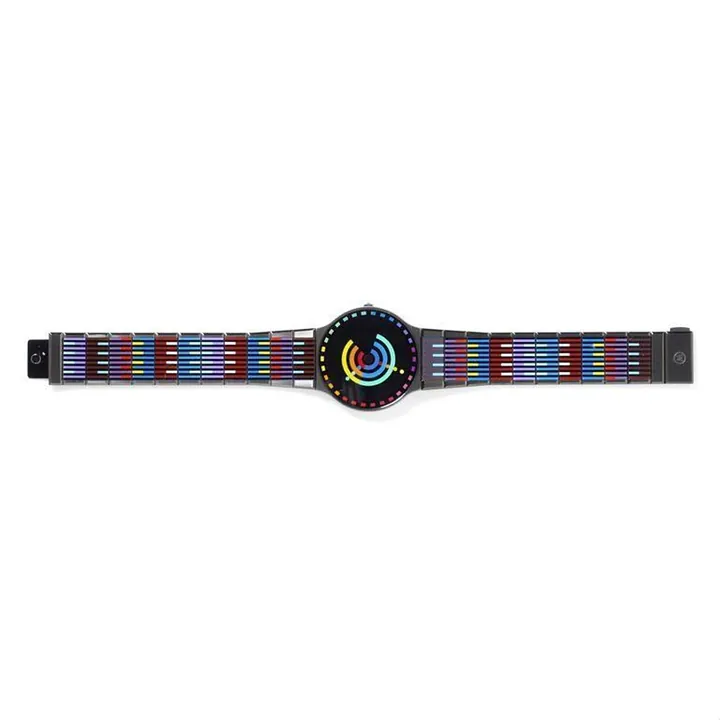
Steel, France and Switzerland, 1989; designed by Yaacov Agam (born 1928) for a limited edition by Movado
Victoria and Albert Museum, London

Wristwatches · 1970
Wristwatch by Heno, Switzerland, 1970
Museum Rotterdam

Wristwatches · 1960–1986
'Tri-Compax' calendar chronograph wristwatch in gold case, by Universal, Geneva, Switzerland, 1960–1986.
Science Museum Group, London

Wristwatches · 1969–1970
Beta 21 Quartz wristwatch movement, made in Switzerland, 1970.
Science Museum Group, London

Wristwatches · c. 1969
Omega Speedmaster Moonwatch, ref. 145022-69st, c. 1969
Antiquorum auction archive, Geneva