
Wristwatches · Wristwatch
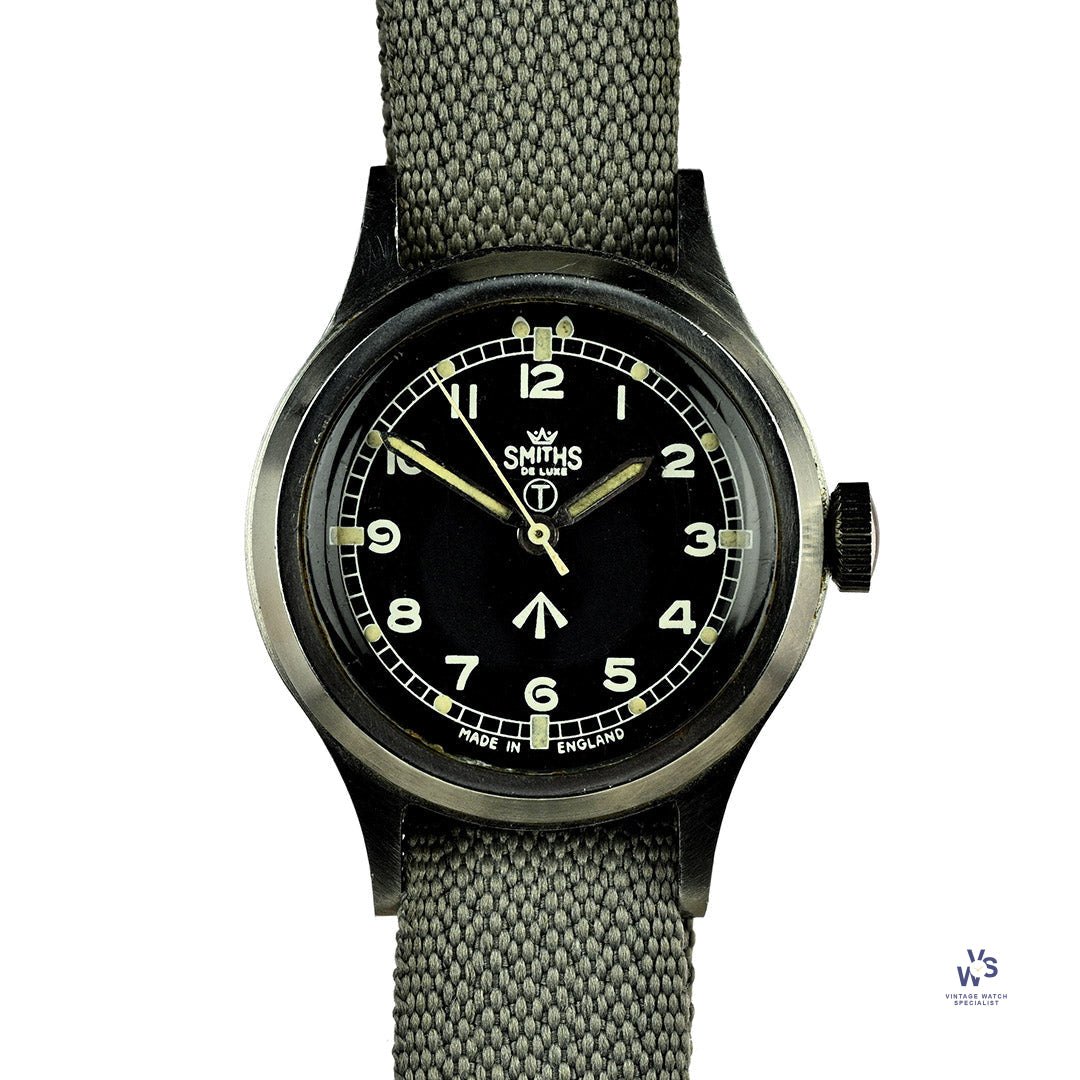
Military Issued Smiths DeLuxe T Dial, 6B/542 For The British RAF, 1956
- Maker / attribution
- Smiths (maker)
- Date
- 1956
- Historical period
- Modern Mechanical Horology (1945 – 1969)
- Country of origin
- England
- Object type
- Wristwatch
- Stock no.
- vws3636cs
- Credit line
- Dealer listing, Vintage Watch Specialist (vws3636cs)
- Catalogue title (original)
- Military Issued Smiths DeLuxe T Dial - 6B/542 For The British RAF - 1956 (English)
View the source record (dealer listing) ↗ (opens another website in a new tab)Suggest a correction
Record summary
Catalogued by Vintage Watch Specialist (dealer), United Kingdom (stock number vws3636cs), this is a wristwatch by Smiths, made in England, dated 1956. The Atlas places it in the Modern Mechanical Horology period (1945 – 1969) of its Wristwatches collection. The record is illustrated with 6 photographs.
Assembled from the source record's structured fields. Dates and attributions are given as the source states them; where a field is missing the Atlas leaves it blank rather than estimating.
Catalogue description
Dealer description — Vintage Watch Specialist
A Beautifully Preserved and Very Rare Military (RAF) Issued Smiths De Luxe Watch in Original Condition with Tritium Lume, 1956 In the 1950s, before the production of the W10 watch, Smiths were asked by the MoD to produce a watch for general military service to be used by all of the forces which would be built to their particular specifications. 300 of these 6B/542 designation watches were ordered and issued first to the RAF in the mid-1950s. After this, no more were ordered until 1961 when 600 were produced and sold to the Royal Australian Air Force. Given the small numbers in which this watch was manufactured, they proved particularly expensive to Smiths and subsequently production was ceased meaning this watch is a rarity indeed. What's on Offer Unbelievably this is the second of these watches we have acquired this year - they are so rare to come across that we don't expect to find them often and certainly not in this condition! Just look at that super rich and blemish-free black dial boasting ultra crisp and brilliant white Arabic numerals, lumed hour plots and corresponding hands. The tritium lume (denoted by the circled T) has aged to a beautiful light yellow across the dial - a detail we love to see on vintage watches. Of course, the pheon is also present - the arrow on the dial that denotes the watch as a property of the MoD. Encapsulated underneath shatterproof plexiglass, the dial is a delight, however, the steel case and lugs are also in superb condition and to the case back you will note the original military markings are all present and correct. This really is a significant piece of horological and military history and we don't expect it to be around for long. Don't sleep on this one. Serviced recently for us by the revered horological marvel, John Senior, so expect it to run extremely well and we have you covered with our 12 month guarantee!
Historical context
Modern Mechanical Horology (1945 – 1969)
Tool watches for divers, pilots and astronauts; electric watches anticipate the electronic age.
The classic era of the mechanical wristwatch: dive watches, chronographs for motor racing and space flight, GMT watches for jet travel, slim dress watches, automatic calendars, and the rise of Japanese manufacturers alongside Swiss, American, German and Soviet industries.
Read the period in the timelineMore wristwatches from this periodEarlier: Golden Age of Mechanical Watchmaking
Atlas type guide
Military, pilot and travel watches
The wristwatch owes much of its adoption by men to warfare and aviation. Wristlets — small pocket watches soldered with lugs and worn on a strap — were used in colonial campaigns and became standard equipment in the First World War, with protective grilles over the crystal ('shrapnel guards'). Louis Cartier's Santos (1904), designed for the aviator Alberto Santos-Dumont, is often cited as an early purpose-made pilot's watch.
In the Second World War governments specified watches in detail: the German B-Uhr observation watches, the American A-11, and the British 'W.W.W.' (the 'Dirty Dozen' set of 1945). After the war, jet travel brought GMT and world-time watches, which show two or more time zones at once — Louis Cottier's world-time mechanism and the Rolex GMT-Master (1955) are examples.
What to look for
- Military markings on the case back: broad arrow, issue numbers, 'W.W.W.', 'A.T.P.'
- High-legibility black dials with luminous Arabic numerals; oversized crowns for gloved hands.
- 24-hour hands and rotating 24-hour bezels or city rings on GMT/world-time watches.
- Wire lugs on early wristlets converted from pocket watches.
Dating clues
- Wire-lug wristlets: c. 1900–1925.
- Military specifications of the Second World War: 1939–1945.
- GMT and world-time wristwatches: mainly after 1950.
General guidance written by the Atlas editors about this kind of object. It is not a statement about this particular piece; for that, rely on the source record above and on physical examination.
Related records
Clocks · 1971–1979
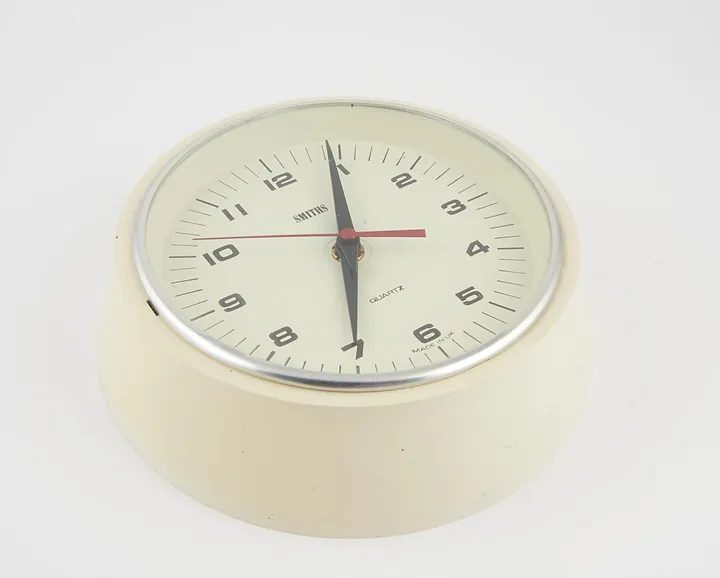
Electric clock by Smiths, England, 1971–1979
Science Museum Group, London
Wristwatches · c. 1950s
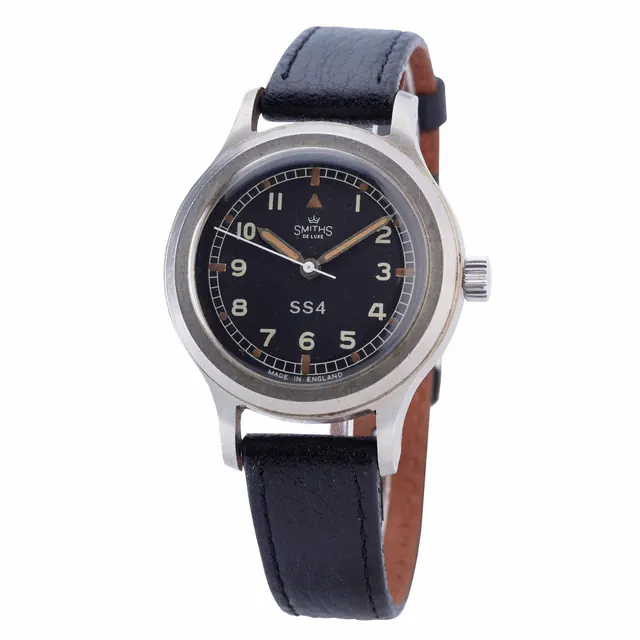
Smiths wristwatch, ref. SS4, Military, circa 1950s
Antiquorum auction archive, Geneva
Wristwatches · 1955
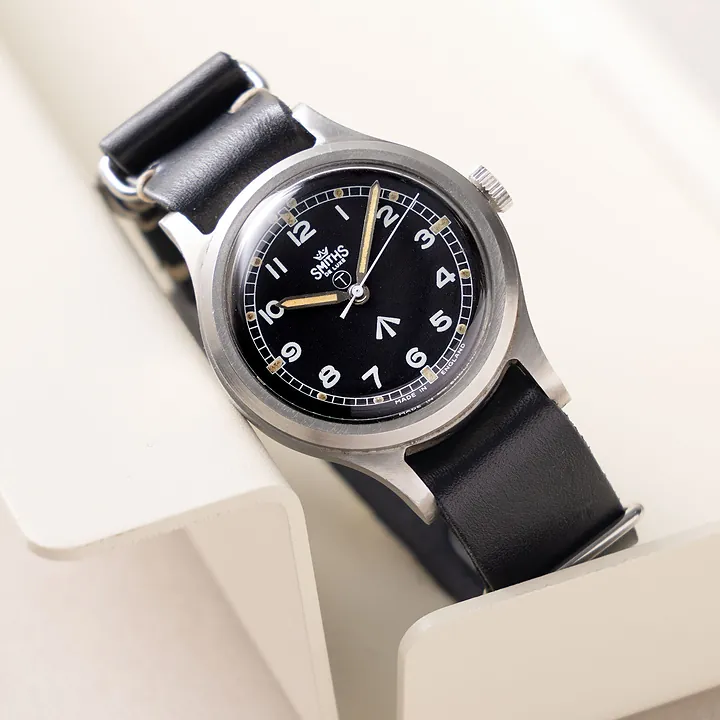
Smiths "Deluxe" ref 6B/542 Military Watch for the British RAF, 1955
Bulang & Sons (dealer), Copenhagen
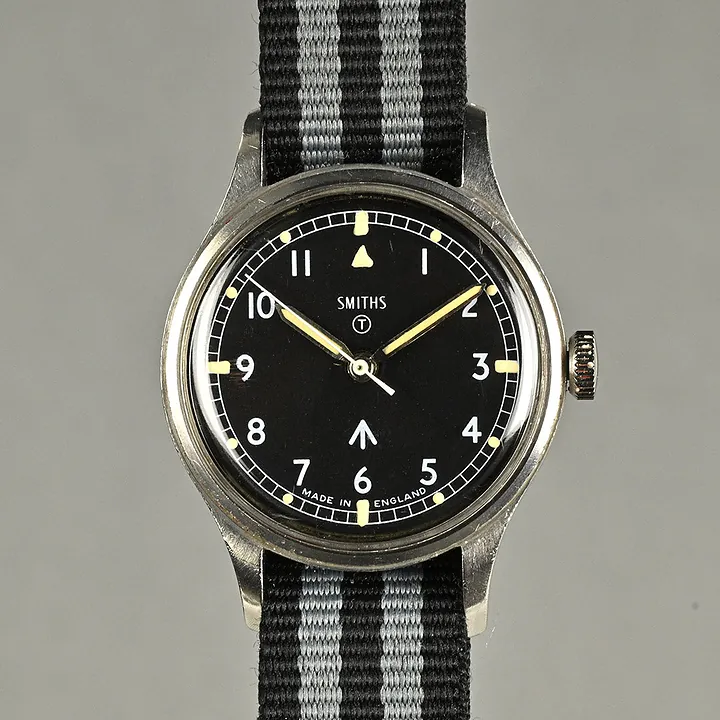
Wristwatches · 1968
Smiths W10 British Army Military Watch, ref. W10/6645-99-961-4045, 1968
Vintage Watch Specialist (dealer), United Kingdom
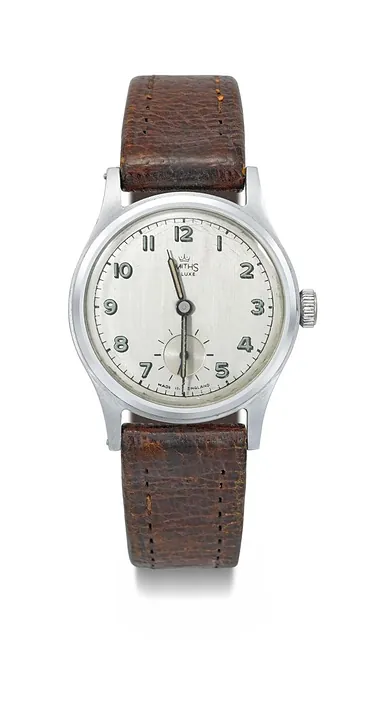
Wristwatches · 1953
Wristwatch by Smiths English Clocks Limited, England, 1953
Science Museum Group, London
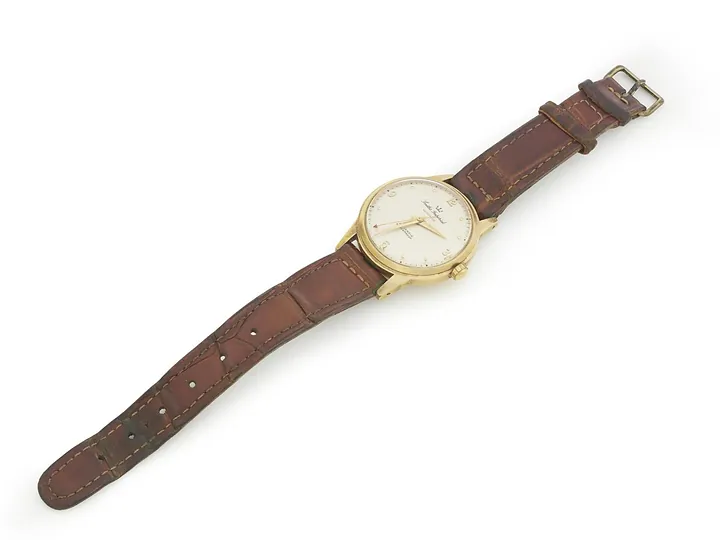
Wristwatches · 1959
Wristwatch by Smiths Clocks & Watches Ltd, England, 1959
Science Museum Group, London
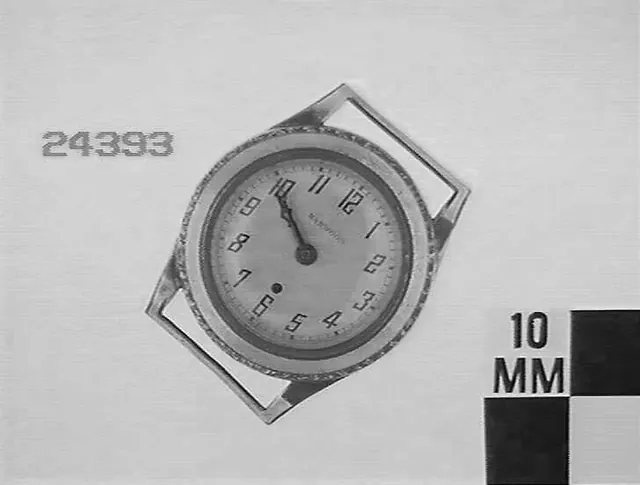
Wristwatches · 1958
Wrist Watch - Harwood, England, 1958
Museums Victoria, Melbourne
Wristwatches · c. 1957
Wrist Watch - Timex, Great Britain, c. 1957
Museums Victoria, Melbourne