
Wristwatches · Wristwatch
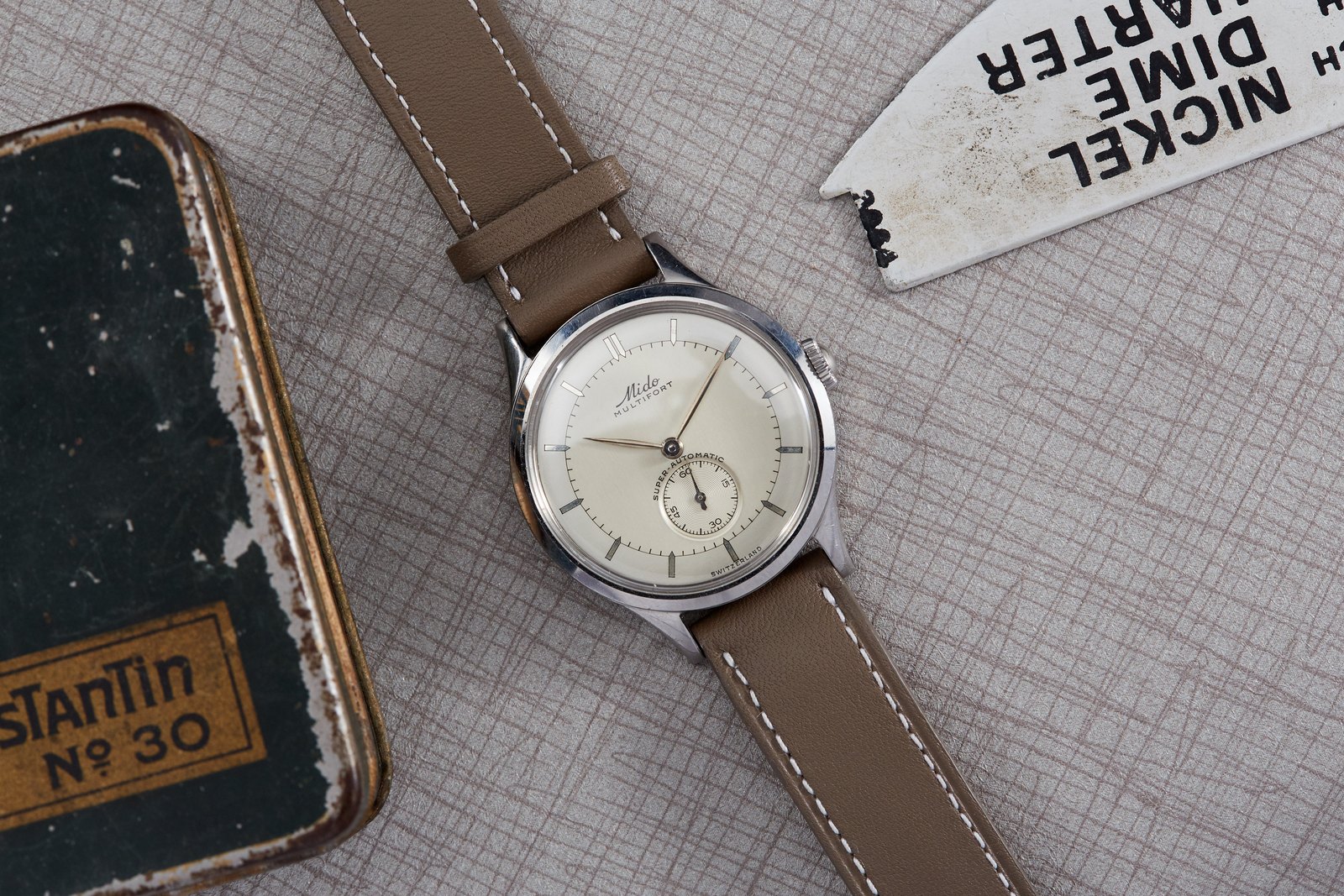
Mido Multifort Super-Automatic, 1950s
- Maker / attribution
- Mido (maker)
- Date
- 1950s
- Historical period
- Modern Mechanical Horology (1945 – 1969)
- Country of origin
- Unrecorded in source
- Object type
- Wristwatch
- Dimensions
- Case 34 mm
- Stock no.
- Product 1572870651991
- Credit line
- Dealer listing, Analog/Shift (product 1572870651991)
- Catalogue title (original)
- Mido Multifort Super-Automatic (English)
View the source record (dealer listing) ↗ (opens another website in a new tab)Suggest a correction
Record summary
Catalogued by Analog/Shift (dealer), New York (stock number Product 1572870651991), this is a wristwatch by Mido, dated 1950s. The Atlas places it in the Modern Mechanical Horology period (1945 – 1969) of its Wristwatches collection. Recorded dimensions: Case 34 mm. The record is illustrated with 6 photographs.
Assembled from the source record's structured fields. Dates and attributions are given as the source states them; where a field is missing the Atlas leaves it blank rather than estimating.
Catalogue description
Dealer description — Analog/Shift
Why we love it Dating from the 1950s, this particular steel wristwatch is sized at an infinitely wearable 34mm and is sure to make your heart stop. The beautifully, lightly aged two-tone sector dial and feuille hands bring all the charm from this absolutely lovely mid-century steel gent's watch. Powered by the bumper-winding 'Super Automatic' Mido Calibre 916, it was introduced as part of the Multifort collection - a series of anti-magnetic automatic winding timepieces - a proud part of Mido's history. Classic and elegant, it's the perfect subdued and stylish everyday watch, sure to complete your suit or everyday outfit. The Story We admit it, we do tend to get carried away pontificating about vintage watches. Whether it is the history of a particular piece or some oft-forgotten sidenote in the development of a particular case design or movement, there are numerous elements to vintage timepieces that make them so desirable. On the other hand, sometimes all it takes to get us excited about a particular timepiece are some killer looks. With roots stretching back to 1918, the name Mido is a play on the Spanish phrase Yo mido - I measure. The brand designed a host of interesting designs throughout the mid-20th Century, and even has some pretty impressive innovations in the industry, including anti-magnetic automatic wristwatches (the Mulitfort Collection) and monocoque case construction. They even used a robot as their mascot... in 1939. Seriously, pretty cool!
Historical context
Modern Mechanical Horology (1945 – 1969)
Tool watches for divers, pilots and astronauts; electric watches anticipate the electronic age.
The classic era of the mechanical wristwatch: dive watches, chronographs for motor racing and space flight, GMT watches for jet travel, slim dress watches, automatic calendars, and the rise of Japanese manufacturers alongside Swiss, American, German and Soviet industries.
Read the period in the timelineMore wristwatches from this periodEarlier: Golden Age of Mechanical Watchmaking
Atlas type guide
Automatic (self-winding) watches
Self-winding watches use the wearer's motion to wind the mainspring. Abraham-Louis Perrelet and Breguet made 'perpétuelle' pocket watches with oscillating weights in the late eighteenth century, but the principle only became practical in the wristwatch. John Harwood patented a bumper automatic in 1923; Rolex's Perpetual rotor (1931) winding in one direction, and later bidirectional rotors (Eterna, Felsa Bidynator), established the modern form. Micro-rotors (Universal Genève, Buren) and peripheral rotors made automatic watches thinner.
What to look for
- A semicircular rotor turning 360° over the movement, or a 'bumper' weight that rebounds between springs.
- 'Automatic', 'Perpetual' or 'Self-winding' on the dial.
- A sealed screw-back case, since automatic watches are wound less often by the crown.
Dating clues
- Bumper automatics: 1923–c. 1955.
- Full rotors: from 1931 (Rolex); widespread after c. 1950.
- Micro-rotors: from 1954–1958.
General guidance written by the Atlas editors about this kind of object. It is not a statement about this particular piece; for that, rely on the source record above and on physical examination.
Related records
Wristwatches · c. 1962
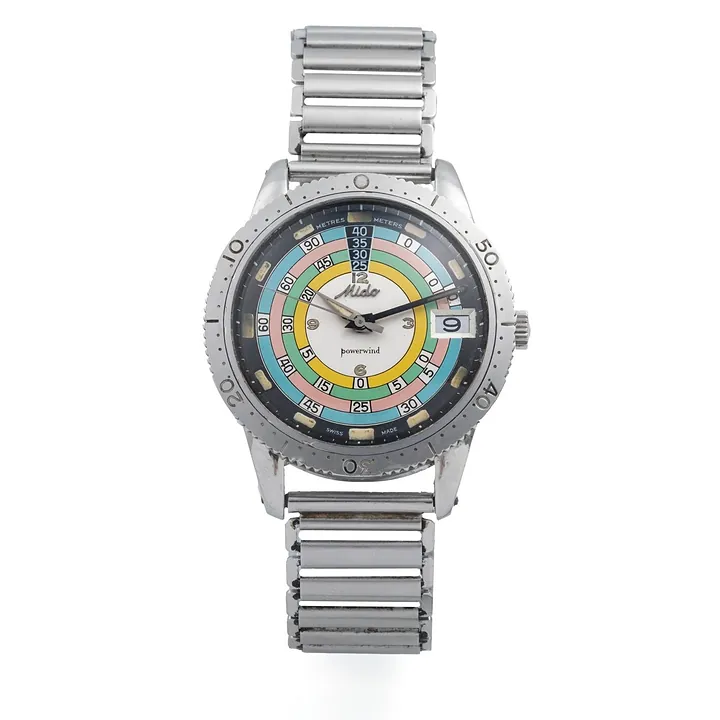
Mido Powerwind Rainbow, ref. 5907, c. 1962
Antiquorum auction archive, Geneva
Wristwatches · c. 1940s
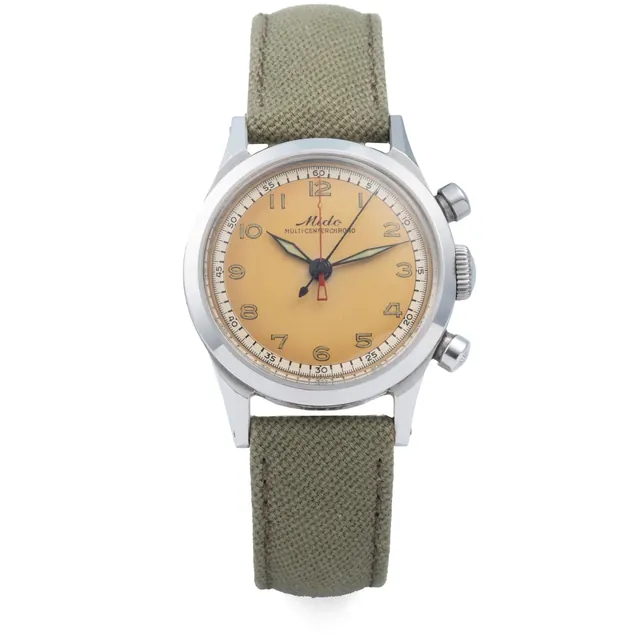
Mido wristwatch, Multi-Centerchrono Taubert/Borgel Case, circa 1940's
Antiquorum auction archive, Geneva
Wristwatches · c. 1940-1950s
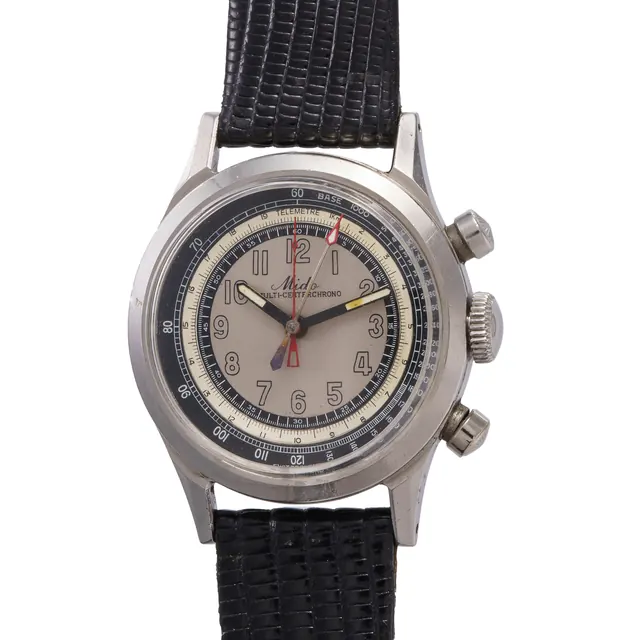
Mido wristwatch, Multi-Centerchrono, circa 1940-1950s
Antiquorum auction archive, Geneva
Wristwatches · c. 1950s
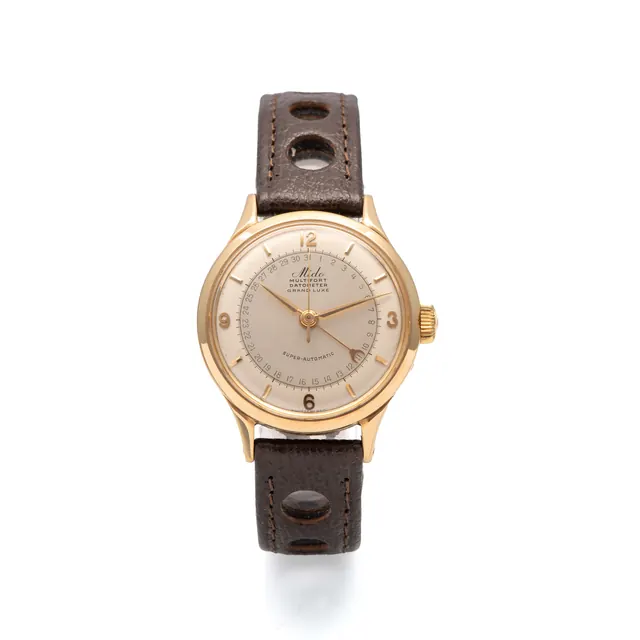
Mido wristwatch, Multifort Datometer Grand Luxe Waterproof, circa 1950's
Antiquorum auction archive, Geneva

Wristwatches · 1945
Wristwatch by Eterna, 1945
Museum Rotterdam

Wristwatches · c. 1945
Breitling Premier, ref. 790, c. 1945
Antiquorum auction archive, Geneva

Wristwatches · c. 1945
Universal Genève Uni-Compax, ref. 22492, c. 1945
Antiquorum auction archive, Geneva
Wristwatches · c. 1950s
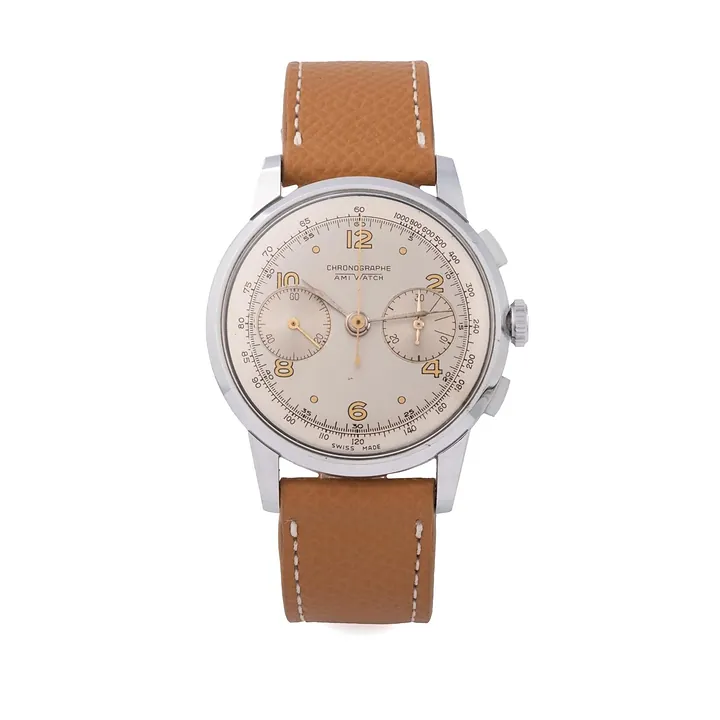
Ami Watch Chronographe, c. 1950s
Antiquorum auction archive, Geneva