
Clocks · Mantel clock
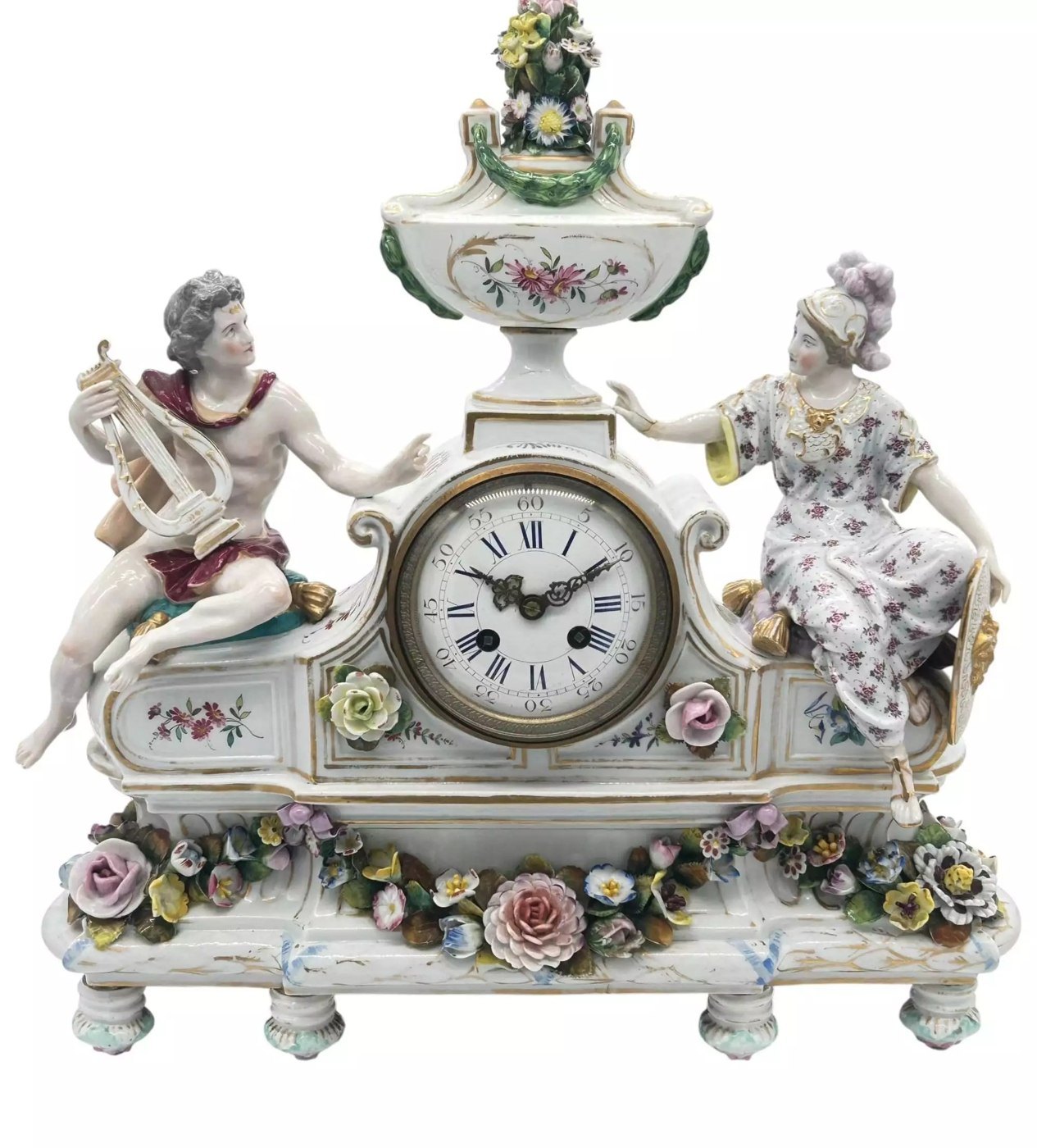
Meissen Porcelain Figural Mantel Clock
- Maker / attribution
- Meissen (source attribution)
- Date
- c. 1850
- Historical period
- Industrial Revolution (1850 – 1900)
- Country of origin
- Germany
- Object type
- Mantel clock
- Holding institution
- Zamanito/Vintage Clocks UK
- Accession / object no.
- meissen-porcelain-figural-mantel-clock-9788547af8
- Credit line
- Zamanito/Vintage Clocks UK
- Catalogue title (original)
- Fabulous Meissen Porcelain Figural Mantel clock – ca1850 (English)
View the source record ↗ (opens another website in a new tab)Suggest a correction
Record summary
Held and catalogued by Zamanito/Vintage Clocks UK (object number meissen-porcelain-figural-mantel-clock-9788547af8), this is a mantel clock attributed to Meissen, made in Germany, dated c. 1850. The Atlas places it in the Industrial Revolution period (1850 – 1900) of its Clocks collection. The record is illustrated with 1 photograph.
Assembled from the source record's structured fields. Dates and attributions are given as the source states them; where a field is missing the Atlas leaves it blank rather than estimating.
Catalogue description
Original object description
Attributed to the Meissen manufactory and dated to circa 1850, this figural mantel clock features an ornate porcelain case resting on molded feet. The polychrome decoration includes hand-painted floral motifs, three-dimensional applied flowers and foliage, a vase-form floral finial at the top, and sculptural figures of two lovers flanking the central clock opening. The circular white enamel dial is surrounded by a brass bezel, featuring black Roman hour marks, outer Arabic minute numerals, and two winding arbors indicating a twin-train movement. Housed within the ceramic housing and accessed via a rear hinged metal door is an eight-day French mechanical caliber with bell striking, which the vendor reports has been recently serviced and runs reliably. Preserved in good condition for its age, the piece exhibits an isolated hairline crack on the female figure's hand. Prospective owners should verify the condition of the delicate applied floral work, the porcelain factory marks, and the installation of the French movement within the porcelain case.
Historical context
Industrial Revolution (1850 – 1900)
American interchangeable-parts manufacture; railroad time standards; Swiss and German factory systems.
Factory production transformed the clock into an everyday object. American makers (Seth Thomas, Ansonia, Waterbury) and German factories (Junghans, Gustav Becker, Lenzkirch) sold millions of shelf, wall and alarm clocks worldwide; France produced standardised Paris movements and carriage clocks; electric time distribution began.
Read the period in the timelineMore clocks from this periodEarlier: Precision & Scientific Horology
Atlas type guide
Mantel and French pendule clocks
The mantel clock — the French pendule de cheminée — is as much decorative art as timekeeper. From the late seventeenth century Parisian clockmakers worked with cabinet-makers, bronze founders and gilders (ciseleurs-doreurs) to create cases in Boulle marquetry, gilt bronze and marble, while the movements were often supplied by specialist makers. Clocks of the Louis XIV, Louis XV and Louis XVI periods, and Empire clocks with allegorical figures, set fashions copied across Europe.
The nineteenth century industrialised the type. The 'Paris movement', a standardised round movement with silk-thread or Brocot suspension and count-wheel striking, was made in huge numbers by firms such as Japy and Vincenti, and fitted into cases of every style and material.
What to look for
- Round 'Paris' movements with makers' stamps (e.g. Japy Frères, Vincenti, S. Marti) and medal marks from exhibitions.
- Suspension type: silk thread (earlier) or Brocot adjustable suspension (after c. 1840).
- Visible Brocot escapement on the dial in later clocks.
- Fire-gilt (mercury) gilding on bronzes versus later electro-gilding.
- Signed dials naming a retailer rather than the movement maker.
Dating clues
- Silk-suspension Paris movements: c. 1800–1850.
- Brocot suspension and visible escapements: after c. 1840.
- Exhibition medal stamps on movements give dates after the medal year.
General guidance written by the Atlas editors about this kind of object. It is not a statement about this particular piece; for that, rely on the source record above and on physical examination.
Read next:Anchor (recoil) escapement
Related records
Clocks · 1800–1814
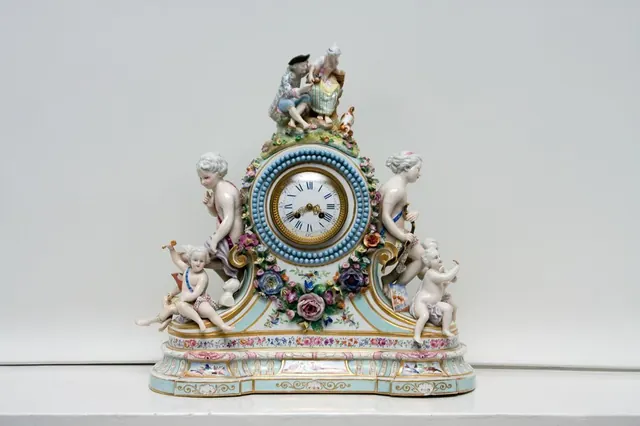
Table clock by Meissen, Germany, 1800–1814
Pohjanmaan museo
Clocks · 1755–1760
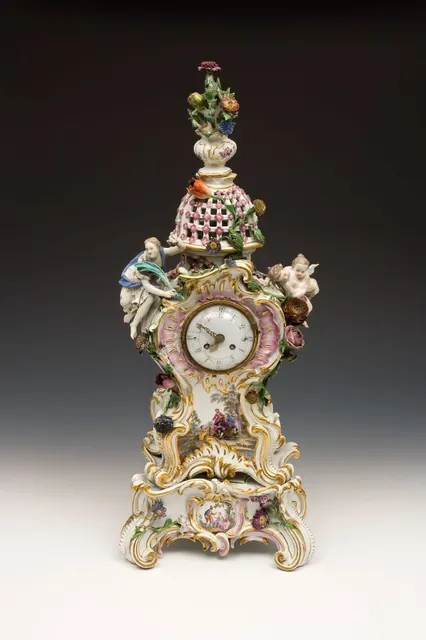
Table clock by Meissen, Germany, 1755–1760
Pohjanmaan museo
Clocks · 19th century
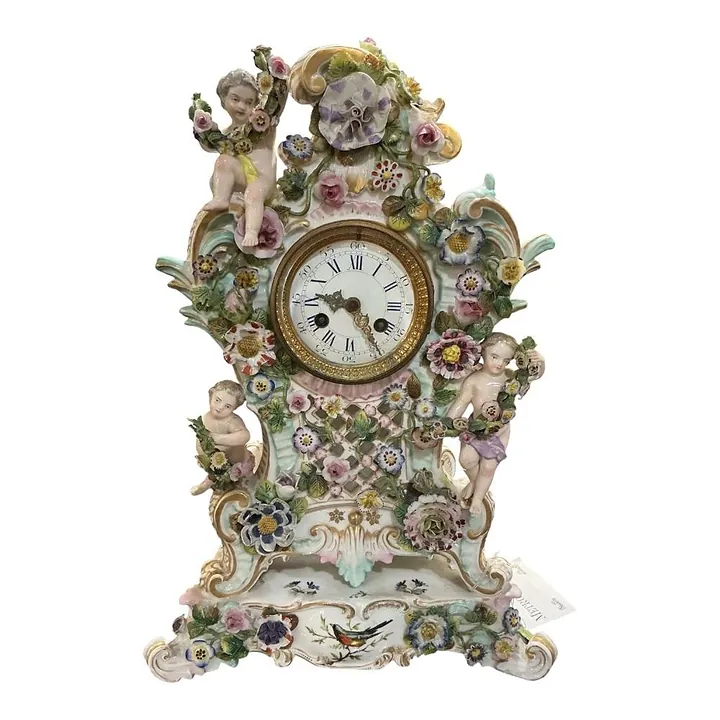
19th Century Meissen Porcelain Figural Clock
Williamson Auction Gallery / Invaluable
Clocks · c. 1850
Cuckoo / black forest clock, Germany, c. 1850
German Clock Museum
Clocks · 1850
Wall clock by Glatz und Co. Kreuzer, Germany, 1850
German Clock Museum
Clocks · 1858
Clock by Jacob Bäuerle, Germany, 1858
German Clock Museum
Clocks · 1860
Clock by August Tritschler, Germany, 1860
German Clock Museum
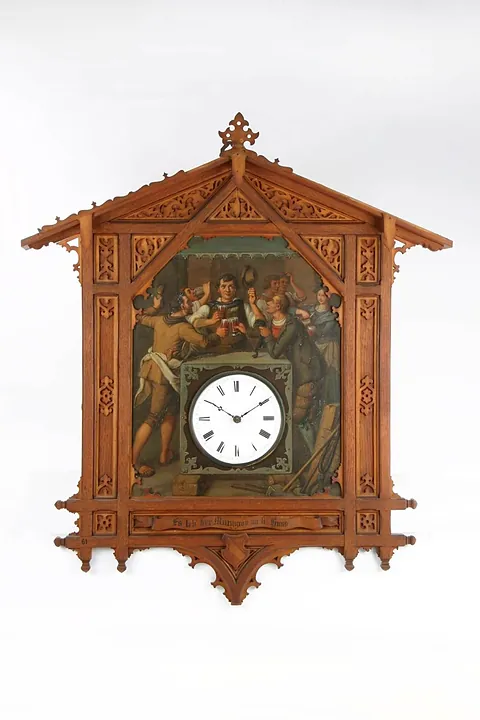
Clocks · 1860
Clock by Großherzoglich Badische Uhrmacherschule, Germany, 1860
German Clock Museum