Clocks · Mantel clock
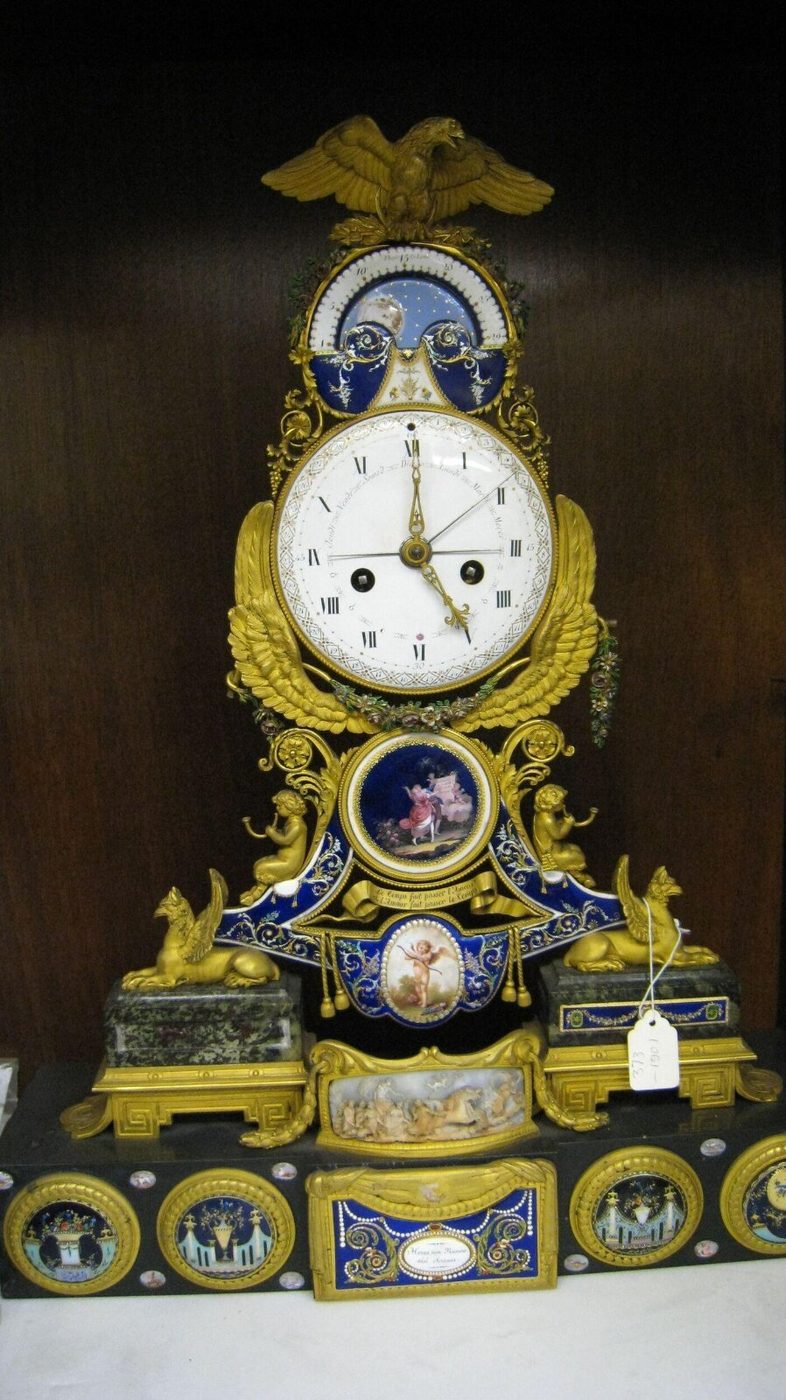
Mantel clock by Coteau, France, 1796
- Maker / attribution
- Coteau (enameller); Bourdier (clockmaker); Joseph Coteau (Enameller)
- Date
- 1796
- Historical period
- Precision & Scientific Horology (1750 – 1850)
- Country of origin
- France
- Place
- Paris
- Object type
- Mantel clock
- Materials / technique
- Marble, gilt bronze, enamel
- Dimensions
- Height: 52 cm; Width: 41.9 cm; Depth: 14 cm; Diameter: 11.8 cm (Diameter of dial)
- Holding institution
- Victoria and Albert Museum, London
- Accession / object no.
- 373-1901
- Credit line
- Bequeathed by Mrs Julia Anne Bonnor
- Catalogue title (original)
- Mantel clock
Record summary
Held and catalogued by Victoria and Albert Museum, London (object number 373-1901), this is a mantel clock by Coteau, made in Paris, France, dated 1796. The Atlas places it in the Precision & Scientific Horology period (1750 – 1850) of its Clocks collection. Materials and techniques recorded by the source: Marble, gilt bronze, enamel. Recorded dimensions: Height: 52 cm; Width: 41.9 cm; Depth: 14 cm; Diameter: 11.8 cm (Diameter of dial). The record is illustrated with 3 photographs.
Assembled from the source record's structured fields. Dates and attributions are given as the source states them; where a field is missing the Atlas leaves it blank rather than estimating.
Catalogue description
V&A — Summary
A composite mantel clock surmounted by an ormolu eagle with open wings perched on a thunderbolt and supported by a crescent dial representing the phases of the moon. The main dial is framed by wings adorned with an enamelled garland of flowers. The dial has a minute ring with Arabic numerals, an outer calendar ring and inner ring indicating the days of the week and their corresponding planetary deities. The case was enamelled by Coteau, established as master of the Parisian Guild of enamellers in 1785. The clock maker Bourdier was established in Paris by 1787. The imagery and inscriptions demonstrate that the clock was intended to celebrate the role of Love in relation to Time.
V&A — Physical description
Case: an elaborate construction of ormolu and enamel work with marble pedestal and base at the top with an eagle grasping a thunderbolt and a crescent moon; below an enamel plaque with a pair of lovers embracing and writing 'serment d’aimer' (pledge of love) on a sheet of paper upheld by cupids, is a ribbon inscribed “Le Temps fait passer l’amour et l’amour fait passer le Temps”. Below another oval plaque shows cupid with his bow; this is just above a further plaque with a bow-shaped upper border showing Apollo in his chariot; both ar set in a frame of enamelled straps complete with lambrequin and tassels. These are flanked by twin winged ormolu griffins on granite bases, with above twin ormolu putti blowing horns seated on the enamelled strapwork. On the pedestal the central enamel plaque is inscribed “Horas non Numero nisi Seranas”; it is flanked by four circular enamel plaques illustrating vases of flowers original intended as watch cases with a further twelve small enamel plaques. Dials: Main dial, white convex enamel, 11.8cm diameter. The minute ring a fine gilt circle interrupted by Arabic numerals at 15 30 45 60. The remaining 5 minute marks consisting of gilt rosettes. The individual minutes indicated by gilt dots. Outside the minute ring, a ring pattern in coloured enamels incorporating 31 diamond shaped openings numbered 1 to 31 in erect Arabic numerals, for the day of the month indicated by a slim steel hand. Inside the minute ring, erect Roman numerals indicate the hours. Within this, a ring divided into 14 parts, the upper half with days of the week, Jeudi to Mercredi (Thursday to Wednesday), clockwise, the lower half with symbols of the corresponding planetary deities and served by a double-ended thin steel hand making one revolution in 14 days. Winding holes inside III ¾ and VIII ¼. Pierced gilt hour and minute hands. The dial is supported by a pair of wings; at either side a filigree ornament is hung with an enameled pendant terminating in a bunch of pearls. Above, a subsidiary lunar dial with an enamel semi circle, 9.2cm diameter, 1.3cm broad, numbered 1 5 10 15 20 25 29 ½, with a moon disc rotating once in 59 days and two effigies, each appearing and disappearing behind deep blue enamel semi circular projections. Inscribed on either side are 15 numerals: “Phase/de Lune”. Movement: brass movement plates 9.5cm diameter. The back plate signed “Bourdier, Paris”. Both trains with going barrels. Going train to right with anchor or tic-tac escapement, the palettes now missing. There is an associated velvet covered stand and glass shade. The original description notes that the base is chipped, the pendulum missing and two ornaments and one small plaque are wanting from the base
V&A — Object history
Bequeathed by Mrs Julia Anne Bonner; formerly the property of her father, Captain Charles Spencer Ricketts
V&A gallery label
MANTEL CLOCK Marble, gilt bronze, enamel Paris, movement signed Bourdier Paris , dial signed coteau ft , enamels signed coteau and dated 1796 Given by Mrs Bonner 373-1901 Though the name of the manufacturer of the bronzes is unknown, the several inscriptions on the enamels confirm that this clock was put together in 1796 in the aftermath of the Revolution. The enamels were made by Coteau, whose address is inscribed, 'rue poupe no 7/quart. St andre des arts. Paris'. Coteau was the most prominent enameller in Paris and this clock shoes the variety of his techniques. He is thought to have been responsible for devising the 'jewelled' enamelling technique visible on the lower central panel. Here the small beads of enamel were applied to stamped gold discs to hold them in place during firing. The circular enamels along the base appear to be watch backs.
Inscriptions & marks
Horas non Numero nisi Seranas; Le Temps fait passer l'amour et l'amour fait passer le Temps; Bourdier, Paris; Sermant d'aimer
Historical context
Precision & Scientific Horology (1750 – 1850)
Harrison solves longitude; Mudge invents the lever; Breguet's Paris workshop defines the modern watch.
The age of the deadbeat escapement, compensated pendulums and observatory regulators. Domestic clocks spread through the middle classes: English longcase and bracket clocks, French gilt-bronze mantel clocks, Viennese Biedermeier wall clocks, Black Forest painted-shield clocks, and the first American shelf clocks.
Read the period in the timelineMore clocks from this periodEarlier: Early Modern Horology
Atlas type guide
Mantel and French pendule clocks
The mantel clock — the French pendule de cheminée — is as much decorative art as timekeeper. From the late seventeenth century Parisian clockmakers worked with cabinet-makers, bronze founders and gilders (ciseleurs-doreurs) to create cases in Boulle marquetry, gilt bronze and marble, while the movements were often supplied by specialist makers. Clocks of the Louis XIV, Louis XV and Louis XVI periods, and Empire clocks with allegorical figures, set fashions copied across Europe.
The nineteenth century industrialised the type. The 'Paris movement', a standardised round movement with silk-thread or Brocot suspension and count-wheel striking, was made in huge numbers by firms such as Japy and Vincenti, and fitted into cases of every style and material.
What to look for
- Round 'Paris' movements with makers' stamps (e.g. Japy Frères, Vincenti, S. Marti) and medal marks from exhibitions.
- Suspension type: silk thread (earlier) or Brocot adjustable suspension (after c. 1840).
- Visible Brocot escapement on the dial in later clocks.
- Fire-gilt (mercury) gilding on bronzes versus later electro-gilding.
- Signed dials naming a retailer rather than the movement maker.
Dating clues
- Silk-suspension Paris movements: c. 1800–1850.
- Brocot suspension and visible escapements: after c. 1840.
- Exhibition medal stamps on movements give dates after the medal year.
General guidance written by the Atlas editors about this kind of object. It is not a statement about this particular piece; for that, rely on the source record above and on physical examination.
Read next:Anchor (recoil) escapement
Related records
Clocks · 1723–1811
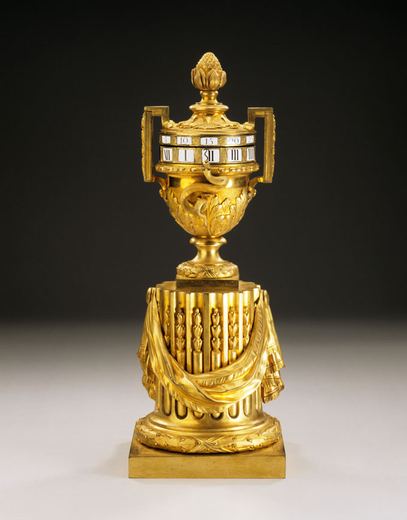
Table clock by Louis Montjoye, France, 1723–1811
Badisches Landesmuseum Karlsruhe
Clocks · 1738–1814
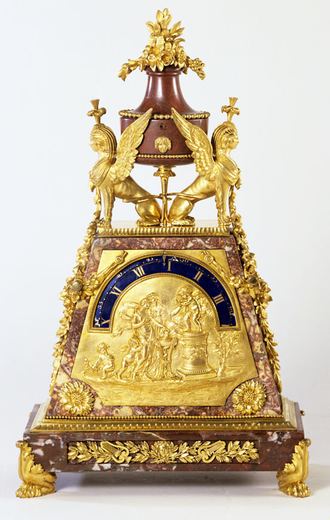
Table clock by Jean Simon Bourdier, France, 1738–1814
Badisches Landesmuseum Karlsruhe
Clocks · 1750-1800
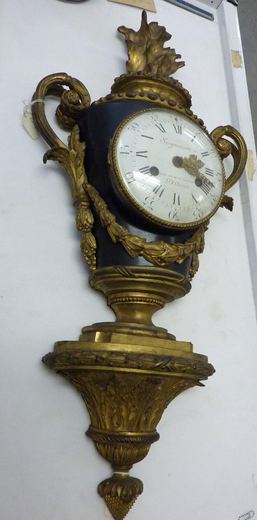
Bracket clock in metal case with scroll handles and flamed-shaped top signed by Pierre Seignoret, Clockmaket to the the Comte d'Artois
Victoria and Albert Museum, London
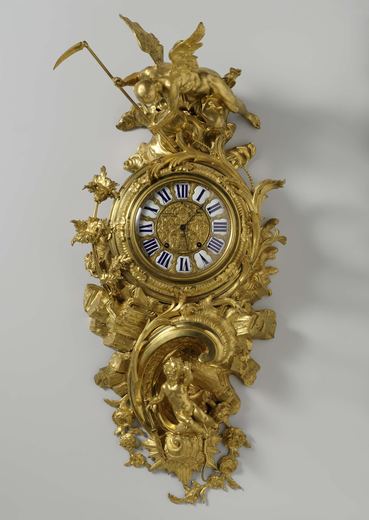
Clocks · 1756
Mantel clock, France, 1756
Rijksmuseum
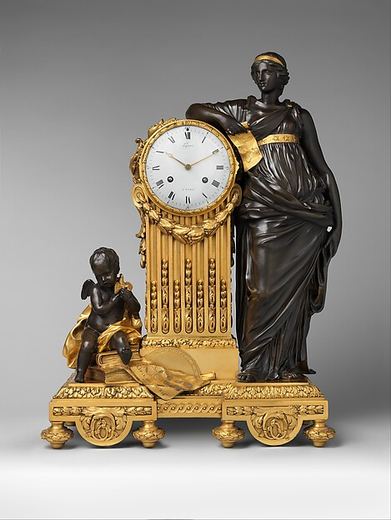
Clocks · ca. 1764–70
Mantel clock by Jean-André Lepaute, France, ca. 1764–70
The Metropolitan Museum of Art, New York
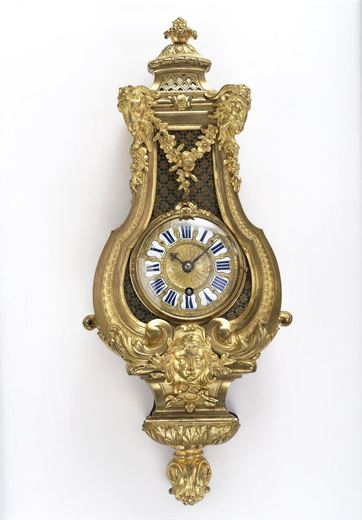
Clocks · 1760–1860
'Pendule d'alcove' wall clock, gilt-bronze and boulle marquetry, Paris, 1760-1860
Victoria and Albert Museum, London
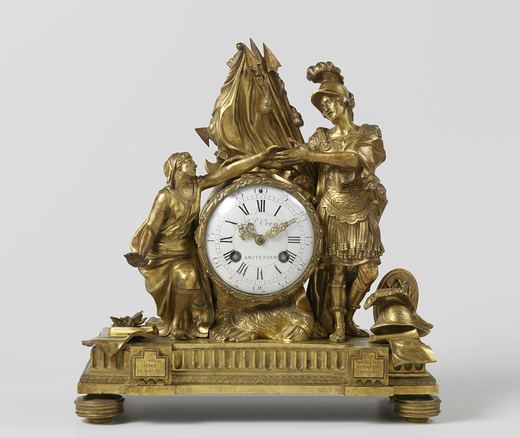
Clocks · 1760
Mantel clock, France, 1760
Rijksmuseum
Clocks · ca. 1768–70
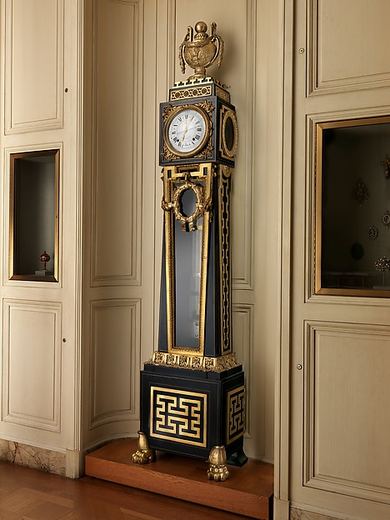
Longcase astronomical regulator by Ferdinand Berthoud, France, ca. 1768–70
The Metropolitan Museum of Art, New York