
Wristwatches · Wristwatch
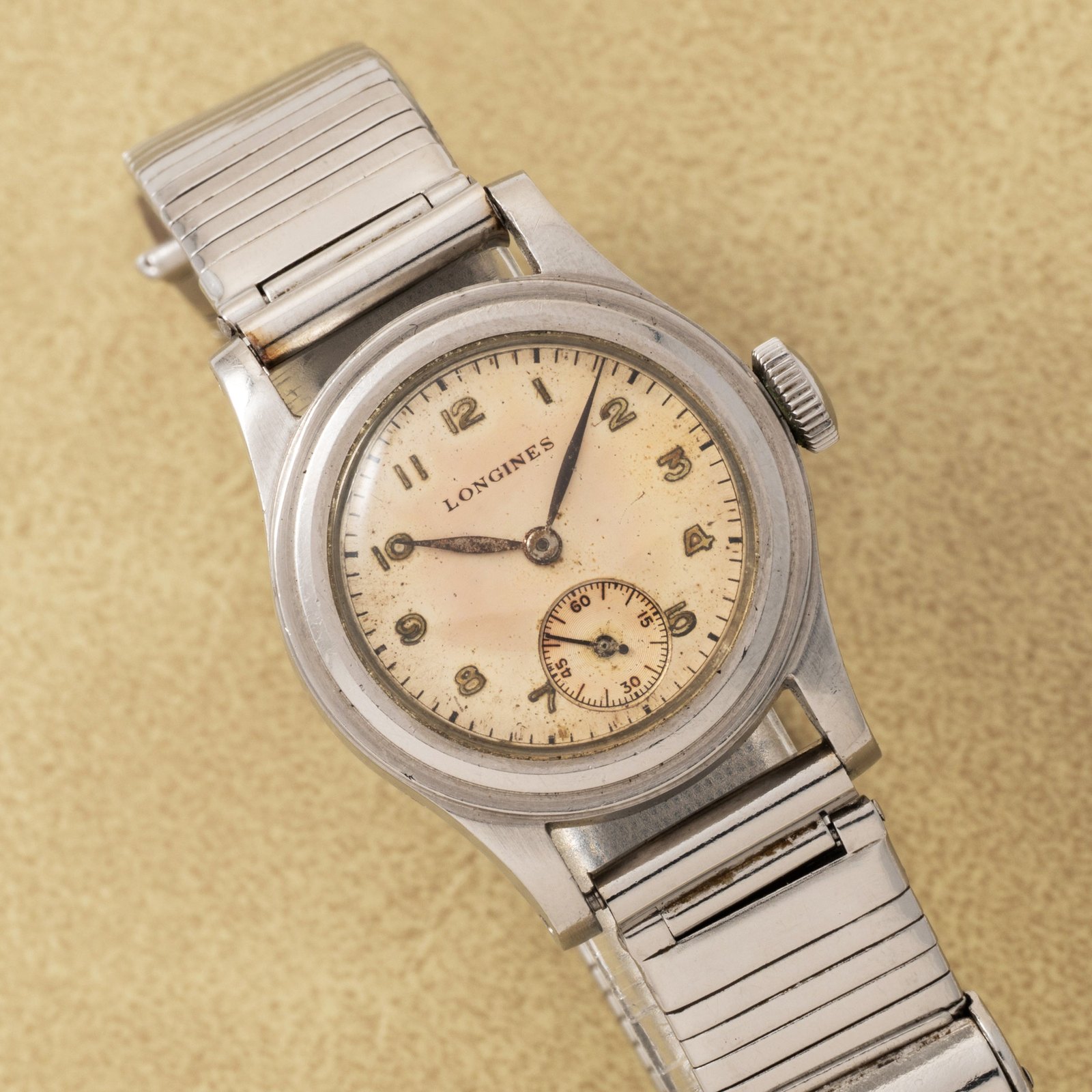
Longines WWII Tre-Tacche, 1940s
- Maker / attribution
- Longines (maker)
- Date
- 1940s
- Historical period
- Golden Age of Mechanical Watchmaking (1900 – 1945)
- Country of origin
- Switzerland
- Object type
- Wristwatch
- Dimensions
- Case 25 mm
- Stock no.
- 40992672
- Credit line
- Dealer listing, Analog/Shift (40992672)
- Catalogue title (original)
- Longines WWII Tre-Tacche (English)
View the source record (dealer listing) ↗ (opens another website in a new tab)Suggest a correction
Record summary
Catalogued by Analog/Shift (dealer), New York (stock number 40992672), this is a wristwatch by Longines, made in Switzerland, dated 1940s. The Atlas places it in the Golden Age of Mechanical Watchmaking period (1900 – 1945) of its Wristwatches collection. Recorded dimensions: Case 25 mm. The record is illustrated with 6 photographs.
Assembled from the source record's structured fields. Dates and attributions are given as the source states them; where a field is missing the Atlas leaves it blank rather than estimating.
Catalogue description
Dealer description — Analog/Shift
In our opinion, Longines doesn't quite get the respect that it deserves. That is not to say that the firm isn't held in high regard. But the level of innovation, craftsmanship, and design that Longines has demonstrated over the course of its existence simply cannot be understated, and certainly extends to a wide variety of timepieces across the board. "Tre-Tacche" watches from the late 1930s and 1940s in particular have developed a cult-like following amongst vintage enthusiasts. The name references its unique three-notch caseback which requires a special tool to remove, but the watch itself is perhaps the most pure execution of a no-frills robust "tool" watch before that designation ever existed. Dating to the 1940s, this smaller Tre-Tacche features a 25mm stainless steel case with a stepped bezel, strong lugs, an unsigned crown, and an acrylic crystal. Its patinated silver dial, meanwhile, boasts an outer open minute track, applied 'Arabic' indices, a classic 'feuille' handset, and a sub-seconds display above 6 o'clock. Signed 'Longines' in the firm's vintage-style serif signature, it's a picture of simplicity and legibility. Flip this piece over, however, and its true character is revealed: Hand-engraved into the triple-notched caseback is the name of Robert O. Hayes and his U.S. military serial number. Hayes enlisted to the Army Air Corps into 1942 as a private in Peoria, IL — a fact we can confirm given the serial number listed clearly in the engraving. Powered by a hand-wound Longines movement and paired to a vintage stainless steel bracelet from Speidel, this supremely cool tool watch proves that Tre-Tacche and Sei-Tacche watches were, in fact, commonly worn by servicemen during the War... and that they weren't afraid to wear smaller watches! Perfect today as a ladies' piece — or as a man's watch for someone who, like Hayes, was perfectly comfortable with a smaller case — it's a supremely cool bit of horological and military history.
Historical context
Golden Age of Mechanical Watchmaking (1900 – 1945)
The wristwatch displaces the pocket watch; waterproof cases, self-winding and grand complications.
The wristwatch overtook the pocket watch. Military use in the First World War, aviation, water-resistant cases (1926), automatic winding (1923–31), rectangular Art Deco designs and early chronographs and calendars defined the period.
Read the period in the timelineMore wristwatches from this periodEarlier: Industrial Revolution
Atlas type guide
Wristwatches
Bracelet watches were worn by women from the early nineteenth century — Breguet made one for Caroline Murat, Queen of Naples, in 1810–12 — but the wristwatch only became a man's instrument with military use and aviation in the early twentieth century. Between the World Wars it overtook the pocket watch; the 1920s and 1930s brought rectangular Art Deco cases, water-resistant cases and the first automatic winding systems.
After 1945 the wristwatch became a carrier of identity — dress watches, sports and dive watches, chronographs, calendars — produced by Swiss, American, Japanese, German, Soviet and Chinese industries. The quartz revolution after 1969 and the mechanical renaissance since the 1990s, including the rise of independent watchmakers, complete the story.
What to look for
- The reference number (between the lugs or inside the case back) and serial number, the starting point for dating.
- The calibre: its maker and number are often stamped under the dial or on the bridge.
- Originality of dial, hands and crown — refinished ('redial') dials are common.
- Case material marks: 18K/750, 14K/585, stainless steel, gold-filled, plated.
Dating clues
- Wire-lug cases: before c. 1925.
- Water-resistant screw-down cases: from 1926.
- Quartz movements: from 1969; sapphire crystals widespread after c. 1980.
General guidance written by the Atlas editors about this kind of object. It is not a statement about this particular piece; for that, rely on the source record above and on physical examination.
Related records
Instruments · c. 1940
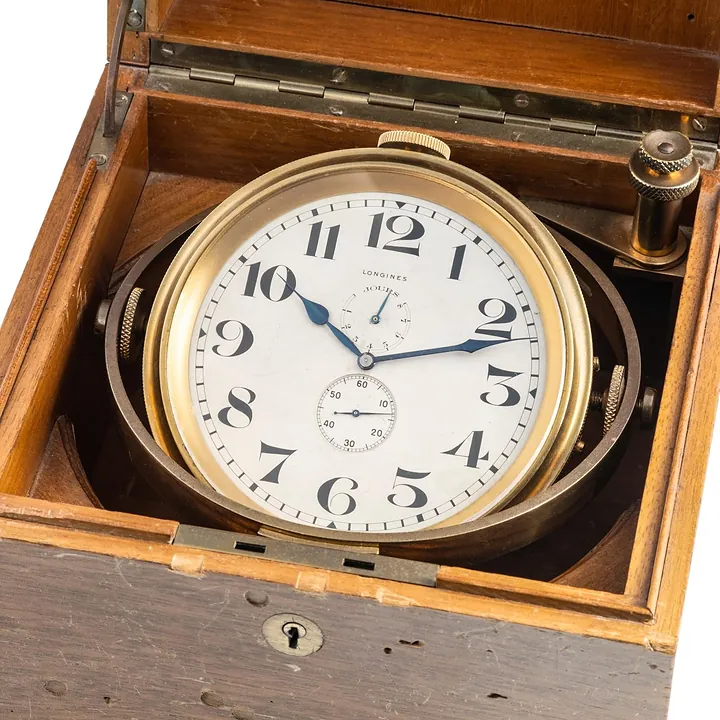
Longines marine chronometer, c. 1940
Antiquorum auction archive, Geneva
Pocket Watches · c. 1910-1920s
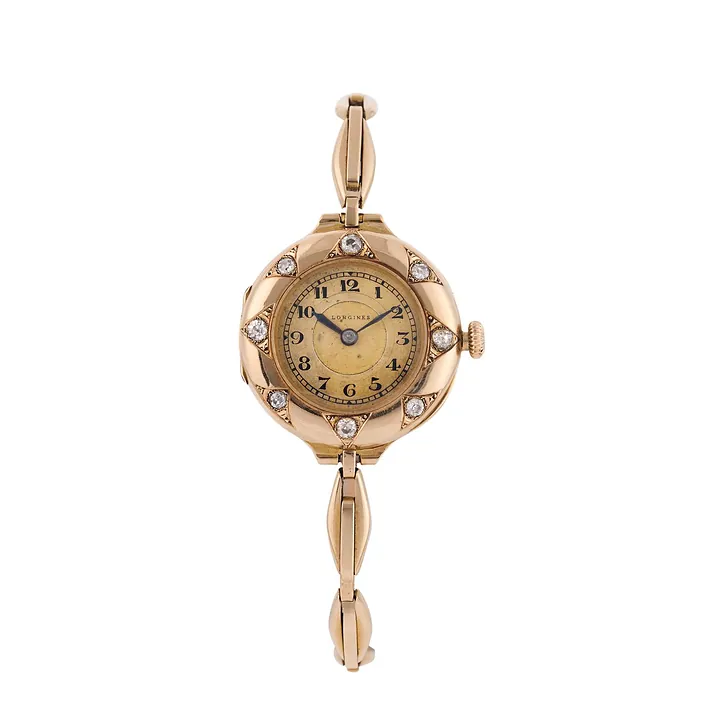
Longines watch, c. 1910-1920s
Antiquorum auction archive, Geneva
Pocket Watches · c. 1915
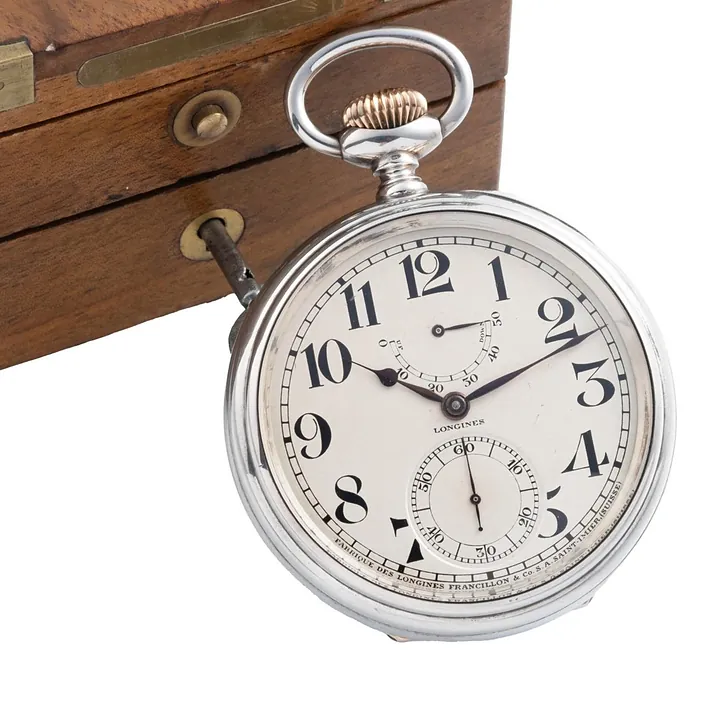
Longines ''torpedo-Boat Watch'', c. 1915
Antiquorum auction archive, Geneva
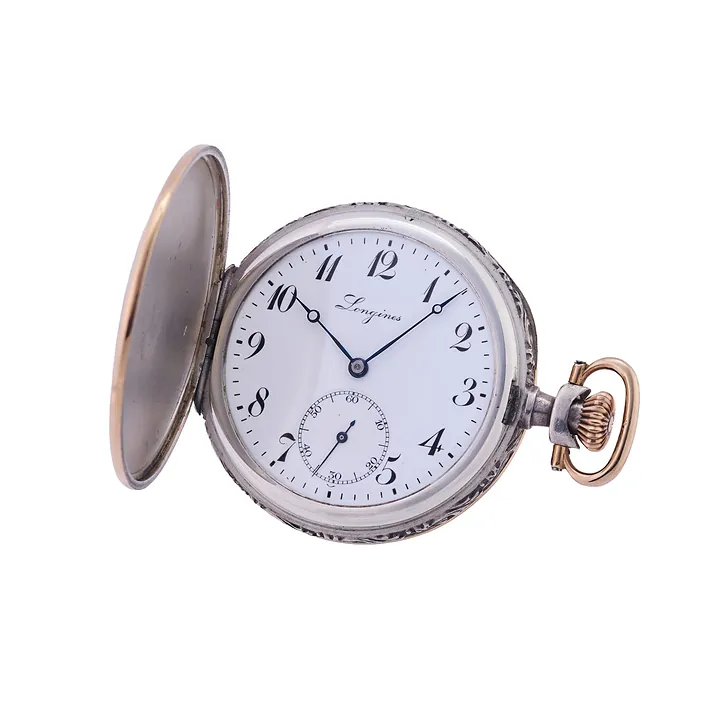
Pocket Watches · c. 1920s
Longines pocket watch, c. 1920s (Antiquorum Lot 389-59)
Antiquorum auction archive, Geneva

Wristwatches · 1931
Rolex 'Oyster Perpetual' rotor self-winding wrist-watch, lever escapement, in steel case with glass in back, Montres Rolex SA, Geneva, Switzerland, 1931
Science Museum Group, London

Wristwatches · 1900–1999
Wristwatch by Certina, Switzerland, 1900–1999
Nordic Museum Foundation
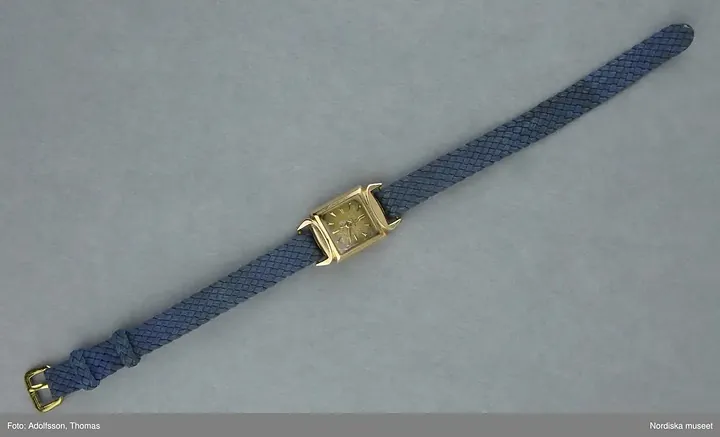
Wristwatches · 1900–1999
Wristwatch by Omega, Västerås, 1900–1999
Nordic Museum Foundation
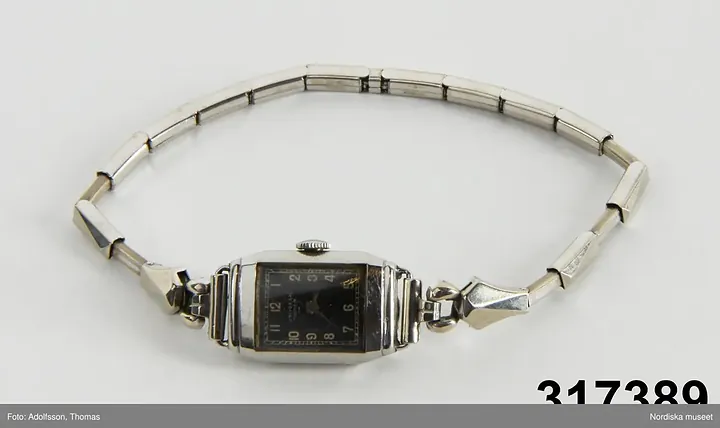
Wristwatches · 1900–1999
Wristwatch by Universal, Switzerland, 1900–1999
Nordic Museum Foundation