
Wristwatches · Wristwatch
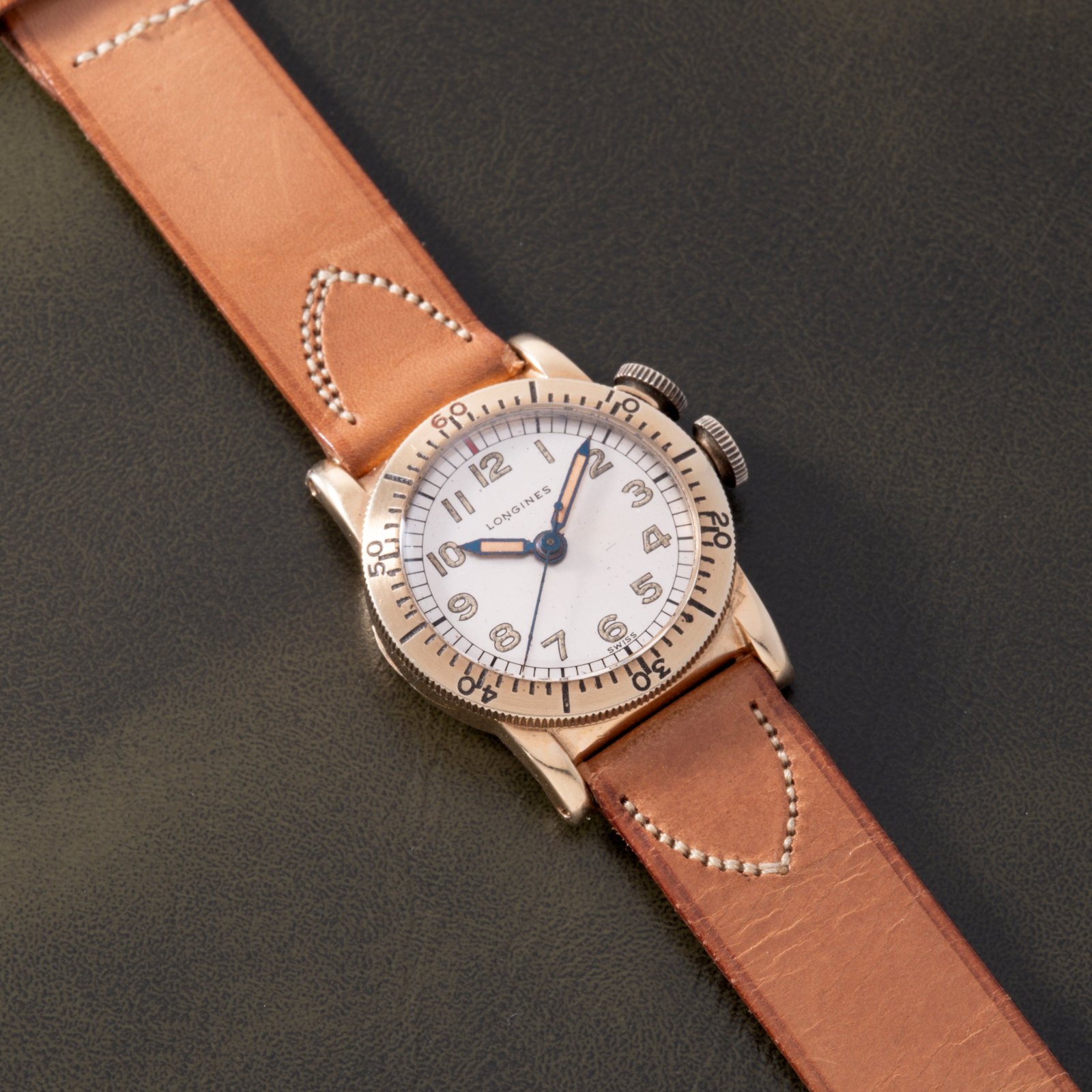
Longines Weems, 1940s
- Maker / attribution
- Longines (maker)
- Date
- 1940s
- Historical period
- Golden Age of Mechanical Watchmaking (1900 – 1945)
- Country of origin
- Switzerland
- Object type
- Wristwatch
- Dimensions
- Case 28 mm
- Stock no.
- 40993031
- Credit line
- Dealer listing, Analog/Shift (40993031)
- Catalogue title (original)
- Longines Weems (English)
View the source record (dealer listing) ↗ (opens another website in a new tab)Suggest a correction
Record summary
Catalogued by Analog/Shift (dealer), New York (stock number 40993031), this is a wristwatch by Longines, made in Switzerland, dated 1940s. The Atlas places it in the Golden Age of Mechanical Watchmaking period (1900 – 1945) of its Wristwatches collection. Recorded dimensions: Case 28 mm. The record is illustrated with 6 photographs.
Assembled from the source record's structured fields. Dates and attributions are given as the source states them; where a field is missing the Atlas leaves it blank rather than estimating.
Catalogue description
Dealer description — Analog/Shift
In this age of global travel, it’s easy to take for granted the sight of contrails snaking across the sky. And yet in the early years of the last century, airplanes were a new invention. But thanks to the contributions of aviation pioneers like Alberto Santos-Dumont, whose achievements in aviation are matched by those in watches, flying became more commonplace. Since aeronautical navigation posed its own particular challenges, there arose a need for specialized tools and timekeepers. Due to the distance traveled at higher speeds, any error in navigation—even if it was as little as 30 seconds off—would put the pilot off course by as much as seven miles. Therefore, just as John Harrison did for sailors in the Age of Sail with his marine chronometer, so too did Captain Philip Van Horn Weems do for pilots. A native of land-locked Tennessee, Weems must have felt the call of the sea from an early age. At just nineteen, he enrolled at the US Naval Academy in Annapolis. There he developed an aptitude for celestial navigation, and during his tenure with the Aircraft Squadron Battle Fleet, he encountered airplanes for the the first time. Despite the advances undertaken in the century between the development of John Harrison’s marine chronometer and the time Captain Weems joined the Navy, the tools and charts used in navigation were just as primitive. For example, Weems—and many of his fellow navigators—had been trained to use the American Nautical Almanac. This publication used tables, first published in 1757, that called for navigators to take measurements using observations that were so complicated that few navigators could even do them. First introduced in 1929, the Longines Weems Second-Setting Watch was the preferred timekeeping tool for navigators and pilots until the introduction of Charles Lindbergh’s version, the Hour Angle, in 1931. The Second-Setting watch allows pilots to synchronize their watches with radio signals without stopping the movement. The brilliant innovation was instrumental in the history of aviator watches. This particular iteration is one of the most valuable, executed in 14K yellow gold. Dating to the 1940s, the beautiful 28mm piece is powered by Longines manual-winding Calibre 10L and ready for a history lover's collection!
Historical context
Golden Age of Mechanical Watchmaking (1900 – 1945)
The wristwatch displaces the pocket watch; waterproof cases, self-winding and grand complications.
The wristwatch overtook the pocket watch. Military use in the First World War, aviation, water-resistant cases (1926), automatic winding (1923–31), rectangular Art Deco designs and early chronographs and calendars defined the period.
Read the period in the timelineMore wristwatches from this periodEarlier: Industrial Revolution
Atlas type guide
Wristwatches
Bracelet watches were worn by women from the early nineteenth century — Breguet made one for Caroline Murat, Queen of Naples, in 1810–12 — but the wristwatch only became a man's instrument with military use and aviation in the early twentieth century. Between the World Wars it overtook the pocket watch; the 1920s and 1930s brought rectangular Art Deco cases, water-resistant cases and the first automatic winding systems.
After 1945 the wristwatch became a carrier of identity — dress watches, sports and dive watches, chronographs, calendars — produced by Swiss, American, Japanese, German, Soviet and Chinese industries. The quartz revolution after 1969 and the mechanical renaissance since the 1990s, including the rise of independent watchmakers, complete the story.
What to look for
- The reference number (between the lugs or inside the case back) and serial number, the starting point for dating.
- The calibre: its maker and number are often stamped under the dial or on the bridge.
- Originality of dial, hands and crown — refinished ('redial') dials are common.
- Case material marks: 18K/750, 14K/585, stainless steel, gold-filled, plated.
Dating clues
- Wire-lug cases: before c. 1925.
- Water-resistant screw-down cases: from 1926.
- Quartz movements: from 1969; sapphire crystals widespread after c. 1980.
General guidance written by the Atlas editors about this kind of object. It is not a statement about this particular piece; for that, rely on the source record above and on physical examination.
Related records
Instruments · c. 1940
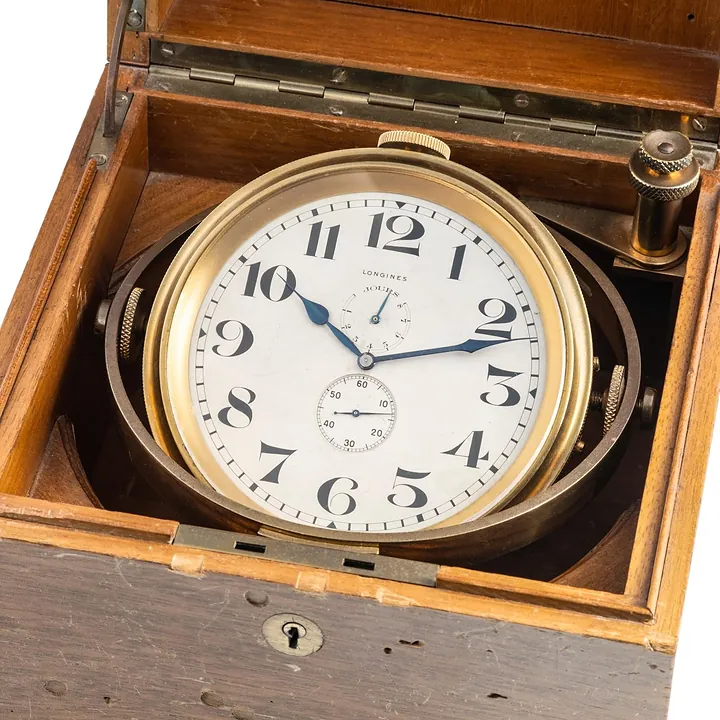
Longines marine chronometer, c. 1940
Antiquorum auction archive, Geneva
Pocket Watches · c. 1910-1920s
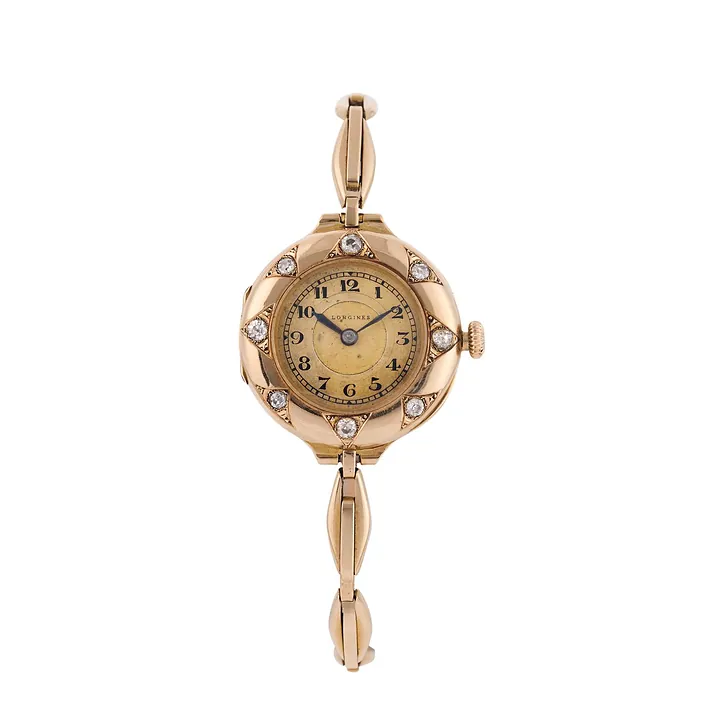
Longines watch, c. 1910-1920s
Antiquorum auction archive, Geneva
Pocket Watches · c. 1915
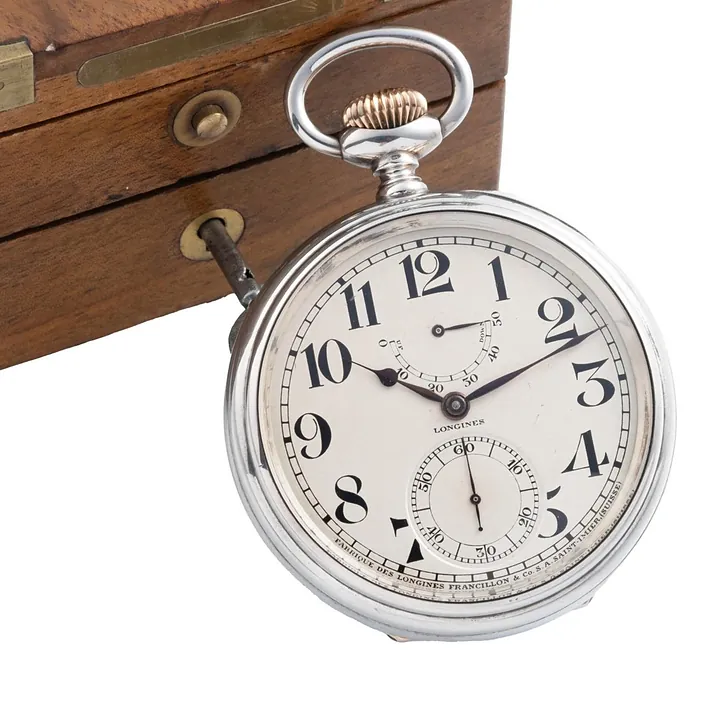
Longines ''torpedo-Boat Watch'', c. 1915
Antiquorum auction archive, Geneva
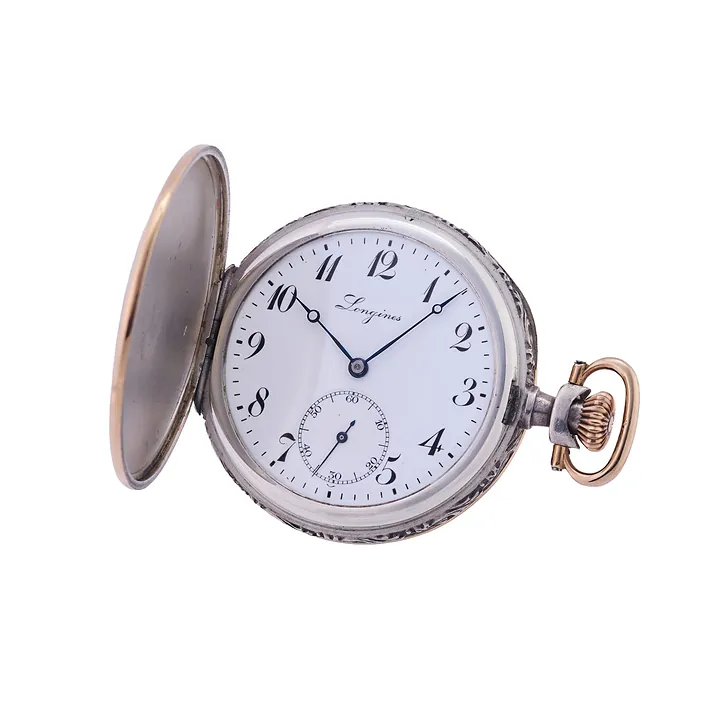
Pocket Watches · c. 1920s
Longines pocket watch, c. 1920s (Antiquorum Lot 389-59)
Antiquorum auction archive, Geneva

Wristwatches · 1931
Rolex 'Oyster Perpetual' rotor self-winding wrist-watch, lever escapement, in steel case with glass in back, Montres Rolex SA, Geneva, Switzerland, 1931
Science Museum Group, London

Wristwatches · 1900–1999
Wristwatch by Certina, Switzerland, 1900–1999
Nordic Museum Foundation

Wristwatches · 1900–1999
Wristwatch by Omega, Västerås, 1900–1999
Nordic Museum Foundation

Wristwatches · 1900–1999
Wristwatch by Universal, Switzerland, 1900–1999
Nordic Museum Foundation