
Wristwatches · Wristwatch
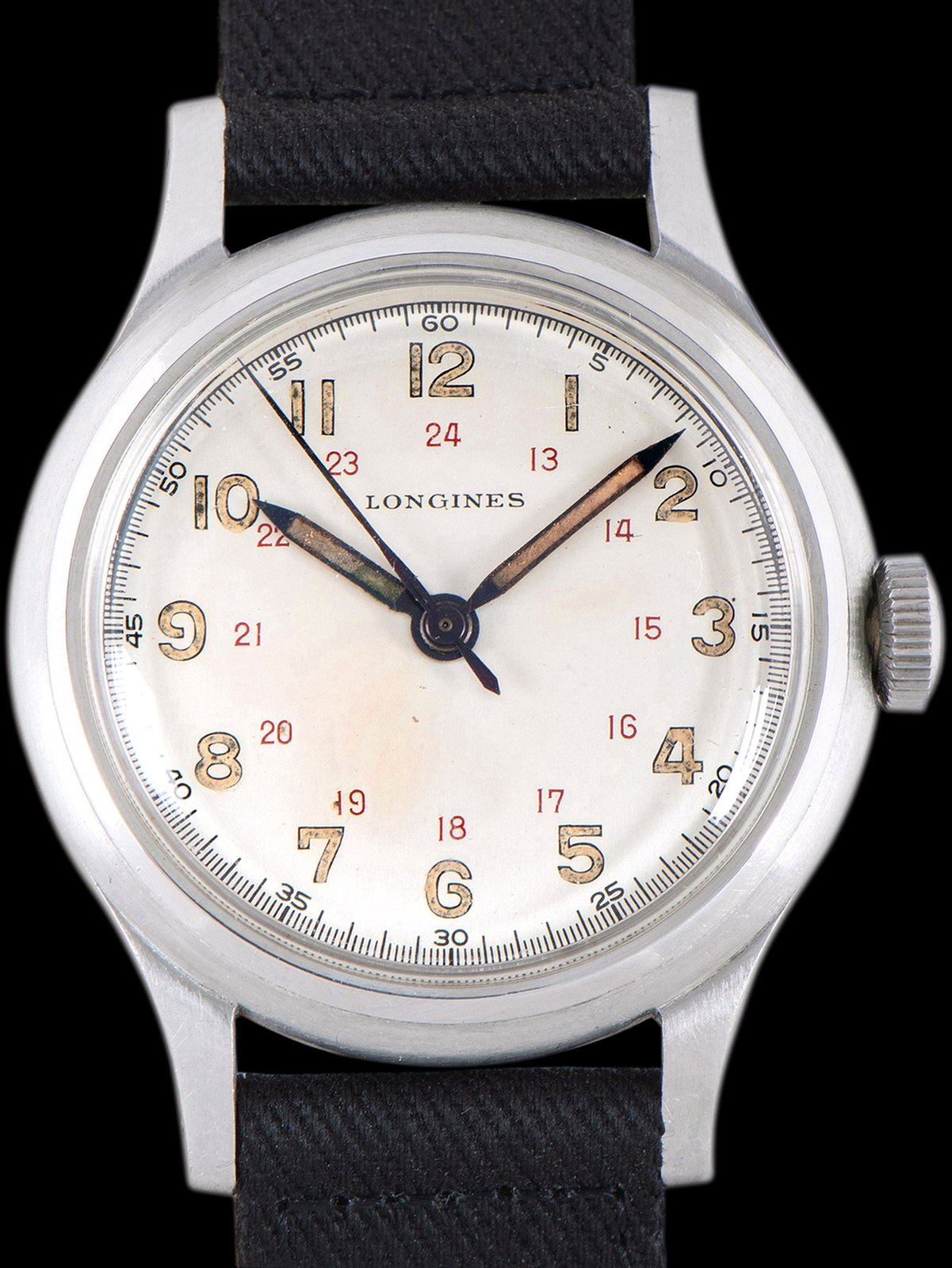
Longines Sei-Tacche (Ref. 23059), 1945
- Maker / attribution
- Longines (maker)
- Date
- 1945
- Historical period
- Modern Mechanical Horology (1945 – 1969)
- Country of origin
- Switzerland
- Object type
- Wristwatch
- Dimensions
- Case 33 mm
- Stock no.
- LGSST23059
- Credit line
- Dealer listing, Craft & Tailored (LGSST23059)
- Catalogue title (original)
- 1945 Longines Sei-Tacche (Ref. 23059) (English)
View the source record (dealer listing) ↗ (opens another website in a new tab)Suggest a correction
Record summary
Catalogued by Craft & Tailored (dealer), Los Angeles (stock number LGSST23059), this is a wristwatch by Longines, made in Switzerland, dated 1945. The Atlas places it in the Modern Mechanical Horology period (1945 – 1969) of its Wristwatches collection. Recorded dimensions: Case 33 mm. The record is illustrated with 6 photographs.
Assembled from the source record's structured fields. Dates and attributions are given as the source states them; where a field is missing the Atlas leaves it blank rather than estimating.
Catalogue description
Dealer description — Craft & Tailored
Longines is one of the oldest continuously operating watch manufacturers in the world, with roots dating back to 1832. Over that immense period of time, the brand has crafted some truly incredible—and incredibly accurate—timepieces. In fact, it's one of the reasons Longines is the official timekeeper of the Kentucky Derby, where accuracy is paramount. Among vintage Longines, few models capture the imagination of collectors quite like the “Sei-Tacche.” Produced in the 1930s and 1940s alongside the earlier “Tre-Tacche,” these watches earned their names from their distinctive casebacks—six notches for the Sei-Tacche, three for the Tre-Tacche—engineered for a tighter seal and requiring specialized tools to remove. Beyond this functional innovation, the Sei-Tacche has become a cult favorite, celebrated for its uncompromising simplicity and its place as one of the earliest true “tool watches” before the category even had a name. This 1945 example ref. 23059 brings all the hallmarks that collectors seek: a 33mm stainless steel case with drilled lugs, a warm silver dial with bold radium lumed Arabic numerals, a red 24-hour scale for a touch of color, and a refined blue steel handset. The six-notched caseback and rugged construction speak to Longines’ wartime focus on reliability and resilience, making these pieces both historically significant and incredibly wearable today. For collectors, the Sei-Tacche represents more than just a vintage Longines—it embodies the brand’s legacy of precision and durability, qualities that established its reputation in both civilian and military circles. With its understated aesthetics, robust build, and undeniable historical importance, the Sei-Tacche remains one of the most compelling entry points into serious vintage Longines collecting. SPECS Stock # LGSST23059 Brand Longines Style Sei-Tracche "WWII Military" Model 23059 Serial 69XXXXX Size Men's / Unisex Material Stainless Steel Dial Silver "Aged" Millimeters 33 Strap 2pc Leather Strap CASE & BRACELET The excellent case features long lugs extending its size beyond its diameter measurements and retains crisp finishing and edges throughout, showing no notable wear and only nominal evidence of being previously polished. The distinctive 6-notch case back is also in very clean condition and retains its original factory engravings. Additionally, the back of the top left lug bears a matching engraving to the case back, corroborating the originality of the watch. The watch comes supplied on a 2pc black canvas strap. DIAL & HANDS The original satin silver featuring large radium lumed numerals and a red 24-hour scale is beautifully preserved, especially for the age of the watch, with no notable damage and only minor elements of age present. The radium lume numerals have achieved a charming beige patina and exhibit no degradation when inspected under UV light. The original blued-steel radium hands are in near-perfect condition, showing no degradation under UV light, and have aged a few shades darker than the dial. ACCESSORIES None. The watch is keeping time; the service history is unknown. A movement service can be provided upon request.
Historical context
Modern Mechanical Horology (1945 – 1969)
Tool watches for divers, pilots and astronauts; electric watches anticipate the electronic age.
The classic era of the mechanical wristwatch: dive watches, chronographs for motor racing and space flight, GMT watches for jet travel, slim dress watches, automatic calendars, and the rise of Japanese manufacturers alongside Swiss, American, German and Soviet industries.
Read the period in the timelineMore wristwatches from this periodEarlier: Golden Age of Mechanical Watchmaking
Atlas type guide
Wristwatches
Bracelet watches were worn by women from the early nineteenth century — Breguet made one for Caroline Murat, Queen of Naples, in 1810–12 — but the wristwatch only became a man's instrument with military use and aviation in the early twentieth century. Between the World Wars it overtook the pocket watch; the 1920s and 1930s brought rectangular Art Deco cases, water-resistant cases and the first automatic winding systems.
After 1945 the wristwatch became a carrier of identity — dress watches, sports and dive watches, chronographs, calendars — produced by Swiss, American, Japanese, German, Soviet and Chinese industries. The quartz revolution after 1969 and the mechanical renaissance since the 1990s, including the rise of independent watchmakers, complete the story.
What to look for
- The reference number (between the lugs or inside the case back) and serial number, the starting point for dating.
- The calibre: its maker and number are often stamped under the dial or on the bridge.
- Originality of dial, hands and crown — refinished ('redial') dials are common.
- Case material marks: 18K/750, 14K/585, stainless steel, gold-filled, plated.
Dating clues
- Wire-lug cases: before c. 1925.
- Water-resistant screw-down cases: from 1926.
- Quartz movements: from 1969; sapphire crystals widespread after c. 1980.
General guidance written by the Atlas editors about this kind of object. It is not a statement about this particular piece; for that, rely on the source record above and on physical examination.
Related records
Instruments · c. 1940
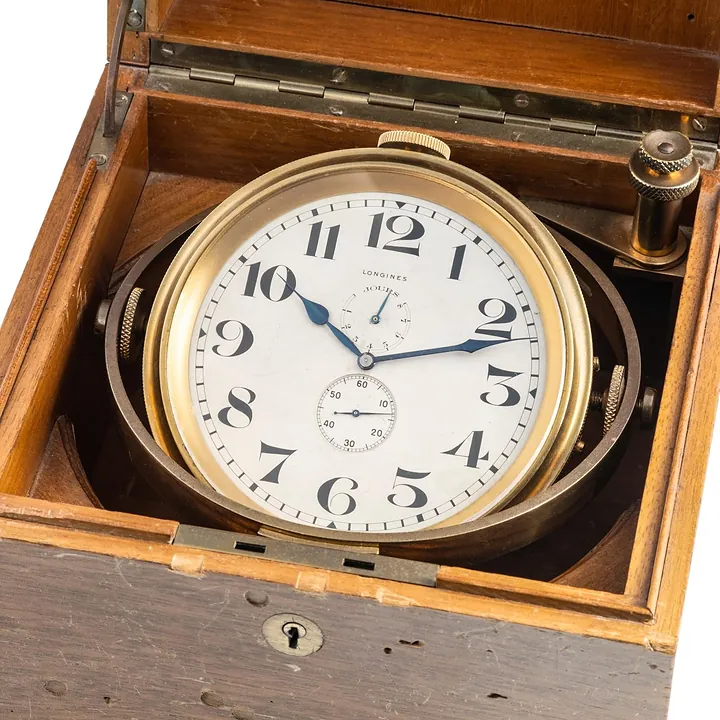
Longines marine chronometer, c. 1940
Antiquorum auction archive, Geneva
Pocket Watches · c. 1910-1920s
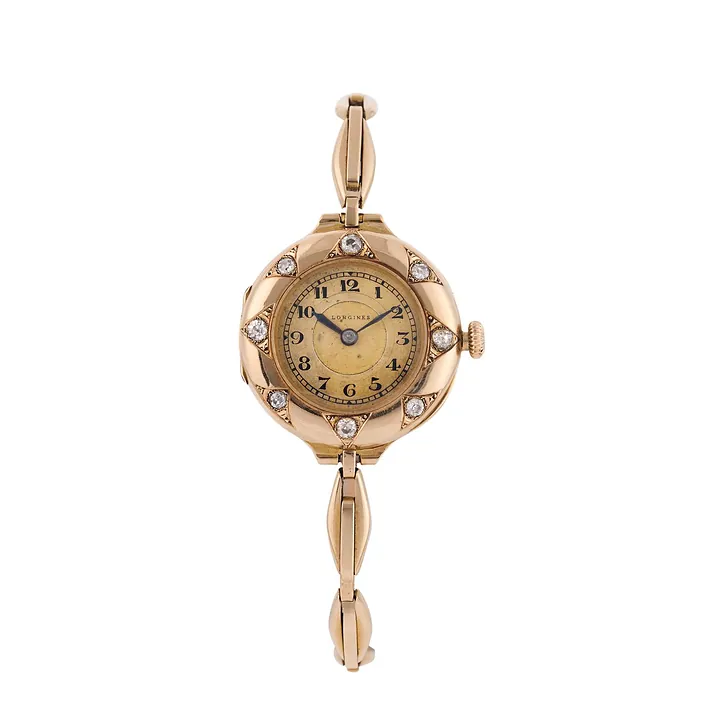
Longines watch, c. 1910-1920s
Antiquorum auction archive, Geneva
Pocket Watches · c. 1915
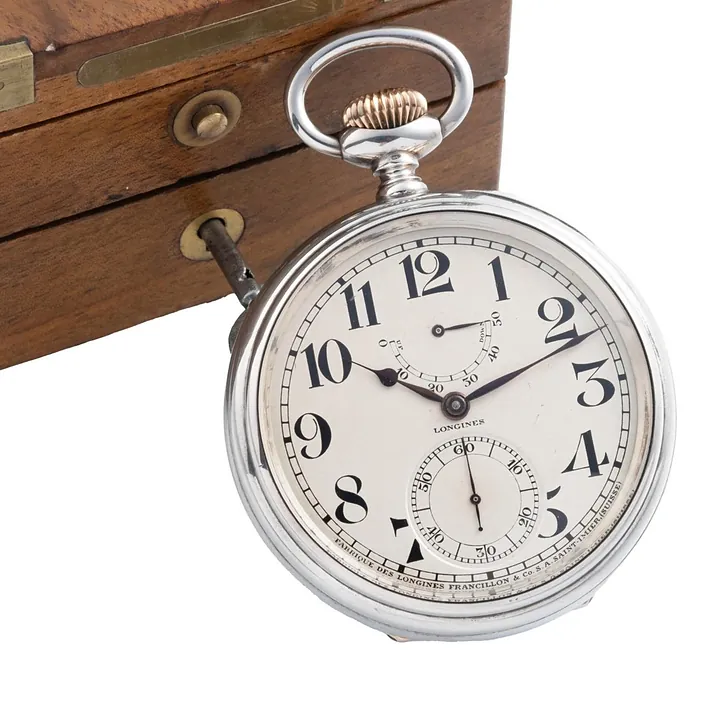
Longines ''torpedo-Boat Watch'', c. 1915
Antiquorum auction archive, Geneva
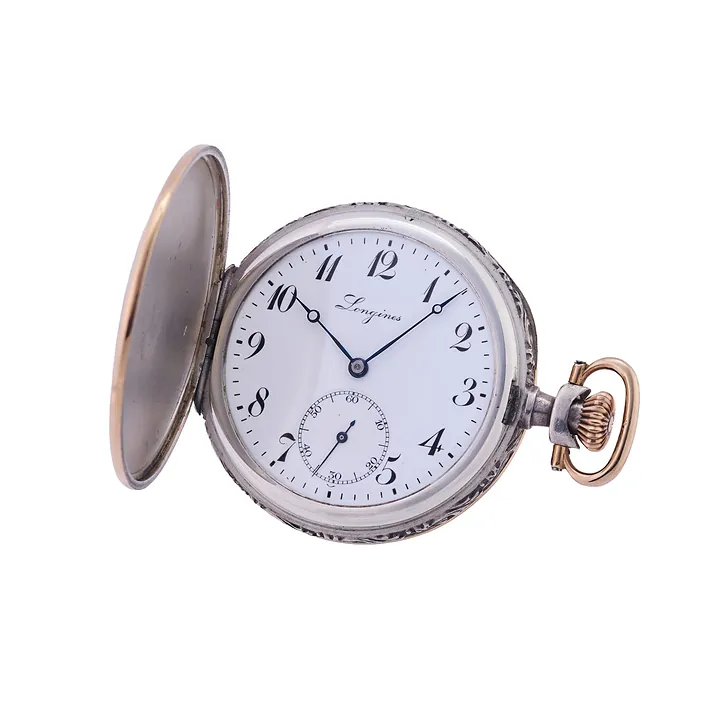
Pocket Watches · c. 1920s
Longines pocket watch, c. 1920s (Antiquorum Lot 389-59)
Antiquorum auction archive, Geneva

Wristwatches · 1945
Wristwatch by Eterna, 1945
Museum Rotterdam

Wristwatches · c. 1945
Breitling Premier, ref. 790, c. 1945
Antiquorum auction archive, Geneva

Wristwatches · c. 1945
Universal Genève Uni-Compax, ref. 22492, c. 1945
Antiquorum auction archive, Geneva

Wristwatches · c. 1950s
Baume & Mercier wristwatch, c. 1950s
Antiquorum auction archive, Geneva