
Wristwatches · Wristwatch
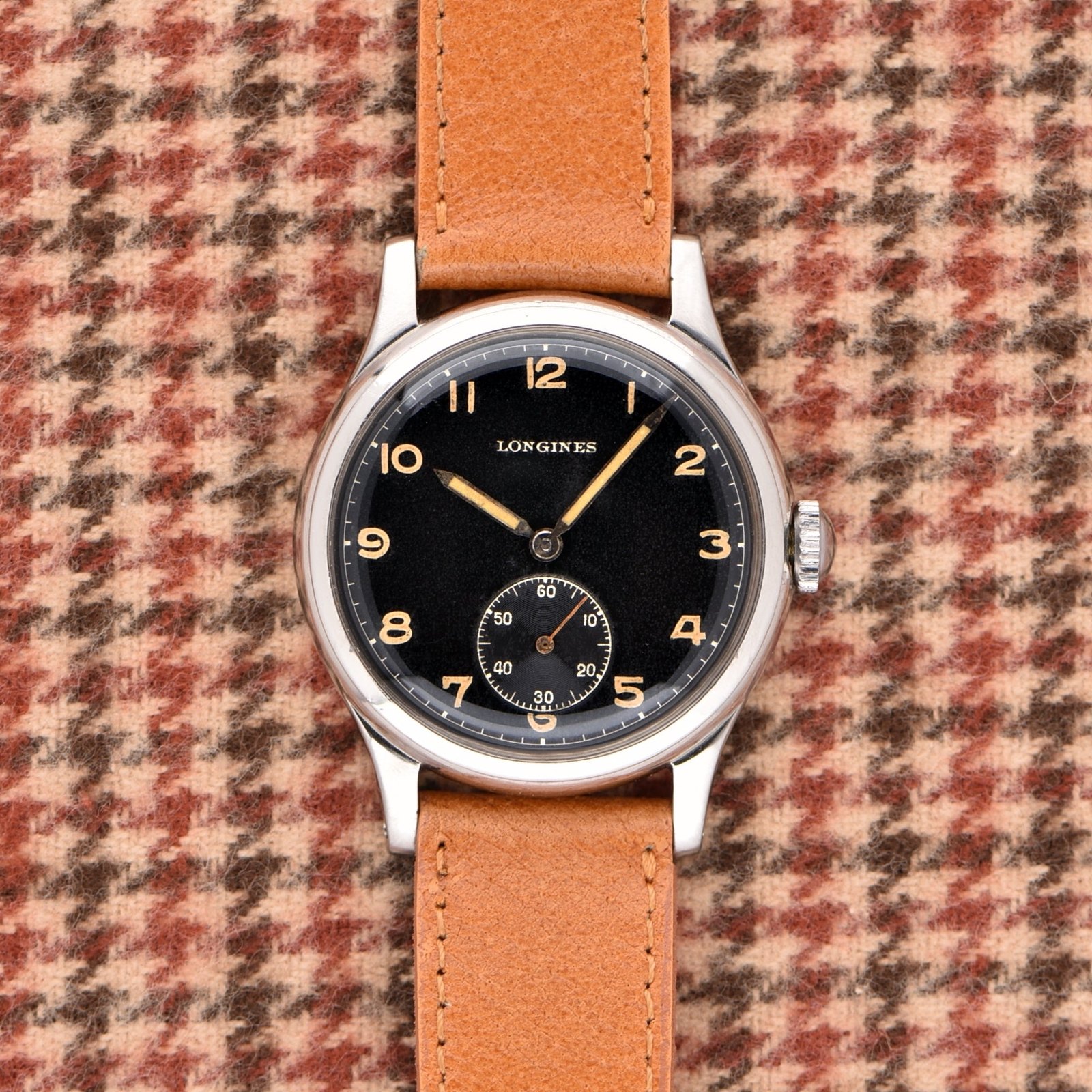
Longines Sei Tacche Black Gilt Dial - Archives, 1945
- Maker / attribution
- Longines (maker)
- Date
- 1945
- Historical period
- Modern Mechanical Horology (1945 – 1969)
- Country of origin
- Switzerland
- Object type
- Wristwatch
- Dimensions
- Case 32 mm
- Stock no.
- Product 7348800061623
- Credit line
- Dealer listing, Huntington Company (product 7348800061623)
- Catalogue title (original)
- 1945 Longines Sei Tacche Black Gilt Dial - Archives (English)
View the source record (dealer listing) ↗ (opens another website in a new tab)Suggest a correction
Record summary
Catalogued by Huntington Company (dealer) (stock number Product 7348800061623), this is a wristwatch by Longines, made in Switzerland, dated 1945. The Atlas places it in the Modern Mechanical Horology period (1945 – 1969) of its Wristwatches collection. Recorded dimensions: Case 32 mm. The record is illustrated with 6 photographs.
Assembled from the source record's structured fields. Dates and attributions are given as the source states them; where a field is missing the Atlas leaves it blank rather than estimating.
Catalogue description
Dealer description — Huntington Company
Reference 5391 Extract From Longines Specifications Year: 1945 Model: Sei Tacche Case Diameter: 32mm Lug to Lug: 38.8mm Case: Steel Condition: In regular, worn, condition Dial: Black gilt Movement: Manual winding Condition Condition-wise, this is a stunner. The case looks great with normal wear. The original lume is still all intact and has gained beautiful patina, and the same goes for the dial. The gilt dial has a speckled gloss texture from aging that looks amazing. To think this watch is almost 80 years old is crazy. This Sei Tacche also comes with the Extract from Longines. The Story The Italian word "tacche" refers to the number of wrench notches in the case back, which gained popularity in the 1930s. Screw-in backs were later used by various manufacturers, including Oyster, Taubert Freres, and others. The most widespread type of screw-in backs had ordinary notches for simple two-point or three-point wrenches. Tre tacche, meaning three wrench notches, was popular from the late 1930s to mid-1940s and was used by Longines collectors in various watches. Three-notch backs are less common but not uncommon, and Longines watches with three-notch backs are often featured. The origin of these nicknames is Italian, and the number of notches in the case back is not significant. The popularity of Longines watches with three-notch backs is largely due to their design and dials, rather than the number of notches. With that being said, the reference 5391 is a Sei Tacche. This example comes with a very nice gloss black dial with very nice lume. The watch comes with the Archives from Longines dating and referencing the watch. The Brand In 1832, Swiss watchmaker Auguste Agassiz established a watch company in Saint-Imier with the help of two partners, lawyers and brothers-in-law Henri Raiguel and Florian Morel. The company's name was Raiguel Jeune & Cie., but by 1846, both partners had retired from the watch industry, leaving Agassiz solely in charge. In 1852, Agassiz brought in his nephew Ernest Francillon to help run the business, who was responsible for important decisions such as the establishment of the first Longines factory and the Longines name itself. Under Francillon's control, the growing watch company set up its first manufacturing factory in 1867, located in an area of southern Saint-Imier known as Es Longines (meaning “long meadows”). To help lead the new factory, Francillon appointed a talented engineer named Jacques David as the Technical Director for Longines. David was sent to the United States to attend the 1876 World's Fair in Philadelphia, where he gathered ideas about America's approach to industrialized watchmaking and created a 108-page report detailing his findings. Upon returning to Switzerland, Longines began implementing some of the strategies that Jacques David had learned from American watchmakers, making Longines a pioneer in industrialized timepiece production. The same year Longines established its first factory, it also produced its first movement (the 20A) and by 1878, it was already producing a simple chronograph movement (the 20H; patented by watchmaker Alfred Lugrin). These early advancements gave the brand an advantage in the world of competitive sports, particularly horse racing. As early as 1886, Longines was already the supplier of timepieces to most sports officials in New York. Longines is most famous for its contributions to navigation and the early days of flight. In 1919, Longines was named the official supplier of timepieces for the International Aeronautical Federation and collaborated with US Navy officer Philip Van Horn Weems to create the Longines Weems Second-Setting Watch in 1927. After making his historic non-stop solo flight over the North Atlantic, American pilot Charles Lindbergh worked with Longines to create the Lindbergh Hour Angle Watch in 1931. Longines continues to be a part of the Swatch Group and operates out of its perennial home in Saint-Imier, producing a wide variety of different Swiss-made timepieces. The brand continues to play an active role in the worlds of aviation, equestrian, and alpine skiing, and has been gaining traction among buyers in recent years.
Historical context
Modern Mechanical Horology (1945 – 1969)
Tool watches for divers, pilots and astronauts; electric watches anticipate the electronic age.
The classic era of the mechanical wristwatch: dive watches, chronographs for motor racing and space flight, GMT watches for jet travel, slim dress watches, automatic calendars, and the rise of Japanese manufacturers alongside Swiss, American, German and Soviet industries.
Read the period in the timelineMore wristwatches from this periodEarlier: Golden Age of Mechanical Watchmaking
Atlas type guide
Wristwatches
Bracelet watches were worn by women from the early nineteenth century — Breguet made one for Caroline Murat, Queen of Naples, in 1810–12 — but the wristwatch only became a man's instrument with military use and aviation in the early twentieth century. Between the World Wars it overtook the pocket watch; the 1920s and 1930s brought rectangular Art Deco cases, water-resistant cases and the first automatic winding systems.
After 1945 the wristwatch became a carrier of identity — dress watches, sports and dive watches, chronographs, calendars — produced by Swiss, American, Japanese, German, Soviet and Chinese industries. The quartz revolution after 1969 and the mechanical renaissance since the 1990s, including the rise of independent watchmakers, complete the story.
What to look for
- The reference number (between the lugs or inside the case back) and serial number, the starting point for dating.
- The calibre: its maker and number are often stamped under the dial or on the bridge.
- Originality of dial, hands and crown — refinished ('redial') dials are common.
- Case material marks: 18K/750, 14K/585, stainless steel, gold-filled, plated.
Dating clues
- Wire-lug cases: before c. 1925.
- Water-resistant screw-down cases: from 1926.
- Quartz movements: from 1969; sapphire crystals widespread after c. 1980.
General guidance written by the Atlas editors about this kind of object. It is not a statement about this particular piece; for that, rely on the source record above and on physical examination.
Related records
Instruments · c. 1940
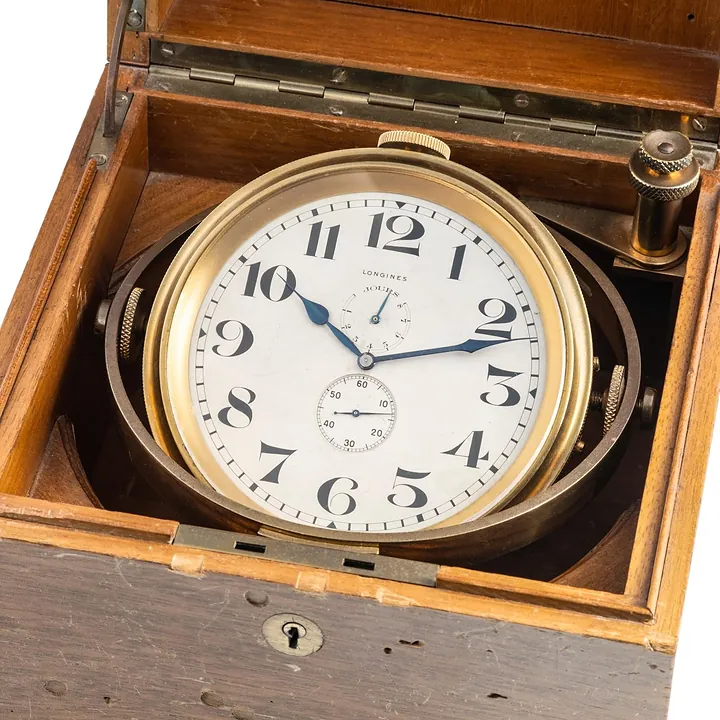
Longines marine chronometer, c. 1940
Antiquorum auction archive, Geneva
Pocket Watches · c. 1910-1920s
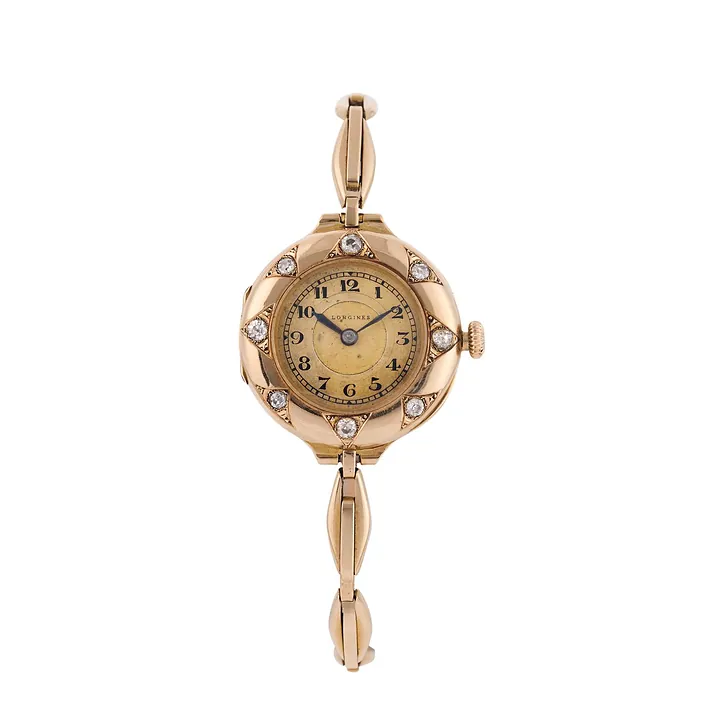
Longines watch, c. 1910-1920s
Antiquorum auction archive, Geneva
Pocket Watches · c. 1915
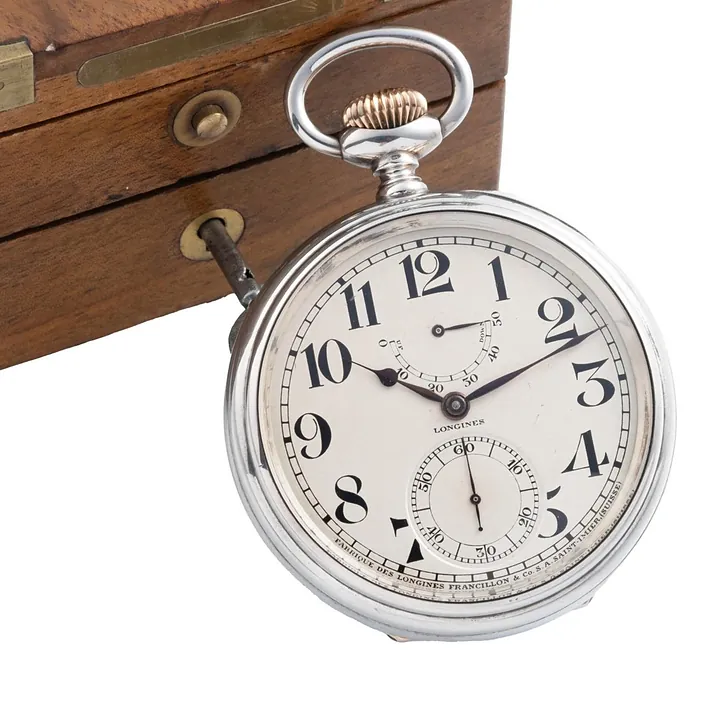
Longines ''torpedo-Boat Watch'', c. 1915
Antiquorum auction archive, Geneva
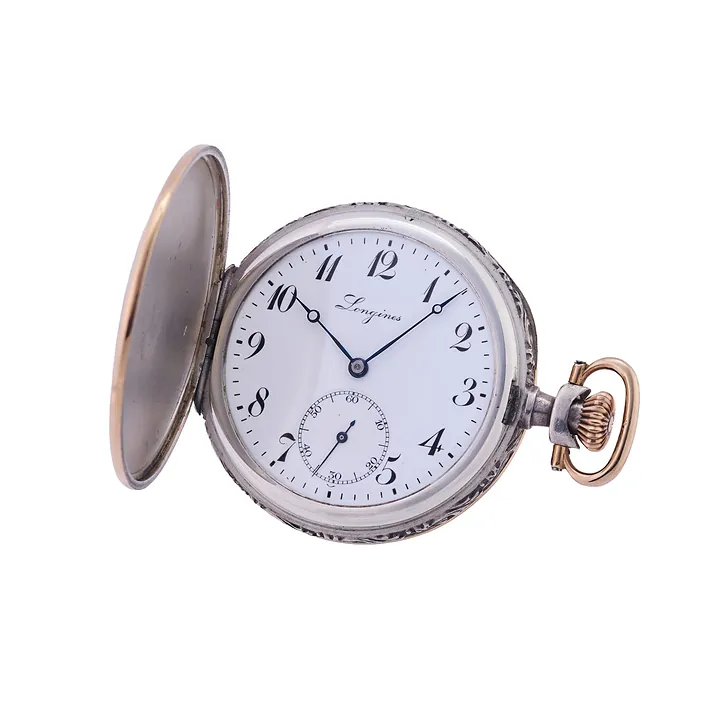
Pocket Watches · c. 1920s
Longines pocket watch, c. 1920s (Antiquorum Lot 389-59)
Antiquorum auction archive, Geneva

Wristwatches · 1945
Wristwatch by Eterna, 1945
Museum Rotterdam

Wristwatches · c. 1945
Breitling Premier, ref. 790, c. 1945
Antiquorum auction archive, Geneva

Wristwatches · c. 1945
Universal Genève Uni-Compax, ref. 22492, c. 1945
Antiquorum auction archive, Geneva

Wristwatches · c. 1950s
Baume & Mercier wristwatch, c. 1950s
Antiquorum auction archive, Geneva