
Wristwatches · Wristwatch
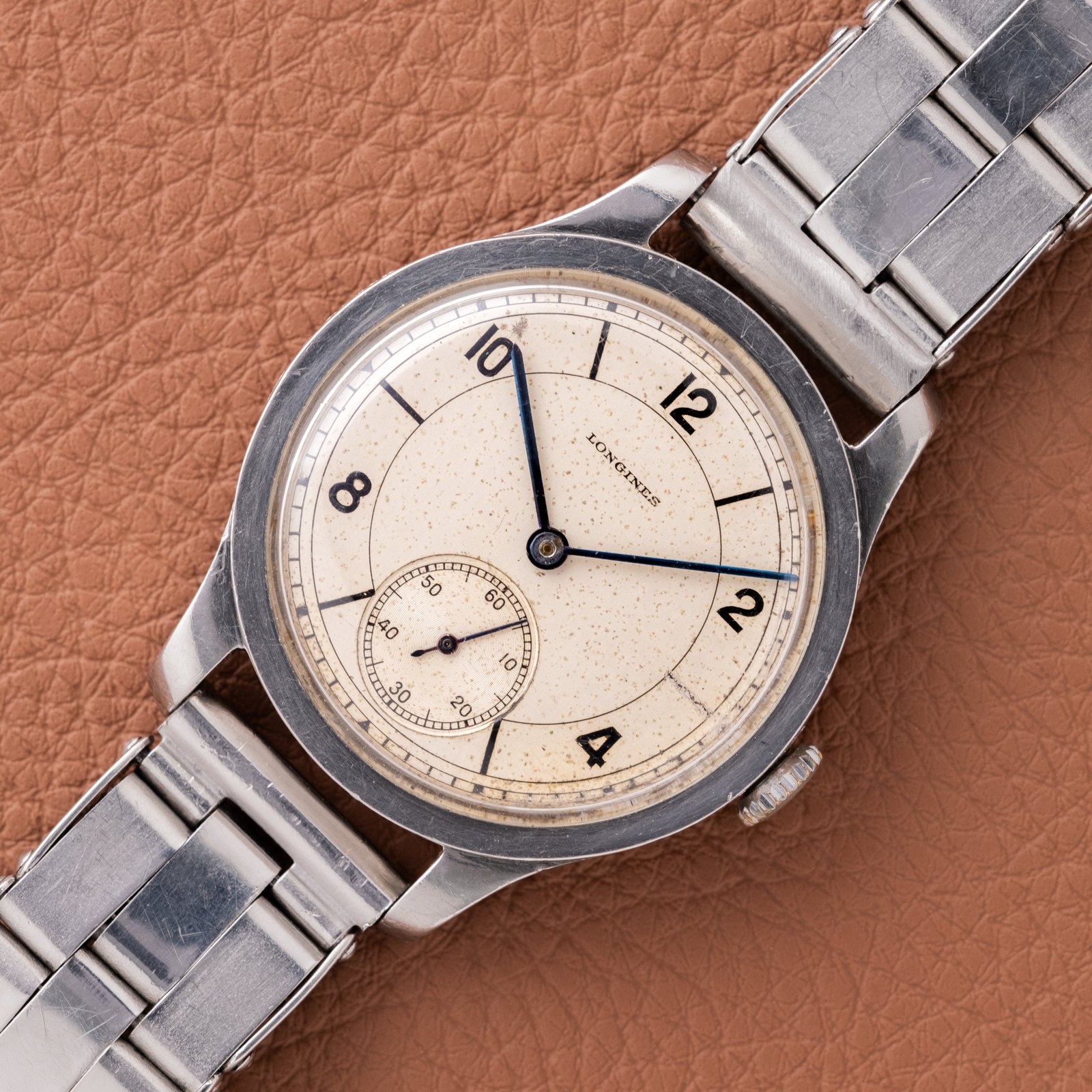
Longines Sector Dial Calibre 12.68z (Ref. 2326), 1940s
- Maker / attribution
- Longines (maker)
- Date
- 1940s
- Historical period
- Golden Age of Mechanical Watchmaking (1900 – 1945)
- Country of origin
- Switzerland
- Object type
- Wristwatch
- Dimensions
- Case 33 mm
- Stock no.
- Product 8817255481527
- Credit line
- Dealer listing, Huntington Company (product 8817255481527)
- Catalogue title (original)
- 1940s Longines Sector Dial Calibre 12.68z (Ref. 2326) (English)
View the source record (dealer listing) ↗ (opens another website in a new tab)Suggest a correction
Record summary
Catalogued by Huntington Company (dealer) (stock number Product 8817255481527), this is a wristwatch by Longines, made in Switzerland, dated 1940s. The Atlas places it in the Golden Age of Mechanical Watchmaking period (1900 – 1945) of its Wristwatches collection. Recorded dimensions: Case 33 mm. The record is illustrated with 6 photographs.
Assembled from the source record's structured fields. Dates and attributions are given as the source states them; where a field is missing the Atlas leaves it blank rather than estimating.
Catalogue description
Dealer description — Huntington Company
History and Significance Longines produced some of the most compelling time-only watches of the 1930s and 1940s, and much of their appeal comes from how much attention was given to the dial. The reference 2326 is a perfect example. Rather than relying on ornamentation, the sector layout divides the dial into clearly defined areas for the hours, minutes, and subsidiary seconds. It is a design rooted in legibility and proportion, but decades later it has become one of the most recognizable aesthetics associated with pre-war and wartime-era wristwatches. The sector dial gives this example an almost architectural quality. The contrasting tracks visually expand the dial beyond what might be expected from a 33mm watch, while the subsidiary seconds provides balance without interrupting the geometry. Everything has a defined place, and there is very little decoration that does not also serve a functional purpose. That restraint is a major reason these designs have aged so gracefully. Inside the reference 2326 is the Longines caliber 12.68Z, a manually wound movement from one of the strongest periods of Longines movement production. Longines was still manufacturing its own calibers during this era, and movements such as the 12.68Z demonstrate why vintage examples from the manufacture have developed such a dedicated following. The movement is straightforward in purpose but beautifully representative of the quality Longines was capable of producing. Paired with a simple time-only dial, it keeps the entire watch focused on traditional mechanical watchmaking. The stretch rivet bracelet changes the personality considerably. A watch like the reference 2326 could easily become an extremely formal vintage piece on leather, but the steel bracelet gives it a more casual and utilitarian character. That combination suits the sector dial particularly well and makes the watch feel less delicate than its age might suggest. The bracelet, steel case, and graphic dial together create a watch that feels unmistakably from the 1940s without appearing overly dressy. Finally, the 33mm dimensions are an important part of why the design works. The narrow bezel allows the sector dial to occupy most of the visual footprint, so the watch reads larger and more confidently than the measurement alone suggests. Nothing about the reference 2326 needs to be enlarged or modernized for the design to make sense. Its appeal comes from the proportions being exactly what the dial and movement required. Writer’s Thoughts Sector dials are often recreated because the formula is so effective, but an original period Longines has a completely different presence. The reference 2326 has the geometry, restrained proportions, and manually wound caliber that modern interpretations are usually trying to capture. Putting it on a stretch rivet bracelet makes it even better because it removes some of the formality normally associated with a 1940s Longines. It becomes the kind of vintage watch that looks interesting rather than simply old. Our Promise Every watch is thoroughly vetted, carefully described with complete transparency, and guaranteed authentic. Each piece is offered in honest condition, ensuring collectors receive a timepiece that reflects both originality and integrity. Specifications Brand: Longines Model: Sector Dial Reference: 2326 Year: 1940s Case Material: Stainless steel Case Size: 33mm Dial: Sector dial with subsidiary seconds Movement: Manual-wind Longines caliber 12.68Z Strap/Buckle: Stainless steel stretch rivet bracelet Buckle/Clasp: Folding clasp Contents: Watch only Condition Case: Stainless steel case presents attractively with visible surface wear and aging consistent with a watch from the 1940s. The case retains a pleasing overall shape and vintage character. Dial: Sector dial shows visible aging and patina consistent with age while retaining strong legibility and its distinctive original-style layout. Hands: Hands show age consistent with the dial and remain attractive overall. Crystal: Crystal presents well with light surface wear consistent with age and use. Strap/Buckle: Stretch rivet bracelet presents with visible wear and aging consistent with its vintage construction. Buckle/Clasp: Folding clasp remains present and shows wear consistent with the bracelet.
Historical context
Golden Age of Mechanical Watchmaking (1900 – 1945)
The wristwatch displaces the pocket watch; waterproof cases, self-winding and grand complications.
The wristwatch overtook the pocket watch. Military use in the First World War, aviation, water-resistant cases (1926), automatic winding (1923–31), rectangular Art Deco designs and early chronographs and calendars defined the period.
Read the period in the timelineMore wristwatches from this periodEarlier: Industrial Revolution
Atlas type guide
Wristwatches
Bracelet watches were worn by women from the early nineteenth century — Breguet made one for Caroline Murat, Queen of Naples, in 1810–12 — but the wristwatch only became a man's instrument with military use and aviation in the early twentieth century. Between the World Wars it overtook the pocket watch; the 1920s and 1930s brought rectangular Art Deco cases, water-resistant cases and the first automatic winding systems.
After 1945 the wristwatch became a carrier of identity — dress watches, sports and dive watches, chronographs, calendars — produced by Swiss, American, Japanese, German, Soviet and Chinese industries. The quartz revolution after 1969 and the mechanical renaissance since the 1990s, including the rise of independent watchmakers, complete the story.
What to look for
- The reference number (between the lugs or inside the case back) and serial number, the starting point for dating.
- The calibre: its maker and number are often stamped under the dial or on the bridge.
- Originality of dial, hands and crown — refinished ('redial') dials are common.
- Case material marks: 18K/750, 14K/585, stainless steel, gold-filled, plated.
Dating clues
- Wire-lug cases: before c. 1925.
- Water-resistant screw-down cases: from 1926.
- Quartz movements: from 1969; sapphire crystals widespread after c. 1980.
General guidance written by the Atlas editors about this kind of object. It is not a statement about this particular piece; for that, rely on the source record above and on physical examination.
Related records
Instruments · c. 1940
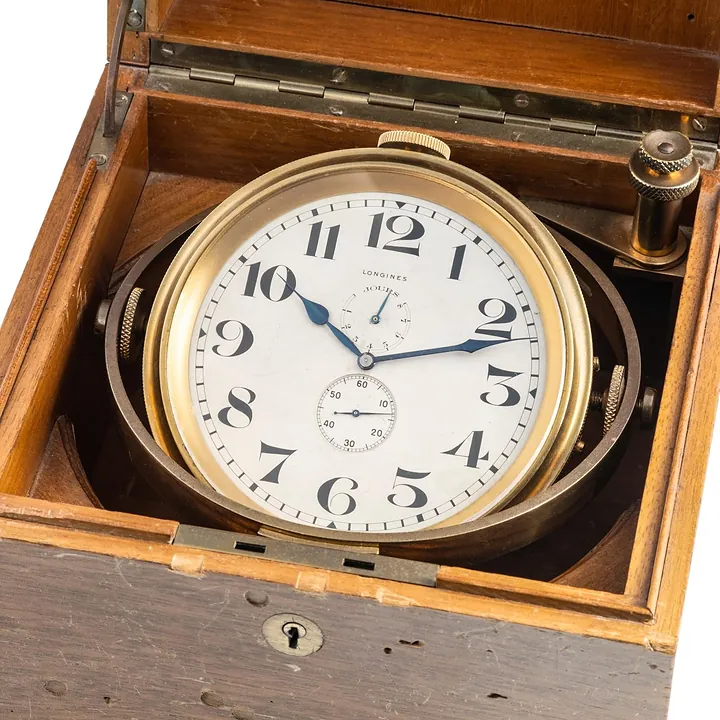
Longines marine chronometer, c. 1940
Antiquorum auction archive, Geneva
Pocket Watches · c. 1910-1920s
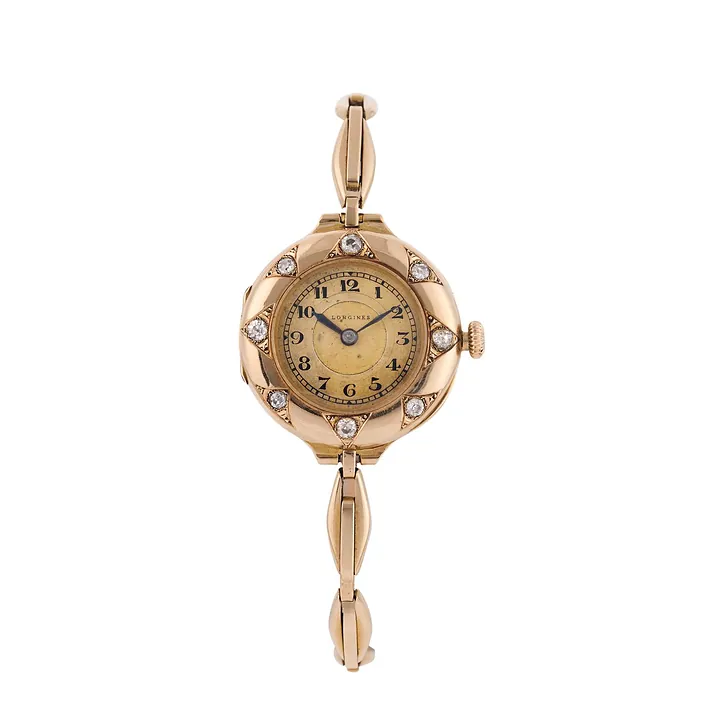
Longines watch, c. 1910-1920s
Antiquorum auction archive, Geneva
Pocket Watches · c. 1915
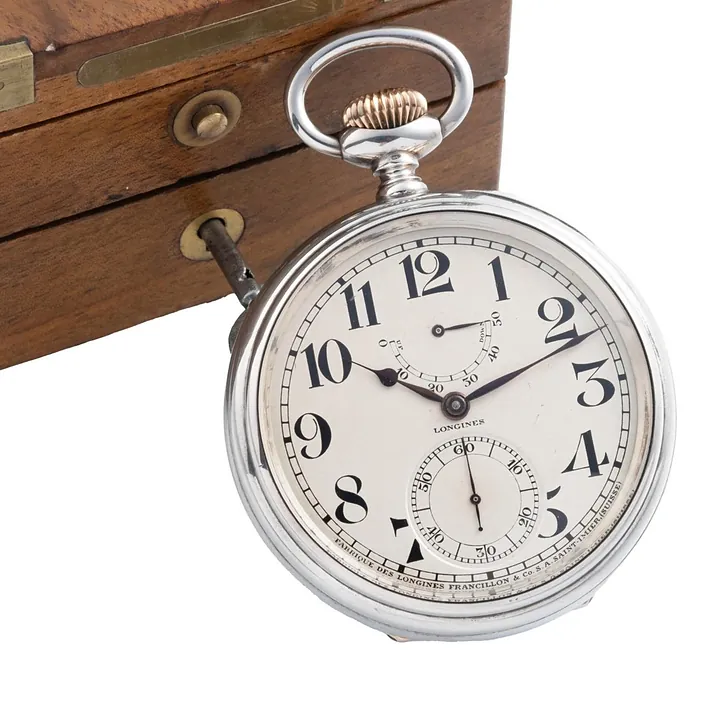
Longines ''torpedo-Boat Watch'', c. 1915
Antiquorum auction archive, Geneva
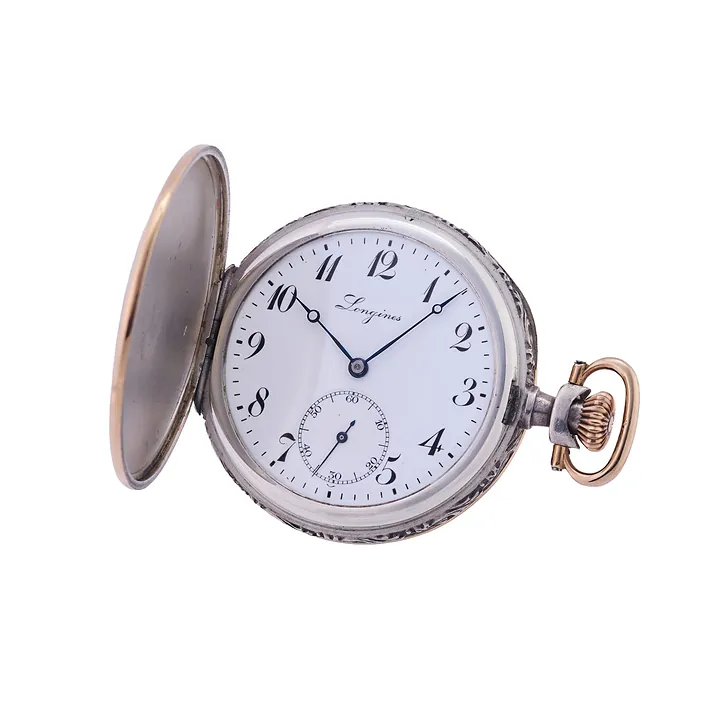
Pocket Watches · c. 1920s
Longines pocket watch, c. 1920s (Antiquorum Lot 389-59)
Antiquorum auction archive, Geneva

Wristwatches · 1931
Rolex 'Oyster Perpetual' rotor self-winding wrist-watch, lever escapement, in steel case with glass in back, Montres Rolex SA, Geneva, Switzerland, 1931
Science Museum Group, London

Wristwatches · 1900–1999
Wristwatch by Certina, Switzerland, 1900–1999
Nordic Museum Foundation
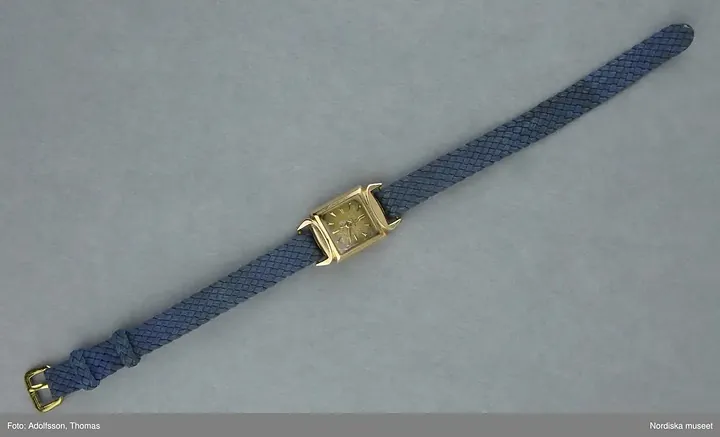
Wristwatches · 1900–1999
Wristwatch by Omega, Västerås, 1900–1999
Nordic Museum Foundation
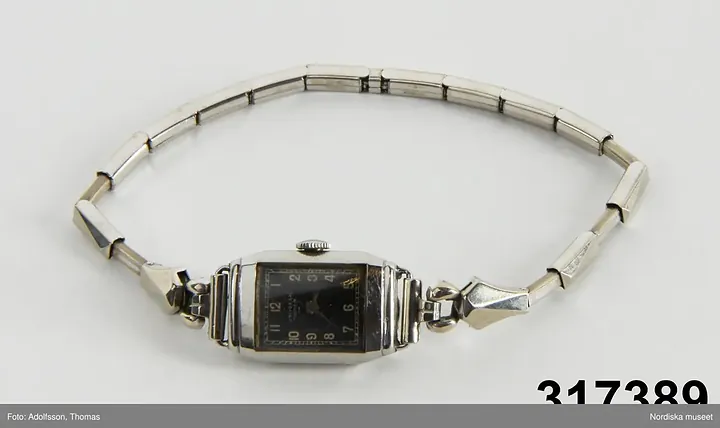
Wristwatches · 1900–1999
Wristwatch by Universal, Switzerland, 1900–1999
Nordic Museum Foundation