
Wristwatches · Wristwatch
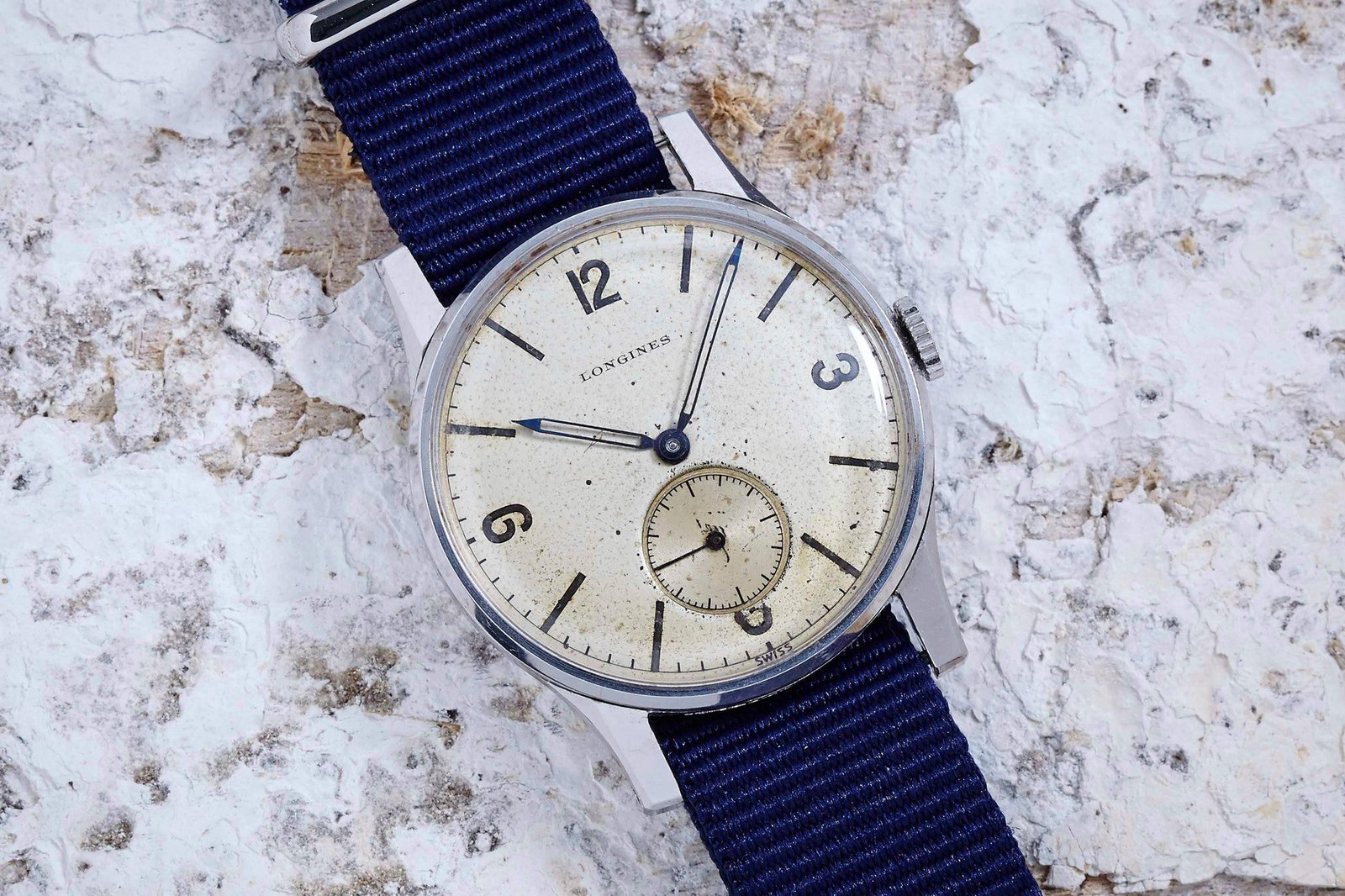
Longines Gent's Watch, 1940s
- Maker / attribution
- Longines (maker)
- Date
- 1940s
- Historical period
- Golden Age of Mechanical Watchmaking (1900 – 1945)
- Country of origin
- Switzerland
- Object type
- Wristwatch
- Stock no.
- Product 1969612097
- Credit line
- Dealer listing, Analog/Shift (product 1969612097)
- Catalogue title (original)
- Longines Gent's Watch (English)
View the source record (dealer listing) ↗ (opens another website in a new tab)Suggest a correction
Record summary
Catalogued by Analog/Shift (dealer), New York (stock number Product 1969612097), this is a wristwatch by Longines, made in Switzerland, dated 1940s. The Atlas places it in the Golden Age of Mechanical Watchmaking period (1900 – 1945) of its Wristwatches collection. The record is illustrated with 6 photographs.
Assembled from the source record's structured fields. Dates and attributions are given as the source states them; where a field is missing the Atlas leaves it blank rather than estimating.
Catalogue description
Dealer description — Analog/Shift
Simplicity. So much of the modern watch world is confused. No iconic style, no cherished design language ever benefitted from addition. True style is spoken in simple direct tones, executed effortlessly in a cohesive voice. Longines has had it's fair share of pitfalls. Most of of the brand's offerings since the Quartz Revolution flunked; their design language was injected with artificial features that leaned more toward glitz and glam than style and function. Even today, the brand seems to tip-toe about the market, asking questions with their pieces instead of answering them. But the Longines of today is not the Longines of yesteryear. From the late 1800s, Longines was at the sharp end of the watchmaking spear. Constantly innovating, Longines was a company to be compared with the other major Swiss manufactures. By 1919, Longines was the official supplier of timepieces for the International Aeronautical Federation, working to develop highly accurate navigation chronometers for many of the era's great aviation pioneers. Most famous among Longines' forays into navigation pieces is probably the Lindberg Hour Angle watch, a wristwatch designed by Charles Lindberg in conjunction with the brand to allow aviators to calculate, with the help of a sextant and their latitude, their exact geographic location. (Don't ask us how, but word has it that Jack Forster over at HODINKEE has figured it out.) This piece, a simple time-only watch from the 1940s, is emblematic of Longines at full stride. The simple steel case houses a chipper Calibre 23M manually-winding movement with a running seconds sub-dial at 6:00 - a classic and lovely design complimented by the spartan dial with Arabic numerals at 12, 3, 6 and 9. Over all, this piece is a true benchmark of the simple, timeless styling mastered by Longines in its prime.
Historical context
Golden Age of Mechanical Watchmaking (1900 – 1945)
The wristwatch displaces the pocket watch; waterproof cases, self-winding and grand complications.
The wristwatch overtook the pocket watch. Military use in the First World War, aviation, water-resistant cases (1926), automatic winding (1923–31), rectangular Art Deco designs and early chronographs and calendars defined the period.
Read the period in the timelineMore wristwatches from this periodEarlier: Industrial Revolution
Atlas type guide
Wristwatches
Bracelet watches were worn by women from the early nineteenth century — Breguet made one for Caroline Murat, Queen of Naples, in 1810–12 — but the wristwatch only became a man's instrument with military use and aviation in the early twentieth century. Between the World Wars it overtook the pocket watch; the 1920s and 1930s brought rectangular Art Deco cases, water-resistant cases and the first automatic winding systems.
After 1945 the wristwatch became a carrier of identity — dress watches, sports and dive watches, chronographs, calendars — produced by Swiss, American, Japanese, German, Soviet and Chinese industries. The quartz revolution after 1969 and the mechanical renaissance since the 1990s, including the rise of independent watchmakers, complete the story.
What to look for
- The reference number (between the lugs or inside the case back) and serial number, the starting point for dating.
- The calibre: its maker and number are often stamped under the dial or on the bridge.
- Originality of dial, hands and crown — refinished ('redial') dials are common.
- Case material marks: 18K/750, 14K/585, stainless steel, gold-filled, plated.
Dating clues
- Wire-lug cases: before c. 1925.
- Water-resistant screw-down cases: from 1926.
- Quartz movements: from 1969; sapphire crystals widespread after c. 1980.
General guidance written by the Atlas editors about this kind of object. It is not a statement about this particular piece; for that, rely on the source record above and on physical examination.
Related records
Instruments · c. 1940
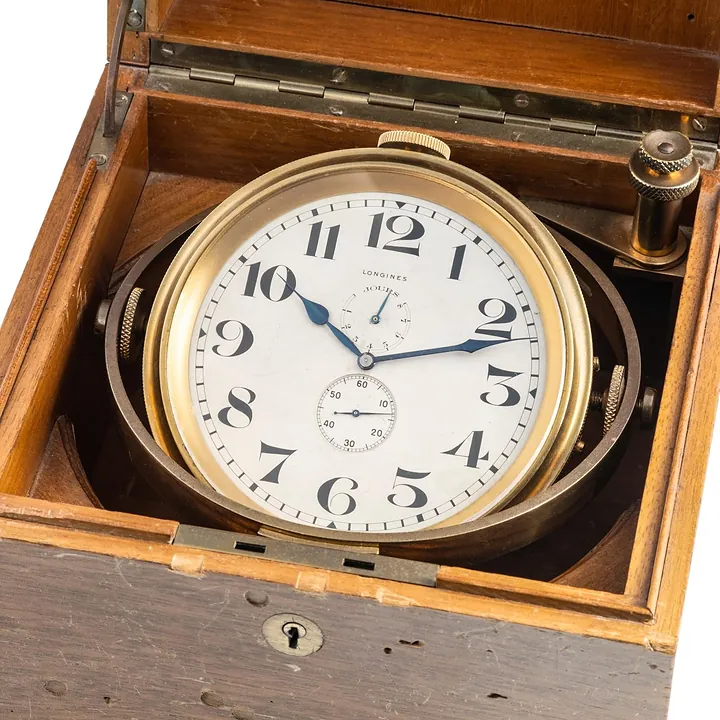
Longines marine chronometer, c. 1940
Antiquorum auction archive, Geneva
Pocket Watches · c. 1910-1920s
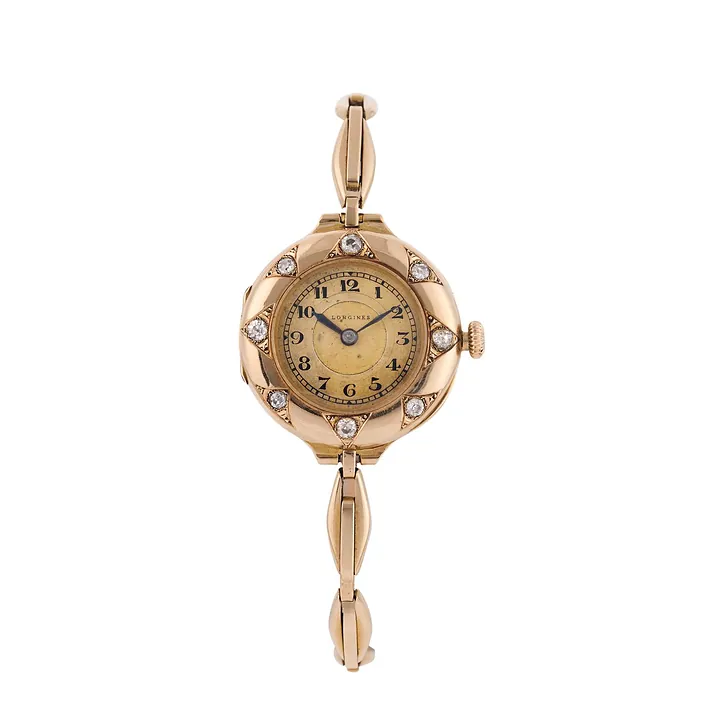
Longines watch, c. 1910-1920s
Antiquorum auction archive, Geneva
Pocket Watches · c. 1915
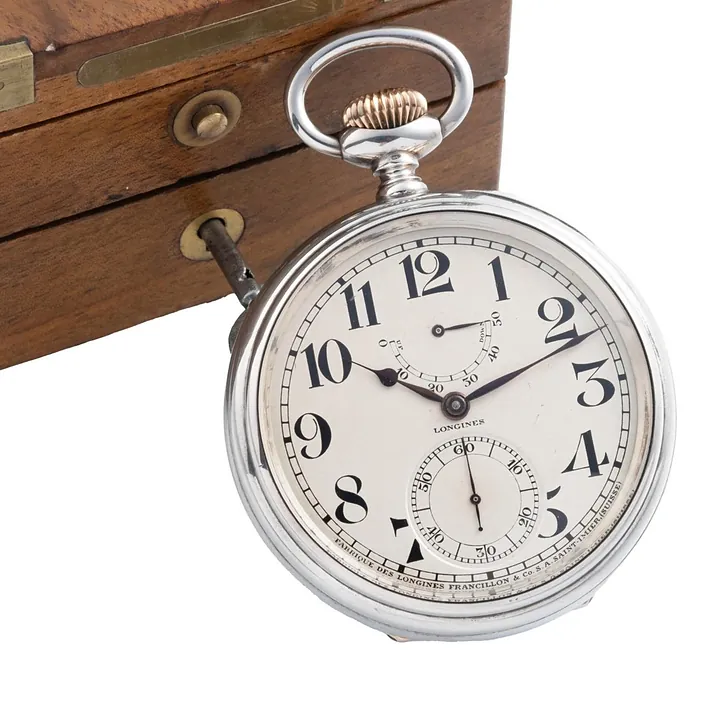
Longines ''torpedo-Boat Watch'', c. 1915
Antiquorum auction archive, Geneva
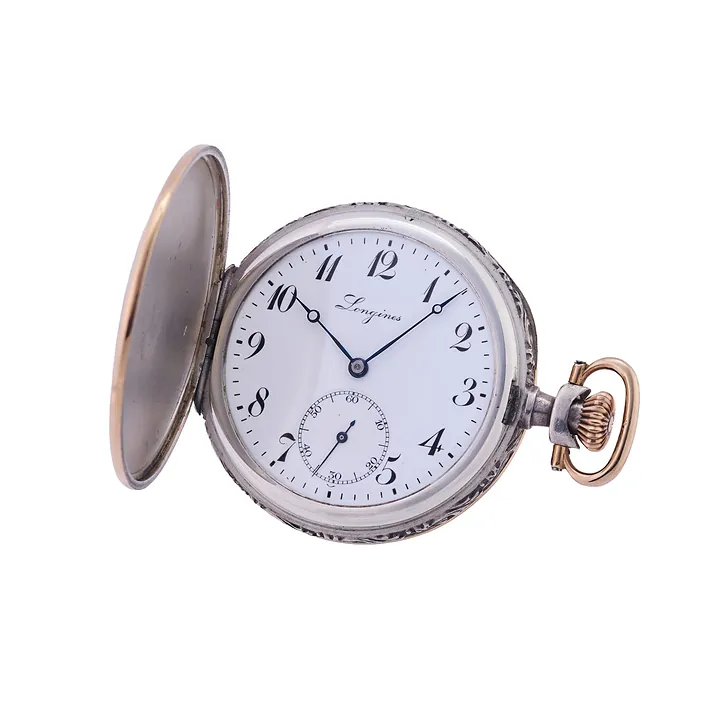
Pocket Watches · c. 1920s
Longines pocket watch, c. 1920s (Antiquorum Lot 389-59)
Antiquorum auction archive, Geneva

Wristwatches · 1931
Rolex 'Oyster Perpetual' rotor self-winding wrist-watch, lever escapement, in steel case with glass in back, Montres Rolex SA, Geneva, Switzerland, 1931
Science Museum Group, London

Wristwatches · 1900–1999
Wristwatch by Certina, Switzerland, 1900–1999
Nordic Museum Foundation

Wristwatches · 1900–1999
Wristwatch by Omega, Västerås, 1900–1999
Nordic Museum Foundation

Wristwatches · 1900–1999
Wristwatch by Universal, Switzerland, 1900–1999
Nordic Museum Foundation