
Wristwatches · Wristwatch
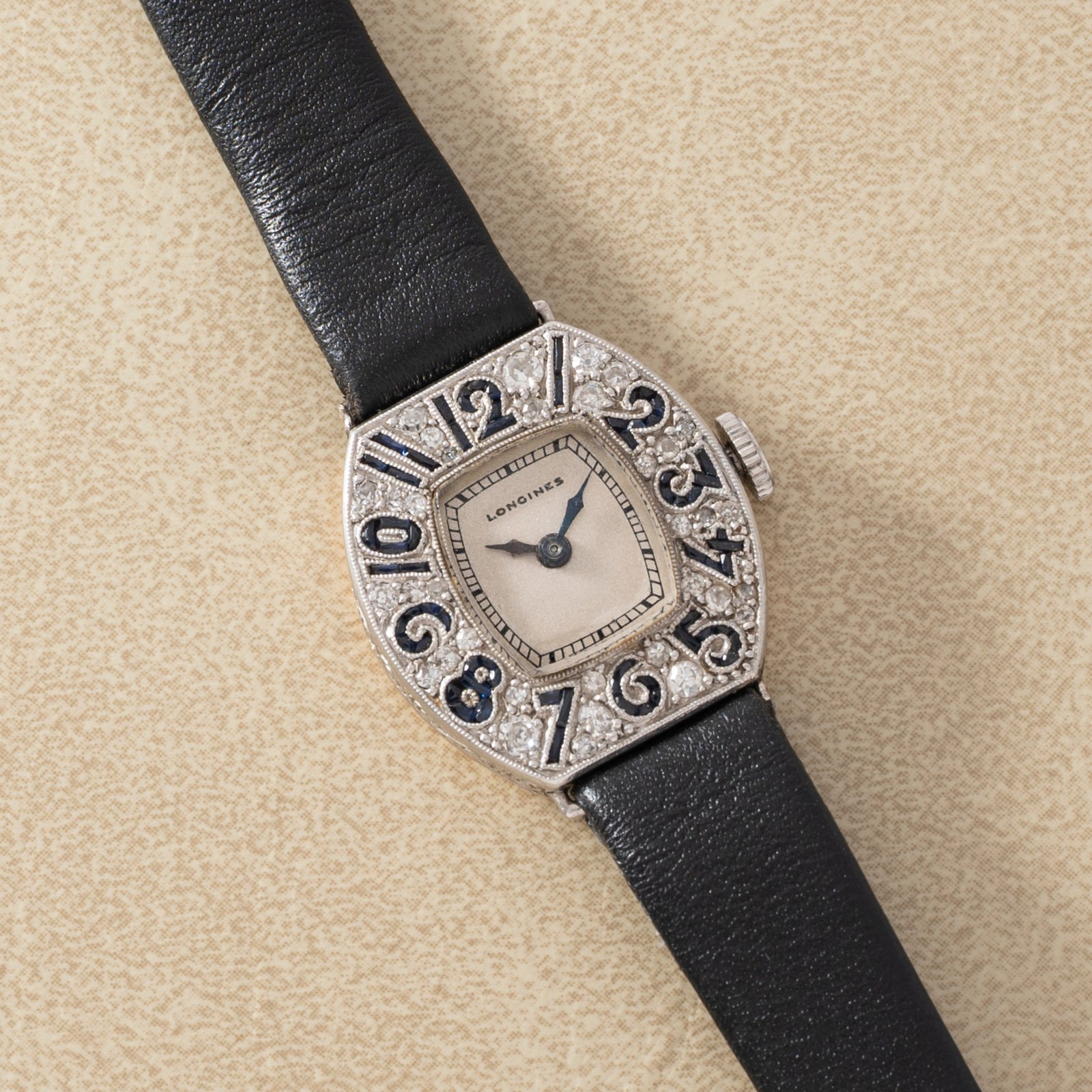
Longines Diamonds Cocktail Watch, 1920s–1930s
- Maker / attribution
- Longines (maker)
- Date
- 1920s–1930s
- Historical period
- Golden Age of Mechanical Watchmaking (1900 – 1945)
- Country of origin
- Switzerland
- Object type
- Wristwatch
- Stock no.
- 40992884
- Credit line
- Dealer listing, Analog/Shift (40992884)
- Catalogue title (original)
- Longines Diamonds Cocktail Watch (English)
View the source record (dealer listing) ↗ (opens another website in a new tab)Suggest a correction
Record summary
Catalogued by Analog/Shift (dealer), New York (stock number 40992884), this is a wristwatch by Longines, made in Switzerland, dated 1920s–1930s. The Atlas places it in the Golden Age of Mechanical Watchmaking period (1900 – 1945) of its Wristwatches collection. The record is illustrated with 6 photographs.
Assembled from the source record's structured fields. Dates and attributions are given as the source states them; where a field is missing the Atlas leaves it blank rather than estimating.
Catalogue description
Dealer description — Analog/Shift
There’s a very particular kind of glamour that only exists in the Art Deco era — the kind that feels equal parts jazz club, cigarette case, and midnight cab ride. This vintage Longines cocktail watch captures that mood perfectly, with a tonneau-shaped case that leans into Deco geometry without feeling fussy or precious. Longines is a brand that needs no introduction. It was a staple of the Swiss watchmaking industry throughout the 20th century. They are well-known for their broad assortment of models and designs, as well as their masterful — and iconic — chronographs. Today’s piece is a wonderful extension of their watchmaking prowess into the realm of delicate ladies’ watches. Dating to the 1920s–1930s, it features a petite tonneau (tortoise or barrel-shaped) case set in a pale precious metal, typical of the era, with a shimmering field of brilliant-cut diamonds framing the dial. Bold 'Arabic' numerals encircle the design in blue sapphires, creating that signature Deco contrast, while the center remains elegantly restrained: a warm silver-toned dial signed Longines, finished with a crisp minute track. Topping it all off is a blued steel 'spear' handset. Inside, the watch is powered by a manual-winding mechanical movement, exactly as a proper ladies’ dress piece of the period should be. The case is engraved on the sides and back, and it comes fitted to a simple black leather strap with a traditional pin buckle, letting the watch itself do all the talking. This is the exact category that’s been quietly resurging lately: true vintage ladies’ pieces worn not as “women’s watches,” but as pure style. Jennifer Lawrence, a long-time Longines Ambassador, has been championing this look on the red carpet (including at the 2026 Golden Globes), proving that the most modern watch statement you can make right now is sometimes the one that’s already stood the test of time. Over a century, in fact!
Historical context
Golden Age of Mechanical Watchmaking (1900 – 1945)
The wristwatch displaces the pocket watch; waterproof cases, self-winding and grand complications.
The wristwatch overtook the pocket watch. Military use in the First World War, aviation, water-resistant cases (1926), automatic winding (1923–31), rectangular Art Deco designs and early chronographs and calendars defined the period.
Read the period in the timelineMore wristwatches from this periodEarlier: Industrial Revolution
Atlas type guide
Wristwatches
Bracelet watches were worn by women from the early nineteenth century — Breguet made one for Caroline Murat, Queen of Naples, in 1810–12 — but the wristwatch only became a man's instrument with military use and aviation in the early twentieth century. Between the World Wars it overtook the pocket watch; the 1920s and 1930s brought rectangular Art Deco cases, water-resistant cases and the first automatic winding systems.
After 1945 the wristwatch became a carrier of identity — dress watches, sports and dive watches, chronographs, calendars — produced by Swiss, American, Japanese, German, Soviet and Chinese industries. The quartz revolution after 1969 and the mechanical renaissance since the 1990s, including the rise of independent watchmakers, complete the story.
What to look for
- The reference number (between the lugs or inside the case back) and serial number, the starting point for dating.
- The calibre: its maker and number are often stamped under the dial or on the bridge.
- Originality of dial, hands and crown — refinished ('redial') dials are common.
- Case material marks: 18K/750, 14K/585, stainless steel, gold-filled, plated.
Dating clues
- Wire-lug cases: before c. 1925.
- Water-resistant screw-down cases: from 1926.
- Quartz movements: from 1969; sapphire crystals widespread after c. 1980.
General guidance written by the Atlas editors about this kind of object. It is not a statement about this particular piece; for that, rely on the source record above and on physical examination.
Related records
Instruments · c. 1940
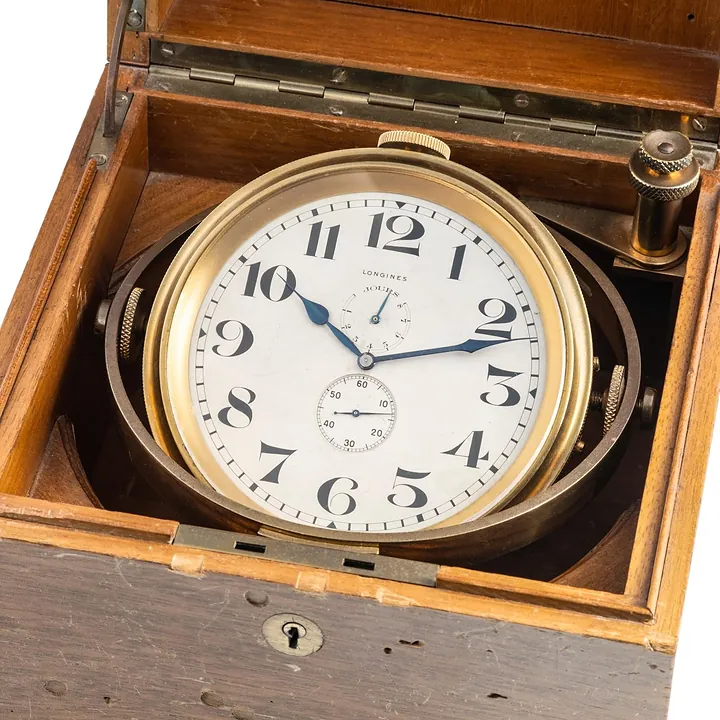
Longines marine chronometer, c. 1940
Antiquorum auction archive, Geneva
Pocket Watches · c. 1910-1920s
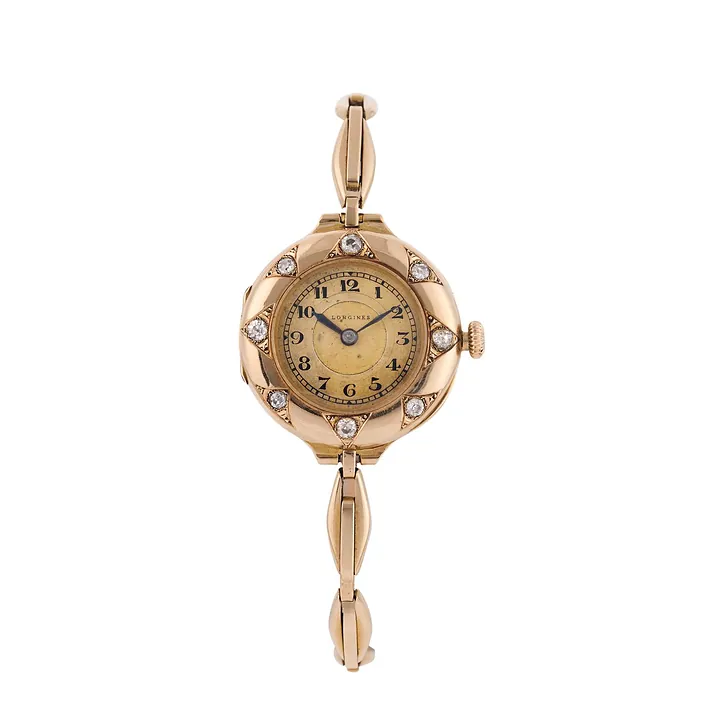
Longines watch, c. 1910-1920s
Antiquorum auction archive, Geneva
Pocket Watches · c. 1915
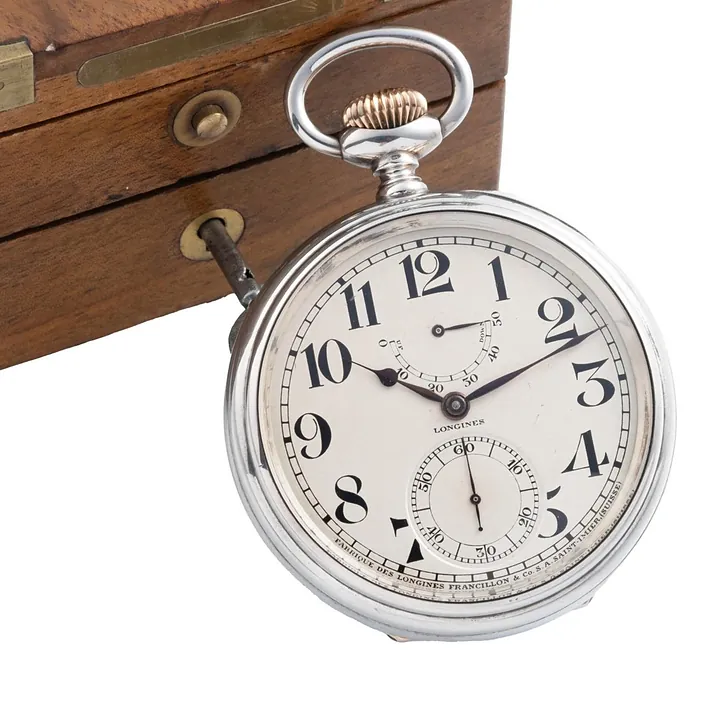
Longines ''torpedo-Boat Watch'', c. 1915
Antiquorum auction archive, Geneva
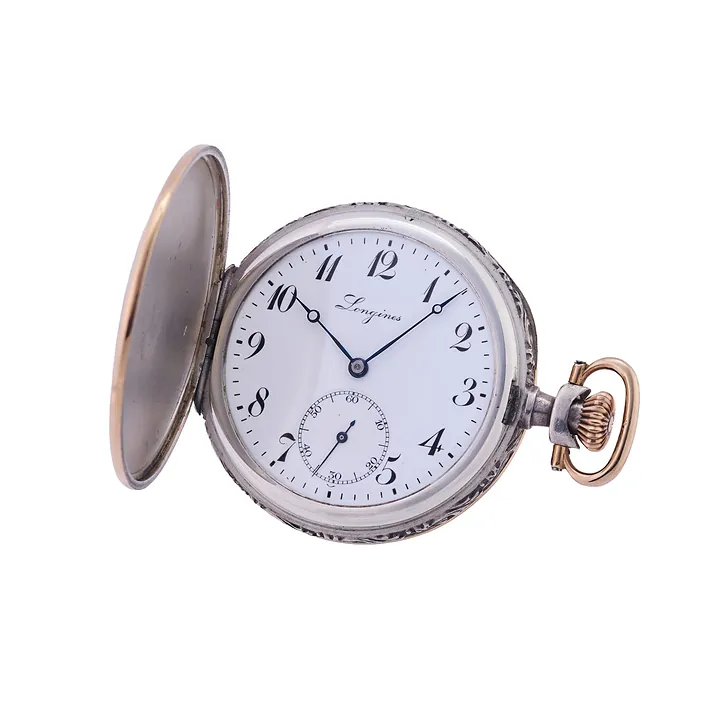
Pocket Watches · c. 1920s
Longines pocket watch, c. 1920s (Antiquorum Lot 389-59)
Antiquorum auction archive, Geneva

Wristwatches · 1931
Rolex 'Oyster Perpetual' rotor self-winding wrist-watch, lever escapement, in steel case with glass in back, Montres Rolex SA, Geneva, Switzerland, 1931
Science Museum Group, London

Wristwatches · 1900–1999
Wristwatch by Certina, Switzerland, 1900–1999
Nordic Museum Foundation

Wristwatches · 1900–1999
Wristwatch by Omega, Västerås, 1900–1999
Nordic Museum Foundation

Wristwatches · 1900–1999
Wristwatch by Universal, Switzerland, 1900–1999
Nordic Museum Foundation