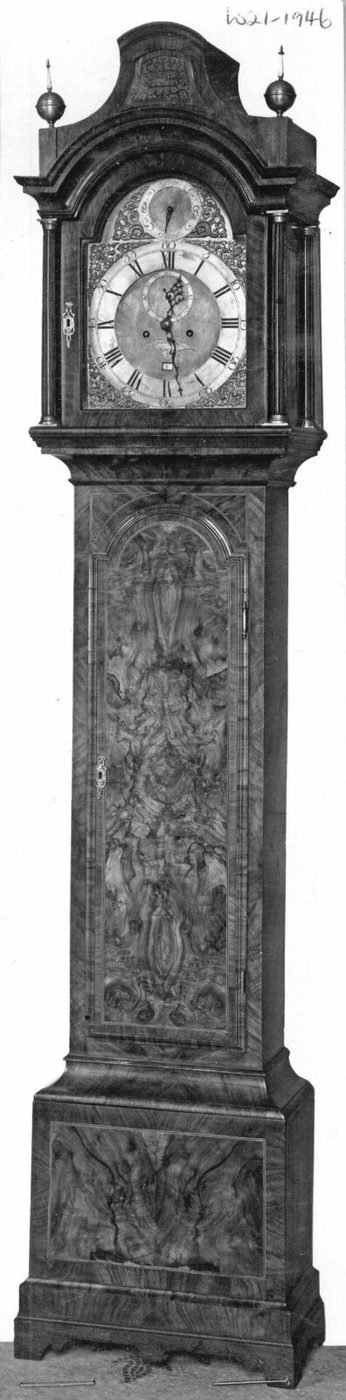
Clocks · Longcase clock
Longcase clock by Francis Jullion, England, 1775-1785
- Maker / attribution
- Francis Jullion (made)
- Date
- 1775-1785
- Historical period
- Precision & Scientific Horology (1750 – 1850)
- Country of origin
- England
- Place
- London
- Object type
- Longcase clock
- Materials / technique
- Oak, veneered in burr walnut and other woods, the dial of brass, partly silvered
- Dimensions
- Height: 236.5 cm; Width: 53.5 cm; Depth: 27.5 cm; Weight: 6.1 kg (w.21:2 Brass weight 10/10/2025 NH); Weight: 6.25 kg (w.21:3 Brass weight 10/10/2025 NH)
- Holding institution
- Victoria and Albert Museum, London
- Accession / object no.
- W.21:1to:5-1946
- Credit line
- Bequeathed by the Reverend E G Winstanley
Record summary
Held and catalogued by Victoria and Albert Museum, London (object number W.21:1to:5-1946), this is a longcase clock by Francis Jullion, made in London, England, dated 1775-1785. The Atlas places it in the Precision & Scientific Horology period (1750 – 1850) of its Clocks collection. Materials and techniques recorded by the source: Oak, veneered in burr walnut and other woods, the dial of brass, partly silvered. Recorded dimensions: Height: 236.5 cm; Width: 53.5 cm; Depth: 27.5 cm; Weight: 6.1 kg (w.21:2 Brass weight 10/10/2025 NH); Weight: 6.25 kg (w.21:3 Brass weight 10/10/2025 NH). The record is illustrated with 4 photographs.
Assembled from the source record's structured fields. Dates and attributions are given as the source states them; where a field is missing the Atlas leaves it blank rather than estimating.
Catalogue description
V&A — Summary
Clocks became an important export commodity during the eighteenth century, supporting the trade of clockmakers in London. Examples of British-made clocks are found all over Europe, particularly in the western states close to sea routes. The trade also benefited from clockmakers who settled here from other centres in Europe, as Mr Jullion clearly did.
V&A — Physical description
Longcase clock of oak veneered with burr walnut, with brass mounts. The hood is shaped for the arched dial, which is engraved with the name of the maker, 'Frans Jullion, London' Case: Figured walnut veneer on oak carcass. Break-arched topped trunk door, with moulded border enclosing banding. Triangular-shaped moulded borders on trunk front to either side of trunk door at top. Concave moulding below hood. Sliding hood with break-arch shape to cornice, glazed front door and concave section frieze. Pagoda top to hood with blind wood fret at its centre. Pagoda flanked by brass ball and spire finials. Free-standing coarsely fluted brass-capped columns to hood front, attached quarter columns to rear. Rectangular glazed panels in hood sides. Rectangular base with banding to front panel above double plinth, the lower with shaped front. Dial: Brass, break-arch, total height 16 inches central portion 12 inches square. Centre matted. Rectangular calendar aperture is located below silvered, semicircular brass plaque pinned to the dial plate, engraved Fran Jullian / London . Finely executed female head in foliage spandrels, one secured by a single screw, the rest by a pair of screws, located at corners of main dial plate. In the break-arch, a silvered brass ring bearing engraved designs and Strike / Silent is flanked by arch dolphin spandrels. Pinned to the dial plate is the silvered brass chapter ring having an engraved minute band with small triangles and Arabic minute numerals both at intervals of five, and Roman hour numerals. Pinned to the dial plate below "XII" is the subsidiary seconds ring of silvered brass, its engraved seconds band with small triangles and Arabic seconds numerals, both at intervals of five; its diameter is such that its lower portion is partially cut away to clear the central hole for the hands, and the "30" is much reduced in size in comparison with the other seconds numerals. A silvered brass ring with engraved Arabic numerals for the date (1-31) runs behind dial on brass pulleys, lowest pulley substantially larger in diameter than remainder, having four semicircular cast crossings. Four dial feet attached to movement front plate by pinning. Hands: Pierced steel hour and minute; seconds hand with tail. Located in centre of strike/silent scale is a substantial steel hand serving to indicate and, if desired, operate or silence the striking; this mechanism is missing from the clock. Movement: Brass and steel, weight driven, hour striking of 8-day duration, with recoil escapement, pendulum regulated. Five pillars each with a central knop, riveted to backplate, pinned to front. Hour striking on bell controlled by rack and snail. Brass train wheels with four semicircular crossings, centre wheel with substantial crossings lead-soldered in place. Where visible, some wheels with scribed lines. Double profiled wheel collets of two cylindrical sections each of different diameter, larger section adjacent to wheel. Steel arbors with slight barrel shape, except gathering pallet and warning; these also having pinion heads with a small portion at reduced diameter. Pinion heads generally tending to elongation except going side third. Steel recoil pallets spanning 6½ teeth of escape wheel, attached to pallet arbor by brass collet. Backcock with elongated locating holes. It also has a pair of vacant steady pin holes; likewise, backplate. Other vacant holes evident in plates: in backplate a pair close to bell standard screw hole; near and below hammer arbor, a threaded hole and two smaller holes; below present hammer spring hole, an unused threaded hole. Frontplate: threaded and plain holes above escape arbor; one vacant hole adjacent to pallet arbor; either side and below the winding arbors on each side, single vacant hole. Elsewhere, one unused threaded hole in upper proper right movement pillar knop. Description and notes by Francis Brodie, c. 2008
V&A — Object history
Bequeathed by the Reverend E G Winstanley (RP 138/1946) Maker's details: Francis Jullion c.1780 (Baillie, G.H. and Clutton, C. Britten’s Old Clocks and Watches and their Makers, London, 1982). Remarks: The first pagoda top case appeared during the 1730s but of rather odd proportions, only really developing into the more familiar shape when mahogany began to be used for clock cases during the mid-eighteenth century. Nevertheless, walnut was not completely displaced. The later Walnut period also saw the introduction of free-standing hood columns mounted close to the door in London cases, a feature continuing in mahogany. The shaping of the plinth bottom as seen on W.21-1946 is a style more usually associated with the later eighteenth century mahogany case. For the dial, the Jullian exhibits what might be described as classic London features of the second half of the eighteenth century, including the plain matted centre, the chapter ring devoid of a quarter-hour band, half-hour markers and half-quarters, the Strike/Silent scale in the arch and, in this case, the maker’s name on a silvered plaque in the lower centre. The large seconds ring was also common at this date. The hands are in a style more typical of the later part of the century. The movement exhibits features that would not be out of place in the second half of the eighteenth century, such as plain, knopped pillars and double profiled collets. The rack striking is of conventional form, suggesting ‘later’, established practice. The design of case certainly could be contemporary with the movement. The Jullian is interesting in being housed in a walnut case; its style is more commonly associated with mahogany. The Jullian could therefore be a late example of a walnut pagoda top in the mahogany style, with an approximate date of c.1770. The vacant holes are indicative of modifications to the movement. There is evidence that the pallet arbor has been moved from the elongation of the location holes in the backcock, the spare steady pin holes and vacant hole by the front pallet arbor. The shape of the pallet frame could be nineteenth century although this is by no means a definitive feature. Elsewhere, vacant holes close to the hammer arbor, combined with the unused threaded hole in the pillar knop, may be evidence of an alteration, at the very least, to the hammer stop. Finally, the vacant holes in the upper part of the front plate most probably relate to the now missing Strike/Silent mechanism, which would have been pivoted at this location. The lead soldering of the centre wheel is a past repair which retained the original wheel band. It is not unknown for wheel crossings to fracture at their junction with the wheel band. Description and notes by Francis Brodie, c. 2008
V&A gallery label
LONGCASE CLOCK ENGLISH; about 1780 Walnut Signed by Frans Jullion, London
Inscriptions & marks
Frans Jullion London
Historical context
Precision & Scientific Horology (1750 – 1850)
Harrison solves longitude; Mudge invents the lever; Breguet's Paris workshop defines the modern watch.
The age of the deadbeat escapement, compensated pendulums and observatory regulators. Domestic clocks spread through the middle classes: English longcase and bracket clocks, French gilt-bronze mantel clocks, Viennese Biedermeier wall clocks, Black Forest painted-shield clocks, and the first American shelf clocks.
Read the period in the timelineMore clocks from this periodEarlier: Early Modern Horology
Atlas type guide
Longcase (tall-case or grandfather) clocks
The longcase clock was born from two seventeenth-century innovations: Christiaan Huygens's pendulum (1656–57) and the anchor escapement (c. 1670). A long seconds pendulum, nearly a metre long, swings with a small arc, and enclosing it together with the driving weights in a tall wooden case protected the mechanism and created a new piece of furniture. London makers such as Ahasuerus Fromanteel, Thomas Tompion and Joseph Knibb set the pattern.
By the eighteenth century longcase clocks were made throughout Britain, the Netherlands, Scandinavia (the Swedish Mora clock), France (the Comtoise from the Franche-Comté), Germany and colonial America. Eight-day movements with two weights became standard in better clocks; thirty-hour clocks with one weight and a rope or chain were cheaper alternatives.
What to look for
- Winding holes in the dial: two (eight-day, going and striking) or none (thirty-hour, pulled up by a chain).
- Brass dials with applied chapter rings (earlier) versus painted iron 'white' dials (after c. 1770 in Britain).
- Moon-phase arches, date apertures, seconds dials and maker's name on the dial.
- Case woods and style: ebonised, walnut marquetry, lacquer, oak or mahogany; regional styles from London, Lancashire, Scotland or America.
- Whether the movement and dial match the case — 'marriages' are common.
Dating clues
- Square brass dials suggest c. 1670–1720; arched brass dials c. 1715–1790.
- Painted (white) dials were made by Birmingham dial-makers from about 1772.
- Comtoise clocks with repoussé pendulums are mostly nineteenth century.
General guidance written by the Atlas editors about this kind of object. It is not a statement about this particular piece; for that, rely on the source record above and on physical examination.
Read next:Anchor escapement
Related records
Clocks · 1711–1827
Longcase clock by David Roentgen ( - ), England, 1711–1827
Badisches Landesmuseum Karlsruhe
Clocks · 1740-1760
Longcase clock, English, 1740-1760, japanned wood, John Ellicott
Victoria and Albert Museum, London
Clocks · 1751
Large wheel engine, signed and dated "John Tipping, Whildon Green, 1751".
Science Museum Group, London
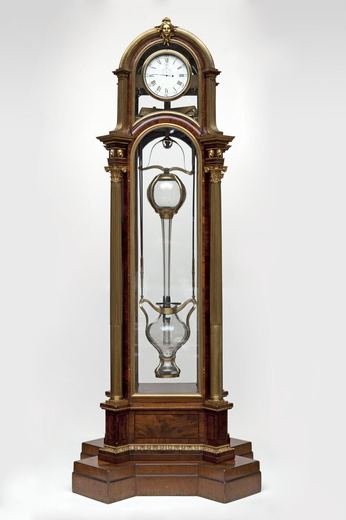
Clocks · ca. 1760
Longcase clock by James Cox, England, ca. 1760
Victoria and Albert Museum, London
Clocks · 1766
Clock by Cumming, Alexander, England, 1766
Science Museum Group, London
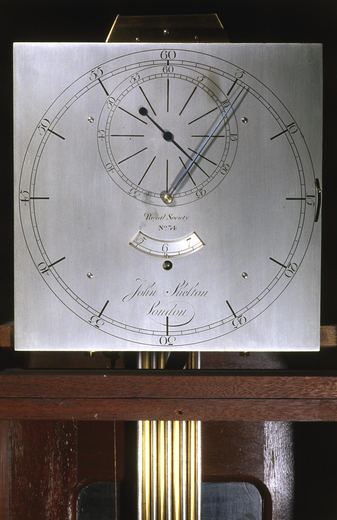
Clocks · 1768-1769
Regulator clock by Shelton, John, England, 1768-1769
Science Museum Group, London
Clocks · ca. 1775
Longcase clock, England, ca. 1775
Victoria and Albert Museum, London
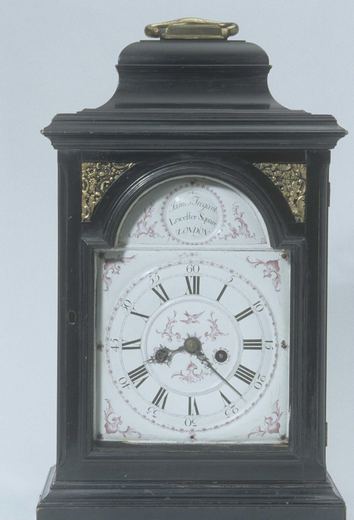
Clocks · ca. 1780
Bracket clock of ebony, with face of West Midlands enamel painted in black and crimson, made by James Tregent, London, England, about 1780
Victoria and Albert Museum, London