
Wristwatches · Wristwatch
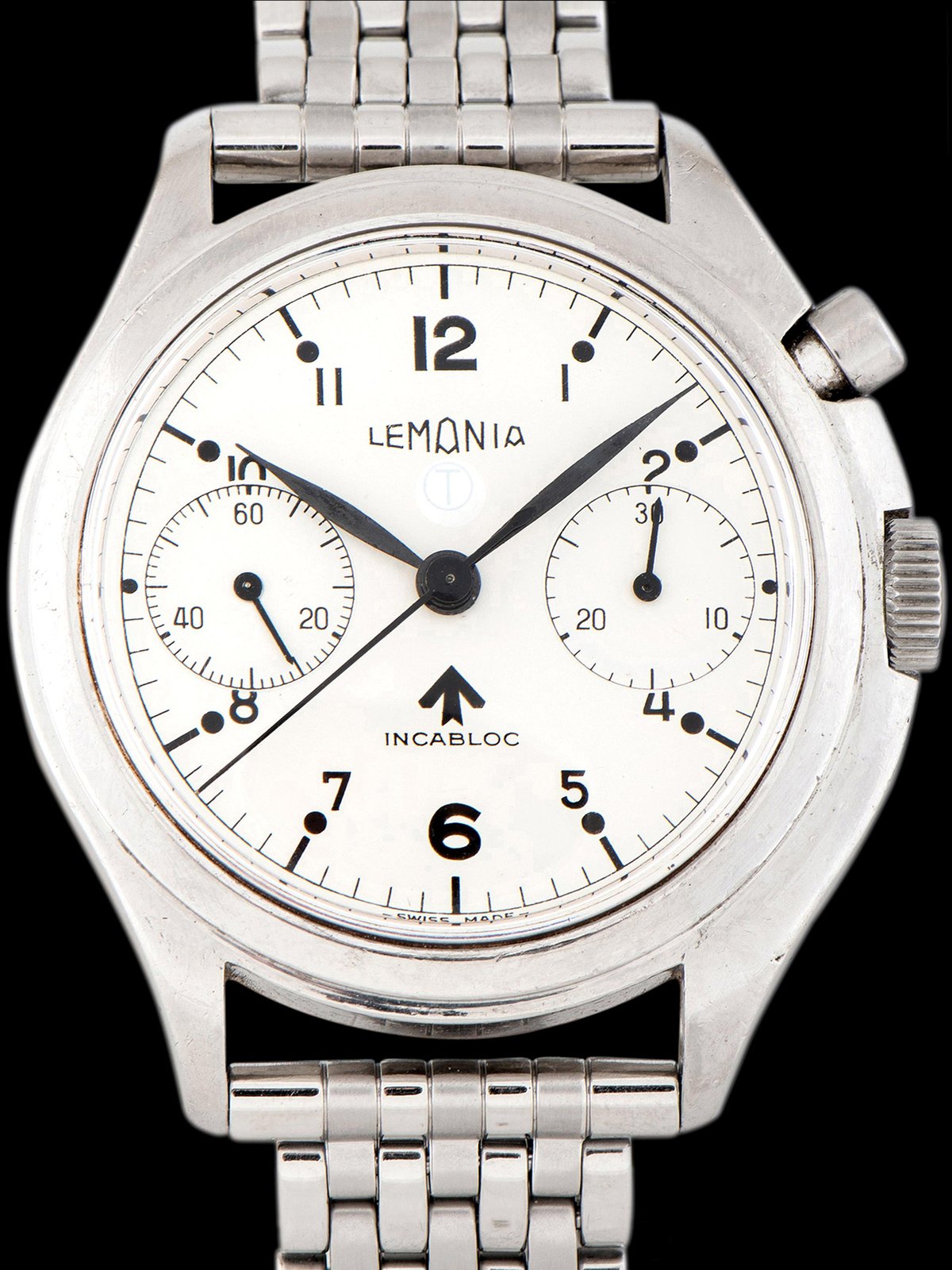
Lemania Mono-Pusher Chronograph (Royal Navy Nuclear Submarine) White Non-Luminous Dial "Series III", 1960s
- Maker / attribution
- Unrecorded in source
- Date
- 1960s
- Historical period
- Modern Mechanical Horology (1945 – 1969)
- Country of origin
- Unrecorded in source
- Object type
- Wristwatch
- Dimensions
- Case 39.5 mm
- Stock no.
- LMMOD3312RNNS
- Credit line
- Dealer listing, Craft & Tailored (LMMOD3312RNNS)
- Catalogue title (original)
- 1960s Lemania Mono-Pusher Chronograph (Royal Navy Nuclear Submarine) White Non-Luminous Dial "Series III" (English)
View the source record (dealer listing) ↗ (opens another website in a new tab)Suggest a correction
Record summary
Catalogued by Craft & Tailored (dealer), Los Angeles (stock number LMMOD3312RNNS), this is a wristwatch, dated 1960s. The Atlas places it in the Modern Mechanical Horology period (1945 – 1969) of its Wristwatches collection. Recorded dimensions: Case 39.5 mm. The record is illustrated with 6 photographs.
Assembled from the source record's structured fields. Dates and attributions are given as the source states them; where a field is missing the Atlas leaves it blank rather than estimating.
Catalogue description
Dealer description — Craft & Tailored
Military-issued chronographs represent one of the most compelling corners of vintage watch collecting, combining purpose-built design with tangible historical provenance. Among the most significant are Lemania’s mono-pusher chronographs, produced from the 1940s through the early 1970s for Britain’s Royal Air Force, Fleet Air Arm, and Royal Navy, as well as military forces in Australia, Sweden, and South Africa. Better known as one of Switzerland’s great chronograph movement manufacturers, supplying calibers to Omega, Heuer, Tissot, and others, Lemania produced comparatively few watches under its own name. Its British military chronographs are generally divided into three generations by case construction: the externally notched Series I, internally notched Series II, and later Series III, distinguished by its asymmetrical case. This Series III example is an especially rare variation developed for service aboard Royal Navy nuclear submarines. While otherwise identical to its luminous counterpart, the dial and handset were stripped of radioactive luminous material so they would not interfere with the submarines’ sensitive radiation-monitoring equipment. The white dial retains a faint, blotted-out “Circle T” designation, originally used to identify the presence of tritium, providing visible evidence of its Ministry of Defence modification. The resulting configuration is striking, with black syringe hands, bold Arabic numerals, twin registers, and an oversized Broad Arrow offering exceptional contrast and legibility. Its 39.5mm stainless steel case features the characteristic Series III asymmetrical profile, with an extended right side partially shielding the crown. Additional military specifications include fixed-bar lugs, a single chronograph pusher at 2 o’clock, and a screw-down caseback bearing its Royal Navy issue markings. Most notably, the original NATO stock number, 0552/924-3306, has been struck through and replaced with 0552/924-3312, formally distinguishing this non-luminous submarine variant from the standard luminous model. Reportedly produced in a run of approximately 450 examples, the Series III Royal Navy Nuclear Submarine is among the rarest and most desirable Lemania military chronographs. From its modified dial to its factory reengraved military designation, nearly every detail speaks directly to its highly specialized role aboard a nuclear-powered Royal Navy submarine. SPECS Stock # LMMOD3312RNNS Brand Lemania Style Mono-Pusher Chronograph Model Series III Royal Navy Nuclear Submarine Serial 81XXX Size Men's Material Stainless Steel Dial White "Non-Luminous" Millimeters 40 Bracelet Forstner "Beads of Rice" Bracelet CASE & BRACELET The impressively well-preserved and honest Series III asymmetrical case features strong factory dimensions and finishing while exhibiting honest wear and nominal evidence of prior polishing. The unsigned crown and single pump pusher are believed to remain original to the watch. The screw-down caseback retains crisp, fully legible military issue markings and features the correct crossed-out 3306 and added 3312 military designation engravings. The watch will come supplied on a new Forstner "Beads of Rice" Bracelet. DIAL & HANDS The original flat white non-luminous dial is in exceptionally well-preserved, virtually perfect vintage condition, exhibiting no damage or notable age. The dial retains its original blotted-out "circle T" designation under the dial, which is characteristic of this specific model. The feuille hour and minute hands, as well as the chronograph hands, are all original and in excellent condition, remaining fully black in color. ACCESSORIES None. The watch is functioning perfectly and keeping time, previous service history is unknown. A movement service can be purchased upon request.
Historical context
Modern Mechanical Horology (1945 – 1969)
Tool watches for divers, pilots and astronauts; electric watches anticipate the electronic age.
The classic era of the mechanical wristwatch: dive watches, chronographs for motor racing and space flight, GMT watches for jet travel, slim dress watches, automatic calendars, and the rise of Japanese manufacturers alongside Swiss, American, German and Soviet industries.
Read the period in the timelineMore wristwatches from this periodEarlier: Golden Age of Mechanical Watchmaking
Atlas type guide
Chronographs and split-seconds watches
A chronograph is a watch with an additional seconds hand that can be started, stopped and returned to zero independently of the timekeeping. Louis Moinet built an early example in 1816 and Nicolas Rieussec a recording 'chronographe' in 1821; Adolphe Nicole's heart-shaped reset cam (patented 1862) made the modern return-to-zero possible. Split-seconds (rattrapante) chronographs add a second hand that can be stopped for intermediate times; flyback chronographs restart instantly.
Chronographs were essential tools for doctors (pulsometer scales), artillery (telemeter), engineers and sport. In wristwatches, Valjoux, Venus, Lemania and later the automatic chronographs of 1969 (Zenith El Primero, the Chronomatic Calibre 11 group and Seiko 6139) are milestones.
What to look for
- Push-pieces on the case band or a single button in the crown (monopusher).
- Subsidiary registers for minutes and hours; tachymeter, telemeter or pulsometer scales.
- Column wheel versus cam control visible in the movement.
- Calibre markings of specialist makers (Valjoux, Lemania, Venus, Landeron).
Dating clues
- Pocket chronographs with heart cam reset: after 1862.
- Wrist chronographs: from c. 1910; two-button designs from the 1930s.
- Automatic chronographs: from 1969.
General guidance written by the Atlas editors about this kind of object. It is not a statement about this particular piece; for that, rely on the source record above and on physical examination.
Read next:Flyback chronographChronograph
Related records

Wristwatches · 1945
Wristwatch by Eterna, 1945
Museum Rotterdam

Wristwatches · c. 1945
Breitling Premier, ref. 790, c. 1945
Antiquorum auction archive, Geneva

Wristwatches · c. 1945
Universal Genève Uni-Compax, ref. 22492, c. 1945
Antiquorum auction archive, Geneva
Wristwatches · c. 1950s
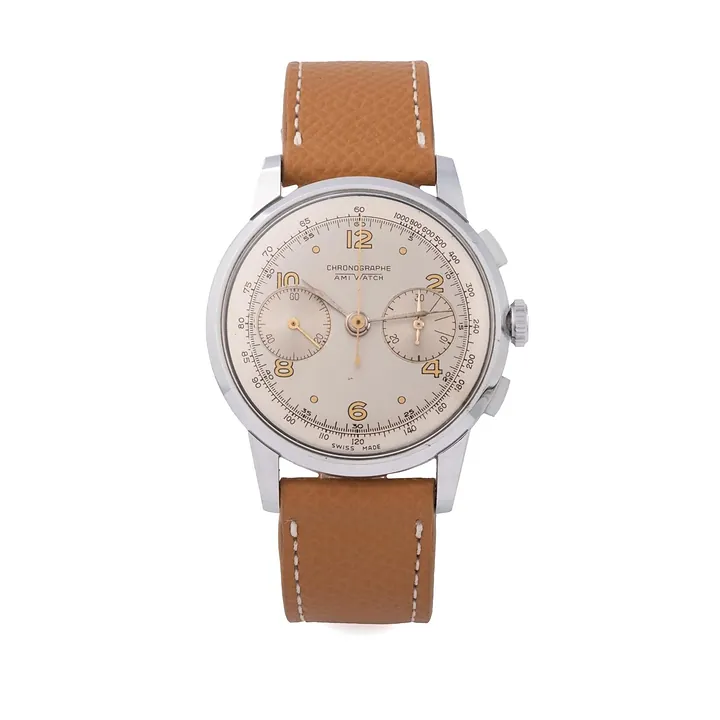
Ami Watch Chronographe, c. 1950s
Antiquorum auction archive, Geneva

Wristwatches · c. 1950s
Baume & Mercier wristwatch, c. 1950s
Antiquorum auction archive, Geneva
Wristwatches · c. 1955
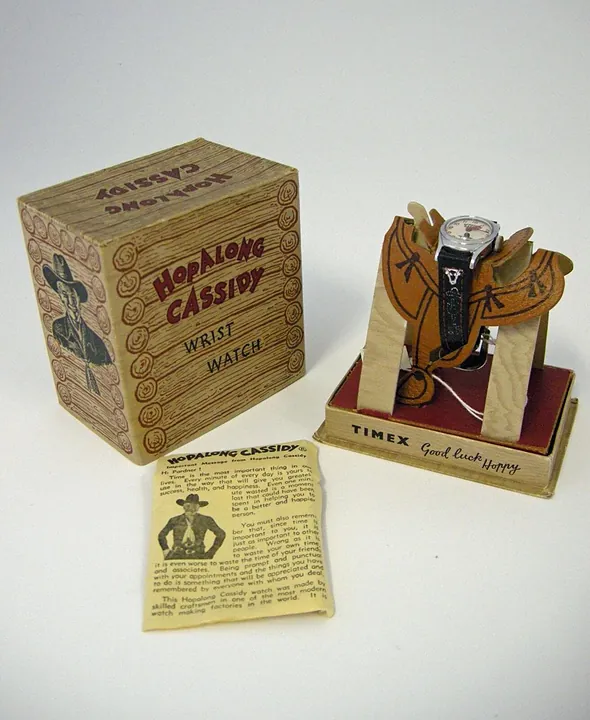
Child's wrist watch by Timex, Dundee, c. 1955
Victoria and Albert Museum, London
Wristwatches · c. 1950
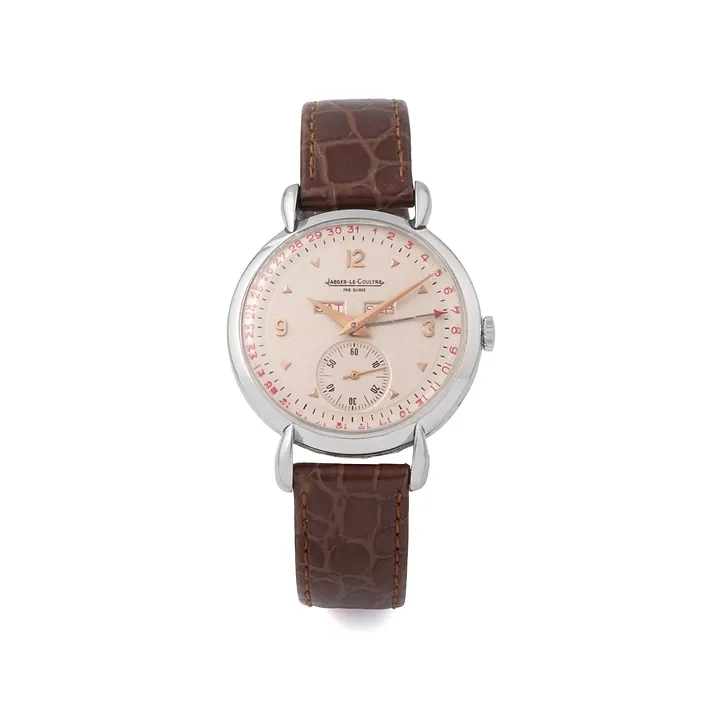
Jaeger Lecoultre Triple Calendar, c. 1950
Antiquorum auction archive, Geneva
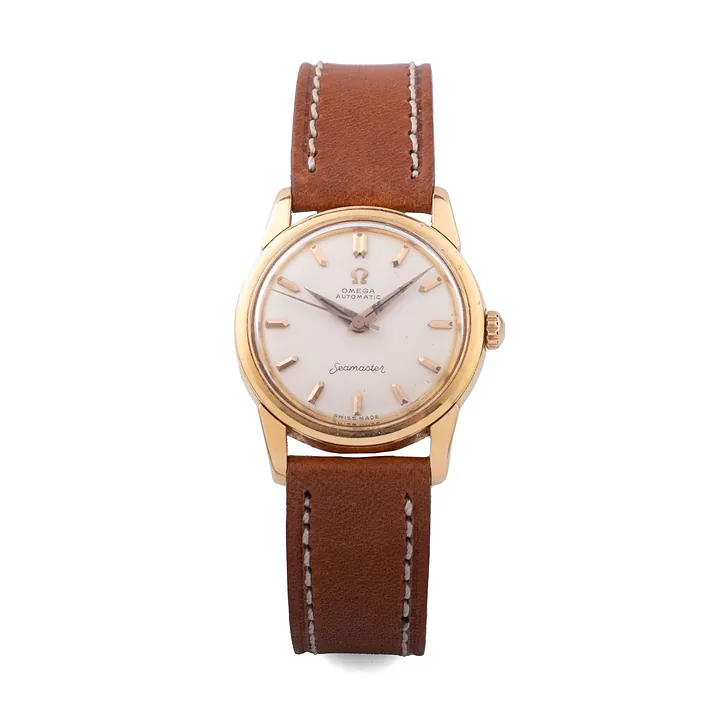
Wristwatches · c. 1950
Omega Seamaster Automatic, ref. 2991-1, c. 1950
Antiquorum auction archive, Geneva