
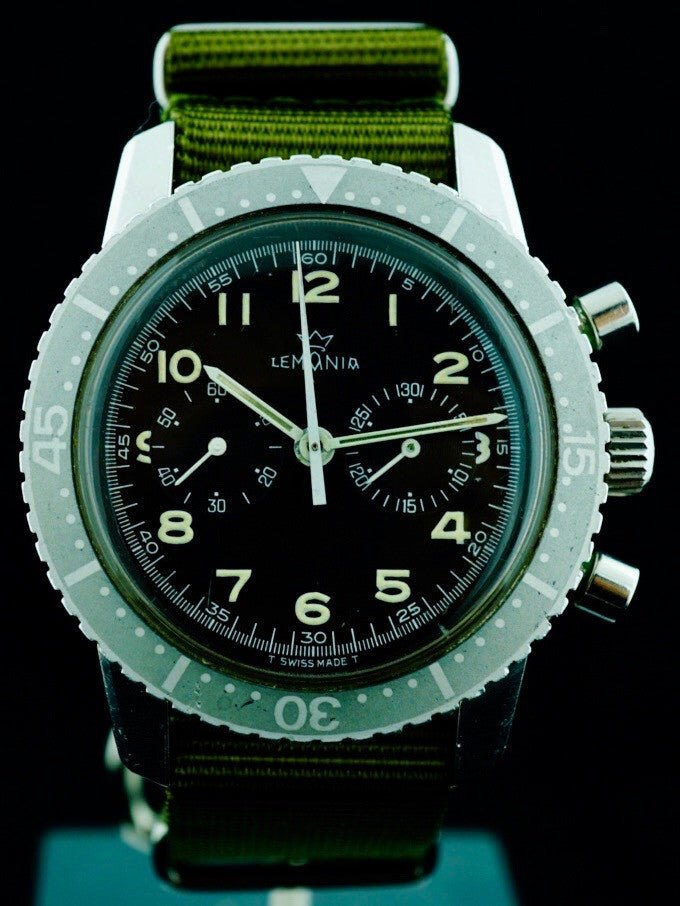
Wristwatches · Wristwatch
Lemania, cal. 1872 Military Pilots Chronograph (South African Air Force), 1973
- Maker / attribution
- Lemania (maker)
- Date
- 1973
- Historical period
- Quartz Revolution (1969 – 1990)
- Country of origin
- Switzerland
- Object type
- Wristwatch
- Dimensions
- Case 41 mm
- Stock no.
- LMPC1970
- Credit line
- Dealer listing, Craft & Tailored (LMPC1970)
- Catalogue title (original)
- 1973 LEMANIA Cal. 1872 Military Pilots Chronograph (South African Air Force) (English)
View the source record (dealer listing) ↗ (opens another website in a new tab)Suggest a correction
Record summary
Catalogued by Craft & Tailored (dealer), Los Angeles (stock number LMPC1970), this is a wristwatch by Lemania, made in Switzerland, dated 1973. The Atlas places it in the Quartz Revolution period (1969 – 1990) of its Wristwatches collection. Recorded dimensions: Case 41 mm. The record is illustrated with 6 photographs.
Assembled from the source record's structured fields. Dates and attributions are given as the source states them; where a field is missing the Atlas leaves it blank rather than estimating.
Catalogue description
Dealer description — Craft & Tailored
In the early to mid 1970s, Lemania produced this specific timepiece for the Swedish Air Force as well as the the South African Air Force. There are very few examples of this specific timepieces available as b etween the years of 1971-1976 approximately 630 examples of this specific reference were ever produced based on our extensive research. Half of the watches produced were issued to the Swedish Air Force, and the other half to the South African Air Force. rbassson: provides the full history of South African Air Force Watches on his site which is packed full of information about the history and usage of watches by the South African Air Force : http://rbasson.wix.com/saafwatches#!lemania-cal-1872 This model came in two different dial patterns and bezel patterns. The earlier examples had fine and small font used for the numbers except for the 12 and 6 on the dial, and also had lume dots outside of each number around the dial, the earlier version of the dial also possessed a broad arrow just above the 6 o'clock position with a circled T just below the 12 o'clock position denoting the use of Tritium lume on the dial, also present was SWISS MADE which was placed on the dial under the outside of the minute track at the 6 o'clock position. The tritium lume was only used on the lume dots next to each number but fully filled the 12 o'clock and 6 o'clock numbers only. The later dial variant had a bold font and did not have the broad arrow above the 6 o'clock position on the dial. The numbers are much larger and the sub dials at the 3 o'clock and 9 o'clock positions "cover" the 3 and 9 so that they are only partially visible. The large numbers on the dial are fully lumed and the minute track has been updated to show the minutes at all marked positions increasing the functionality of the watch when using the chronograph function. The earlier versions were far more sterile in look and in over all design and did not possess the gauge like look and feel like the later model such as the one we have featured here at Craft and Tailored. The later dial variant also denotes the use of tritium lume at 6 o'clock position outside the minute track with T SWISS MADE T The main difference between the Swedish (SWAF) and the South African Variants (SAAF) is the rotating bezel the SWAF version had a bakelite type bezel similar to what would be found on early Omega Seamaster references, And the SAAF version had an anodized aluminum bezel as seen in the pictures below (Photo Credit: http://www.thewatchspot.co.uk ) (Photo: Showing SAAF & SWAF Bezel Variance) The one thing that both variants have in common is the crosshatched winding crown more commonly found on the super compressor dive watches of the late 60's and early 70's. The crosshatched crown is specific to the 1872 as well as the Lamina 817 case reference itself. Although Lemania did produce a few similar timepieces that were ultimately rebranded by other companies and used similar Lemania movements like the Wakmann ref. 817, the Selectron Chronograph Swiss, and the 1970's Tissot Navigator. The 1872 reference has a direct line to the Swedish Air Force and South African Air Force. As research shows no civilian models of the Lemania Cal. 1872 was commercially available to the civilian market. Stock # LMPC1970 Brand Lemania Style 1872 Military Pilots Chronograph Model Ref. 1872 Serial Size Men's Material SS Dial Black Millimeters 41mm Bracelet O.D. Green Premium NATO Strap CASE & BRACELET The case is in original and unpolished condition showing original geometric chamfers on the thick lugs that are specific to this Lemania produced case. The aluminum bezel has faded evenly from black to a wonderful grey and posses the rare and highly sought after the ghost look. The military serial numbers have unfortunately faded from the back of the case as the SAAF engravings were light surface engravings. The watch will be supplied on a Craft & Tailored premium NATO strap in olive drab green. DIAL This specific Lemania 1872 possesses the later dial variant which has a stunning matte black base and a bold tritium lumed font. The lume on the dial and hands is matching and has aged to a charming custard like creamy yellow. The dial is in original condition and has gained a wonderful and light patina. The white minute track shows the minutes at all marked positions unlike the earlier dial variants and at the 6 o'clock position outside the minute track with the dial is signed with T SWISS MADE T noting the use of tritium in the lume. ACCESSORIES
Historical context
Quartz Revolution (1969 – 1990)
Seiko's Astron begins mass quartz timekeeping; traditional industries contract sharply.
Quartz and digital watches transformed the market after 1969. Swiss employment collapsed, Japanese and Hong Kong production soared, and the Swatch (1983) helped the Swiss industry recover; mechanical watches survived as luxury goods.
Read the period in the timelineMore wristwatches from this periodEarlier: Modern Mechanical Horology
Atlas type guide
Chronographs and split-seconds watches
A chronograph is a watch with an additional seconds hand that can be started, stopped and returned to zero independently of the timekeeping. Louis Moinet built an early example in 1816 and Nicolas Rieussec a recording 'chronographe' in 1821; Adolphe Nicole's heart-shaped reset cam (patented 1862) made the modern return-to-zero possible. Split-seconds (rattrapante) chronographs add a second hand that can be stopped for intermediate times; flyback chronographs restart instantly.
Chronographs were essential tools for doctors (pulsometer scales), artillery (telemeter), engineers and sport. In wristwatches, Valjoux, Venus, Lemania and later the automatic chronographs of 1969 (Zenith El Primero, the Chronomatic Calibre 11 group and Seiko 6139) are milestones.
What to look for
- Push-pieces on the case band or a single button in the crown (monopusher).
- Subsidiary registers for minutes and hours; tachymeter, telemeter or pulsometer scales.
- Column wheel versus cam control visible in the movement.
- Calibre markings of specialist makers (Valjoux, Lemania, Venus, Landeron).
Dating clues
- Pocket chronographs with heart cam reset: after 1862.
- Wrist chronographs: from c. 1910; two-button designs from the 1930s.
- Automatic chronographs: from 1969.
General guidance written by the Atlas editors about this kind of object. It is not a statement about this particular piece; for that, rely on the source record above and on physical examination.
Read next:Flyback chronographChronograph
Related records
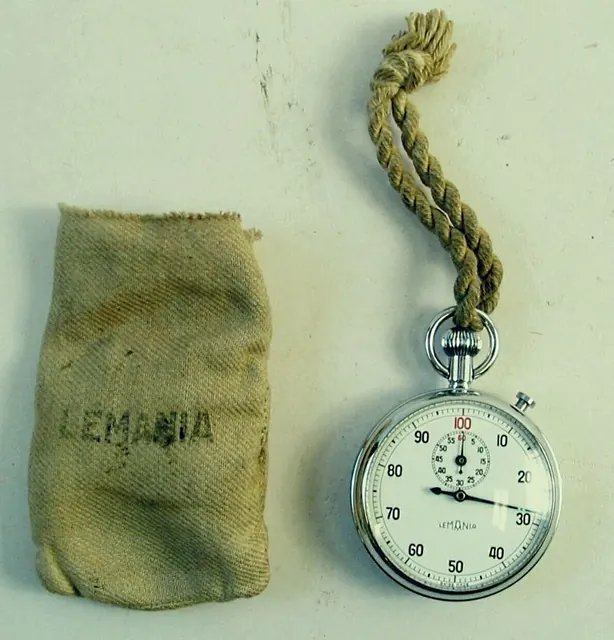
Instruments · 1950–1970
Stopwatch by Lemania, Switzerland, 1950–1970
Museokeskus Vapriikki
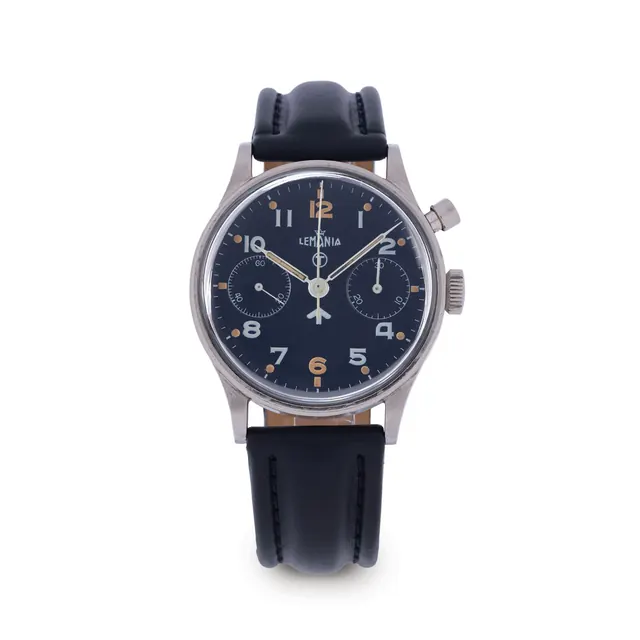
Wristwatches · c. 1970s
Lemania wristwatch, Series 2 Monopusher Chronograph, circa 1970s
Antiquorum auction archive, Geneva
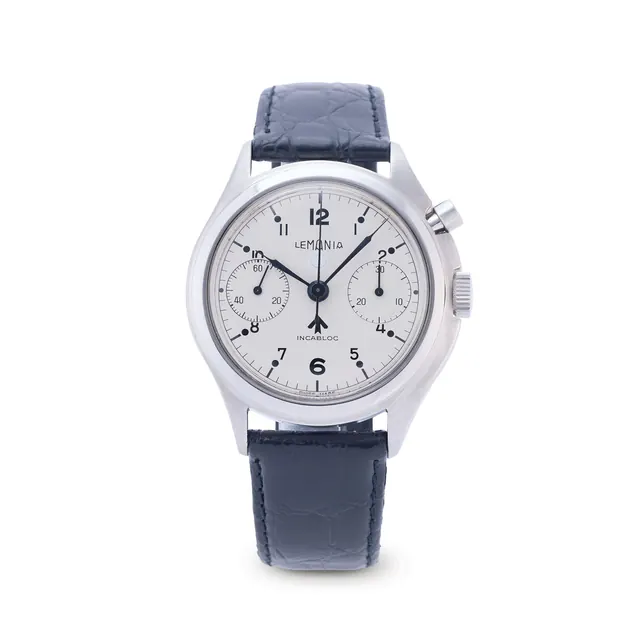
Wristwatches · c. 1960s-1980s
Lemania wristwatch, ref. 35-64, Series 3 Monopusher Chronograph, circa 1960s-1980s
Antiquorum auction archive, Geneva
Pocket Watches · c. 1940
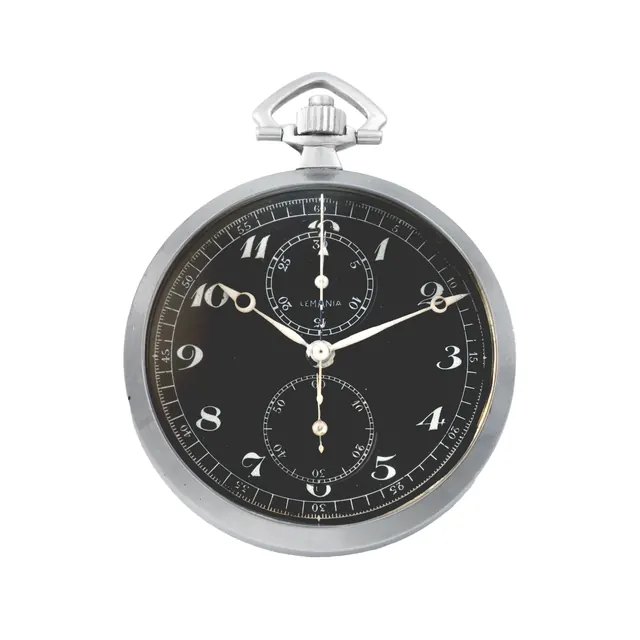
Lemania pocket watch, Single Button Chronograph, circa 1940
Antiquorum auction archive, Geneva

Wristwatches · 1970
Wristwatch by Heno, Switzerland, 1970
Museum Rotterdam

Wristwatches · 1960–1986
'Tri-Compax' calendar chronograph wristwatch in gold case, by Universal, Geneva, Switzerland, 1960–1986.
Science Museum Group, London

Wristwatches · 1969–1970
Beta 21 Quartz wristwatch movement, made in Switzerland, 1970.
Science Museum Group, London

Wristwatches · c. 1969
Omega Speedmaster Moonwatch, ref. 145022-69st, c. 1969
Antiquorum auction archive, Geneva