
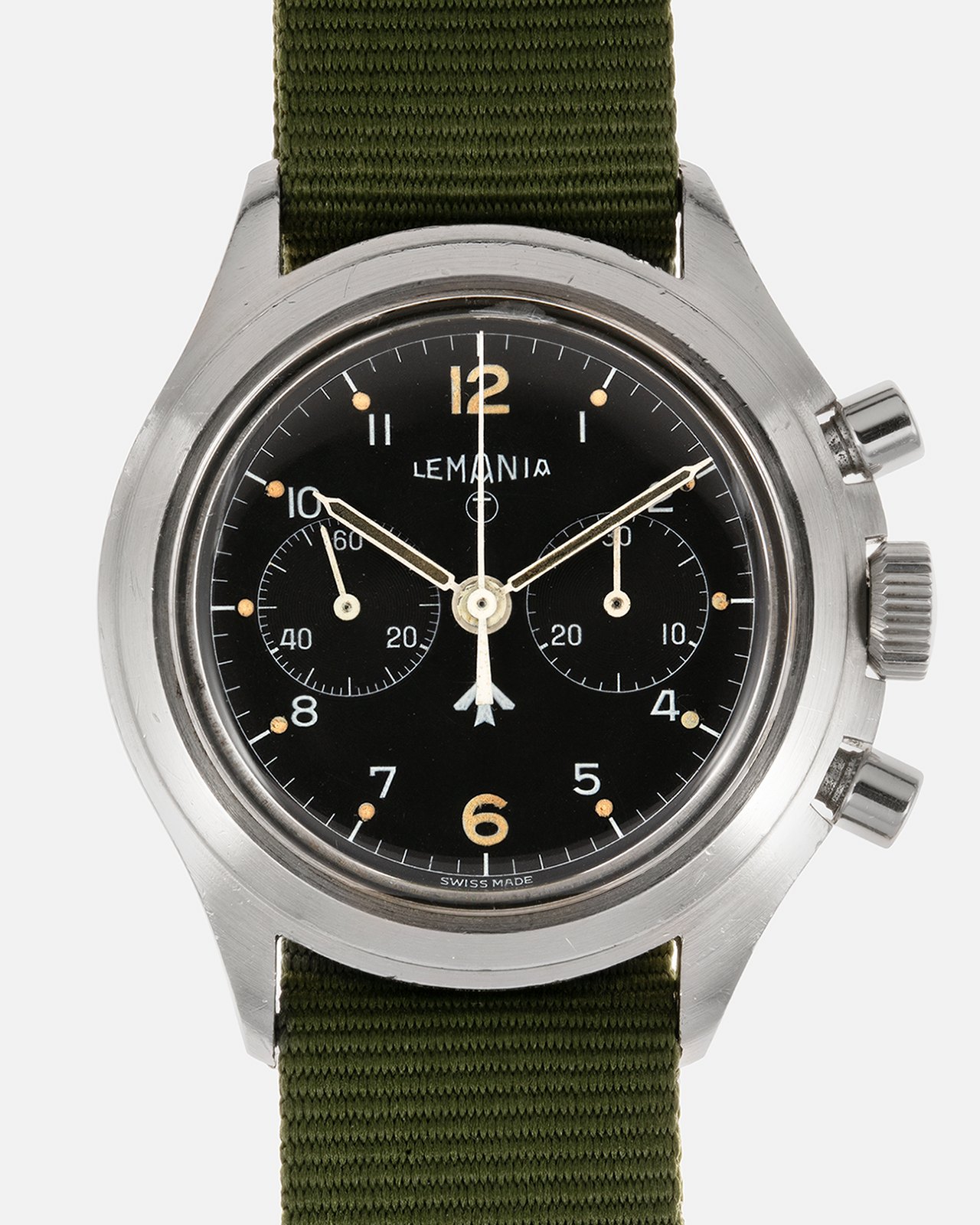
Wristwatches · Wristwatch
Lemania 818 Royal Navy Double Pusher Chronograph, 1975
- Maker / attribution
- Lemania (maker)
- Date
- 1975
- Historical period
- Quartz Revolution (1969 – 1990)
- Country of origin
- Switzerland
- Object type
- Wristwatch
- Dimensions
- Case 40 mm
- Stock no.
- Product 6964297695319
- Credit line
- Dealer listing, S.Song Watches (product 6964297695319)
- Catalogue title (original)
- Lemania 818 Royal Navy Double Pusher Chronograph (English)
View the source record (dealer listing) ↗ (opens another website in a new tab)Suggest a correction
Record summary
Catalogued by S.Song Watches (dealer), Seattle (stock number Product 6964297695319), this is a wristwatch by Lemania, made in Switzerland, dated 1975. The Atlas places it in the Quartz Revolution period (1969 – 1990) of its Wristwatches collection. Recorded dimensions: Case 40 mm. The record is illustrated with 6 photographs.
Assembled from the source record's structured fields. Dates and attributions are given as the source states them; where a field is missing the Atlas leaves it blank rather than estimating.
Catalogue description
Dealer description — S.Song Watches
Out of all the vintage military watches we've come across and offered over the years, the Lemania Royal Navy Chronographs have always been a standout for me personally, purely based on how cool they look aesthetically. In my mind, there is something undeniably bad-ass about a Lemania chronograph designed specifically for military usage. The subtle hint of a flight jacket vibe adds an extra layer of appeal that resonates with me. Offered here today is an exceptionally rare variant of a Lemania Royal Navy Chronograph – the Ref. 818 ‘Double Pusher’. Typically, these chronographs are seen with a single-pusher configuration, a design choice made to minimize the risk of timing errors or inadvertent halting of the chronograph. In the year 1969, the Ministry of Defence (MoD) implemented a significant alteration to its wristwatch chronograph specifications, transitioning from the single-pusher design to double-pushers. This modification allowed the user the convenience of pausing the timing of an event and subsequently resuming the stopwatch function seamlessly. This stands in contrast to the earlier single-pusher chronographs, which could only reset the stopwatch function after pausing the timing. Encased within a 40mm asymmetrical case which was deliberately designed to protect the crown and the pushers, the matte black dial on this Ref. 818 features applied tritium lume (as indicated by the circled ‘T’ beneath the ‘Lemania’ logo) on each hour marker and the MoD’s broad arrow marker at the 6 o ‘clock. It is believed that only a mere total of 500 pieces were ever issued to pilots of the Royal Navy within a brief production window of just two years, spanning from 1975 to 1976. What can I say? This Ref. 818 stands out as exceedingly rare in the realm of vintage military watch collecting, and to be able to offer this extraordinary example on our site today is a real delight.
Historical context
Quartz Revolution (1969 – 1990)
Seiko's Astron begins mass quartz timekeeping; traditional industries contract sharply.
Quartz and digital watches transformed the market after 1969. Swiss employment collapsed, Japanese and Hong Kong production soared, and the Swatch (1983) helped the Swiss industry recover; mechanical watches survived as luxury goods.
Read the period in the timelineMore wristwatches from this periodEarlier: Modern Mechanical Horology
Atlas type guide
Chronographs and split-seconds watches
A chronograph is a watch with an additional seconds hand that can be started, stopped and returned to zero independently of the timekeeping. Louis Moinet built an early example in 1816 and Nicolas Rieussec a recording 'chronographe' in 1821; Adolphe Nicole's heart-shaped reset cam (patented 1862) made the modern return-to-zero possible. Split-seconds (rattrapante) chronographs add a second hand that can be stopped for intermediate times; flyback chronographs restart instantly.
Chronographs were essential tools for doctors (pulsometer scales), artillery (telemeter), engineers and sport. In wristwatches, Valjoux, Venus, Lemania and later the automatic chronographs of 1969 (Zenith El Primero, the Chronomatic Calibre 11 group and Seiko 6139) are milestones.
What to look for
- Push-pieces on the case band or a single button in the crown (monopusher).
- Subsidiary registers for minutes and hours; tachymeter, telemeter or pulsometer scales.
- Column wheel versus cam control visible in the movement.
- Calibre markings of specialist makers (Valjoux, Lemania, Venus, Landeron).
Dating clues
- Pocket chronographs with heart cam reset: after 1862.
- Wrist chronographs: from c. 1910; two-button designs from the 1930s.
- Automatic chronographs: from 1969.
General guidance written by the Atlas editors about this kind of object. It is not a statement about this particular piece; for that, rely on the source record above and on physical examination.
Read next:Flyback chronographChronograph
Related records
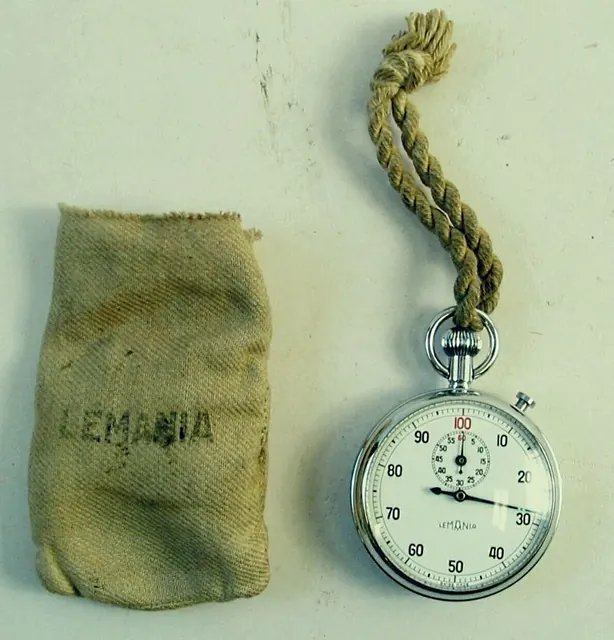
Instruments · 1950–1970
Stopwatch by Lemania, Switzerland, 1950–1970
Museokeskus Vapriikki
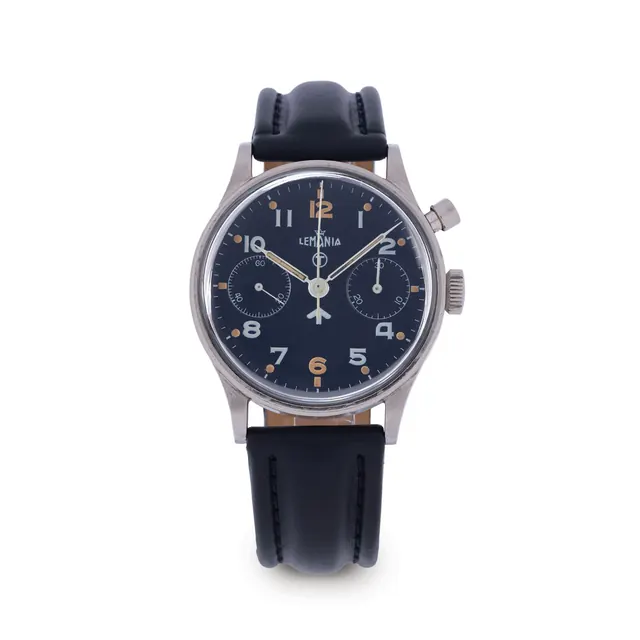
Wristwatches · c. 1970s
Lemania wristwatch, Series 2 Monopusher Chronograph, circa 1970s
Antiquorum auction archive, Geneva
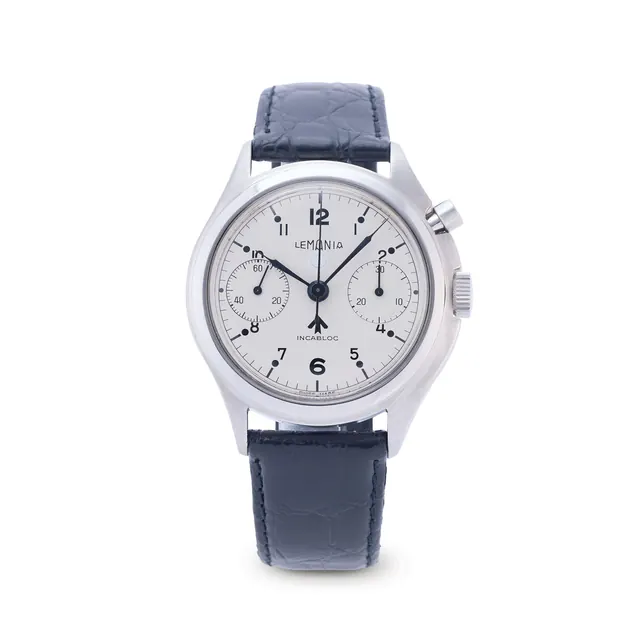
Wristwatches · c. 1960s-1980s
Lemania wristwatch, ref. 35-64, Series 3 Monopusher Chronograph, circa 1960s-1980s
Antiquorum auction archive, Geneva
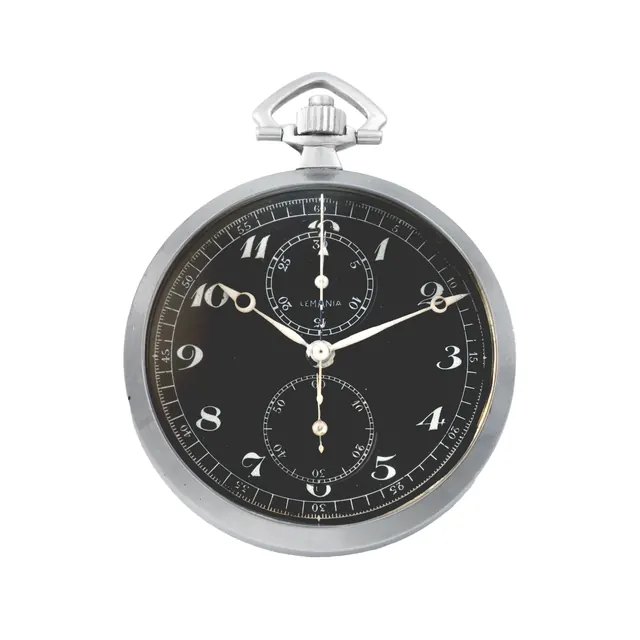
Pocket Watches · c. 1940
Lemania pocket watch, Single Button Chronograph, circa 1940
Antiquorum auction archive, Geneva

Wristwatches · 1970
Wristwatch by Heno, Switzerland, 1970
Museum Rotterdam

Wristwatches · 1960–1986
'Tri-Compax' calendar chronograph wristwatch in gold case, by Universal, Geneva, Switzerland, 1960–1986.
Science Museum Group, London

Wristwatches · 1969–1970
Beta 21 Quartz wristwatch movement, made in Switzerland, 1970.
Science Museum Group, London

Wristwatches · c. 1969
Omega Speedmaster Moonwatch, ref. 145022-69st, c. 1969
Antiquorum auction archive, Geneva