
Wristwatches · Wristwatch
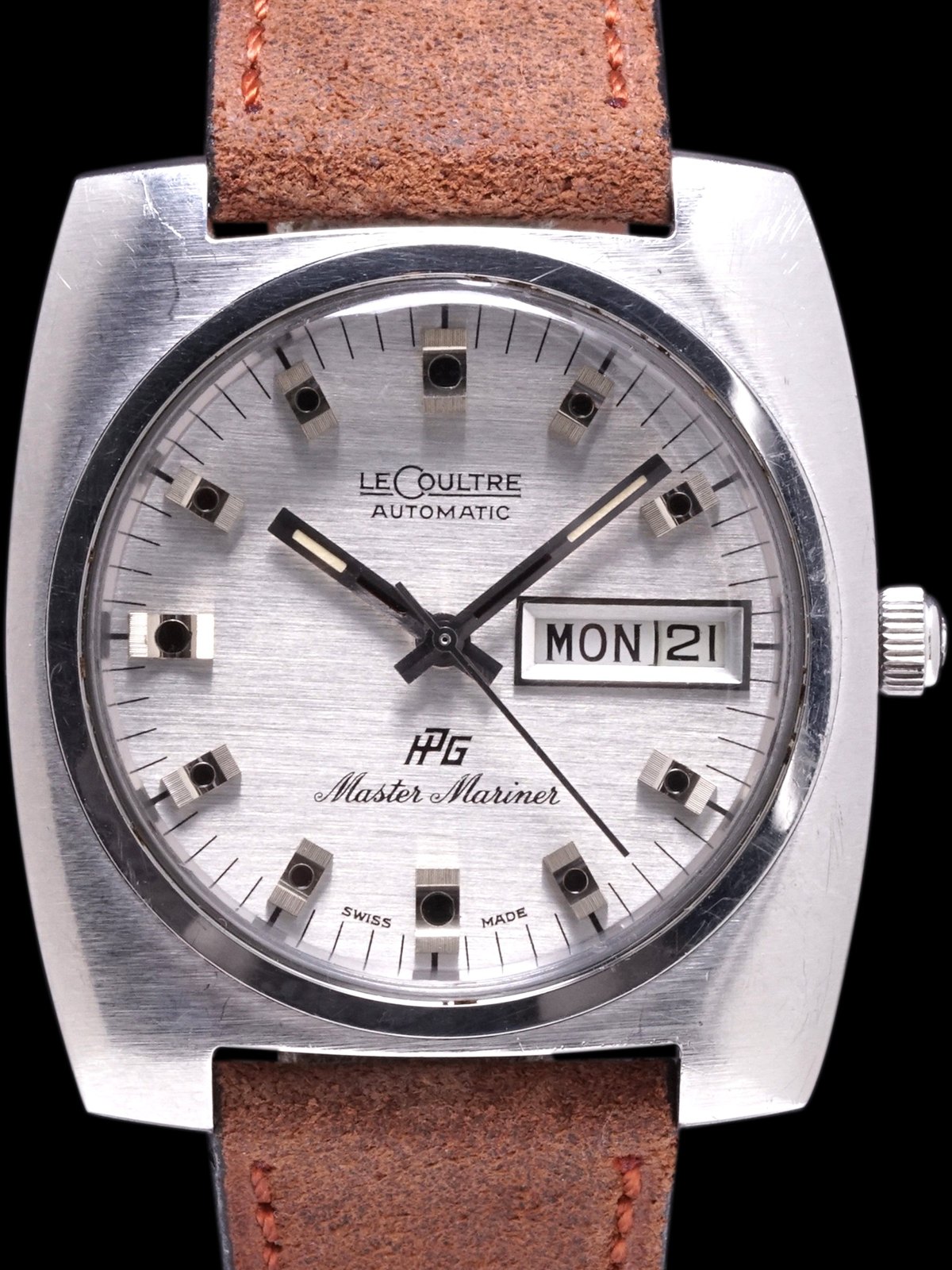
LeCoultre Master Mariner Day-Date (Ref. 9514), 1970s
- Maker / attribution
- Jaeger-LeCoultre (maker)
- Date
- 1970s
- Historical period
- Quartz Revolution (1969 – 1990)
- Country of origin
- Switzerland
- Object type
- Wristwatch
- Stock no.
- LECMM9514
- Credit line
- Dealer listing, Craft & Tailored (LECMM9514)
- Catalogue title (original)
- 1970s LeCoultre Master Mariner Day-Date (Ref. 9514) (English)
View the source record (dealer listing) ↗ (opens another website in a new tab)Suggest a correction
Record summary
Catalogued by Craft & Tailored (dealer), Los Angeles (stock number LECMM9514), this is a wristwatch by Jaeger-LeCoultre, made in Switzerland, dated 1970s. The Atlas places it in the Quartz Revolution period (1969 – 1990) of its Wristwatches collection. The record is illustrated with 6 photographs.
Assembled from the source record's structured fields. Dates and attributions are given as the source states them; where a field is missing the Atlas leaves it blank rather than estimating.
Catalogue description
Dealer description — Craft & Tailored
Antoine LeCoultre created the LeCoultre brand in 1833, which originally created movement blanks or unfinished movements for some of Switzerland's most prestigious watchmaking houses such as Vacheron Constantin, Audemars Piguet, and Patek Philippe. LeCoultre merged with Jaeger in 1937 to form Jaeger-LeCoultre and went on to become the brand we know and love today, though until the 1980s Jaeger-LeCoultre reserved the name “Jaeger” only on their watches destined for the United States. The Jaeger Master Mariner was created in celebration of the Jaeger brand's 125th anniversary and has taken on many shapes and variants over its production period, all featuring an aesthetic that married sophistication and utility in one. Stock # LECMM9514 Brand LeCoultre Style Master Mariner Model 9514 Serial N/A Size Men's Material Stainless Steel Dial Silver Millimeters 36 Strap 2pc Handmade Leather Strap CASE & BRACELET The rectangular case shows signs of being lightly polished in the past and exhibits very light signs of previous use. The case retains a Jaeger-LeCoultre crown which features a push-in quickest mechanism. The case back features an engraving "Joseph Ducharme, 25 Years Service, NB & M Div./LSI, 1972". The watch comes supplied on a 2pc handmade leather strap. DIAL & HANDS The horizontally textured silver dial is in near flawless condition and features trapezoidal markers with circular black enamel inlays. The markers retain all of their original enamel. The original tritium hands have aged to a charming creamy patina and show no degradation when inspected under U.V. light, the hands retain their original black enamel as well. ACCESSORIES
Historical context
Quartz Revolution (1969 – 1990)
Seiko's Astron begins mass quartz timekeeping; traditional industries contract sharply.
Quartz and digital watches transformed the market after 1969. Swiss employment collapsed, Japanese and Hong Kong production soared, and the Swatch (1983) helped the Swiss industry recover; mechanical watches survived as luxury goods.
Read the period in the timelineMore wristwatches from this periodEarlier: Modern Mechanical Horology
Atlas type guide
Dive and water-resistant watches
Keeping water and dust out of a wristwatch was a long-standing challenge. Rolex's screw-down Oyster case (1926) and Omega's Marine (1932) were landmarks; in the early 1950s Blancpain's Fifty Fathoms and Rolex's Submariner defined the professional dive watch with rotating bezels for timing dives, luminous dials and high water resistance. The ISO 6425 standard (1982) later codified what a 'diver's watch' must do.
Dive watches became icons of post-war design and exploration, and their evolution — helium escape valves, ceramic bezels, saturation-diving depth ratings — records the history of underwater work.
What to look for
- Unidirectional or bidirectional rotating bezel with minute markings.
- Screw-down crown and case back; depth rating printed on the dial.
- Luminous hands and markers (radium before c. 1960, tritium c. 1960–1998, then Super-LumiNova).
- Reference numbers on the case between the lugs or inside the back.
Dating clues
- Screw-down Oyster cases: from 1926.
- Professional dive watches: from 1953.
- Tritium 'T' marks on dials: c. 1960–1998.
General guidance written by the Atlas editors about this kind of object. It is not a statement about this particular piece; for that, rely on the source record above and on physical examination.
Related records
Clocks · 1937–1938
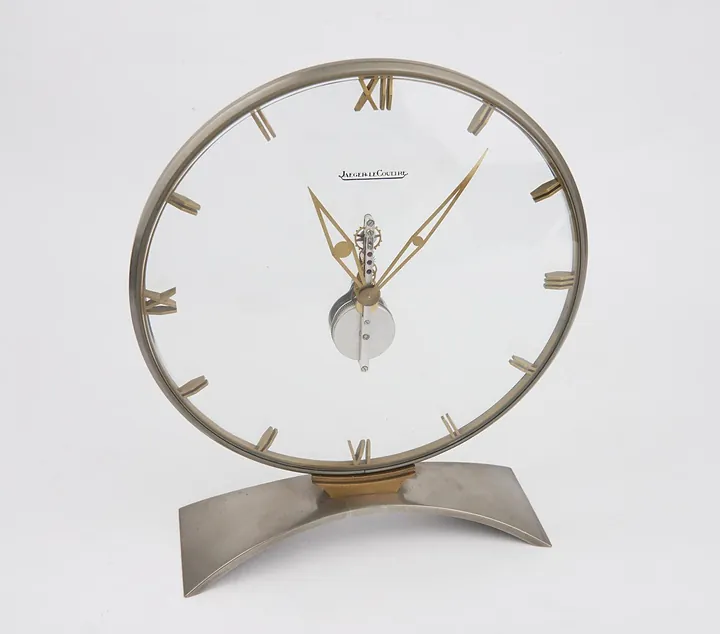
Skeleton clock by Jaeger-LeCoultre, Switzerland, 1937–1938
Science Museum Group, London
Movements & Components · 1953
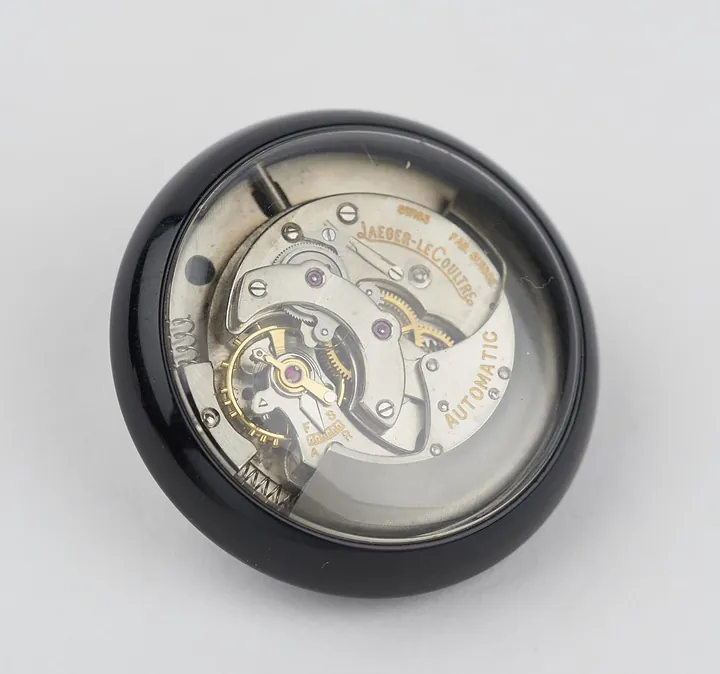
Automatic watch movement, Jaeger-LeCoultre, 1953, Geneva, Switzerland, showing self-winding mechanism
Science Museum Group, London
Wristwatches · 1953
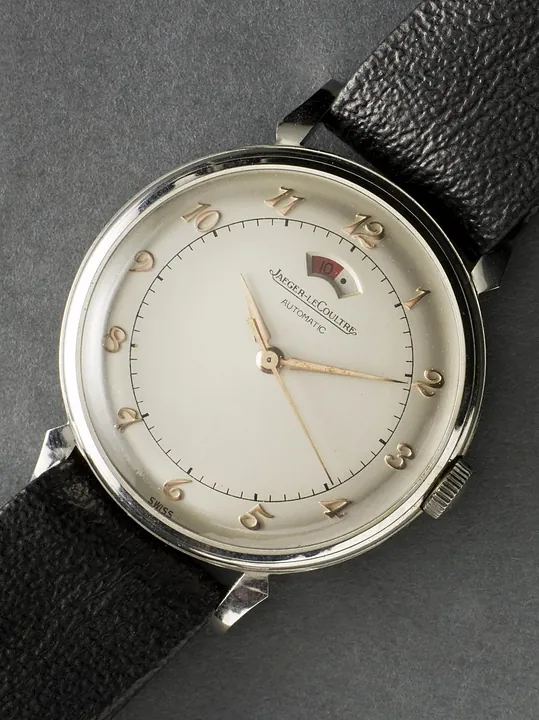
Automatic Wrist-watch, Jaeger-LeCoultre, Geneva, Switzerland, with reserve power indicator complete in steel case, 1953. Back numbered 564556.
Science Museum Group, London
Wristwatches · 1953
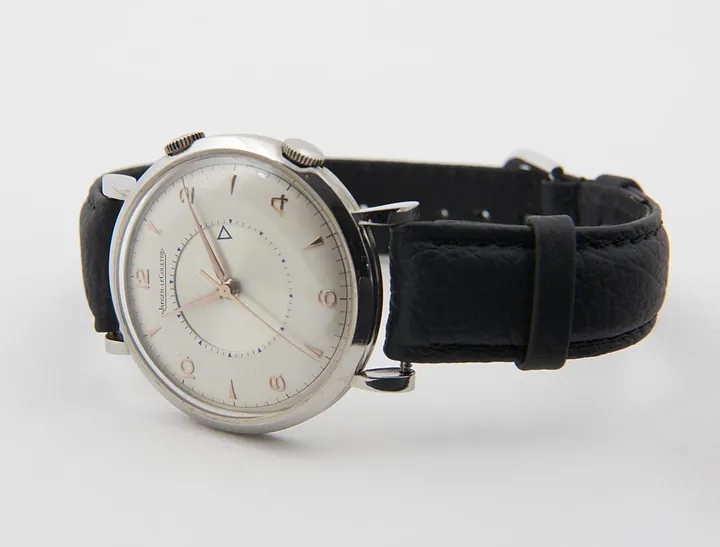
Wrist-watch, 'Memovox' alarm, Jaeger-LeCoultre, Geneva, Switzerland, complete in steel case, 1953.
Science Museum Group, London

Wristwatches · 1970
Wristwatch by Heno, Switzerland, 1970
Museum Rotterdam

Wristwatches · 1960–1986
'Tri-Compax' calendar chronograph wristwatch in gold case, by Universal, Geneva, Switzerland, 1960–1986.
Science Museum Group, London

Wristwatches · 1969–1970
Beta 21 Quartz wristwatch movement, made in Switzerland, 1970.
Science Museum Group, London

Wristwatches · c. 1969
Omega Speedmaster Moonwatch, ref. 145022-69st, c. 1969
Antiquorum auction archive, Geneva