
Wristwatches · Wristwatch
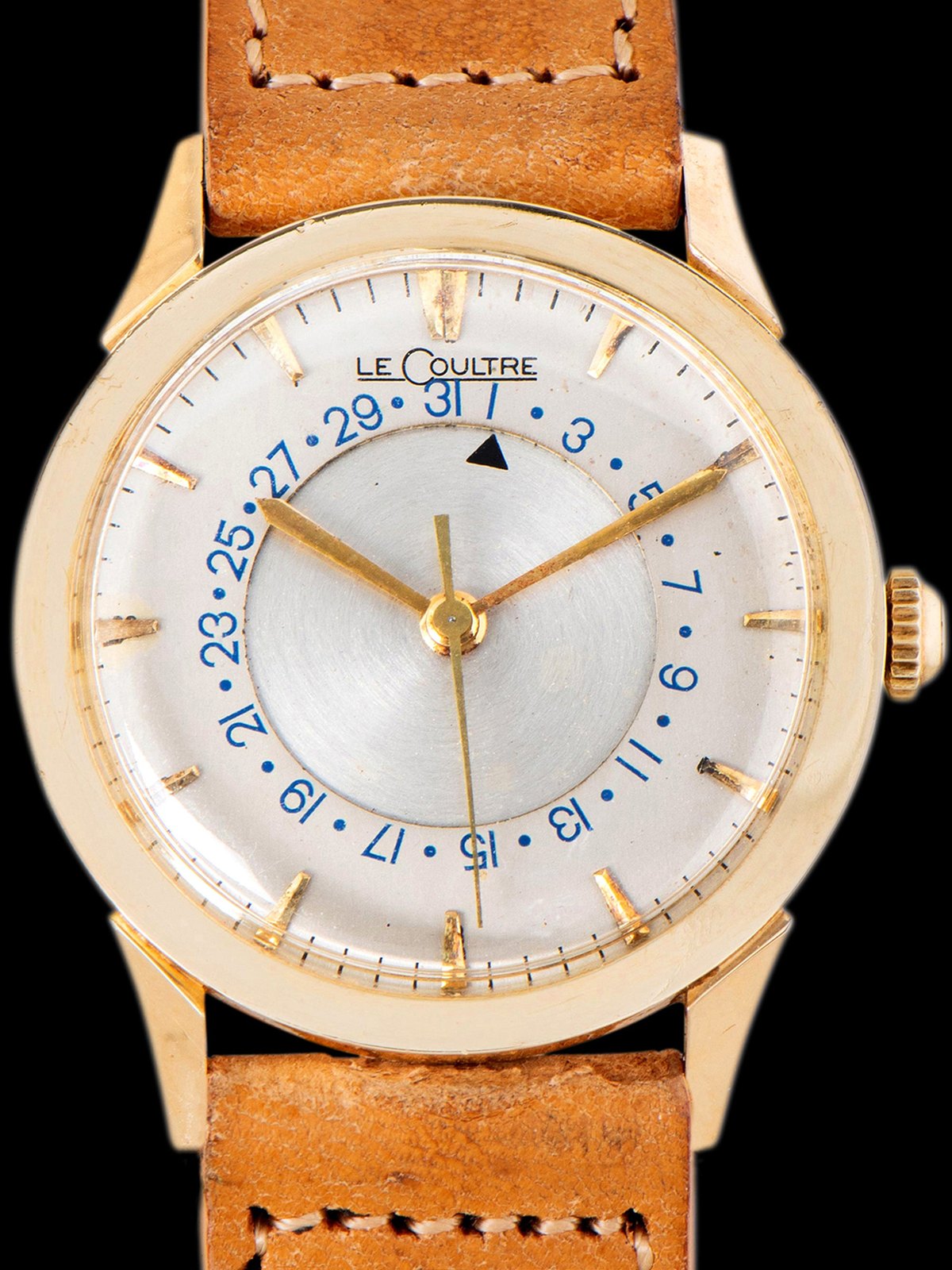
LeCoultre "Calendar Disk" Dress Watch 14K YG Cal. 810/AW’, 1950s
- Maker / attribution
- Jaeger-LeCoultre (maker)
- Date
- 1950s
- Historical period
- Modern Mechanical Horology (1945 – 1969)
- Country of origin
- Switzerland
- Object type
- Wristwatch
- Stock no.
- LECCD810AW
- Credit line
- Dealer listing, Craft & Tailored (LECCD810AW)
- Catalogue title (original)
- 1950s LeCoultre "Calendar Disk" Dress Watch 14K YG 'Cal. 810/AW’ (English)
View the source record (dealer listing) ↗ (opens another website in a new tab)Suggest a correction
Record summary
Catalogued by Craft & Tailored (dealer), Los Angeles (stock number LECCD810AW), this is a wristwatch by Jaeger-LeCoultre, made in Switzerland, dated 1950s. The Atlas places it in the Modern Mechanical Horology period (1945 – 1969) of its Wristwatches collection. The record is illustrated with 6 photographs.
Assembled from the source record's structured fields. Dates and attributions are given as the source states them; where a field is missing the Atlas leaves it blank rather than estimating.
Catalogue description
Dealer description — Craft & Tailored
Founded in 1833 by Antoine LeCoultre, the manufacture earned its reputation by producing some of Switzerland's finest movements, supplying ébauches to legendary houses including Vacheron Constantin, Audemars Piguet, and Patek Philippe. Following its 1937 merger with Jaeger to form Jaeger-LeCoultre, the company continued using the "LeCoultre" signature exclusively for the American market until the 1980s, making examples such as this a unique chapter in the brand's history. The early 1950s marked a period of remarkable innovation for the manufacture, with LeCoultre experimenting with elegant yet unconventional complications that departed from traditional watchmaking norms. Produced for fewer than three years between 1952 and 1954, the rarely encountered "Calendar Disk" models stand among the brand's most inventive creations. At first glance, this watch is easily mistaken for a Memovox, or Wrist Alarm, as it shares the same visual language of a large central rotating disk. However, its classic Calatrava-style case and single crown reveal an entirely different purpose. What truly distinguishes the Calendar Disk from virtually every other calendar wristwatch of its era is its extraordinary date display. Rather than employing a central date hand or a conventional date aperture, LeCoultre designed a rotating inner disk bearing the numerals 1 through 31, advanced by a discreet, concealed pusher integrated directly into the crown, a clever solution that preserved the clean lines of the case while providing an intuitive method of adjustment. A fixed black triangular marker at the center of the dial indicates the current date, creating a display that is both remarkably legible and strikingly elegant. The result is a design that feels surprisingly modern, lending the watch an architectural appearance decades ahead of its time. Combined with its restrained two-tone silver dial, applied faceted gold hour markers, dauphine hands, and beautifully proportioned 14K yellow gold case, the Calendar Disk remains one of the most charming, innovative, and underappreciated dress watches to emerge from LeCoultre during the golden age of Swiss watchmaking. SPECS Stock # LECCD810AW Brand LeCoultre Style "Calendar Disk" Dress Watch Model N/A Serial 07XX / 96XXXX Size Men's Material 14K Yellow Gold Dial Two-Tone Silver "Aged Millimeters 32.5 Strap 2pc Handmade Leather Strap CASE & BRACELET The exceptional 14K yellow gold case retains very crisp case lines and edges, with only light signs of use and no notable evidence of prioir polishing present. The case retains its original button crown, which operated the quick-set function of the date disc. The snap-on case back exhibits some wear from use, but no damage. The watch comes supplied on a 2pc handmade leather strap. DIAL & HANDS The original two-tone silver dial remains beautifully preserved, exhibiting no notable damage and only very subtle signs of age, with all of the original text fully present and intact. The original yellow gold sword hands are in excellent condition, with minimal oxidation present. ACCESSORIES None. The watch is functioning perfectly and keeping time; the previous service history is unknown. A movement service can be purchased upon request.
Historical context
Modern Mechanical Horology (1945 – 1969)
Tool watches for divers, pilots and astronauts; electric watches anticipate the electronic age.
The classic era of the mechanical wristwatch: dive watches, chronographs for motor racing and space flight, GMT watches for jet travel, slim dress watches, automatic calendars, and the rise of Japanese manufacturers alongside Swiss, American, German and Soviet industries.
Read the period in the timelineMore wristwatches from this periodEarlier: Golden Age of Mechanical Watchmaking
Atlas type guide
Calendar, moon-phase and perpetual calendar watches
Calendar complications range from a simple date to the perpetual calendar, which automatically allows for months of different lengths and leap years until 2100. Pocket watches with perpetual calendars were made in the eighteenth and nineteenth centuries; Patek Philippe made the first perpetual calendar wristwatch in 1925, and series production followed in 1941. The annual calendar (Patek Philippe, 1996) needs correction only once a year.
Moon-phase displays use a disc with two moons and 59 teeth advanced daily, approximating the 29.5-day lunation; more precise trains reduce the error to one day in over a century.
What to look for
- Apertures or subsidiary dials for day, date, month and leap year.
- Moon disc under a 'bosom' shaped aperture.
- Recessed correctors on the case band for setting the calendar.
Dating clues
- Triple-date wristwatches: popular c. 1940–1955.
- Perpetual calendar wristwatches: from 1925 (unique) and 1941 (series).
General guidance written by the Atlas editors about this kind of object. It is not a statement about this particular piece; for that, rely on the source record above and on physical examination.
Related records
Clocks · 1937–1938
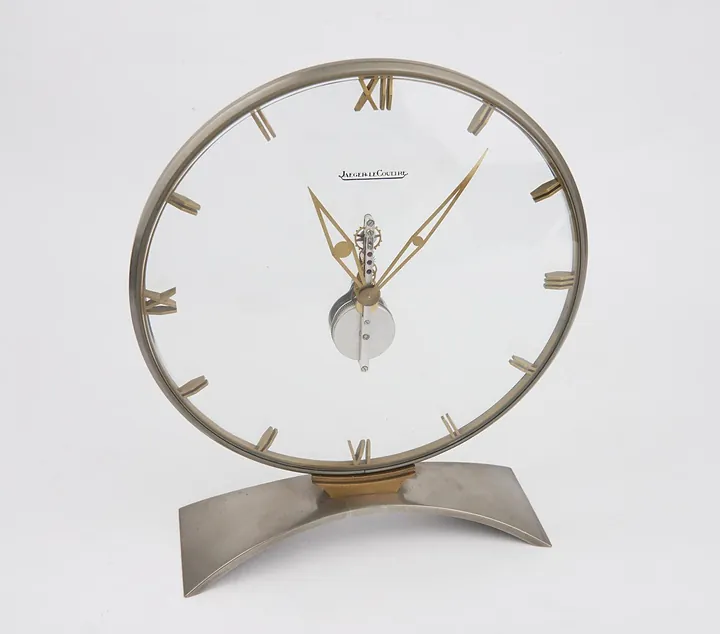
Skeleton clock by Jaeger-LeCoultre, Switzerland, 1937–1938
Science Museum Group, London
Movements & Components · 1953
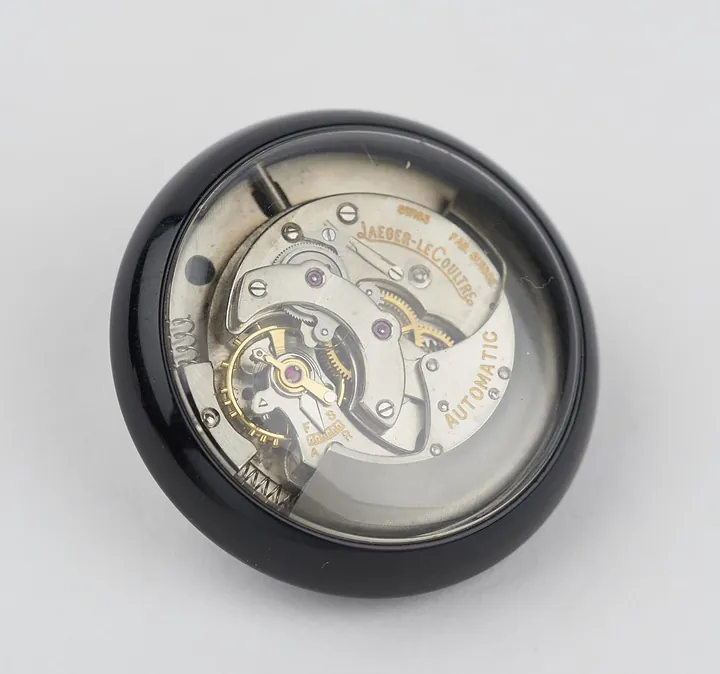
Automatic watch movement, Jaeger-LeCoultre, 1953, Geneva, Switzerland, showing self-winding mechanism
Science Museum Group, London
Wristwatches · 1953
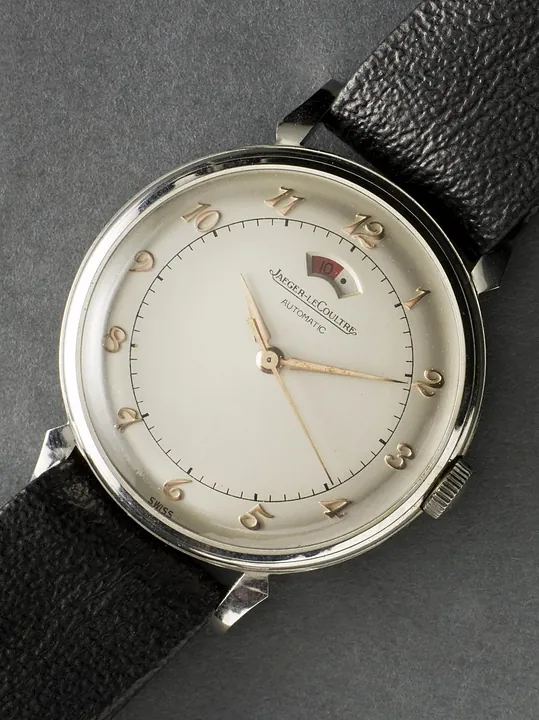
Automatic Wrist-watch, Jaeger-LeCoultre, Geneva, Switzerland, with reserve power indicator complete in steel case, 1953. Back numbered 564556.
Science Museum Group, London
Wristwatches · 1953
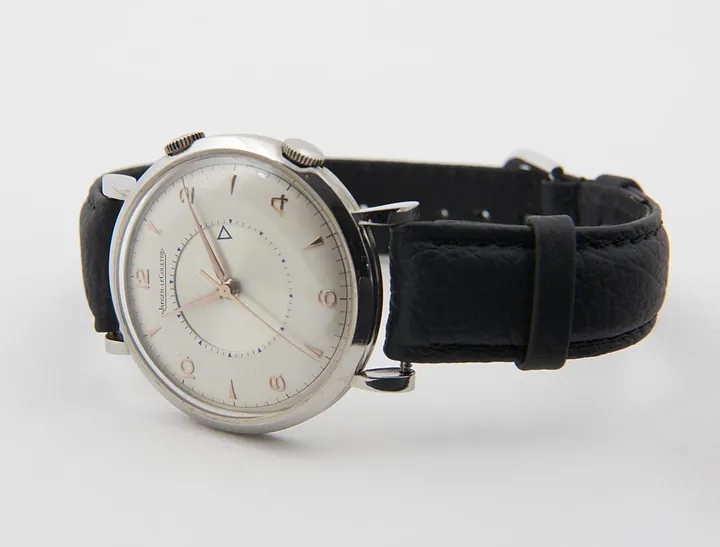
Wrist-watch, 'Memovox' alarm, Jaeger-LeCoultre, Geneva, Switzerland, complete in steel case, 1953.
Science Museum Group, London

Wristwatches · 1945
Wristwatch by Eterna, 1945
Museum Rotterdam

Wristwatches · c. 1945
Breitling Premier, ref. 790, c. 1945
Antiquorum auction archive, Geneva

Wristwatches · c. 1945
Universal Genève Uni-Compax, ref. 22492, c. 1945
Antiquorum auction archive, Geneva

Wristwatches · c. 1950s
Baume & Mercier wristwatch, c. 1950s
Antiquorum auction archive, Geneva