
Wristwatches · Manual-wind wristwatch
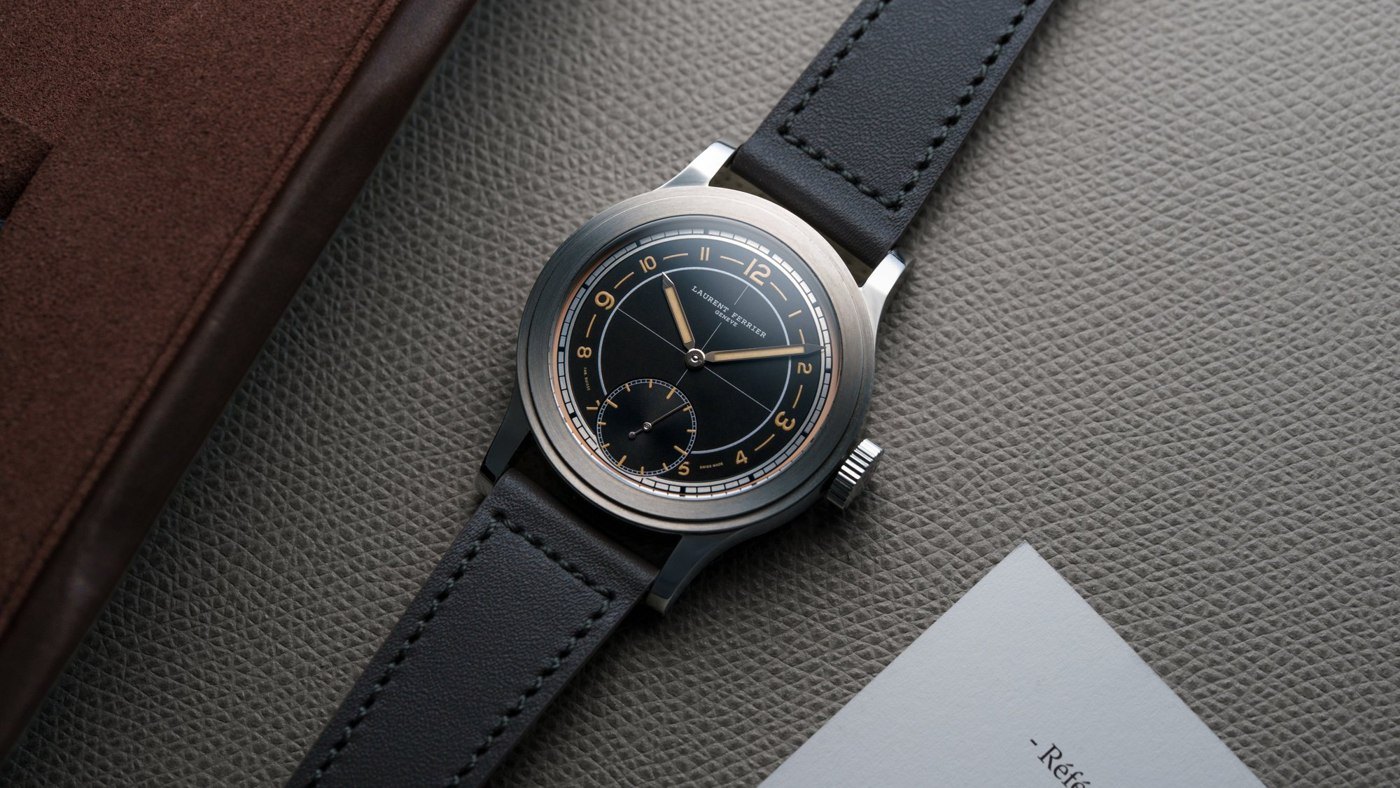
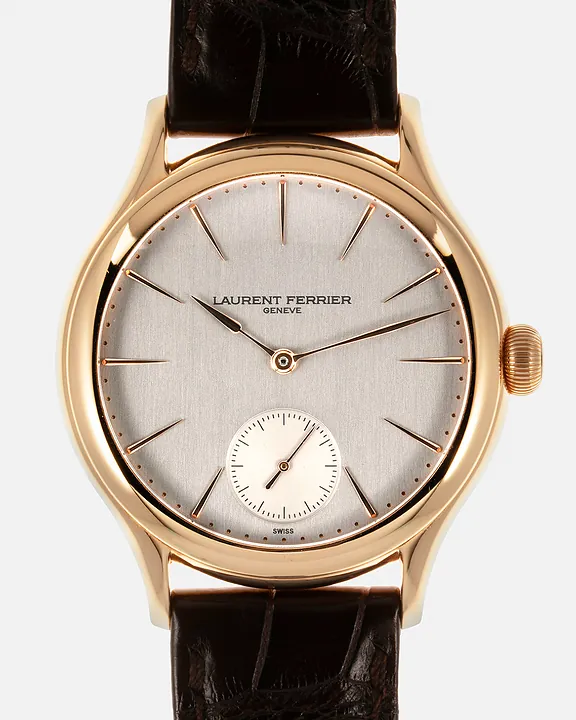
Laurent Ferrier Hommage II for Phillips
- Maker / attribution
- Laurent Ferrier (source attribution)
- Date
- 2020
- Historical period
- Contemporary Horology (2010 – Present)
- Country of origin
- Switzerland
- Object type
- Manual-wind wristwatch
- Materials / technique
- Stainless steel
- Dimensions
- 39.5mm
- Holding institution
- Zamanito
- Accession / object no.
- laurent-ferrier-hommage-ii-for-phillips-c0eef8ffd5
- Credit line
- Zamanito
- Catalogue title (original)
- ساعت مچی فولادی Laurent Ferrier مدل Hommage II برای Phillips (English)
View the source record ↗ (opens another website in a new tab)Suggest a correction
Record summary
Held and catalogued by Zamanito (object number laurent-ferrier-hommage-ii-for-phillips-c0eef8ffd5), this is a manual-wind wristwatch attributed to Laurent Ferrier, made in Switzerland, dated 2020. The Atlas places it in the Contemporary Horology period (2010 – Present) of its Wristwatches collection. Materials and techniques recorded by the source: Stainless steel. Recorded dimensions: 39.5mm. The record is illustrated with 1 photograph.
Assembled from the source record's structured fields. Dates and attributions are given as the source states them; where a field is missing the Atlas leaves it blank rather than estimating.
Catalogue description
Original object description
Produced in 2020 through an extended design partnership between Laurent Ferrier and Phillips auction house, the Hommage II is a stainless steel time-only wristwatch created outside regular production lines and styled after mid-century sports models. The 39.5 mm case features stepped geometry and fine hand-finishing, housing a luminous sector dial with a revised Laurent Ferrier logo and a small seconds register at 6 o'clock. A sapphire crystal back showcases the manually wound caliber LF 116.01, uniting vintage-style layout with contemporary manufacture methods.
Original object description
Taking design cues from 1950s timepieces, the 39.5 mm stainless steel case is built with stepped edges. It frames a luminescent sector dial that incorporates a small seconds counter at 6 o'clock and a distinct variation of the brand emblem created specifically for this joint venture.
Original object description
The timepiece is powered by the manual-wind mechanical caliber LF 116.01, whose construction and decorative finishing are visible through the sapphire exhibition back. Rather than a serial model, this reference resulted from a sustained collaborative development effort between the Laurent Ferrier manufacture and Phillips auction specialists.
Original object description
All descriptive points for this individual watch stem from consignor notes and auction cataloguing; no servicing records, independent functional evaluations, or platform authentications are provided.
Historical context
Contemporary Horology (2010 – Present)
Silicon components, connected watches, optical-lattice research clocks and a thriving independent scene.
Smartwatches became the world's best-selling watches, while mechanical watchmaking focuses on craft, innovation (silicon components, new escapements) and independent makers.
Read the period in the timelineMore wristwatches from this periodEarlier: Mechanical Renaissance
Atlas type guide
Wristwatches
Bracelet watches were worn by women from the early nineteenth century — Breguet made one for Caroline Murat, Queen of Naples, in 1810–12 — but the wristwatch only became a man's instrument with military use and aviation in the early twentieth century. Between the World Wars it overtook the pocket watch; the 1920s and 1930s brought rectangular Art Deco cases, water-resistant cases and the first automatic winding systems.
After 1945 the wristwatch became a carrier of identity — dress watches, sports and dive watches, chronographs, calendars — produced by Swiss, American, Japanese, German, Soviet and Chinese industries. The quartz revolution after 1969 and the mechanical renaissance since the 1990s, including the rise of independent watchmakers, complete the story.
What to look for
- The reference number (between the lugs or inside the case back) and serial number, the starting point for dating.
- The calibre: its maker and number are often stamped under the dial or on the bridge.
- Originality of dial, hands and crown — refinished ('redial') dials are common.
- Case material marks: 18K/750, 14K/585, stainless steel, gold-filled, plated.
Dating clues
- Wire-lug cases: before c. 1925.
- Water-resistant screw-down cases: from 1926.
- Quartz movements: from 1969; sapphire crystals widespread after c. 1980.
General guidance written by the Atlas editors about this kind of object. It is not a statement about this particular piece; for that, rely on the source record above and on physical examination.
Related records
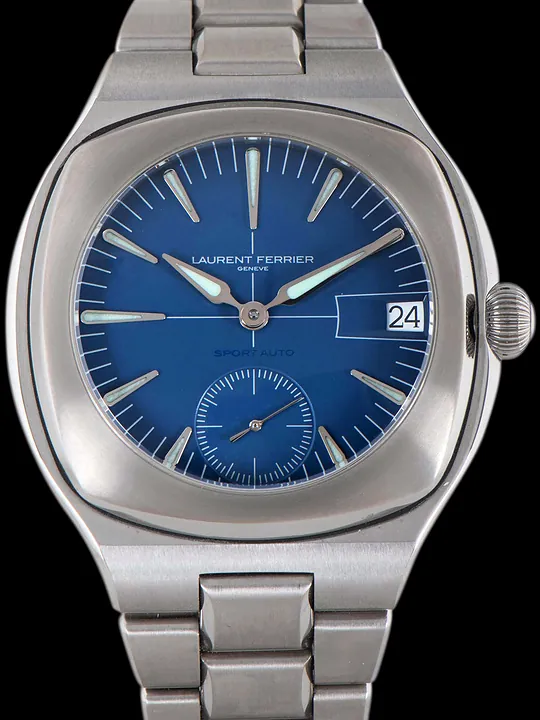
Wristwatches · 2024
Laurent Ferrier Sport Auto Titanium (Ref. LF270.01) Blue Dial, 2024
Craft & Tailored (dealer), Los Angeles
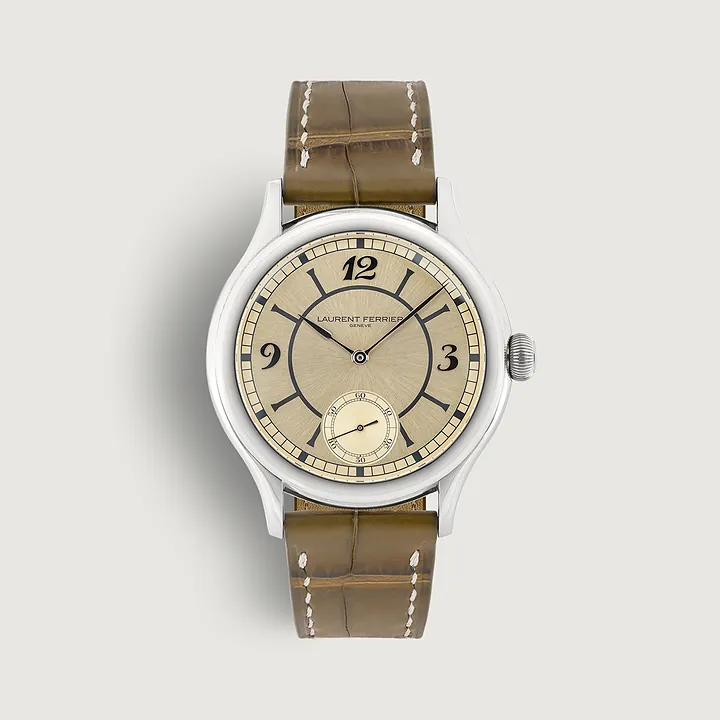
Wristwatches · 2021
Laurent Ferrier Classic Origin Revolution x The Rake, 2021
Watches of Knightsbridge (dealer), London
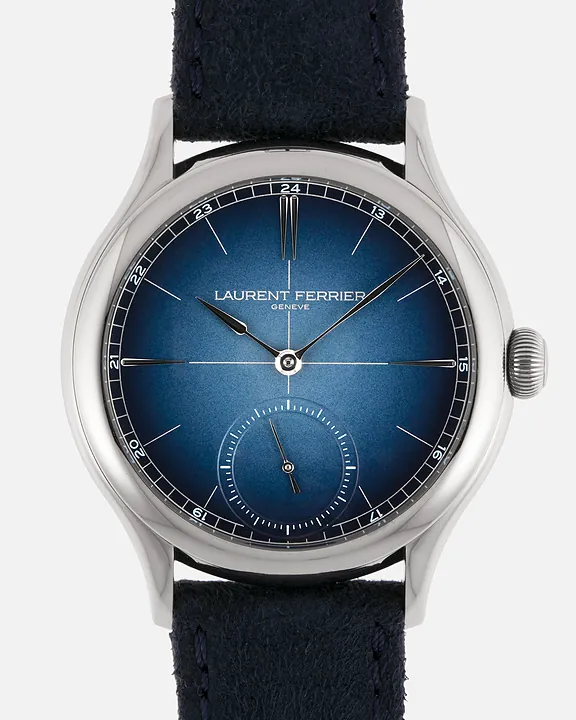
Wristwatches · 2024
Laurent Ferrier Classic Origin Blue Titanium, 2024
S.Song Watches (dealer), Seattle
Wristwatches · 2015
Laurent Ferrier Galet Classic Microrotor, 2015
S.Song Watches (dealer), Seattle

Wristwatches · c. 2010s
Breguet Type XXI, ref. 3810, c. 2010s (Antiquorum Lot 381-24)
Antiquorum auction archive, Geneva

Wristwatches · c. 2010s
Breguet Type XXI, ref. 3810, c. 2010s (Antiquorum Lot 386-229)
Antiquorum auction archive, Geneva

Wristwatches · Sold in September 2010
Breitling Cosmonaute, ref. A 22322, Sold in September 2010
Antiquorum auction archive, Geneva

Wristwatches · c. 2010
Corum Bubble Chrono, ref. 396.150.20, c. 2010
Antiquorum auction archive, Geneva