
Wristwatches · Wristwatch
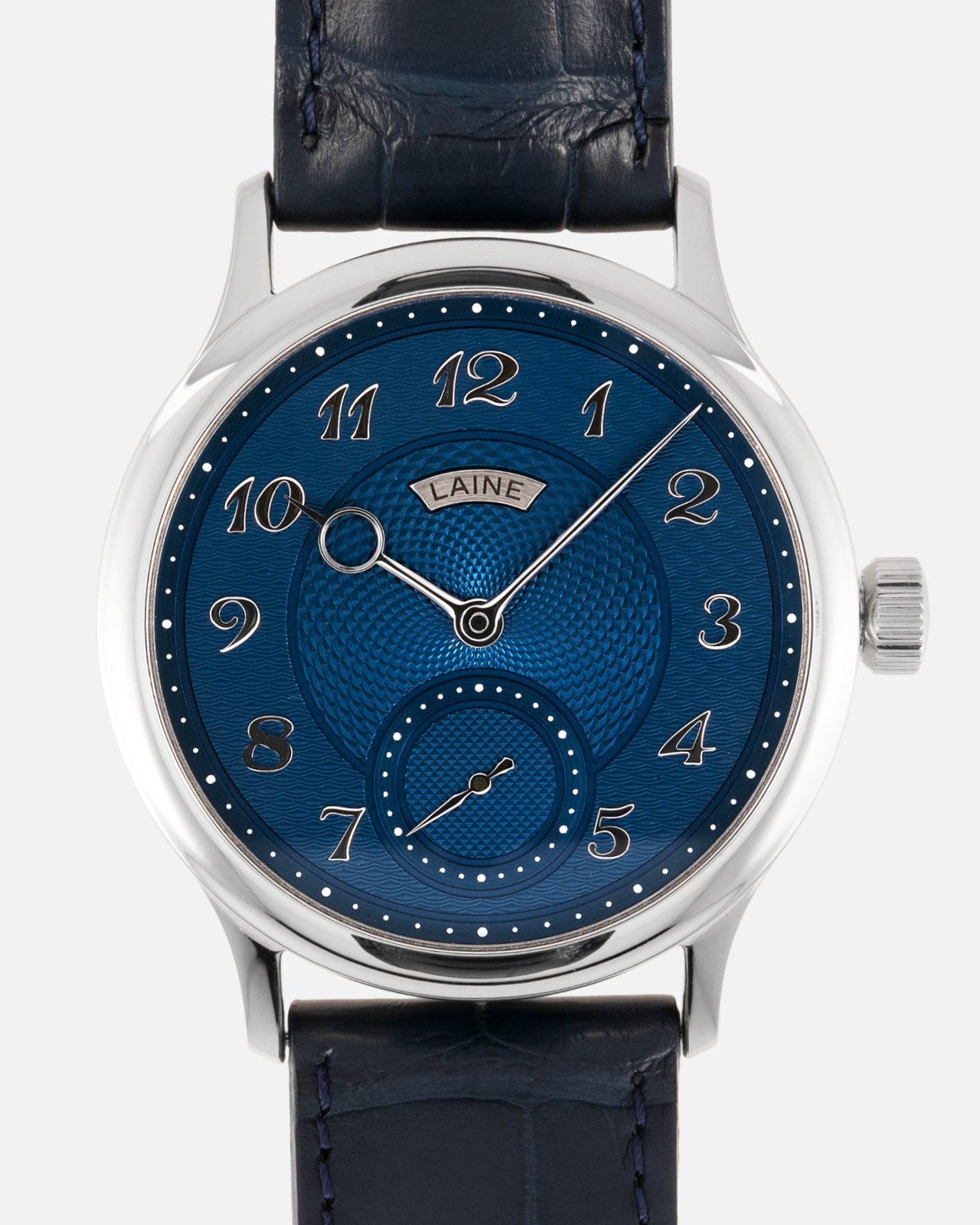
Laine V38, 2021
- Maker / attribution
- Laine (maker)
- Date
- 2021
- Historical period
- Contemporary Horology (2010 – Present)
- Country of origin
- Unrecorded in source
- Object type
- Wristwatch
- Dimensions
- Case 38 mm
- Stock no.
- Product 6738592792663
- Credit line
- Dealer listing, S.Song Watches (product 6738592792663)
- Catalogue title (original)
- Laine V38 (English)
View the source record (dealer listing) ↗ (opens another website in a new tab)Suggest a correction
Record summary
Catalogued by S.Song Watches (dealer), Seattle (stock number Product 6738592792663), this is a wristwatch by Laine, dated 2021. The Atlas places it in the Contemporary Horology period (2010 – Present) of its Wristwatches collection. Recorded dimensions: Case 38 mm. The record is illustrated with 6 photographs.
Assembled from the source record's structured fields. Dates and attributions are given as the source states them; where a field is missing the Atlas leaves it blank rather than estimating.
Catalogue description
Dealer description — S.Song Watches
An independent watchmaker based in Switzerland, Laine is one of the lesser-known indie brands within the modern world of horology due to their relatively recent start. Founded in 2014 by Finnish watchmaker Torsti Laine on the back of winning A. Lange & Söhne's F.A. Lange Watchmaking Excellence Award of the same year, the small independent watchmaker's lack of publicity is not down to their lack of credentials. Trained in the same Finnish school of watchmaking as Stepan Sarpaneva and Kari Voutilainen, Laine is undoubtedly in some good company, and it shows in their watches. Launched in 2021, the Laine V38 was introduced as a smaller and thinner watch that the brand was usually known for, keeping with the growing demand for elegant timepieces suitable for daily wear. A beautiful watch on and off the wrist, the Laine V38 is made of stainless steel and features a 38mm case that measures just 9mm thick. Entirely polished and sporting a domed bezel, the V38's case is a spectacular sight that only just begins to compare to the majesty that it contains. Found within the border of its bezel is the key to Laine's deserved success and high praise, their immaculate dials. Constructed using three individual sections, the V38's dial is available with a myriad of finishing techniques, with the example I have here sporting the most exclusive, the triple guilloche in a stunning shade of blue. In the center section and within the seconds subdial at 6 o'clock, this blue is a shade darker than along the periphery, which contains striking 18kt white gold applied Breguet numerals. Expertly blending these textures, surfaces, and colors together, the V38's dial is an incredibly unique creation with an amazing depth to it. Furthermore, what makes this example even more special is that the original owner custom-made this piece to have Breguet hands to suit the numerals, rather than the standard production sword hands. On the other side of the V38's stainless steel case lies the dashing Vaucher VMF 5401 movement in plain view beneath its sapphire crystal exhibition caseback. Finished to Laine's highest standards with Côtes de Genève throughout, hand-beveled bridges, and Laine's highly decorated calligraphy-style micro-rotor, the VMF 5401 looks just as finely tuned as the in-house high-horology movements that we see so many brands bring out. A delight to explore inside and out, the V38 is a beautiful expression of Torsti Laine's talent and the wonderful world of watchmaking that lies beyond the most prominent names that come up again and again.
Historical context
Contemporary Horology (2010 – Present)
Silicon components, connected watches, optical-lattice research clocks and a thriving independent scene.
Smartwatches became the world's best-selling watches, while mechanical watchmaking focuses on craft, innovation (silicon components, new escapements) and independent makers.
Read the period in the timelineMore wristwatches from this periodEarlier: Mechanical Renaissance
Atlas type guide
Wristwatches
Bracelet watches were worn by women from the early nineteenth century — Breguet made one for Caroline Murat, Queen of Naples, in 1810–12 — but the wristwatch only became a man's instrument with military use and aviation in the early twentieth century. Between the World Wars it overtook the pocket watch; the 1920s and 1930s brought rectangular Art Deco cases, water-resistant cases and the first automatic winding systems.
After 1945 the wristwatch became a carrier of identity — dress watches, sports and dive watches, chronographs, calendars — produced by Swiss, American, Japanese, German, Soviet and Chinese industries. The quartz revolution after 1969 and the mechanical renaissance since the 1990s, including the rise of independent watchmakers, complete the story.
What to look for
- The reference number (between the lugs or inside the case back) and serial number, the starting point for dating.
- The calibre: its maker and number are often stamped under the dial or on the bridge.
- Originality of dial, hands and crown — refinished ('redial') dials are common.
- Case material marks: 18K/750, 14K/585, stainless steel, gold-filled, plated.
Dating clues
- Wire-lug cases: before c. 1925.
- Water-resistant screw-down cases: from 1926.
- Quartz movements: from 1969; sapphire crystals widespread after c. 1980.
General guidance written by the Atlas editors about this kind of object. It is not a statement about this particular piece; for that, rely on the source record above and on physical examination.
Related records
Wristwatches · 2022
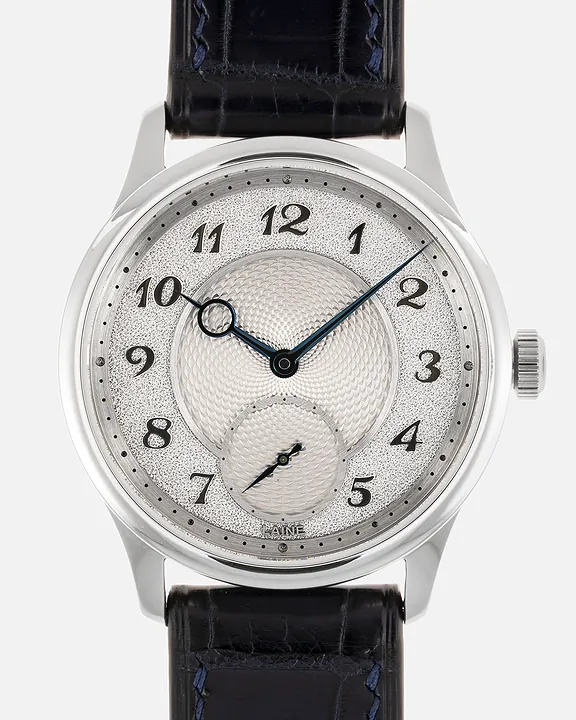
Laine V38, 2022
S.Song Watches (dealer), Seattle
Wristwatches · 2010
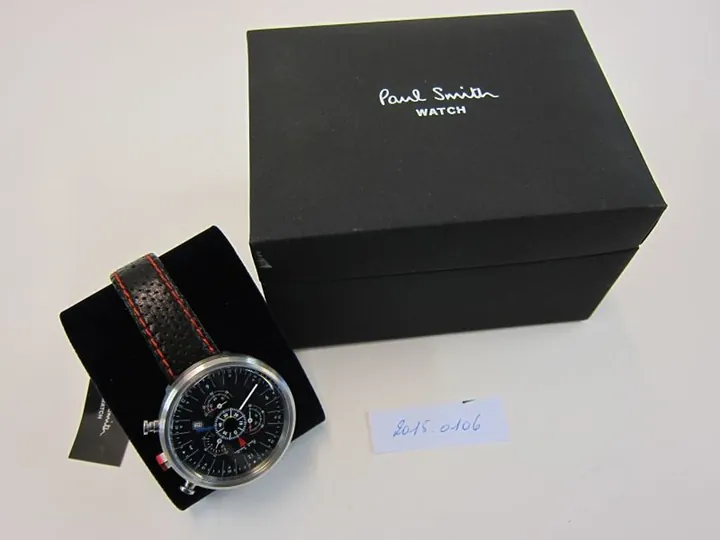
Wristwatch, 2010
Modemuseum Hasselt
Wristwatches · 2018 (Series 4 released in September 2018; '1977' in the source is the model number A1977)
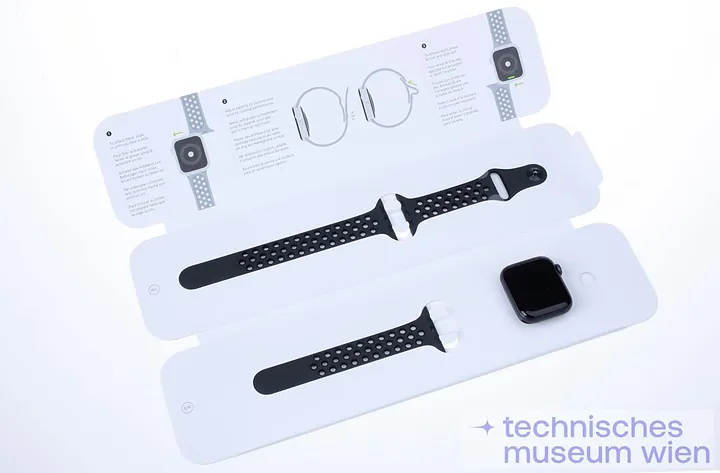
Apple Watch Series 4 (GPS, 40 mm, model A1977), 2018
Vienna Museum of Science and Technology
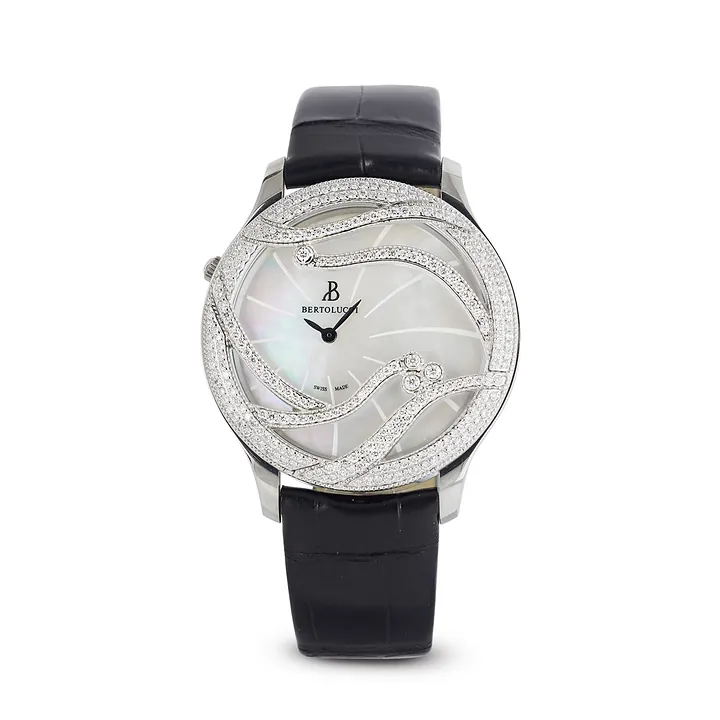
Wristwatches · c. 2010s
Bertolucci Stria III, ref. 11513.50.45.B88.6C1.501, c. 2010s
Antiquorum auction archive, Geneva
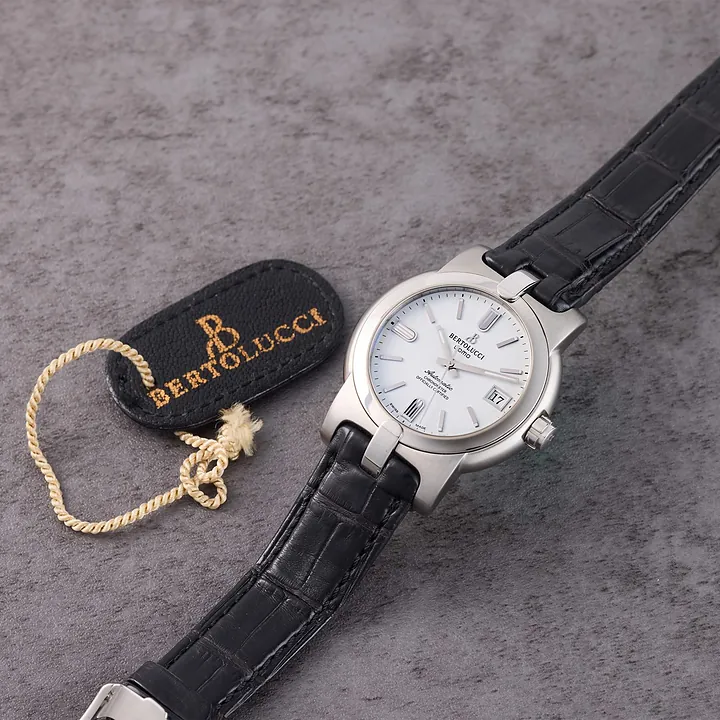
Wristwatches · c. 2010s
Bertolucci Uoma, ref. 824.51.41.10B, c. 2010s
Antiquorum auction archive, Geneva

Wristwatches · c. 2010s
Breguet Type XXI, ref. 3810, c. 2010s (Antiquorum Lot 381-24)
Antiquorum auction archive, Geneva

Wristwatches · c. 2010s
Breguet Type XXI, ref. 3810, c. 2010s (Antiquorum Lot 386-229)
Antiquorum auction archive, Geneva

Wristwatches · Sold in September 2010
Breitling Cosmonaute, ref. A 22322, Sold in September 2010
Antiquorum auction archive, Geneva