
Wristwatches · Wrist-watch
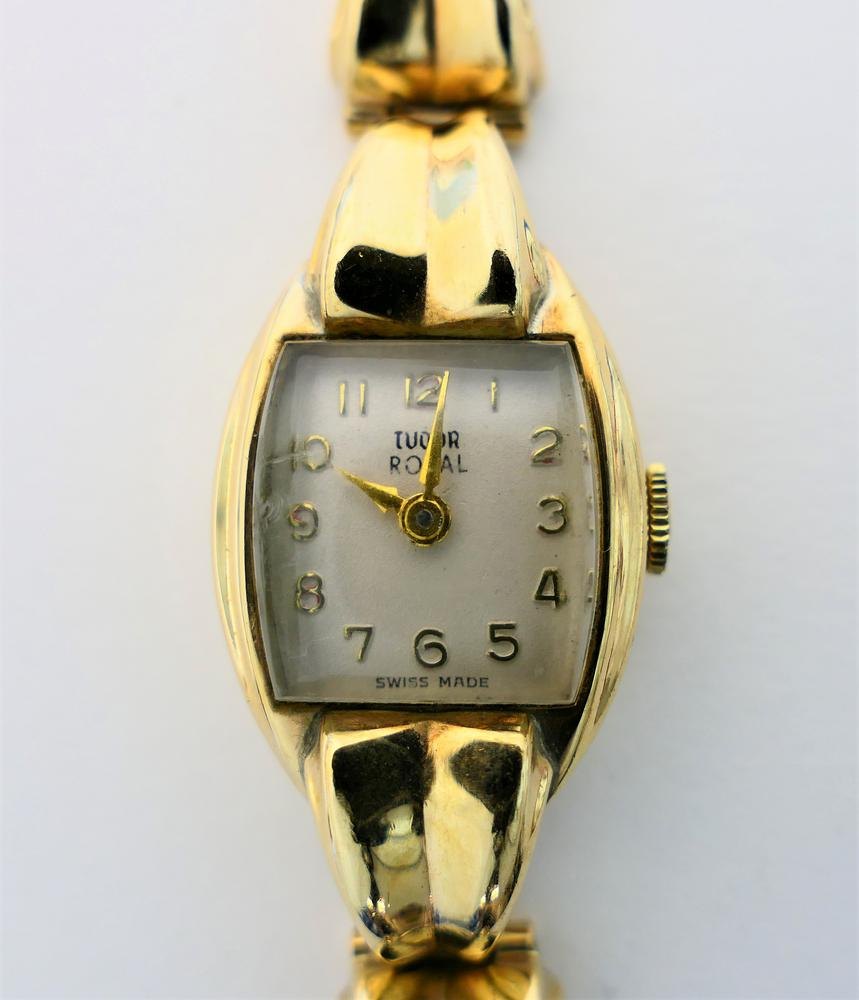
Ladies 'cocktail' wristwatch
- Maker / attribution
- Rolex (as Tudor) (Made by); B H Britton & Sons (clasp/strap) (Attributed to)
- Date
- 1952
- Historical period
- Modern Mechanical Horology (1945 – 1969)
- Country of origin
- Switzerland
- Place
- Switzerland, England (case and bracelet)
- Object type
- Wrist-watch
- Materials / technique
- gold
- Dimensions
- Height: 13 millimetres (visible dial) Length: 186 millimetres (bracelet strap max) Width: 17 millimetres (case max) Width: 12 millimetres (visible dial max) Depth: 8 millimetres (case max (inc glass))
- Holding institution
- British Museum
- Accession / object no.
- 2022,8008.1
- Credit line
- British Museum, London
- Catalogue title (original)
- Ladies ''cocktail' wristwatch (English)
View the source record ↗ (opens another website in a new tab)Suggest a correction
Record summary
Held and catalogued by British Museum (object number 2022,8008.1), this is a wrist-watch by Rolex (as Tudor), made in Switzerland, England (case and bracelet), dated 1952. The Atlas places it in the Modern Mechanical Horology period (1945 – 1969) of its Wristwatches collection. Materials and techniques recorded by the source: gold. Recorded dimensions: Height: 13 millimetres (visible dial) Length: 186 millimetres (bracelet strap max) Width: 17 millimetres (case max) Width: 12 millimetres (visible dial max) Depth: 8 millimetres (case max (inc glass)). The record is illustrated with 6 photographs.
Assembled from the source record's structured fields. Dates and attributions are given as the source states them; where a field is missing the Atlas leaves it blank rather than estimating.
Catalogue description
Description — British Museum
Ladies ''cocktail' wristwatch Case and strap: 9ct gold multi-link bracelet strap and gold case with domed glass. Dial: Rectangular white dial with gold coloured numerals and gold hands. Movement: Oval movement with 17 jewels and club-tooth lever excapement.
Curator's comments — British Museum
The watch is a small, good quality ladies’ wristwatch by Tudor, with 9ct gold case and calibre 1151 Tudor movement with 17 jewels. The Tudor brand was set up by Rolex to produce a more accessible but still high-quality watch. Rolex had previously created various secondary brands in an attempt to appeal to the more modest budget, but most had relied on buying in movements, and none were very successful. In 1945, having abandoned all their other sub-brands, they launched the Tudor brand. The marketing for the brand strongly emphasised its Rolex quality, and that it was made under 'strict Rolex supervision'. In Rolex's first post-war advertisement in the Horological Journal in 1947 it announces the return of the Rolex watch, saying ' … The number of models is equally limited but includes the Tudor, newest addition to the Rolex family, every one of which bears a Rolex label of guarantee'. A 1953 ad describes the Tudor oyster prince as 'For the man whose purse is modest, yet whose aspirations are high'. View more about curator's comments The previous owner restored the watch bracelet (as can be seen in the photographs the posts had worn very thin and distorted). He also had the dial restored (see before and after photograph).
Inscriptions & marks
inscription; dial; TUDOR; ROYAL; SWISS MADE; Dial restored by previous owner, see images for pre-restoration condition.; hallmark; bracelet clasp; B & S; 9 .375; maker's mark; Bracelet clasp; ROLEX; hallmark; bracelet clasp underside; PROV.; PAT; B & S; 9 .375 [ANCHOR] [C?]; Last two marks are indistinct but may well be an anchor (Birmingham mark) and letter 'C' potentially for 1952-53 which matches the estimated production date.; hallmark; case back; 9; (shield with three wheatsheaves and sword) B; .375; Chester hallmark, 9ct gold, 1952; maker's mark; inside case back; R.W. Co LTD; IN OVAL; mark; Inside case back; 17C692; third character may be meant to be a '0'. This would make sense with the range of serial numbers for Tudor watches in the 1950s; inscription; Movement back; TUDOR; 17; RUBIES; RA; SWISS; MADE; inscription; under dial; TUDOR GENEVE 1151
Provenance
Donated by:, John G Taylor, In Memory of:, Judith Anne Taylor
Historical context
Modern Mechanical Horology (1945 – 1969)
Tool watches for divers, pilots and astronauts; electric watches anticipate the electronic age.
The classic era of the mechanical wristwatch: dive watches, chronographs for motor racing and space flight, GMT watches for jet travel, slim dress watches, automatic calendars, and the rise of Japanese manufacturers alongside Swiss, American, German and Soviet industries.
Read the period in the timelineMore wristwatches from this periodEarlier: Golden Age of Mechanical Watchmaking
Atlas type guide
Wristwatches
Bracelet watches were worn by women from the early nineteenth century — Breguet made one for Caroline Murat, Queen of Naples, in 1810–12 — but the wristwatch only became a man's instrument with military use and aviation in the early twentieth century. Between the World Wars it overtook the pocket watch; the 1920s and 1930s brought rectangular Art Deco cases, water-resistant cases and the first automatic winding systems.
After 1945 the wristwatch became a carrier of identity — dress watches, sports and dive watches, chronographs, calendars — produced by Swiss, American, Japanese, German, Soviet and Chinese industries. The quartz revolution after 1969 and the mechanical renaissance since the 1990s, including the rise of independent watchmakers, complete the story.
What to look for
- The reference number (between the lugs or inside the case back) and serial number, the starting point for dating.
- The calibre: its maker and number are often stamped under the dial or on the bridge.
- Originality of dial, hands and crown — refinished ('redial') dials are common.
- Case material marks: 18K/750, 14K/585, stainless steel, gold-filled, plated.
Dating clues
- Wire-lug cases: before c. 1925.
- Water-resistant screw-down cases: from 1926.
- Quartz movements: from 1969; sapphire crystals widespread after c. 1980.
General guidance written by the Atlas editors about this kind of object. It is not a statement about this particular piece; for that, rely on the source record above and on physical examination.
Related records

Wristwatches · 1945
Wristwatch by Eterna, 1945
Museum Rotterdam

Wristwatches · c. 1945
Breitling Premier, ref. 790, c. 1945
Antiquorum auction archive, Geneva

Wristwatches · c. 1945
Universal Genève Uni-Compax, ref. 22492, c. 1945
Antiquorum auction archive, Geneva

Wristwatches · c. 1950s
Baume & Mercier wristwatch, c. 1950s
Antiquorum auction archive, Geneva
Wristwatches · c. 1950
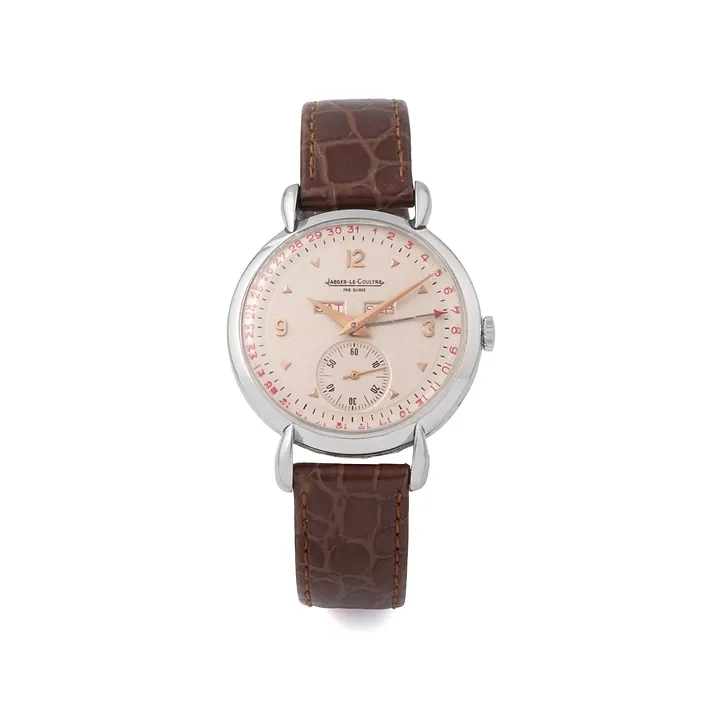
Jaeger Lecoultre Triple Calendar, c. 1950
Antiquorum auction archive, Geneva
Wristwatches · c. 1950
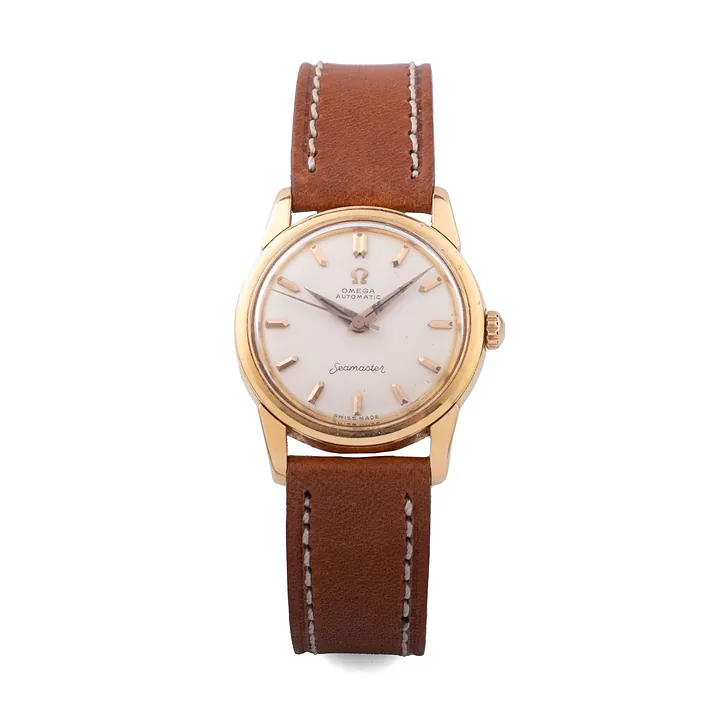
Omega Seamaster Automatic, ref. 2991-1, c. 1950
Antiquorum auction archive, Geneva
Wristwatches · c. 1950s
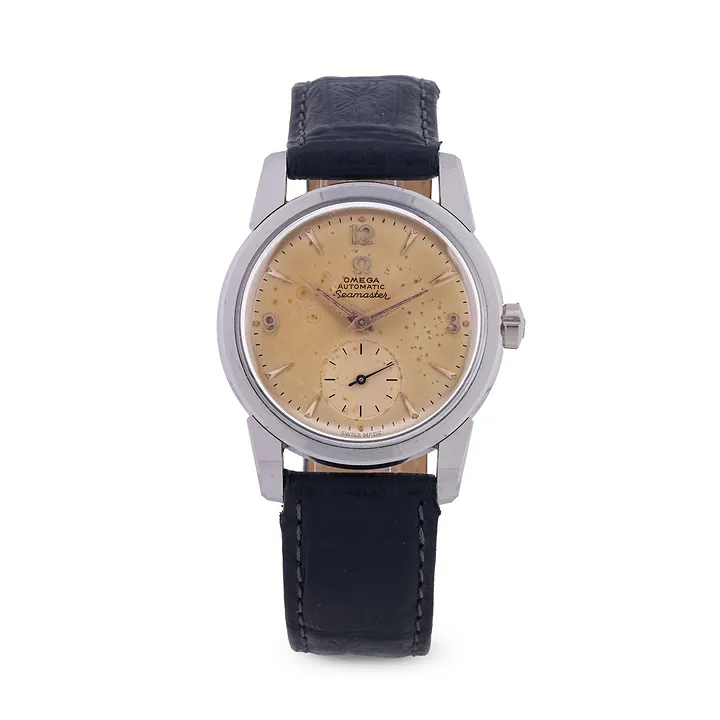
Omega Seamaster, ref. 2848, c. 1950s
Antiquorum auction archive, Geneva
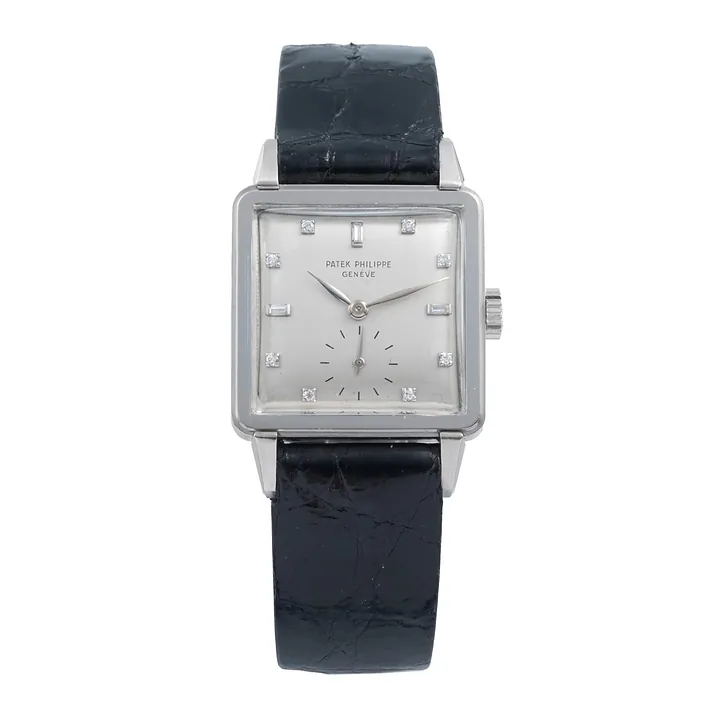
Wristwatches · 1950, sold in May 1951
Patek Philippe wristwatch, ref. 2422, 1950, sold in May 1951
Antiquorum auction archive, Geneva